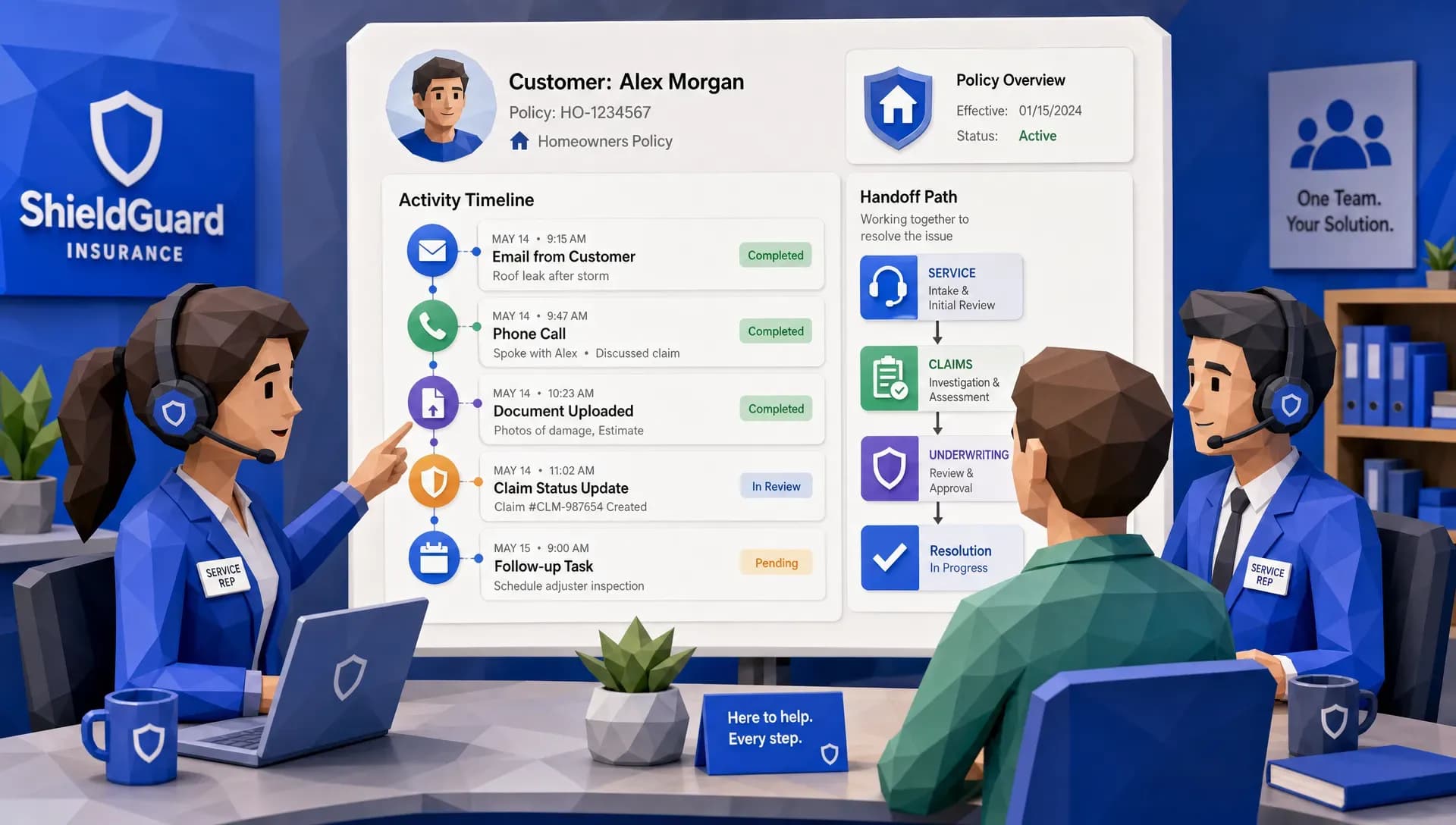
I once watched a perfectly capable service rep ask a customer for the same claim number three times in one call. Not because the rep was careless. Not because the customer was difficult. The system simply kept moving the conversation faster than the context could follow.
That is the quiet mess behind a lot of customer service in insurance. We talk about chatbots, portals, call center scripts, and response-time targets, but the real issue is simpler and more annoying: the person helping the customer often cannot see what already happened.
Here is my hot take after a decade around insurance operations: bad service is rarely a personality problem. It is a memory problem. If the organization cannot remember the last email, the uploaded document, the broker note, the prior underwriting exception, or the reason a claim was routed to a specialist, the customer feels like they are starting from scratch every time.
And nobody enjoys reintroducing themselves to their own insurer.
Customers do not care which system lost the plot
Insurance people love systems. Policy admin system. Claims system. CRM. Document management. Email inbox. Portal. Spreadsheet named Final_v7, because of course.
Customers, however, do not care where the information lives. They care whether the next person they speak with knows enough to help them without making them repeat the entire story.
That is why context has to travel. When a policyholder moves from email to phone, the context should move too. When a broker follows up on a submission, the underwriter should see the prior questions, the supporting documents, and the appetite notes. When a claimant uploads photos, the adjuster should not have to go on a scavenger hunt across three folders and a shared mailbox.
We have written before about maintaining continuous context across email, voice, and chat, and I think that idea deserves to be treated as a core operating principle, not a customer experience slogan. Omnichannel service sounds impressive until every channel has amnesia.
The best service experiences feel boring in the right way. The customer asks a question. The rep understands the situation. The next step is clear. Nobody says, let me check with another department, unless they actually need another department.
Boring is underrated. In insurance, boring often means the plumbing works.
Repetition is more expensive than it looks
When customers repeat themselves, we usually measure the pain as frustration. That is real, but it is only half the story. Repetition also creates operational drag.
Every repeated question means more handle time. Every missing document means another email. Every unclear handoff means someone has to rebuild the story from scraps. In underwriting, that can delay quotes. In claims, it can extend cycle time. In customer service, it can turn a simple question into a complaint.
McKinsey has noted that underwriters can spend as much as 60 percent of their time on administrative work rather than risk assessment. Anyone who has sat near an underwriting team during renewal season knows this is not some abstract consulting statistic. It is Tuesday.
I once saw an underwriter spend half a morning confirming whether a loss run attached to an email was the most recent version. That is not underwriting. That is document archaeology, and Indiana Jones would have rejected the assignment.
Claims has the same problem. J.D. Power’s 2024 U.S. Auto Claims Satisfaction Study points to cycle time and communication as major drivers of customer satisfaction. That should not surprise anyone. When something goes wrong, customers can tolerate a process. What they cannot tolerate is silence, confusion, and being asked for information they already provided.
This is where the cost of missing context gets sneaky. It does not always show up as one dramatic failure. It shows up as hundreds of tiny delays, tiny rework loops, tiny escalations, and tiny apologies that nobody had budgeted for.
What should actually travel with the customer?
When I say context should travel, I do not mean every employee should see every data point at all times. That would be lazy design and a compliance headache wearing a fake mustache.
I mean the right context should follow the work, with permissions, audit trails, and clear ownership. In practical terms, the person handling the next step should understand what happened before, what matters now, and what should happen next.
For customer service in insurance, that usually includes policy details, claim status, prior conversations, submitted documents, open tasks, broker notes, coverage questions, payment history, routing decisions, and any known risk or fraud flags. In commercial lines, it may also include appetite guidance, renewal timing, exposure changes, and account-level history.
The key is not collecting more information for the sake of it. Most insurers already have plenty of information. The key is making it usable at the moment of service.
There is a useful parallel outside insurance. When an agency brings in a white-label paid media specialist like PPC Ghost, the client should not feel the handoff. The brief, history, goals, and next action have to move with the work. Insurance is the same principle, except the stakes are higher and the hold music is usually worse.
Context traveling well means the service rep can say, I can see you uploaded the police report yesterday, rather than, can you send that again. It means the adjuster can see that liability was already reviewed. It means the broker does not need to forward the same attachment to five people with the subject line looping back on this.
Small sentence. Big difference.
Handoffs are where customer service goes to get weird
If you want to find the weak point in an insurance operation, do not start with the front door. Start with the handoffs.
A customer asks a billing question that becomes a coverage question. A coverage question becomes an endorsement request. An endorsement request triggers underwriting review. A claim update reveals a missing document. A service request becomes a complaint because nobody owned the next step.
Each handoff is a chance for context to fall out of someone’s pocket.
That is why I have very little patience for service strategies that focus only on the first response. A fast first reply is nice. A fast wrong reply is just a speedy way to disappoint someone. The real test is whether the second, third, and fourth interactions still make sense.
This is also why insurance operations often break in ways that feel personal to the customer but are actually structural. If the broker team, underwriting team, claims team, and service team all work from different versions of the truth, the customer experiences that as incompetence. Internally, everyone may be doing their best. Externally, it looks like nobody is talking.
That is the argument behind why insurance company operations still break at handoffs. The handoff itself is not the villain. The missing context is.
Automation should make service feel more human, not more robotic
I know automation can be a loaded word in customer service. People hear it and imagine a lifeless phone tree saying, your call is important to us, while proving the opposite.
But good automation in insurance is not about removing judgment from every interaction. It is about removing the grunt work that prevents people from using judgment.
If a system can read an inbound email, identify the policy or claim, attach the right documents, route the request, flag urgency, and show the history, the service rep starts the conversation halfway up the hill. They are not wasting the first five minutes proving the customer exists.
For underwriters, that can mean less time chasing basic submission data and more time evaluating the risk. For adjusters, it can mean fewer blind handoffs and cleaner triage. For brokers, it can mean faster answers without having to become professional email archaeologists.
This is where connected data matters. A claims team cannot provide confident updates if FNOL details, repair estimates, legal correspondence, fraud indicators, and payment status all live in separate corners. The same principle applies across underwriting and service. The more the work depends on scattered files and individual memory, the more fragile the customer experience becomes.
If you want to see the claims version of this problem, the case for connected data in insurance claims services is very similar. Service improves when people can see the thread, not just the latest message.
The data warehouse is the unglamorous hero
Here is another opinion that may not get me invited to the fanciest cocktail table: the customer experience layer is only as good as the data layer underneath it.
Pretty portals are helpful. Polished scripts are helpful. But if your service team is still copying information from PDFs into one system, checking claim status in another, and reading broker emails in a third, the experience will eventually wobble.
A unified data warehouse changes the conversation because it creates a place where operational context can be captured, structured, and analyzed. That matters for the individual customer interaction, but it also matters for management.
You can start asking better questions. Where are requests stalling? Which handoffs create the most rework? Which document types cause delays? Which brokers or customer segments need more proactive communication? Where are service teams overriding workflows because the official process does not match reality?
Those answers are gold. Not shiny gold, perhaps. More like insurance operations gold, which is a dashboard that prevents three meetings and a mild headache.
This is one of the reasons Inaza’s approach combines workflow automation with a data foundation. Automating a task is useful. Capturing the data from that task so the business can improve is where the value compounds.
What better service looks like in practice
Let me make this concrete.
A policyholder calls after submitting a claim online. In a weak setup, the rep asks for the claim number, searches the claims system, checks email for attachments, asks whether photos were uploaded, and promises a callback after speaking to the adjuster.
In a stronger setup, the rep opens the customer record and sees the FNOL, uploaded photos, coverage status, assigned adjuster, last communication, missing items, and next scheduled action. The rep can answer the customer’s question or escalate with a complete summary.
Same people. Same claim. Very different experience.
Or take a broker submission. In a weak setup, the service or underwriting team receives a messy email with attachments, manually extracts details, chases missing fields, and asks questions that may have been answered in last year’s file.
In a stronger setup, the incoming data is captured, matched to the account, checked against known requirements, enriched where appropriate, and routed with the right context. The underwriter still makes underwriting decisions. They just do not need to spend the morning wrestling with attachments.
That is the kind of improvement customers notice, even if they cannot name it. They say things like, that was easy, or thanks for knowing what I meant. Those are the five-star reviews of the insurance world.
Measure context, not just speed
A lot of insurance service dashboards over-worship speed. Average handle time. First response time. Queue age. Those metrics matter, but they can also reward the wrong behavior if used alone.
If a rep closes a ticket quickly but the customer calls back tomorrow because the answer was incomplete, did we really win? If an underwriter responds fast but asks for information already provided, is that efficiency or theater?
Better measurement looks at whether context survived the journey. Track repeat contacts. Track reopen rates. Track how often documents are requested twice. Track handoff rework. Track cycle time from first contact to actual resolution, not just first reply.
The organizations that get this right tend to stop treating customer service as a front-office department and start treating it as a whole-company behavior. Underwriting affects service. Claims affects service. Billing affects service. Broker operations affect service. Data quality affects service more than anyone wants to admit.
That may be the most important point in this whole piece. Customer service in insurance does not live only in the contact center. It lives wherever context is created, changed, lost, or ignored.
Frequently Asked Questions
What does context mean in customer service in insurance? Context means the relevant policy, claim, customer, broker, document, and communication history needed to resolve an issue without forcing the customer or employee to rebuild the story from scratch.
Does making context travel create compliance risk? It can if done poorly. The goal is not open access to everything. The goal is role-based visibility, audit trails, clear permissions, and reliable records so the right people see the right information at the right time.
How does connected context help MGAs and brokers? MGAs and brokers often sit between customers, carriers, underwriters, and claims teams. When context travels, they spend less time chasing updates and more time advising clients, placing risk, and managing relationships.
Where should insurers start if their service context is fragmented? Start with the highest-volume handoffs, usually email intake, claims status requests, endorsements, renewals, or broker submissions. Map what information is lost, duplicated, or manually re-entered, then automate capture and routing around that workflow.
Make context travel with Inaza
If your service teams are working hard but customers still feel like they are repeating themselves, the problem may not be effort. It may be that context is trapped in the wrong places.
Inaza helps insurers, MGAs, and brokers automate workflows across underwriting, claims, customer service, and operations while capturing the data needed for better visibility and reporting. With integrations into existing systems, configurable workflows, and analytics dashboards, teams can reduce manual work and give every handoff a better memory.
If you want customer service to feel smoother without asking your team to become full-time system detectives, see how Inaza can help your context travel where the work goes.