My mildly unpopular opinion: most insurance company operations do not fail because the people are slow, careless, or allergic to change. They fail because the work changes hands too many times without carrying its memory with it.
I have watched a simple endorsement request travel from a broker inbox to an underwriting assistant, then to an underwriter, then to an operations analyst, then back to the broker because one garaging address was buried on page seven of a PDF. Nobody made a mistake in the dramatic sense. No villain was twirling a mustache in the corner. The process simply dropped context every time it moved.
That is the handoff problem. And in 2026, it is still one of the least glamorous, most expensive problems in insurance.
The handoff is where good work goes to get tired
A handoff sounds harmless. One team finishes its part, another team picks it up, and the business moves forward. Lovely. Very process-map friendly.
In real life, the handoff is usually where an insurance workflow changes format. An email becomes a ticket. A PDF becomes manually keyed data. A claim note becomes a fraud referral. A submission becomes a rating request. A call summary becomes a task. Every conversion creates a chance for delay, duplication, or interpretation.
That is why insurance company operations can look perfectly reasonable on a slide and still feel chaotic on a Tuesday afternoon.
The problem is not the number of steps alone. Some insurance processes are naturally complex because risk is complex. The problem is that the operational memory of the file does not travel cleanly across those steps. The next person receives the task, but not the full story.
And when the story is missing, people do what good insurance professionals do. They ask questions. They re-check documents. They send follow-up emails. They wait. Then they chase. Then they create a spreadsheet because the official system is somehow both mandatory and not helpful enough. We have all met that spreadsheet. It has 19 tabs and one person named Karen who understands it.
Why this still happens after years of system investment
Here is the uncomfortable truth: insurers have invested heavily in systems of record, but handoffs happen in the gaps between those systems.
The policy admin platform may hold the policy. The claims system may hold the claim. The CRM may hold the customer interaction. The document repository may hold the evidence. The rating engine may hold the quote logic. The fraud tool may hold the alert. But the handoff often lives in email, notes, attachments, and human memory.
That matters because the cost of manual coordination is not small. McKinsey has written about insurance automation and the amount of underwriter time spent on administrative work rather than risk assessment. In my experience, the same pattern shows up in claims, policy ops, and broker servicing. The expensive talent is not always doing expensive work.
A senior underwriter should not spend half a morning hunting for the latest version of a loss run. A claims adjuster should not have to compare three emails to understand whether liability has already been accepted. A fraud analyst should not open a referral and wonder what triggered the suspicion in the first place.
Yet that is what poor handoffs create: smart people doing detective work on their own process.
The four leaks inside insurance handoffs
When we strip away the noise, most broken handoffs come down to four leaks.
- Context leak: The next team receives the task but not the reasoning, history, exceptions, or customer nuance behind it.
- Data leak: Important information is trapped in PDFs, emails, images, handwritten notes, call recordings, or systems that do not sync properly.
- Accountability leak: Everyone knows the file is somewhere in the process, but nobody is fully sure who owns the next action.
- Timing leak: Reviews, referrals, approvals, and enrichments happen too late, so the business discovers problems after the customer has already been waiting.
The context leak is the sneakiest. It rarely looks like an error at first. It looks like harmless rework. Someone asks for a document that was already supplied. Someone re-verifies an address. Someone requests a claims history that another team already pulled. The customer sees delay, but internally it looks like being thorough.
There is a difference between being thorough and being trapped in a loop. Insurance is very good at the first one. We sometimes confuse it with the second.
Underwriting handoffs break before the underwriter even sees the risk
Underwriting is often blamed for slow turnaround, but I think that misses the real issue. A lot of underwriting delay begins before underwriting, during intake.
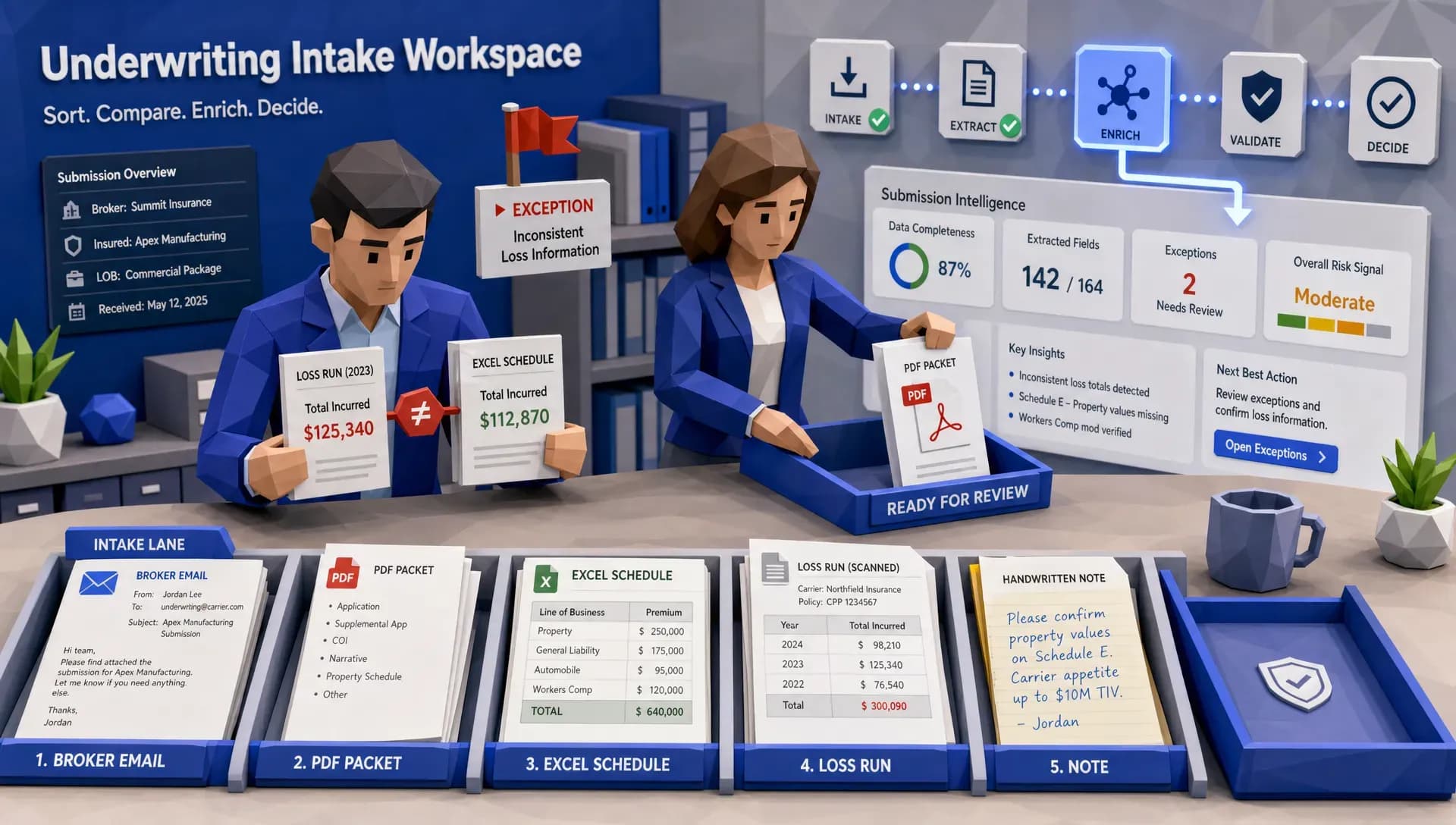
A submission arrives with five attachments, two versions of a statement of values, a broker note in the email body, and a schedule that was clearly exported from a system last updated during the early seasons of reality television. The underwriter does not start with risk selection. They start with reconstruction.
That is why I like the framing in Inaza’s article on why the insurance underwriting process has an intake problem. The bottleneck is often not judgment. It is getting the submission into a state where judgment can even begin.
The handoff from broker to intake to underwriting should preserve the full shape of the risk. Instead, teams often receive a partial picture and spend their time filling blanks. Then, when the account moves to pricing, referral, compliance, or binding, each new handoff invites the same question: are we all looking at the same file?
If the answer is maybe, the operation is already paying a tax.
Claims handoffs are even more unforgiving
Claims expose handoff weakness faster because the customer is usually stressed, the clock is visible, and the facts keep changing.
First notice of loss may be captured well, but then the file moves to triage, coverage review, liability, appraisal, fraud screening, medical review, litigation, subrogation, and payment. Each transition can dilute what the previous team learned.
I once saw an auto claim where the most important detail was not in the claims system at all. It was in a photo sent by a repair shop, attached to an email thread, where someone had casually mentioned that the damage pattern did not match the reported accident. The fraud referral happened eventually, but only after the claim had already gathered momentum. The handoff did not fail loudly. It whispered, then sent an invoice.
J.D. Power’s 2024 U.S. Auto Claims Satisfaction Study points to the pressure around claim cycle time and customer experience. That pressure is not going away. Customers compare claims service with every fast, transparent digital experience they use elsewhere. Fair or not, they do not give insurers extra credit because insurance is complicated.
The fraud angle makes this even sharper. Verisk’s 2025 fraud report highlights how digital tools are changing fraud risk, including the use of manipulated content. That means claim handoffs need to carry evidence, provenance, and risk signals with far more discipline than before. A suspicious image, a mismatched timestamp, or an unusual provider pattern cannot live in someone’s inbox and hope for the best.

The real enemy is the invisible queue
Most insurance leaders can see open claims, pending submissions, and outstanding tasks. Fewer can see the invisible queue: work waiting for clarification, enrichment, review, reassignment, or a missing document that everyone assumes someone else requested.
That queue is dangerous because it does not always show up as backlog. It shows up as aging. It shows up as quote abandonment. It shows up as leakage. It shows up as angry broker emails that begin with just checking in, which is broker-speak for please tell me this has not vanished into the operational swamp.
This is where I think insurance can learn from other industries that obsess over conversion and flow. Web teams, for example, know that a handoff between strategy, design, development, SEO, and automation can wreck performance if the structure is fuzzy. Agencies such as BeBranded make a point of tying website build decisions to content architecture, technical setup, and integrations, because the final experience depends on clean transitions. Insurance operations may be more regulated and complex, but the principle is the same: if the work changes hands, the context must travel with it.
More meetings are not the fix
When handoffs break, the instinct is to add meetings. Weekly backlog calls. Daily huddles. Escalation calls. Root cause calls. Calls to discuss why there are so many calls.
Some meetings are useful. But if a meeting is only compensating for missing context, unclear ownership, or poor data movement, it is a very expensive patch.
Adding more people has the same limitation. Hiring can help when volume grows, but it does not fix a handoff design problem. If every new employee has to learn five systems, three spreadsheets, and the unwritten rules of which inbox matters most, scale becomes a rumor.
The better question is: what should the next person know automatically when the file lands with them?
That one question changes the conversation. It moves teams away from who dropped the ball and toward why the baton did not include the instructions.
What a healthy insurance handoff looks like
A good handoff has three qualities.
First, it carries structured data. If a field matters for triage, pricing, fraud scoring, compliance, reserving, or reporting, it should not be trapped only in a document. Documents still matter, of course. But the operational data inside them needs to be captured and usable.
Second, it carries context. The next person should see what happened, what changed, what was checked, what remains uncertain, and why the file is now with them. This is especially important for exception handling. Straightforward files are easy. Exceptions are where money leaks.
Third, it triggers the right action at the right time. A risk enrichment should not wait until the underwriter has already spent an hour reviewing a submission. A fraud screen should not wait until late-stage settlement. A missing document request should not depend on someone remembering to send a follow-up at 4:55 p.m.
This is also why workflow automation by itself is not enough. If automation only moves tasks faster while the data remains fragmented, you have built a quicker conveyor belt for confusion.
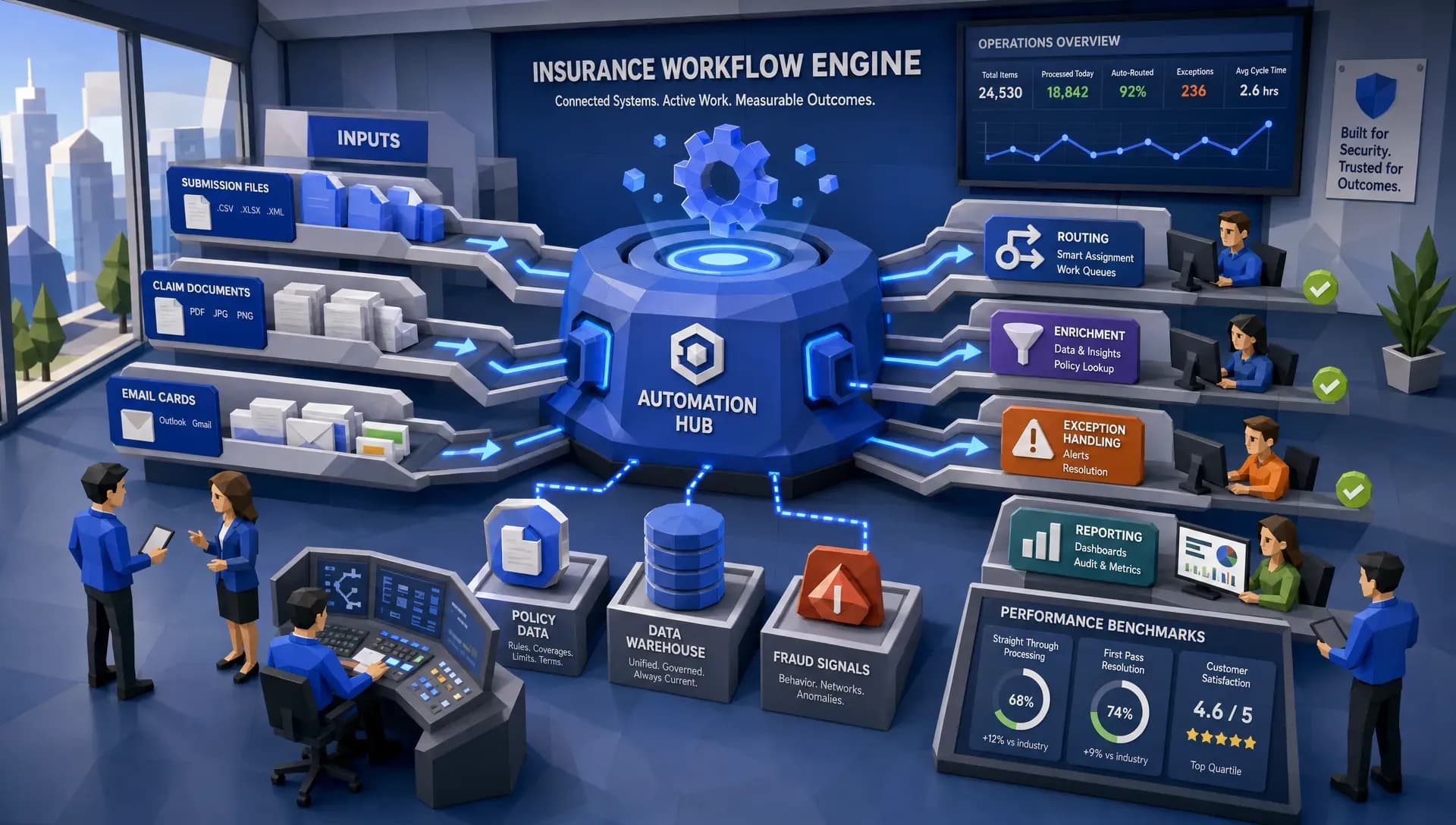
The better model is workflow plus data capture plus reporting. Inaza’s platform is built around that idea: automate underwriting, claims, customer service, and operations while capturing the data that gives leaders visibility into what is actually happening. The data warehouse matters because the business should be able to see where handoffs slow down, which documents cause rework, which referrals are high value, and which teams are stuck waiting on information.
That is a different level of operational control than a task list.
The handoff audit I would run first
If I were walking into an MGA, carrier, or broker operation tomorrow, I would not start with a grand transformation deck. I would pick one process with high volume and obvious frustration. Submissions intake. FNOL to triage. Attorney demand review. Broker service requests. Endorsements. Pick the workflow where everyone sighs before opening the queue.
Then I would ask five questions.
- What information does the receiving team re-check most often? That is usually a signal that context is not traveling.
- Which fields are manually keyed more than once? That is where data leakage becomes error risk.
- Where does work wait without a clear owner? That is the invisible queue.
- Which exceptions create the most email traffic? That is where the process is relying on tribal knowledge.
- Which handoffs are invisible in reporting? That is where leadership lacks operational truth.
You do not need a year-long study to find the pain. People on the floor can usually name the worst handoff in under 30 seconds. They may even have nicknames for it. I have heard a renewal queue called the parking lot of despair. Funny, yes. Also a little too accurate.
Why APIs and enrichment matter at the handoff, not after it
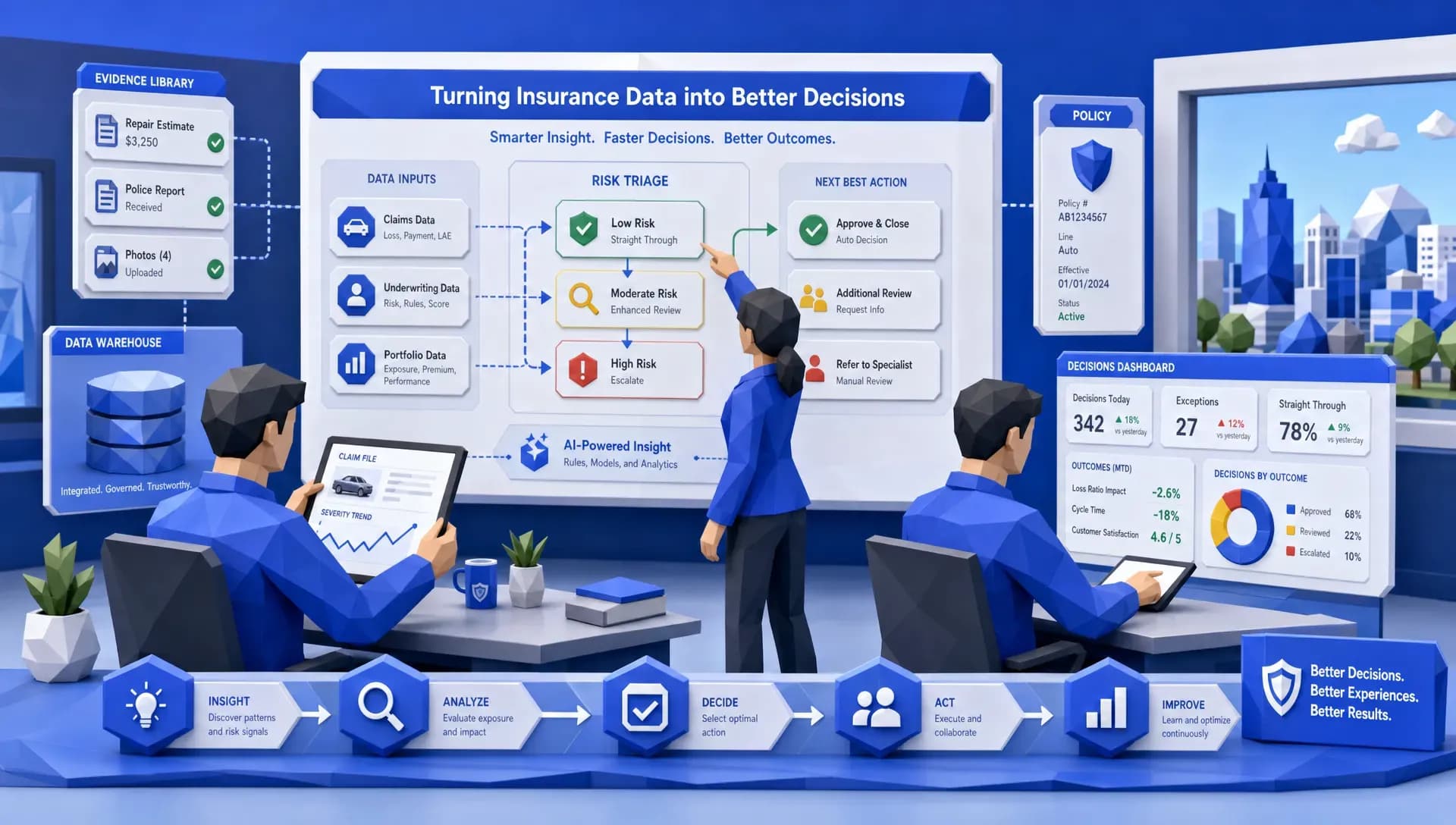
Data enrichment is most valuable when it arrives before a person makes a decision. If external data comes too late, it becomes an audit trail instead of decision support.
This is where pre-built API templates can change the shape of the workflow. If a process can call out to sources such as Verisk, LexisNexis, HazardHub, or other relevant data providers at the moment of intake or triage, the next team receives a richer file. That reduces the amount of manual investigation and makes referrals more purposeful.
For example, a property submission that automatically brings in hazard information before underwriting review is simply better prepared. A claims workflow that flags inconsistencies before settlement review gives adjusters a cleaner path. A portfolio workflow that combines internal performance data with industry benchmarks can support better renewal and reinsurance conversations.
The point is not to remove professional judgment. The point is to stop wasting judgment on gathering the raw material.
Reporting should expose the handoff, not hide it
A lot of insurance reporting is outcome-heavy. How many claims closed? How many submissions bound? What was the loss ratio? What is pending?
Those metrics matter, but they can hide the handoff pain that created the outcome. By the time a metric shows deterioration, the operational issue may have been active for months.
Leaders need to see handoff health directly. How long does intake take before a file is ready for review? How often does underwriting send a submission back for missing data? Which claim types bounce between teams? Which broker requests require the most manual touches? Which document types create the highest exception rate?
That is why I am increasingly skeptical of automation projects that do not include analytics from day one. If the workflow is automated but the business cannot see where the handoffs improve or fail, leadership is still flying with fogged-up windows.
For teams dealing with document-heavy processes, the same principle applies. Inaza’s guide on fixing insurance documentation bottlenecks is a useful companion because many handoff problems begin with unstructured documents that nobody has converted into usable operational data.
The future of insurance operations is fewer cold starts
A cold start is what happens when every team has to rediscover the file from scratch. It is one of the quiet killers of productivity in insurance.
The future should look different. When a file moves from intake to underwriting, the underwriter should inherit a prepared risk. When a claim moves from FNOL to triage, the adjuster should inherit a coherent loss story. When fraud review receives a referral, the analyst should inherit the reason for suspicion and the evidence trail. When leadership reviews performance, they should inherit data that reflects the work as it happened, not a manually assembled version three weeks later.
That is the operational prize: fewer cold starts, fewer rework loops, fewer status chases, and fewer moments where a high-value professional becomes a human search bar.
Frequently Asked Questions
Why do insurance company operations break at handoffs? They break because data, context, and ownership often fail to move cleanly between teams or systems. The task may transfer, but the full story behind the task does not always travel with it.
Are handoff problems mostly caused by legacy systems? Legacy systems contribute, but they are not the whole story. Handoffs also break because documents are unstructured, email is overused, ownership is unclear, and reporting does not expose where work is waiting.
Which insurance workflows are most vulnerable to handoff failure? Submission intake, underwriting referrals, FNOL to claims triage, fraud review, attorney demand handling, endorsements, and broker service requests are common trouble spots because they involve multiple teams and document-heavy work.
Can automation fix insurance handoffs? Automation helps when it captures data, preserves context, triggers the right next action, and gives leaders visibility. If it only moves tasks faster without improving data quality, the underlying handoff problem remains.
What should insurers fix first? Start with the handoff that creates the most rework, delays, or customer frustration. In many organizations, that is intake, claims triage, or document review, because those steps shape everything that follows.
Final thought: stop treating handoffs like admin
Handoffs are not admin trivia. They are where underwriting discipline, claims quality, fraud control, broker experience, and customer trust either hold together or quietly unravel.
My hot take: the best insurance operations teams of the next few years will not be the ones with the biggest systems budget. They will be the ones that design handoffs as carefully as they design products and pricing.
If you want workflows that carry data, context, and accountability from one team to the next, Inaza helps insurers, MGAs, and brokers automate the messy middle of operations without forcing teams to relearn everything from scratch. Because in insurance, the handoff is often where the margin is hiding.