Hidden leakage is the claims department’s version of a slow tire leak. Nothing dramatic happens at first. The car still drives. The dashboard looks fine. Then, weeks later, someone asks why severity is up, why rental spend is drifting, why legal invoices keep landing like confetti, and why the loss ratio has developed a personality disorder.
Here is my hot take after a decade around insurance operations: most leakage is not caused by one big bad decision. It is caused by a hundred tiny delays, handoffs, missing fields, and “we’ll come back to that later” moments. Spoiler alert, nobody comes back to it later.
That is where insurance claim processing services earn their keep. The best ones do not simply add headcount or move tasks from one inbox to another. They tighten the operating rhythm of a claim, from FNOL through investigation, reserving, payment, recovery, and closure. They make the ordinary parts of claims handling less leaky.
What hidden leakage actually looks like
When people hear “claims leakage,” they often picture obvious overpayment or fraud. Those matter, of course. But hidden leakage is usually more boring, which is exactly why it survives.
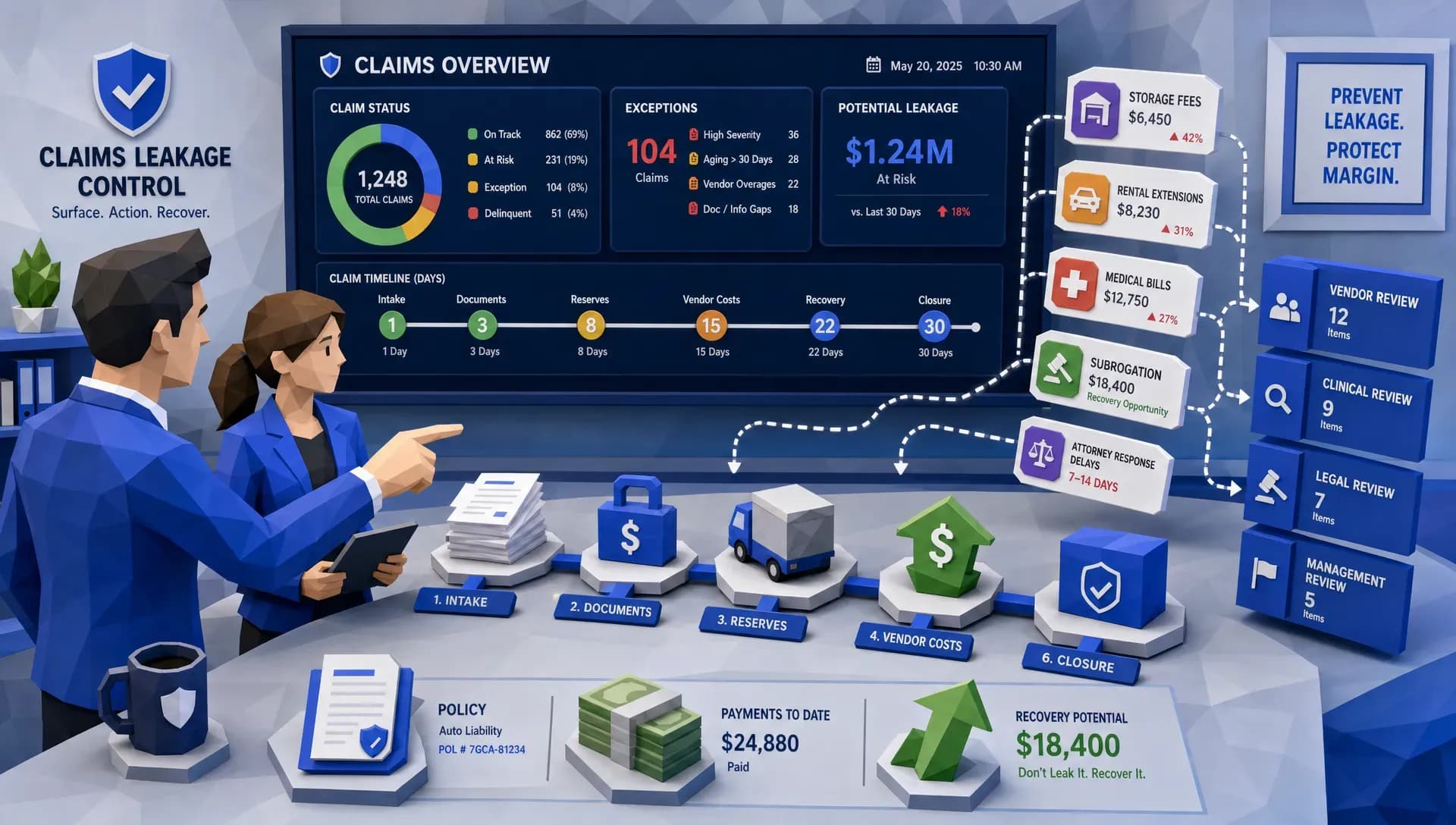
I once reviewed an auto physical damage file where the initial estimate was fine, the liability decision was fine, and the payment authority was fine. The leakage came from storage fees. A vehicle sat at a tow yard because one document was missing and nobody owned the follow-up. By the time the file moved, the extra cost was more than the original disputed line item. No villain. No scandal. Just operational mush.
Hidden leakage often shows up as late reserve changes, missed subrogation opportunities, duplicated medical bills, overlooked policy conditions, unmanaged supplements, rental extensions, excessive attorney response time, or payments made without enough documentation. In commercial lines, it might be a coverage nuance missed during intake. In personal auto, it might be a fraud signal buried in a PDF. In property, it might be a vendor invoice that looks normal until you compare it with the claim facts.
The common thread is simple: the claim had the information somewhere, but the process did not surface it at the right time.
Why insurance claim processing services reduce leakage
Good claim processing services reduce leakage because they standardize the messy middle of claims work. They make sure the claim does not depend on memory, heroic adjusters, or someone named Karen who “knows where everything is.” Every insurer has a Karen. Protect Karen at all costs, but please do not build your operating model around her inbox.
Processing services help by bringing consistency to four areas that quietly drive cost: intake quality, document handling, decision timing, and exception management. If those four areas are weak, even your best adjusters end up spending too much time hunting, rekeying, chasing, and correcting.
That matters because claim cycle time is expensive. J.D. Power’s 2024 U.S. Auto Claims Satisfaction Study points to the continued pressure around auto claims duration and customer satisfaction. Longer claims do not just irritate policyholders. They create more opportunities for rental overruns, supplements, litigation, complaints, and avoidable touches.
Fraud adds another layer. The FBI has long warned that insurance fraud is a major cost burden for the industry and consumers. More recently, Verisk’s 2025 fraud report highlights how digital tools are changing the fraud environment. If your claims process still treats fraud review as a late-stage manual checkpoint, you are probably seeing only the fish that jump into the boat.
The leakage starts earlier than most teams think
A lot of carriers and MGAs try to fix leakage at payment review. That is better than nothing, but it is late. By then, the file may already have poor notes, weak coverage documentation, a stale reserve, and three vendors involved. Payment review becomes archaeology.
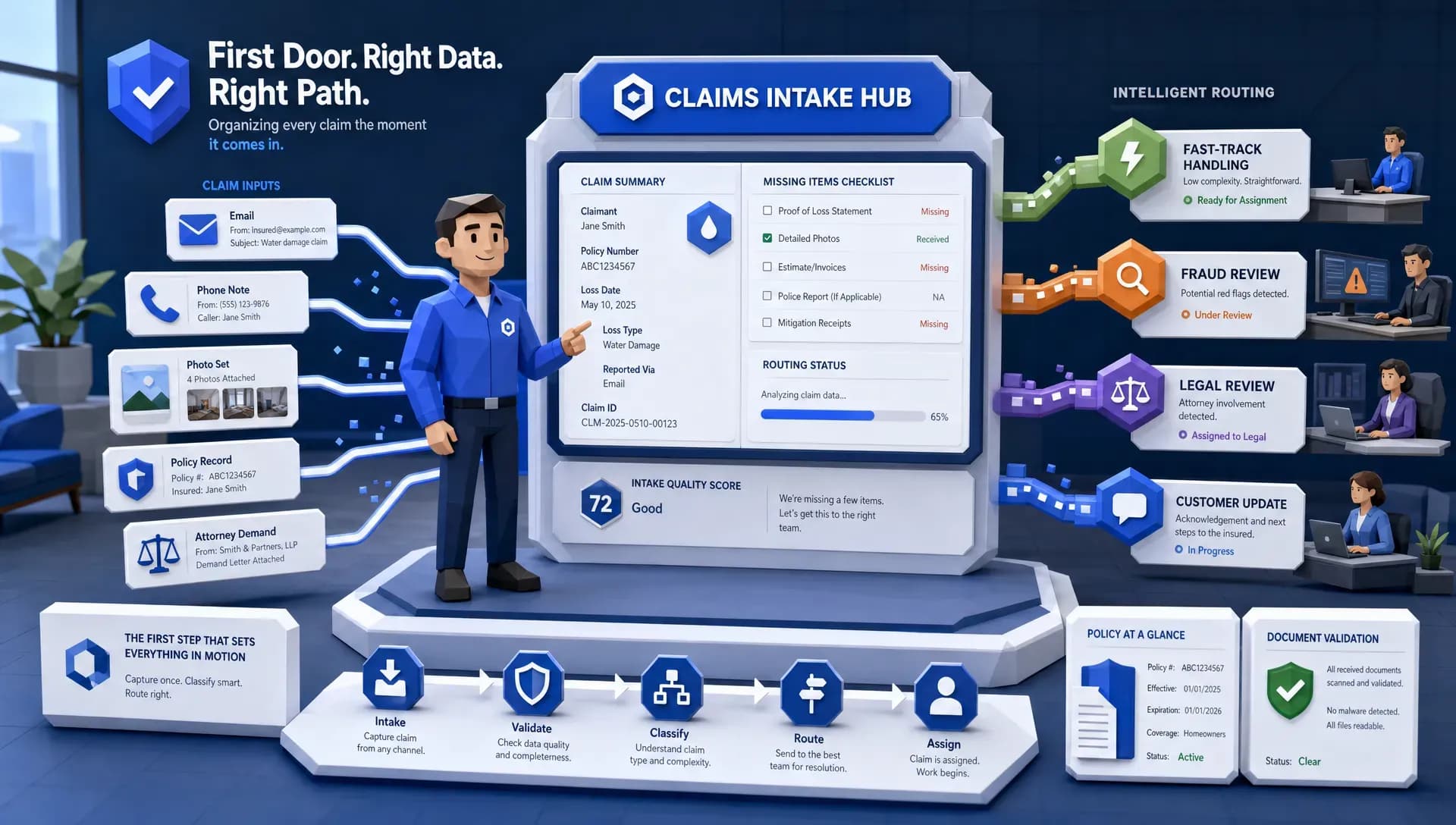
The better move is to catch leakage at intake and triage. FNOL quality is not administrative trivia. It is the first underwriting of the claim. The questions asked, the documents collected, the policy data pulled, and the early red flags captured all shape the rest of the file.
If the first notice misses a driver, a location, a police report number, prior damage, attorney involvement, or a coverage condition, the claim begins with a blind spot. That blind spot becomes rework. Rework becomes delay. Delay becomes cost.
This is why connected data matters so much. A claim is not just a claim record. It is policy data, prior claims, external data, documents, repair information, medical bills, legal correspondence, vendor notes, payments, reserves, and recovery potential. If those pieces sit in separate systems, leakage hides between them. We have written more about this in our article on why insurance claims services work better with connected data.
The quiet power of better document handling
If you want to find leakage, follow the documents.
Medical bills, police reports, attorney demands, repair estimates, photos, invoices, statements, loss runs, emails, spreadsheets, scanned forms, handwritten notes, the claims universe is basically a document buffet. A slightly chaotic buffet, but a buffet.
The old way is familiar. Someone opens the file, reads the document, names it, downloads it, uploads it, keys part of it into the claims system, emails someone else, then hopes the right person notices. Multiply that by thousands of claims and you get a very expensive game of telephone.
Better claim processing services classify documents, extract key data, route exceptions, and connect the extracted information to the claim workflow. The point is not to remove human judgment. The point is to stop wasting human judgment on work a structured process can handle.
McKinsey has noted that a large share of insurance professionals’ time is consumed by administrative work rather than judgment-heavy tasks. Anyone who has watched a senior adjuster spend 20 minutes renaming files knows that statistic has a pulse.
For a deeper look at this specific bottleneck, our piece on reducing claims cycle times with intelligent document processing explains how better document intake and extraction can remove a surprising amount of drag.
Leakage is often a timing problem
One of the most underrated causes of leakage is timing. Not whether the final decision is right, but whether the right review happens early enough to matter.
A suspicious claim flagged on day two is manageable. The same claim flagged on day forty-two, after payments, rental, repairs, and attorney correspondence, is a headache wearing tap shoes.
The same applies to subrogation. Early identification lets the team preserve evidence, gather third-party details, send notices, and protect recovery rights. Late identification turns recovery into wishful thinking. I have seen files where the subro opportunity was obvious, but only in hindsight. Hindsight is a terrible claims handler. Very confident, always late.
Processing services reduce this timing leakage by creating triggers. A claim with attorney representation routes differently. A total loss with storage exposure gets an escalation. A medical bill above threshold receives review before payment. A property claim with inconsistent photos moves to investigation. A claim with a potential third party gets recovery attention before the trail goes cold.
This is not glamorous. It is plumbing. But plumbing is what keeps the building from flooding.
The best services do not chase “touchless” at all costs
Here is another hot take: straight-through processing is useful, but it is not the trophy. The trophy is right-touch processing.
Some claims should move fast with minimal human involvement. A clean glass claim, a low-severity auto claim with no coverage concern, or a simple property claim with complete documentation should not wait in a queue because the process enjoys ceremony.
But other claims deserve early attention. Complex injuries, attorney demands, inconsistent facts, coverage questions, suspected fraud, repeat claimants, unusual vendors, large supplements, or questionable documentation should get human review quickly.
Celent has reported that only a relatively small share of claims are processed fully straight-through without human intervention. That sounds right to me. The goal should not be to pretend every claim is simple. The goal should be to identify which claims are simple, which are risky, and which are quietly becoming expensive.
Good insurance claim processing services make that distinction early. They do not flatten every claim into the same workflow. They route, prioritize, enrich, and escalate based on the facts of the file.
Vendor and payment controls are where small leaks become real money
Vendor leakage is tricky because every individual invoice can look reasonable. A storage fee here. A supplement there. A rental extension. A mitigation invoice. An expert report. A legal bill with a few extra tenths of an hour.
No single item triggers panic. But across a book, those “reasonable” costs become a material severity problem.
Processing services reduce vendor leakage by comparing invoices against claim context, policy limits, approved rates, service dates, prior payments, and expected timelines. The key is not simply checking whether an invoice exists. The key is checking whether it makes sense.
A rental bill should connect to repair duration. A storage bill should connect to release timing. A mitigation invoice should connect to scope and photos. A legal invoice should connect to the actual matter activity. When those connections are missing, claim teams end up approving in fragments.
This is where claims analytics can become very powerful, especially when paired with operational controls rather than reviewed after the damage is done. If you want to go deeper on the data side, we have a separate breakdown of insurance claims analytics that reveal hidden leakage.
What to measure if you want to prove leakage is falling
You cannot manage leakage with vibes. Believe me, I have seen “the team feels better about the process” presented as a success metric. I appreciate the optimism. Finance usually does not.
The useful metrics are practical and claim-specific. I would start with these:
- Average cycle time by claim type and severity band
- Percentage of claims with complete FNOL data on day one
- Reopen rate and rework rate
- Late reserve movement frequency
- Missed or delayed subrogation referrals
- Vendor invoice exceptions and payment leakage by category
- Attorney demand response time
- Percentage of claims routed to the right specialist on first assignment
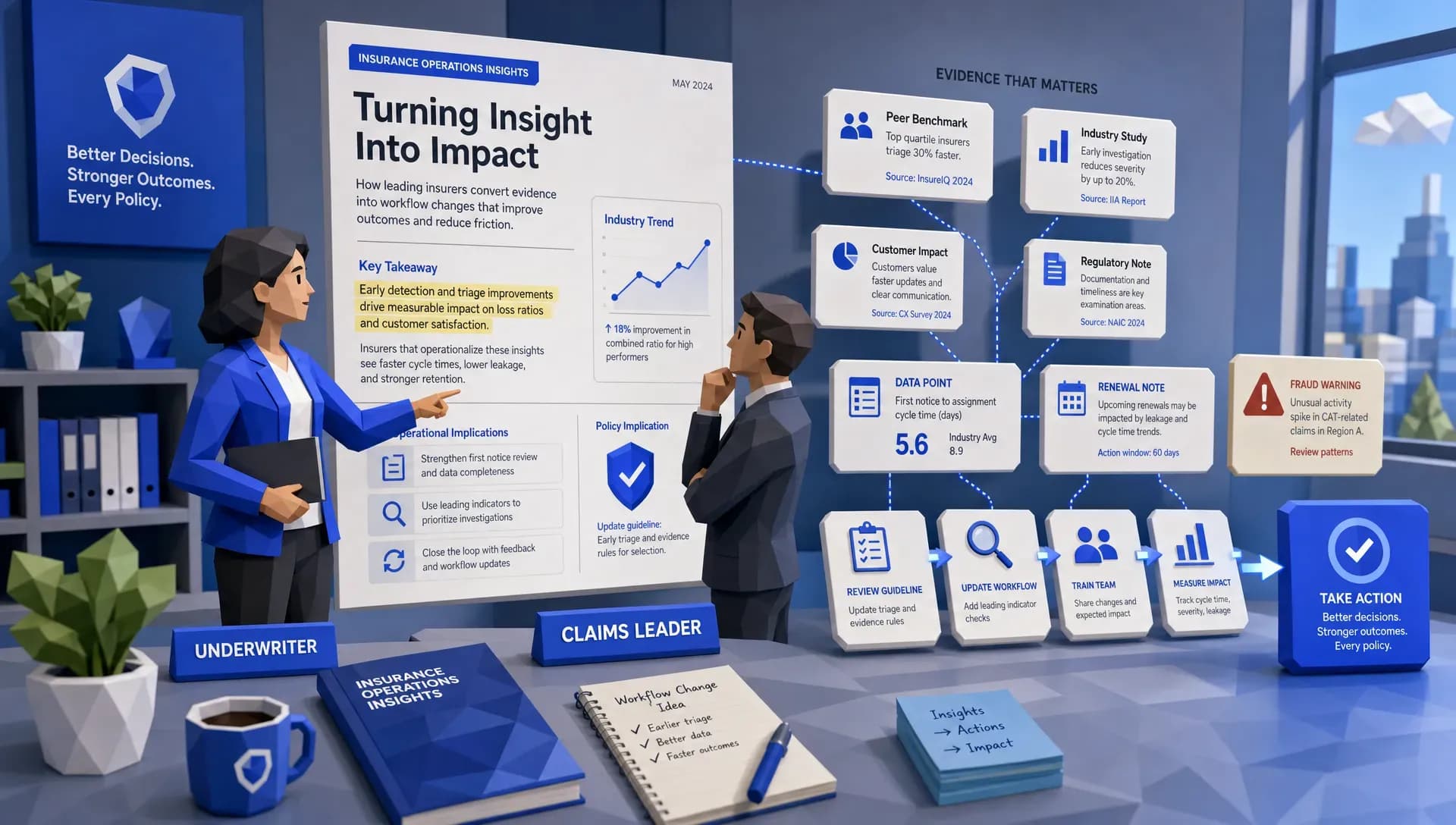
The point is not to drown leaders in dashboards. The point is to connect operational behavior to financial outcomes. If rental leakage drops after earlier total-loss routing, that is a story. If late reserves fall after better triage, that is a story. If recovery referrals increase because third-party data is captured earlier, that is a story.
Outside insurance, the same principle shows up in healthcare. Programs that combine expert guidance with regular check-ins, like progress monitoring and personal medical supervision, tend to work better than one-off advice because the system catches drift early. Claims are similar. A one-time review is helpful, but continuous monitoring is what keeps leakage from quietly returning.
Where Inaza fits into the leakage conversation
Reducing hidden leakage is not about buying a shiny tool and hoping adjusters magically change behavior by next Tuesday. It requires workflows that match how claims actually move, data capture that happens as work is performed, and reporting that shows what is changing.
Inaza’s insurance automation platform is built for that kind of operating model. It helps insurers, MGAs, and brokers automate claims workflows, capture data across documents and systems, and use dashboards to see where bottlenecks and cost drivers are forming. Because the platform integrates with existing systems and supports customizable workflows, teams do not have to rip out their core environment just to improve claim handling.
The part I particularly like is the data warehouse underneath the workflow layer. Automation without data is just faster activity. Data without workflow is just a museum. When the two are connected, claim leaders can see which workflows are reducing leakage, which exceptions keep appearing, and where the process needs tightening.
Inaza also offers pre-built workflow templates and API templates for enrichment sources, which is important because leakage often hides in missing context. Policy data, third-party data, claims history, hazard information, and market benchmarks can all change how a claim should be handled.
Frequently Asked Questions
What are insurance claim processing services? Insurance claim processing services help insurers manage the operational steps of a claim, including intake, document handling, triage, data enrichment, payment review, vendor coordination, fraud flags, recovery routing, and reporting. The best services improve consistency rather than simply adding manual labor.
How do claim processing services reduce hidden leakage? They reduce leakage by capturing better data earlier, routing claims correctly, flagging exceptions, reducing rework, improving document handling, and making sure recovery, fraud, reserve, and vendor issues are reviewed before costs escalate.
Is claims leakage always caused by fraud? No. Fraud is important, but hidden leakage often comes from ordinary process failures such as missed subrogation, delayed total-loss handling, incomplete FNOL, duplicate payments, unmanaged rental costs, late reserves, and weak vendor controls.
Should insurers automate every claim? No. Simple claims should move quickly, but complex or risky claims need early human judgment. The better goal is right-touch processing, where claims are routed based on severity, complexity, documentation, and risk signals.
What is the first place to look for hidden leakage? Start with FNOL quality and document handling. If the claim starts with missing information or key documents are not classified and routed correctly, leakage is likely to appear later as rework, delay, overpayment, or missed recovery.
Final thought: leakage reduction is a discipline, not a clean-up project
Hidden leakage does not disappear because someone sends a stern email about best practices. It disappears when the claim process makes the right action the easy action.
That means better intake, connected data, earlier triage, cleaner document handling, smarter exception routing, and reporting that shows whether the work is actually improving outcomes. Insurance claim processing services reduce hidden leakage because they bring discipline to the parts of claims that are easiest to overlook.
If you want to see where leakage is hiding in your claims operation, Inaza can help you connect workflows, data, and analytics so your team catches small cost drivers before they become loss ratio problems.