Here’s my hot take after a decade around claims teams: insurance claims handling rarely gets slow because adjusters are lazy or systems are “old.” It gets slow because intake is messy, incomplete, and politely pretending to be a process.
We love to talk about settlement automation, litigation strategy, fraud analytics, and customer experience. All worthy topics. But the first notice of loss is where the clock starts, the customer’s patience starts shrinking, and the claim begins either as a clean decision path or as a scavenger hunt.
I once watched an adjuster lose half a morning on what looked like a simple auto claim. The email had three photos, a policy number typed wrong by one digit, and a note that said, “same thing as last time.” That was it. No loss date, no driver confirmation, no location, no police report status. The adjuster did what good adjusters do: investigated. But let’s be honest, that was not adjusting. That was clerical archaeology.
If insurers want faster claims, the smartest place to begin is not the final payment button. It is the front door.
The claim starts slowing down before it really starts
A claim enters through email, portal, phone call, broker submission, attorney letter, repair estimate, photo upload, or sometimes a PDF that looks like it was scanned during an earthquake. By the time it reaches a handler, the organization has already made several decisions, even if nobody admits it.
Was the file classified correctly? Was it assigned to the right queue? Were key facts captured? Were missing items identified? Was the policy matched? Was coverage likely? Were fraud indicators checked early? Was the customer told what happens next?
If the answer is “sort of,” congratulations, you have found the hidden factory inside most claims departments.
J.D. Power’s 2024 U.S. Auto Claims Satisfaction Study highlighted the pressure that long cycle times place on customer satisfaction, with repairable auto claims often stretching beyond 30 days. Customers do not care which internal handoff caused the delay. They do not distinguish between “we are waiting on documents” and “we never asked for the right documents.” To them, slow is slow.
That is why smarter intake matters. It turns claim opening from a loose collection of messages into a structured decision point.
“Intake” is not data entry, and we should stop treating it that way
In too many claims operations, intake is treated like the insurance version of unloading groceries. Get the items inside, sort it out later. That thinking creates rework, duplicate handling, poor routing, and awkward customer follow-ups that sound like, “Sorry, one more thing.”
Smarter intake means the claim is understood as soon as possible. Not perfectly, because claims are messy by nature, but clearly enough to decide what should happen next.
A simple analogy: in manufacturing or retail, labels matter because they tell everyone what the item is, how to handle it, and where it belongs. A jacket with a clear care tag avoids confusion for the customer, the store, and the cleaner. Companies that sell custom woven labels understand that the label is not decoration, it carries operational meaning. Claims need the same idea, but in data form. A claim should arrive with useful “labels” attached: loss type, severity signals, coverage flags, missing evidence, jurisdiction, fraud indicators, and next-best action.
Without those labels, even experienced adjusters waste time orienting themselves. And orientation time is expensive because it repeats across thousands of files.
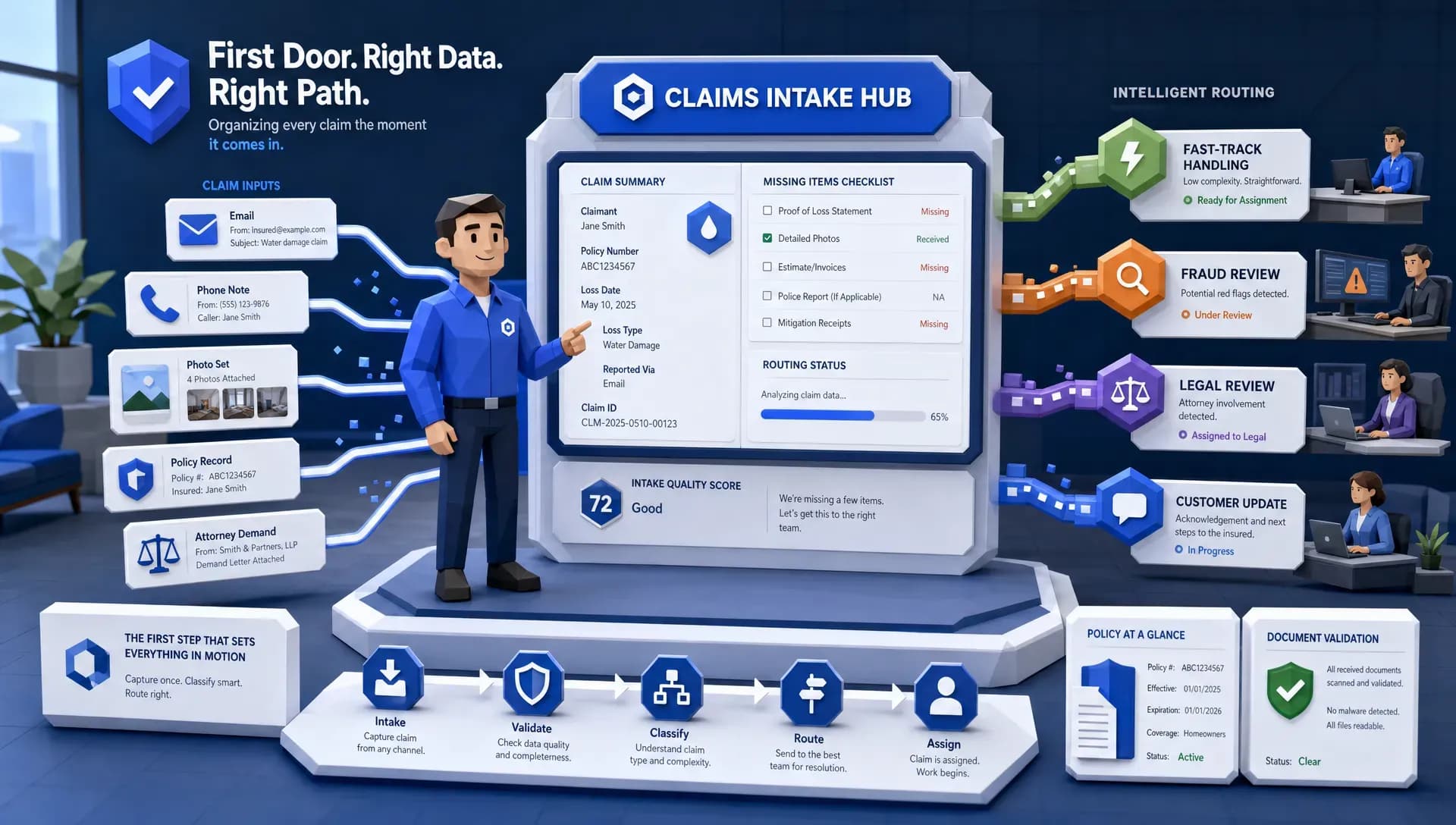
If intake is smart, the claim is not just received. It is classified, enriched, validated, and routed with context.
The first five questions intake should answer
I am not suggesting every claim needs to be fully resolved at FNOL. That is fantasy, and fantasy is not a claims strategy. But every claim should be opened with enough structure to answer five practical questions:
- What happened, and what line of business does it belong to?
- Is the policy match clear, and is coverage likely or uncertain?
- What evidence has already been provided?
- What is missing, contradictory, or suspicious?
- Who or what should handle the claim next?
That last question is underrated. Routing is where speed often dies quietly. A low-complexity glass claim should not sit behind a bodily injury file. A represented claimant should not be treated like a routine FNOL. A claim with possible subrogation should not wait until day 18 for someone to notice the other party’s details were buried in an attachment.
This is also why email intake deserves special attention. A lot of claims still begin in shared inboxes, and shared inboxes are where good intentions go to become backlog. If that sounds familiar, the logic behind smart email routing for FNOL and claims intake is worth reviewing because email is often the real claims portal, whether we planned it that way or not.
Faster claims are cleaner claims
There is a quiet truth in insurance claims handling: speed is usually a byproduct of cleanliness.
Clean data means fewer callbacks. Clean document capture means fewer reopenings. Clean routing means fewer transfers. Clean triage means senior adjusters spend time on senior-adjuster work, not on sorting files that should never have landed in their queue.
Celent has reported that only a small share of claims are processed straight-through without human intervention, often cited around the 10% to 15% range depending on line and complexity. The important lesson from Celent’s work on straight-through processing is not that every claim should be touchless. Many should not be. The lesson is that claims operations need to separate the files that need judgment from the files that need movement.
A claims leader once told me, “We do not have a cycle time problem. We have a waiting problem.” I have repeated that line so many times I should probably send him royalties. He was right. Claims wait for classification, assignment, missing documents, coverage confirmation, supervisor review, vendor selection, fraud referral, legal escalation, and payment approval.
Smarter intake attacks the first waiting state. That matters because delays compound. If you start three days behind, every downstream SLA becomes harder to hit.
Fraud screening needs better intake, not louder alarms
Fraud detection is one of the best examples of why intake quality matters. We all want to catch suspicious claims earlier. But if intake data is poor, fraud tools produce either false comfort or false alarms. Neither is helpful.
The stakes are rising. Verisk’s 2025 fraud report found that carriers are increasingly concerned about digitally altered or fabricated claim evidence. Meanwhile, the FBI describes insurance fraud as a major cost that ultimately affects premiums and operating expenses.
My view: fraud screening should behave more like airport security and less like a courtroom accusation. At intake, the goal is not to prove fraud. The goal is to spot inconsistencies early enough to route the claim properly.
For example, if an auto FNOL says the vehicle was parked, but the photos suggest front-end collision damage at speed, that discrepancy should be visible immediately. If a property claim includes images with suspicious metadata, the file should not drift through normal handling for two weeks before someone asks questions. If a claimant has repeated losses across related parties or addresses, intake should surface that history before payment momentum builds.
That does not replace adjuster judgment. It protects it. Good adjusters are excellent at weighing facts. They are less effective when the facts are scattered across six attachments, two systems, and a call note named “misc.”
Attorney demands are an intake problem too
Represented claims and attorney demands are where sloppy intake becomes especially painful. These files often arrive with dense letters, medical bills, policy limit language, deadlines, and implied bad-faith risk. If the intake process treats that demand like “another PDF,” the clock may already be working against you.
A smarter intake workflow identifies the demand type, extracts deadline dates, matches the claimant and policy, flags missing medical records, summarizes key allegations, and routes the file to the right desk. It also creates a clean record of what arrived and when.
That last part matters. In claims, documentation is not glamourous. Neither is flossing. Both save you later.
The real prize is connected claims data
Here is where many claims modernization projects miss the mark. They automate a task, but the data still disappears into the fog. A document gets read, a field gets populated, a task gets assigned, and then no one can easily see patterns across the portfolio.
Smarter intake should feed a living data layer. Which claim types arrive incomplete most often? Which brokers submit the cleanest FNOLs? Which jurisdictions create the longest lag between loss and notice? Which vendors correlate with faster resolution? Which fraud indicators are predictive, and which are just noisy?
This is where connected data changes the conversation from “How do we process this claim?” to “What is our claims operation telling us?” If that resonates, Inaza has written more on why insurance claims services work better with connected data, especially when policy, FNOL, documents, fraud, legal, and payment data stop living in separate corners.
The operational benefit is speed. The strategic benefit is visibility.
My unpopular opinion: automate intake before you automate settlement
I know settlement automation gets more attention. It sounds more dramatic. It is the shiny object in the demo. But automating settlement while intake stays messy is like putting a racing engine in a car with square wheels. Impressive noise, limited progress.
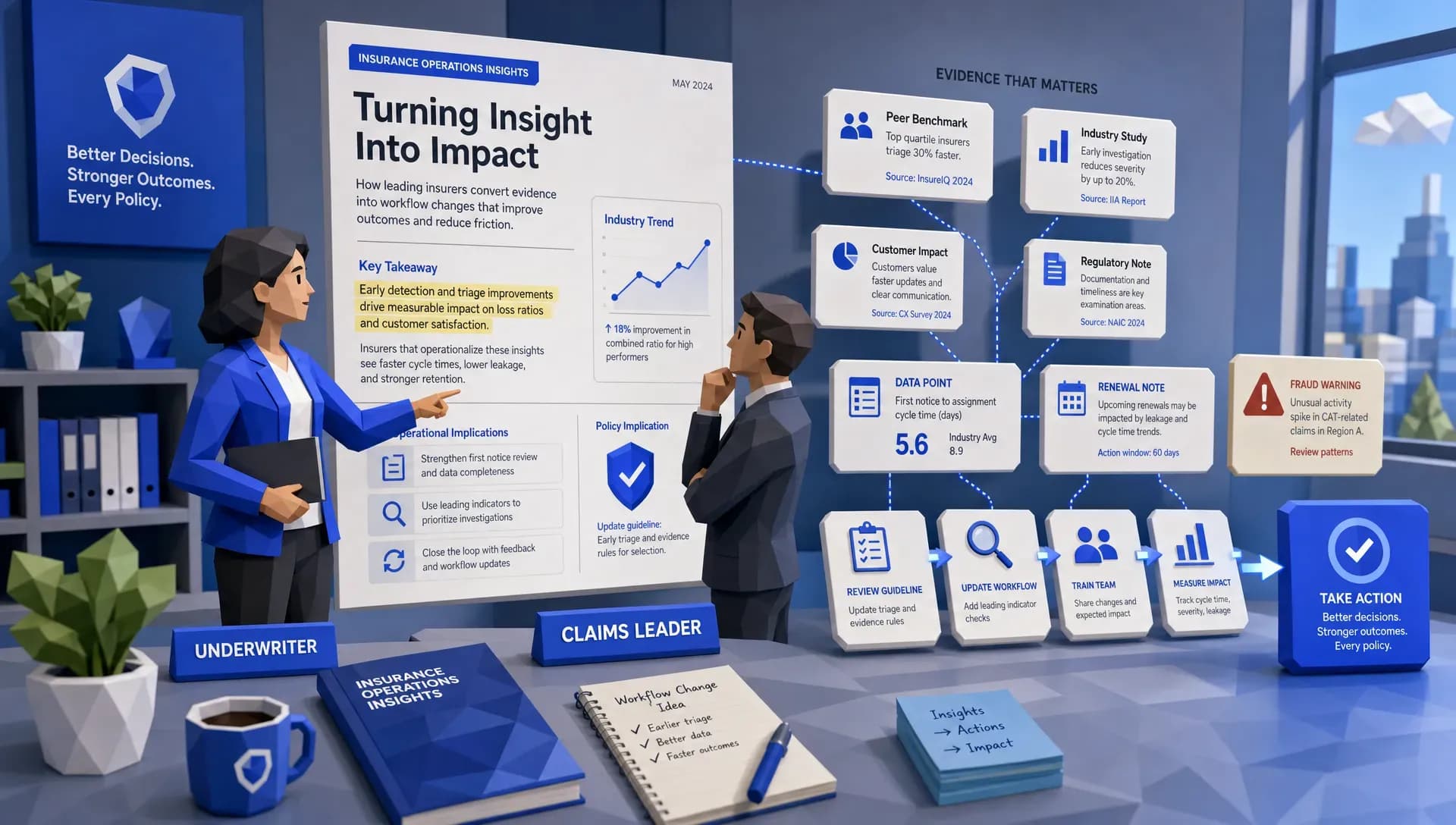
Start with intake because it improves everything after it. Better intake helps triage. Better triage helps assignment. Better assignment helps cycle time. Better documentation helps compliance. Better early fraud screening helps leakage. Better customer communication reduces inbound calls.
This is why modern claims platforms should focus on the first mile of the claim, not only the final mile. Inaza’s claims management solution is built around that idea: automate FNOL processing, document and image handling, fraud checks, communications, and reporting while integrating with the systems insurers already use.
The key is not to rip and replace every system. Most insurers do not have the appetite, budget, or emotional stamina for that. The practical route is to make intake smarter, connect it to existing claims infrastructure, and capture better data as work moves.
What smarter intake looks like in the real world
A good intake process starts by accepting reality. Claims arrive in every format imaginable. Structured forms are nice, but the world still sends emails, PDFs, photos, spreadsheets, police reports, estimates, voicemail notes, and attorney letters.
So the first job is capture. The system needs to read and organize incoming material without forcing staff to rekey everything. Then it needs to extract the useful facts: names, policy numbers, dates, locations, loss descriptions, vehicle details, injury mentions, repair estimates, demand deadlines, and other line-specific fields.
Next comes validation. Does the policy number exist? Does the loss date fall within the policy period? Is the claimant already known? Is the address valid? Are required documents missing? Are there duplicate claims?
Then enrichment. Pull in policy details, prior loss history, third-party data, hazard information, vehicle data, or other sources that help determine risk, severity, and routing. This is where pre-built API templates and integrations can make a real difference because the claim gets context before an adjuster opens it.
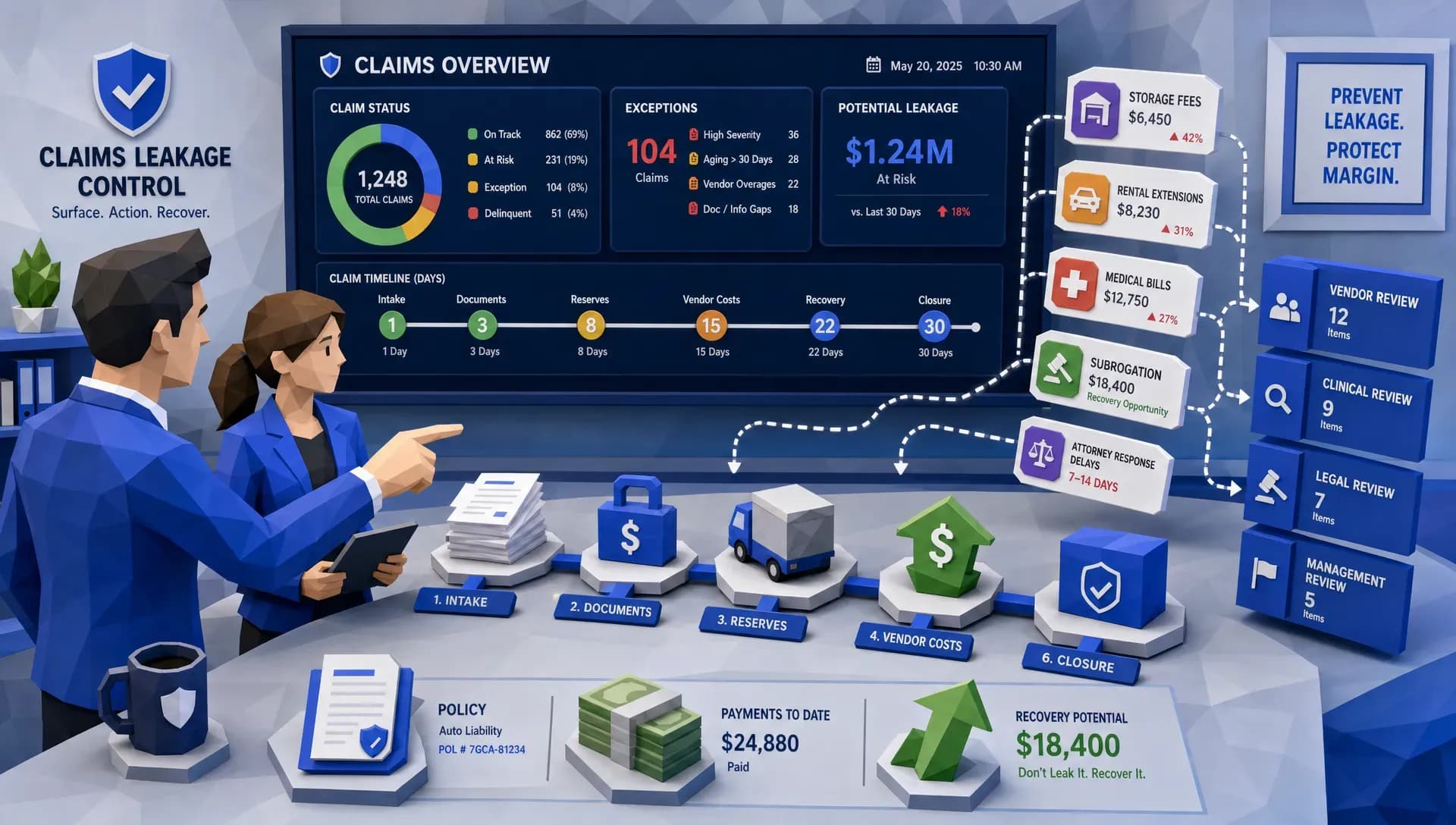
Finally, route and report. The claim should land with the right team, with a clear summary and next steps. The operation should also gain usable data for dashboards, leakage review, staffing, broker performance, and portfolio insight.
That is the difference between moving files and managing claims.
How I would start if I ran the claims floor tomorrow
If I walked into a carrier or MGA claims operation tomorrow, I would not begin with a grand transformation deck. I have seen enough of those to wallpaper a small conference room.
I would pick one high-volume claim type with obvious intake pain. Auto physical damage. Property water damage. Glass. Low-complexity liability. Something frequent enough to measure and contained enough to improve quickly.
Then I would review 100 recently opened claims and ask a few blunt questions. What was missing at intake? How many times did staff touch the file before assignment? How many claims were routed twice? How many customer follow-ups could have been avoided? How many files sat idle waiting for basic data?
After that, I would standardize the minimum data needed to route the claim correctly. Not every possible data point, just the fields that change the next action. That distinction matters. Intake fails when we ask for everything and get nothing useful.
Then I would automate classification, extraction, missing-item detection, and routing for that claim type. Measure the before and after. If it works, expand.
The best claims transformations I have seen did not start with a moonshot. They started with one intake bottleneck everyone hated and fixed it properly.
Metrics that prove intake is getting smarter
If smarter intake is working, you should see it in operational metrics. The most useful ones are practical, not fancy.
Track time from notice to acknowledgment. Track time from notice to correct assignment. Track the percentage of FNOLs that arrive complete enough for routing. Track duplicate touches before assignment. Track avoidable customer follow-ups. Track claims reassigned after initial routing. Track fraud referrals that actually produce useful findings. Track cycle time by intake channel.
One metric I like is “time to clarity.” How long does it take before the organization knows what kind of claim it has, what is missing, and who owns the next action? That number tells you more than a generic open-to-close average because it isolates the front-door problem.
And if you can connect these metrics to dashboards, even better. Claims leaders need to see patterns while they can still act, not at the quarterly post-mortem when everyone nods solemnly and orders more coffee.
Frequently Asked Questions
What does smarter intake mean in insurance claims handling? Smarter intake means capturing, classifying, validating, enriching, and routing a claim as soon as it arrives. The goal is to give adjusters clean context and clear next steps instead of a pile of disconnected documents.
Does smarter intake replace claims adjusters? No. It removes low-value sorting and rekeying so adjusters can focus on coverage, liability, negotiation, fraud evaluation, and customer communication. In my experience, good adjusters do not fear cleaner files.
Which claims should insurers improve first? Start with high-volume claims where intake issues create repeated rework. The best candidates are claim types with predictable documents, common missing fields, and frequent routing delays.
How does intake quality affect fraud detection? Fraud screening depends on accurate facts, consistent data, and early visibility into inconsistencies. If intake is messy, fraud signals can be missed or misread. Better intake helps teams spot concerns earlier without over-escalating normal claims.
Can smarter intake improve customer experience? Yes. Customers mainly feel intake quality through speed, clarity, and fewer repeat requests. When the insurer knows what happened and what is missing early, communication improves quickly.
Make the front door of claims smarter
If your claims team is drowning in rework, the problem may not be the adjusters or the core system. It may be the way claims enter the business.
At Inaza, we help insurers, MGAs, and brokers build smarter intake workflows that capture data, automate routing, connect to existing systems, and turn claims activity into usable business intelligence. Start with the front door, and the rest of the claim has a much better chance of moving fast.