First contact is the part of the claims lifecycle everyone loves to polish. We script it. We measure it. We obsess over how quickly the claimant gets an acknowledgement. Fair enough, because a bad first impression in claims is like serving cold coffee at a client meeting, everyone notices.
But here is my hot take after a decade around claims teams: most claims do not break because first contact was poor. They break because everything after first contact is held together with inboxes, attachments, tribal knowledge, and heroic adjusters.
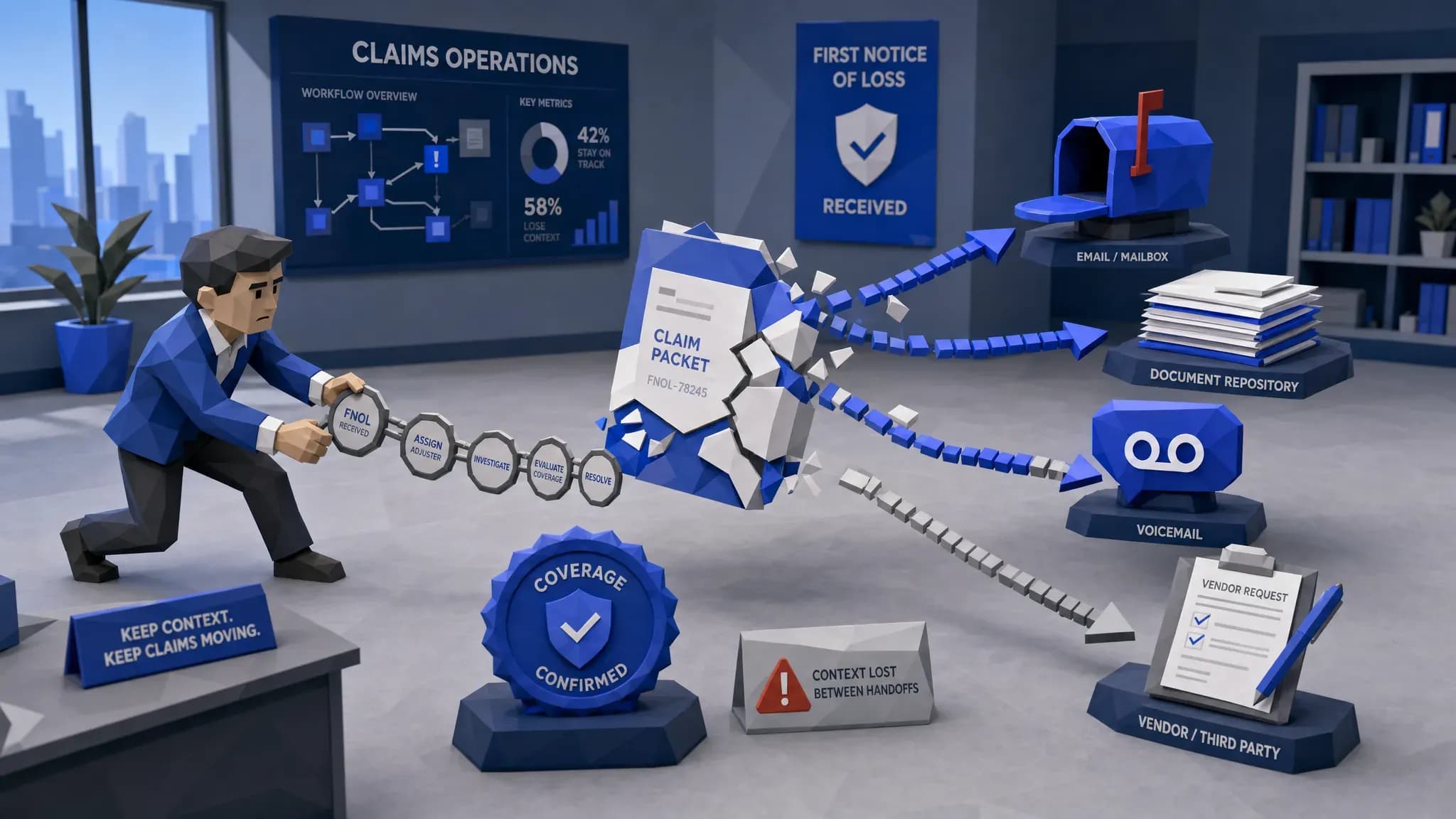
I once watched a simple auto claim go from clean FNOL to operational soup in less than 48 hours. The claimant called promptly, photos came in, the policy was active, and the adjuster was assigned. Then the body shop sent a revised estimate by email, the police report landed in another queue, the claimant asked about rental coverage by voicemail, and a coverage note sat in the policy system like a quiet little landmine. Nobody was careless. The system just made everyone play claims telephone.
That is where the claims lifecycle really starts to crack.
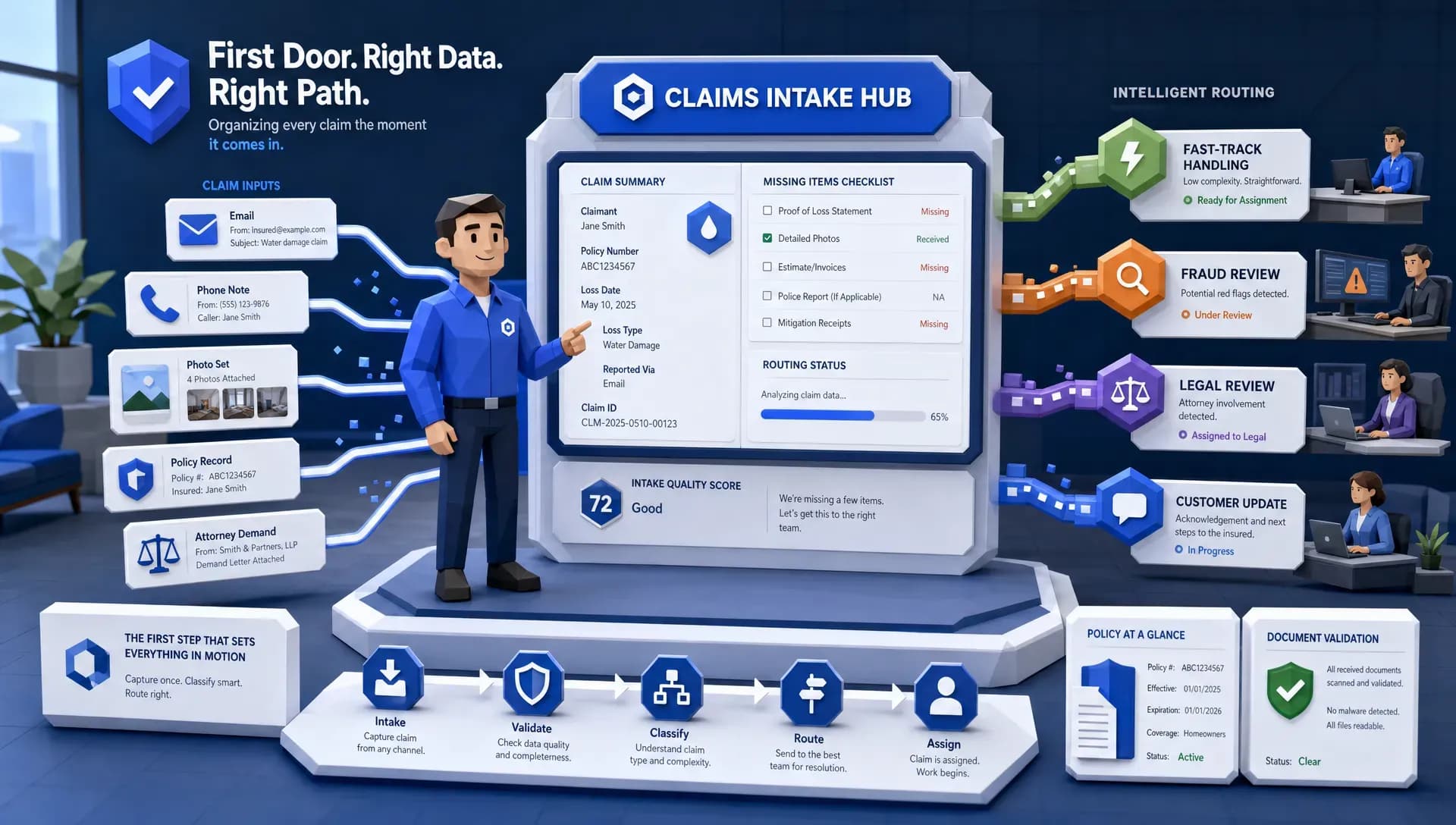
We have made huge progress at the front door of claims. Policyholders can report losses through portals, apps, call centers, brokers, agents, email, and sometimes a carrier chatbot that is trying its best. First Notice of Loss, or FNOL, is no longer the sleepy paper form it used to be.
The problem is that the industry often treats first contact as if it sets the entire claim on rails. It does not. First contact creates the receipt. The actual work begins when the claim needs to be classified, enriched, reviewed, routed, reserved, investigated, updated, negotiated, paid, closed, and sometimes reopened because life enjoys comedy.
This matters because customers do not grade us on intake alone. They remember the silence after they reported the claim. They remember repeating the same information to three people. They remember being told the file is under review without knowing what review means. J.D. Power's 2024 U.S. Auto Claims Satisfaction Study continues to show how strongly cycle time and communication shape the claims experience.
First contact can be smooth and the claim can still feel broken.
The claims lifecycle breaks when context stops travelling
In a healthy claims lifecycle, every new input should add clarity. A repair estimate should update severity. A police report should refine liability. A medical bill should influence exposure. A photo should support damage assessment or raise a fraud flag. A customer email should update the claim timeline and trigger the next best action.
In many real operations, those inputs arrive like guests at different doors of the same party. Some go to the claim system. Some land in a shared mailbox. Some live in PDFs. Some are buried in call notes. Some sit with a vendor. Some are visible to managers only after someone manually updates a field.
That gap between the event and the system of record is where delays breed.
I have seen adjusters spend twenty minutes figuring out whether a document was already received before they could spend five minutes making the decision that mattered. Multiply that by hundreds or thousands of claims, and you do not have a workflow problem. You have a data exhaust problem wearing a cardigan.
Why the post-contact middle is so fragile
The middle of a claim is where reality attacks your workflow. The first contact usually captures what the claimant knows at the beginning. The middle captures what the business needs to decide. Those are very different things.
After FNOL, claims become document magnets. Photos, estimates, medical records, invoices, attorney letters, police reports, repair supplements, rental agreements, proof of ownership, and handwritten notes all show up in different formats.
If the claims team has to manually open, read, classify, and re-key each item, the lifecycle slows down immediately. Worse, the important signals are often trapped inside those files. A mismatched date, a suspicious invoice, a duplicate image, or a severity clue can sit unnoticed until the claim has already consumed time and money.
That risk is growing. Verisk's 2025 fraud report highlights how digital fraud pressure is rising, including concerns around manipulated content and AI-assisted fraud attempts. The practical takeaway is simple: if document review happens late, fraud and leakage get a head start.
Ownership gets fuzzy after triage
Claims look tidy on process maps. In real life, they involve adjusters, supervisors, appraisers, SIU, legal, vendors, brokers, customer service, underwriting, and sometimes reinsurance stakeholders. Each team owns a slice. The claimant thinks one company owns the whole thing.
That mismatch creates friction. A coverage question waits for one team. A severity review waits for another. A fraud concern waits for SIU. A customer update waits for the adjuster to finish three other tasks. Nobody is doing anything wrong, yet the claim is still stuck.
This is why I am skeptical of workflows that only assign tasks. Assigning work is useful. Preserving context across handoffs is what actually keeps a claim moving.
Fraud, severity, and coverage checks happen too late
The most expensive claim is not always the obviously fraudulent one. In my experience, it is often the plausible claim that walks halfway through the process before anyone asks the first hard question.
The FBI notes that non-health insurance fraud costs more than $40 billion per year in the United States. Some of that is blatant. Much of it is subtle: inflated repair costs, inconsistent timelines, staged losses, exaggerated injuries, or documents that look fine until compared against other data.
If coverage, fraud, and severity checks are treated as separate downstream reviews, the claim lifecycle becomes reactive. By then, the carrier may have already paid vendors, set expectations with the customer, missed an escalation window, or allowed litigation risk to grow.
Customer communication lives outside the work
Here is a very common pattern: the claims team is working hard, but the customer thinks nothing is happening.
Why? Because internal activity is not the same as external communication. A claim may have three pending tasks, two vendor updates, a supervisor note, and a coverage review underway. If none of that translates into a clear update for the policyholder, the customer experiences silence.
This is where claims teams get unfairly blamed. Adjusters are not ignoring customers for sport. They are often juggling too many systems, too many inboxes, and too much manual follow-up. When communication is bolted on at the end of the day, rather than triggered by claim events, everyone suffers.
Managers see inventory, not causality
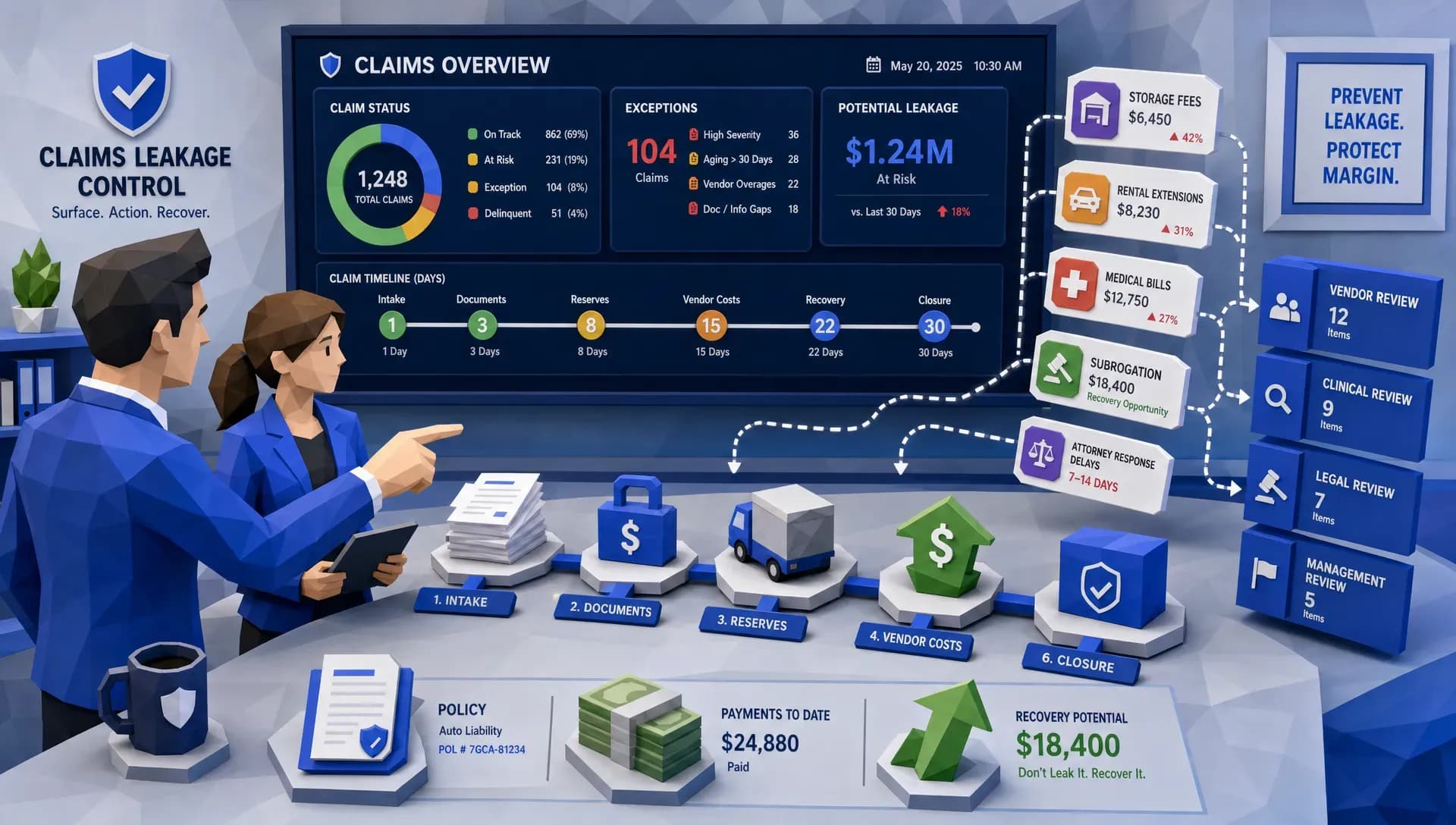
Many claims dashboards show counts, ages, reserves, payments, and closures. Useful, yes. Sufficient, no.
If a manager can see that 400 claims are aging but cannot see why they are aging, the dashboard is a rear-view mirror. The better question is not how many claims are open. It is which handoff, document type, vendor step, coverage rule, or missing data element is causing the delay.
That level of visibility requires the lifecycle to capture data as work happens, not after someone manually summarizes it.
A simple example: the windshield claim that grew teeth
Let me use a non-expert example because insurance people sometimes make claims sound like submarine engineering.
A claimant reports a cracked windshield. Easy claim, right? The photo looks legitimate. The policy has comprehensive coverage. The glass vendor sends an estimate. So far, lovely.
Then the vehicle requires sensor calibration. The estimate changes. The claimant asks whether rental applies. The shop sends a scanned invoice with a different vehicle trim. The adjuster notices a prior glass claim six months ago. The policy deductible was recently changed. A payment request arrives before the documentation is fully matched.
None of these steps is dramatic. But each one adds a decision point. If each decision point lives in a separate place, the lifecycle slows down, and the simple claim becomes a small administrative goblin.
That is the post-contact problem in miniature.
The fix is not more reminders. It is a connected claims lifecycle
When a claims operation breaks after first contact, the answer is rarely to add another reminder, another spreadsheet, or another weekly meeting called claims huddle 2.0. The real fix is to connect the lifecycle so the claim keeps its memory as it moves.
Every inbound document, email, image, call note, and form should be captured, classified, and turned into usable claim data as early as possible. That does not mean every claim should be paid automatically. It means adjusters should not have to excavate the file before they can think.
This is one reason we think about automation at Inaza as more than task routing. The platform supports all file types and is designed to capture key data points from workflows, then feed them into a unified data warehouse. That matters because the same data that helps an adjuster today can help managers understand bottlenecks tomorrow.
Carry context through every handoff
A claim should not lose its story when it moves from intake to coverage, from coverage to appraisal, from appraisal to SIU, or from SIU back to the adjuster.
The practical version of this is straightforward: each handoff should include the relevant claim facts, documents, flags, deadlines, prior decisions, and open questions. The receiving person should not have to rebuild the file from scratch.
If you want to go deeper on this idea, our guide on how claims automation reduces settlement delays covers the operational side of speeding up claims without sacrificing review quality.
Trigger risk checks before the claim is already expensive
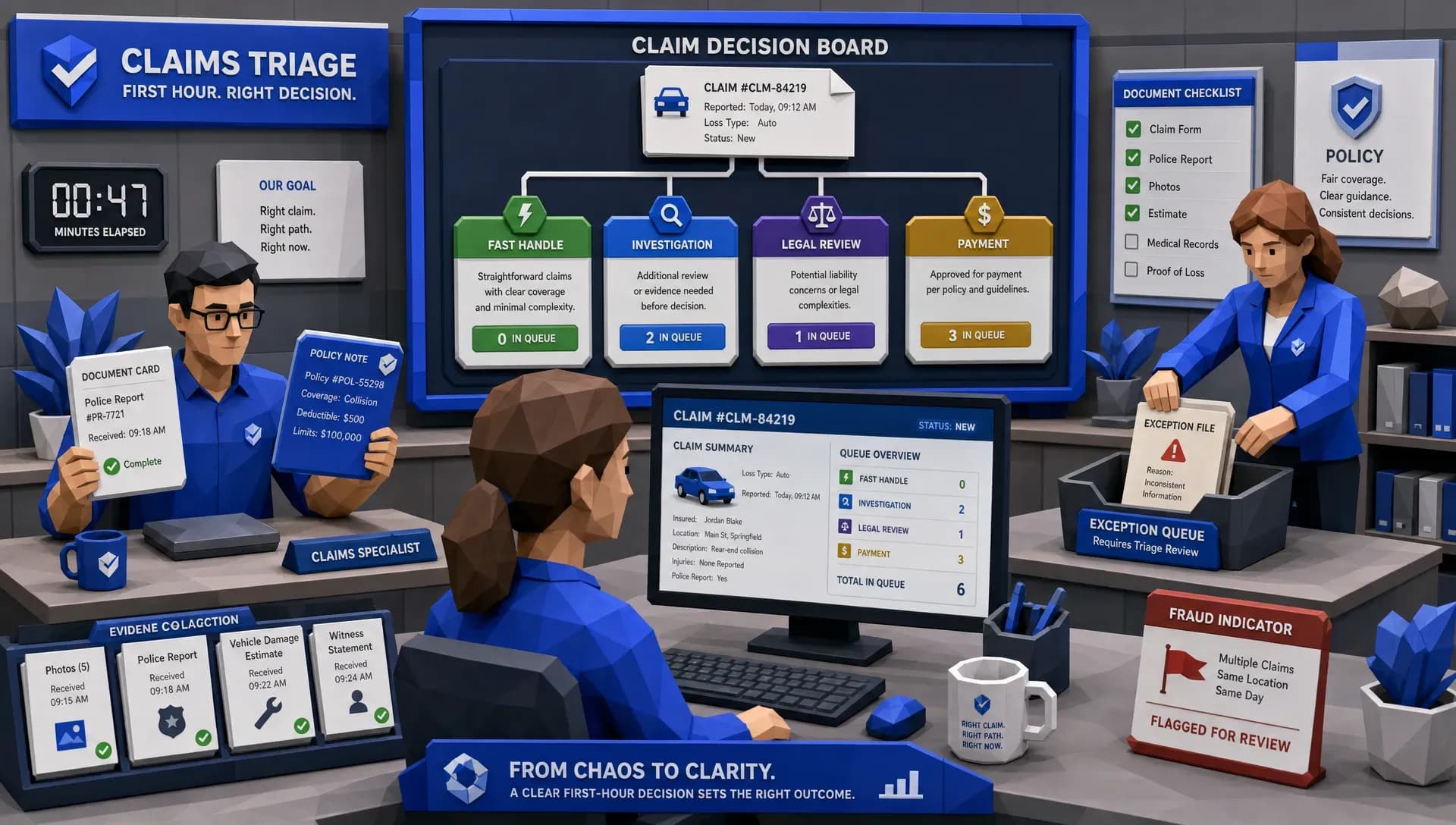
Coverage, severity, fraud, and litigation risk should not wait until the claim looks messy. They should be part of the early flow.
That is where data enrichment helps. Inaza has pre-built API templates for sources such as Verisk, LexisNexis, HazardHub, and others, so workflows can be enriched without turning every integration into a six-month science project. The goal is not to drown adjusters in alerts. The goal is to surface the few signals that change the handling plan.
Give managers a timeline, not just a queue
A queue tells you what is waiting. A timeline tells you why.
If every step in the claims lifecycle produces structured data, managers can see patterns: which document types cause rework, which vendors extend cycle time, which claims need escalation earlier, which adjusters are overloaded, and which processes create leakage.
This is where a data warehouse under the workflow becomes valuable. Workflow automation is the start. Business intelligence is where claims leaders can finally stop guessing.
Inaza provides real-time analytics dashboards, customizable workflows, and 250+ workflow templates. We can often map production-ready workflows quickly, without the usual PoC ping-pong that makes everyone question their life choices. More importantly, the workflow data does not disappear after the task is complete. It becomes usable intelligence.
Security and resilience matter more than insurers admit
A connected claims lifecycle handles sensitive data. That means insurers need strong controls around permissions, audit trails, cybersecurity, vendor access, cloud infrastructure, and retention policies.
This is not glamorous work, but neither is flossing. You notice when it is missing.
The broader lesson applies beyond insurance. Whether you are modernizing a claims platform or working with managed IT and cybersecurity specialists such as MDSI's maintenance IT and security services, operational resilience depends on disciplined infrastructure, not hope. Claims automation should be treated as a core business system, not a shiny side project.
What claims leaders should measure instead
If you want to know whether your claims lifecycle is healthy after first contact, do not stop at FNOL completion rate. That tells you whether the door opened. It does not tell you whether the customer made it through the building.
I would look at metrics that reveal movement, context, and rework:
- Time from first contact to complete claim packet
- Percentage of inbound documents automatically classified and matched to the right claim
- Number of handoffs before coverage, severity, or liability decisions are made
- Time from claim event to customer update
- Percentage of tasks reopened due to missing or inconsistent data
- Fraud, coverage, or severity flags raised before payment recommendation
- Claims aging by bottleneck reason, not only by adjuster or claim type
These metrics make the invisible middle visible. They also create a better conversation with operations, claims leadership, finance, and compliance. Instead of debating whether people are working hard enough, you can see where the workflow is working against them.
For a related look at operational visibility, we have also written about data-driven claims management and observability.
My hot take: the middle office is where insurers win loyalty
Customer experience teams often focus on the front end. Faster intake. Cleaner portals. Friendlier scripts. All useful.
But loyalty is won in the middle, when the customer is anxious, the facts are still forming, and the insurer has to prove it can coordinate the messy parts. That is when a clear update matters. That is when a fast document review matters. That is when an adjuster with the full story can make a better decision.
Automation should not remove human judgment from claims. It should remove the donkey work around human judgment. I have never met an adjuster who entered the profession dreaming of renaming PDFs at 8 p.m.
The best claims operations will not be the ones with the flashiest first contact. They will be the ones where the claim keeps moving after first contact, with context intact, risk signals visible, customers informed, and managers able to see what is really happening.
That is how the claims lifecycle stops breaking in the middle.
Frequently Asked Questions
What is the claims lifecycle? The claims lifecycle is the full journey of a claim from first notice of loss through triage, investigation, documentation, coverage review, settlement, payment, recovery, and closure. In practice, it also includes communication, escalation, fraud checks, and reporting.
Why does the claims lifecycle break down after first contact? It usually breaks because context gets split across emails, documents, claim systems, vendor tools, and team handoffs. First contact may capture the loss, but the later decisions require documents, data enrichment, communication, and coordinated ownership.
Does claims automation replace adjusters? No. Done properly, automation removes manual sorting, re-keying, routing, and status chasing so adjusters can focus on judgment, negotiation, empathy, and complex decisions.
Where should insurers start if their claims process is slow? Start by mapping what happens immediately after FNOL. Look for document bottlenecks, duplicate data entry, unclear ownership, late fraud checks, and customer update gaps. The best first project is often the one that removes the most rework.
How does Inaza help improve the claims lifecycle? Inaza provides an AI-powered insurance automation platform that integrates with existing systems, automates data capture, supports all file types, enriches workflows through API templates, and turns workflow activity into dashboards and business intelligence.
If your FNOL process looks polished but your claims lifecycle gets messy by day three, the problem is probably not your people. It is the handoffs, the data gaps, and the invisible middle.
Visit Inaza to see how connected claims automation can help your team move faster, reduce leakage, and give adjusters the context they need from first contact to settlement.