My slightly spicy opinion after a decade around insurance operations: most slow decisions are not caused by slow people. They are caused by insurance systems that make smart people behave like detectives with bad Wi-Fi.
I once watched an underwriter handle what should have been a straightforward commercial auto submission. The broker email was in Outlook, the fleet schedule was in a spreadsheet, the loss runs were PDFs, the driver data sat in a third-party portal, the pricing notes lived in a shared folder, and the appetite guidance was in someone’s head because, of course, the latest version had not made it into the official document library. The actual underwriting judgment took about ten minutes. Gathering enough confidence to make that judgment took two days.
That is the hidden tax of disconnected insurance systems. They do not merely slow workflows. They slow every decision, including the ones we think of as fast, simple, or routine.
The real bottleneck is context
Insurance has always been a decision business. Should we quote this risk? Should we bind? Should we escalate this claim? Should this attorney demand be treated as routine, risky, or radioactive? Should a portfolio be renewed as-is, repriced, or restructured before reinsurance discussions?
Every one of those decisions depends on context. The trouble is that context is usually scattered. A policy admin system may know the insured. A claims system may know the loss history. An email inbox may hold the newest documents. A rating tool may hold the pricing view. A fraud tool may hold a useful signal, but only after someone manually sends the claim there.
When systems do not share context, people become the integration layer. That sounds harmless until you add volume, deadlines, broker pressure, customer expectations, litigation risk, and month-end reporting. Then it becomes expensive.
McKinsey has noted that underwriters can spend as much as 60 percent of their time on administrative work rather than risk assessment. I do not think that surprises anyone who has ever chased a missing driver schedule at 4:45 p.m. on a Friday. The surprising part is how often we accept it as normal.
Underwriting slows down when every fact has a different home
Underwriting delays rarely begin with a dramatic failure. More often, they begin with small questions that take too long to answer.
Is this vehicle garaged where the application says it is? Does the loss run match the stated history? Has the insured had prior coverage? Are there undisclosed drivers? Is the roof age consistent with the property data? Is this submission inside appetite, or are we politely pretending it might be?
In connected insurance systems, those questions are answered as part of the workflow. In disconnected systems, they become side quests.
The underwriter opens a portal, downloads a PDF, copies a value into a spreadsheet, checks another system, emails a broker, waits, rekeys the update, and then repeats the process when a new document arrives. Nobody calls it rework because it is disguised as diligence. But it is rework.
The business impact is not just slower quote turnaround. It is worse risk selection. When underwriters are buried in admin, they naturally spend less time on judgment, portfolio fit, pricing nuance, and broker strategy. That is where margin lives.
Claims decisions get late before anyone notices
Claims are even less forgiving because the clock starts in the customer’s mind the moment the loss happens.
A small auto claim can look simple at first notice. Then the photos come in separately, the repair estimate lands in a vendor portal, the policy details live in the core system, the prior damage note is buried in an old claim, and the coverage question sits in an adjuster’s inbox. Suddenly the claim is not moving. It is waiting for someone to assemble the picture.
J.D. Power reported that the average auto claim still takes more than 30 days to settle. In my experience, much of that time is not dramatic investigation. It is waiting, routing, checking, clarifying, and rechecking. Very little of that makes the customer feel cared for.
Disconnected claims systems also delay the early signals that matter most. Fraud indicators, coverage issues, injury severity, litigation risk, missing documents, and payment concerns are all easier to manage when they appear early. If they surface after three handoffs and two diary reminders, the claim has already chosen its own path.
Fraud teams see smoke after the fire starts
Fraud detection is where disconnected data can get genuinely painful. A suspicious claim rarely announces itself with a flashing red sign. It is usually a pattern across details: similar addresses, repeated vendors, odd image metadata, unusual timing, inconsistent invoices, prior claims, or behavior that looks innocent in isolation and strange in combination.
The FBI describes insurance fraud as a major cost burden, with non-health insurance fraud alone costing tens of billions of dollars annually. That cost does not come only from missed fraud. It also comes from inefficient fraud handling.
When fraud analysts have to jump between systems, they lose the thread. A claim photo might look fine in one tool, but the metadata raises questions. The invoice might pass a basic review, but the vendor pattern does not. The claimant history might be clean in the claims platform, but the policy data tells a different story.
Fraud work needs connected context. Otherwise, analysts spend their best hours collecting evidence instead of interpreting it. That is like hiring a detective and making them build the filing cabinet before they can investigate.
Reporting becomes archaeology
Here is another hot take: spreadsheets are not the enemy. Spreadsheets are often a symptom.
Most insurance teams do not create spreadsheet jungles because they love manual reporting. They do it because their systems cannot answer the questions leadership asks.
How many submissions are stuck at enrichment? Which brokers send the cleanest data? Which adjusters are waiting on external documents? Which fraud referrals turned into confirmed savings? Which underwriting exceptions became losses? Which portfolio segments are performing better or worse than the market?
If the data needed to answer those questions is spread across underwriting, claims, email, document storage, third-party portals, and finance systems, reporting becomes archaeology. Someone digs. Someone reconciles. Someone explains why last month’s number does not match this month’s number. Everyone nods solemnly while secretly wondering whether the spreadsheet is haunted.
The bigger issue is that late reporting creates late management. If leadership only sees bottlenecks after the month closes, the decision window has already passed.

The real price is hesitation
Disconnected insurance systems do not simply add time. They reduce confidence.
When teams do not trust the data in front of them, they add review steps. When review steps lack context, they schedule meetings. When meetings do not resolve the uncertainty, they ask for more information. The decision does not fail. It drifts.
I have seen this happen in underwriting referrals, bodily injury claims, renewals, and attorney demands. The person handling the file is capable. The process is documented. The systems technically contain the answer. But the answer is split into pieces, and nobody wants to be the person who makes a call on half a picture.
That hesitation is rational. Insurance decisions have consequences. A rushed underwriting decision can create premium leakage. A rushed claims decision can overpay, underpay, or invite litigation. A rushed fraud decision can upset a good customer or miss a bad actor.
The goal is not to make people reckless. The goal is to give them enough connected information to be decisive.
Why one more point solution can make things worse
A lot of insurers try to fix slow decisions by buying another tool. I understand the temptation. A new tool promises speed, and sometimes it delivers speed inside one narrow process. But if it creates another login, another data store, another export, and another report, the enterprise may be slower overall.
This is where insurance can learn from basic IT operations. Before any organization can modernize well, it needs dependable infrastructure, security, cloud, and support. Regional IT providers such as AITEC’s managed IT and cloud services in Antilles-Guyane make that point clearly in their own market: the foundation matters before the clever applications can do their job.
Insurance systems are no different. If every new application becomes a fresh data island, we have not modernized the operation. We have decorated the maze.
A connected approach does not require throwing away every core system. In fact, I usually advise against that unless there is a very good reason. Core replacement is expensive, risky, and often distracts from the decisions that need help today. The better path is to connect the systems that already exist, automate the handoffs, and capture the data created along the way.
What connected insurance systems should actually do
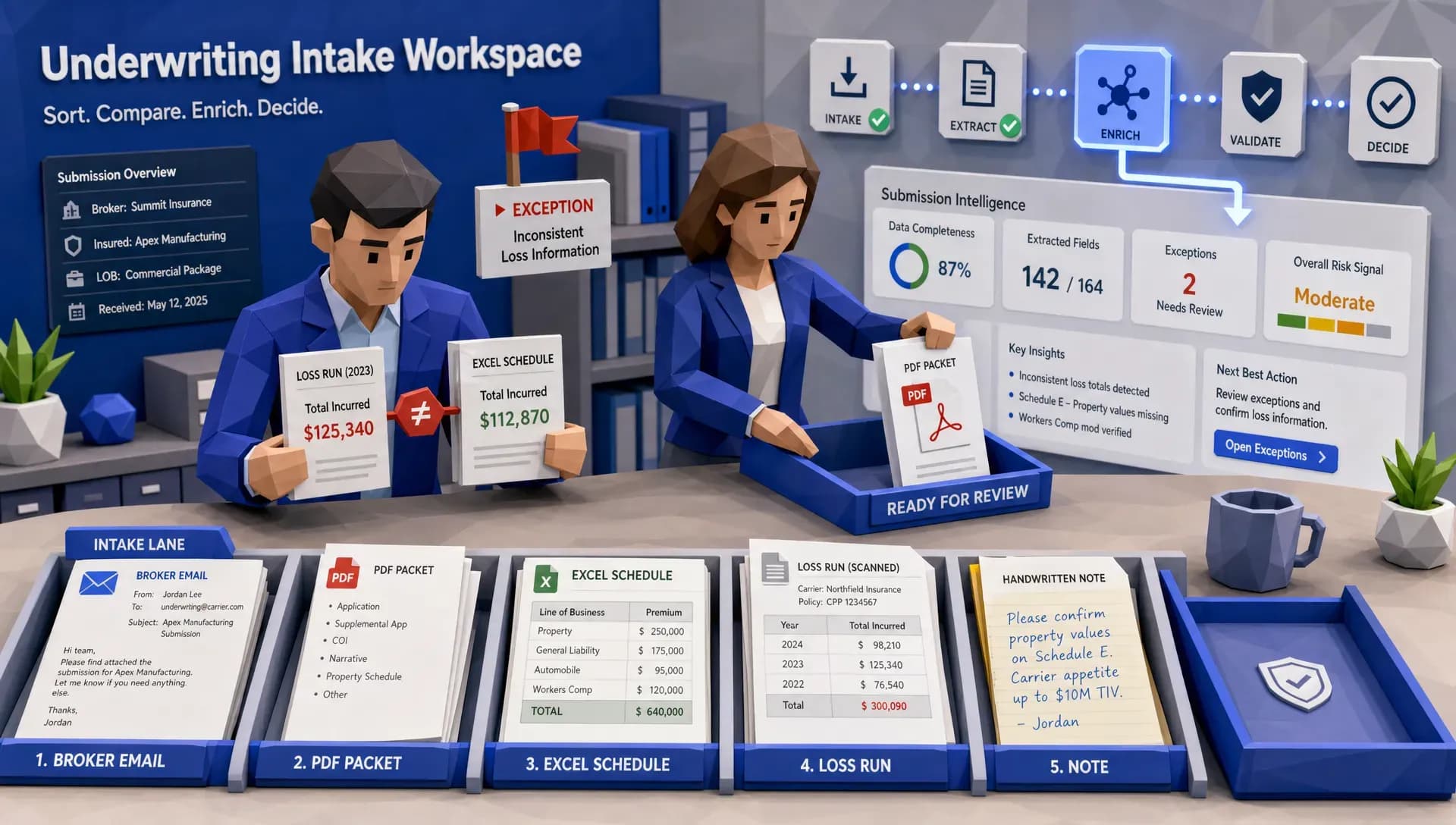
A connected insurance operation starts with intake. Emails, PDFs, spreadsheets, images, forms, and documents should not arrive as miscellaneous clutter. They should become structured information that can move through a workflow.
Then the workflow should enrich the information where needed. If an underwriting decision needs external data, the process should call the right source without forcing the underwriter to manually hop between portals. If a claim needs validation, the system should pull the relevant policy, claim, document, image, and vendor signals into one view.
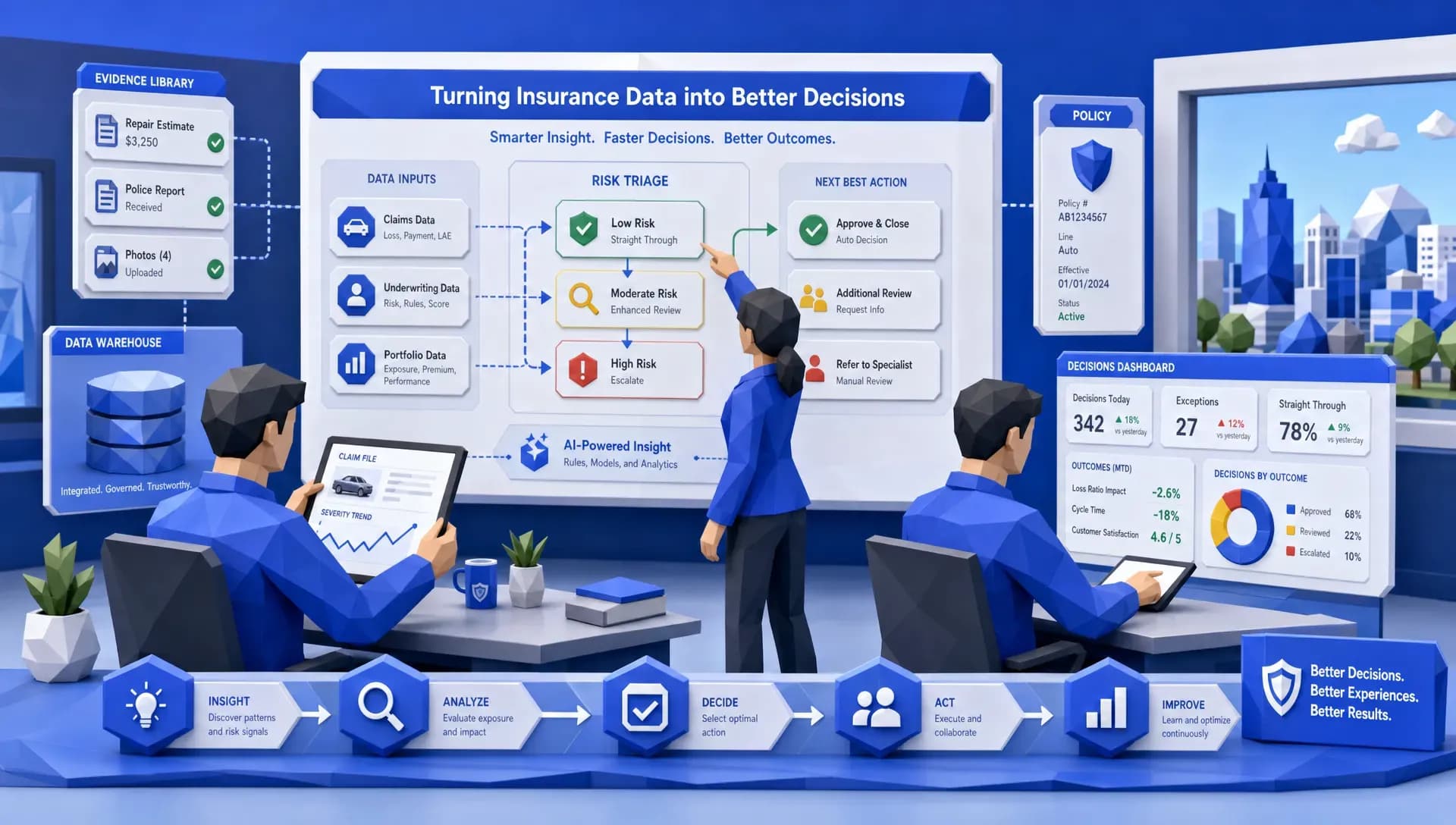
Next, the workflow should route decisions based on rules, authority, appetite, and risk. Simple files should move quickly. Exceptions should go to the right person with the right context. Sensitive matters, such as bodily injury claims or attorney demands, should be escalated with the full file history attached, not with a cryptic email that says, Please advise.
Finally, all of this should leave a usable data trail. This is the part many automation projects miss. If a workflow speeds up a task but does not capture the data behind the decision, leadership gains efficiency but loses insight. A proper data layer turns everyday work into operational intelligence.
Connect decisions, not departments
The practical way forward is to stop thinking in departments first. Start with decisions.
For underwriting, the decision might be whether to quote a commercial auto submission. That requires the fleet schedule, drivers, loss runs, prior coverage, appetite rules, pricing logic, and sometimes external enrichment. If those inputs are connected, the underwriter can spend time on judgment instead of assembly.
For claims, the decision might be whether a claim can proceed quickly or needs human review. That requires policy status, coverage, FNOL details, damage evidence, invoice data, prior claim signals, and fraud indicators. Connected systems help low-risk claims move while making risky ones visible earlier.
For renewals and reinsurance discussions, the decision might be how to explain portfolio performance. That requires normalized policy, claims, exposure, pricing, and benchmark data. When those pieces are connected, teams can tell a credible story instead of arriving with five spreadsheets and a prayer.
This is why I like decision-centric automation. It keeps the scope honest. We are not automating because automation sounds modern. We are connecting the data needed to make a specific business decision faster, cleaner, and with more confidence.
How Inaza thinks about the problem
At Inaza, we see disconnected systems as an operations problem first. The technology matters, of course, but the real question is simpler: what decision are we trying to improve, and what context is missing today?
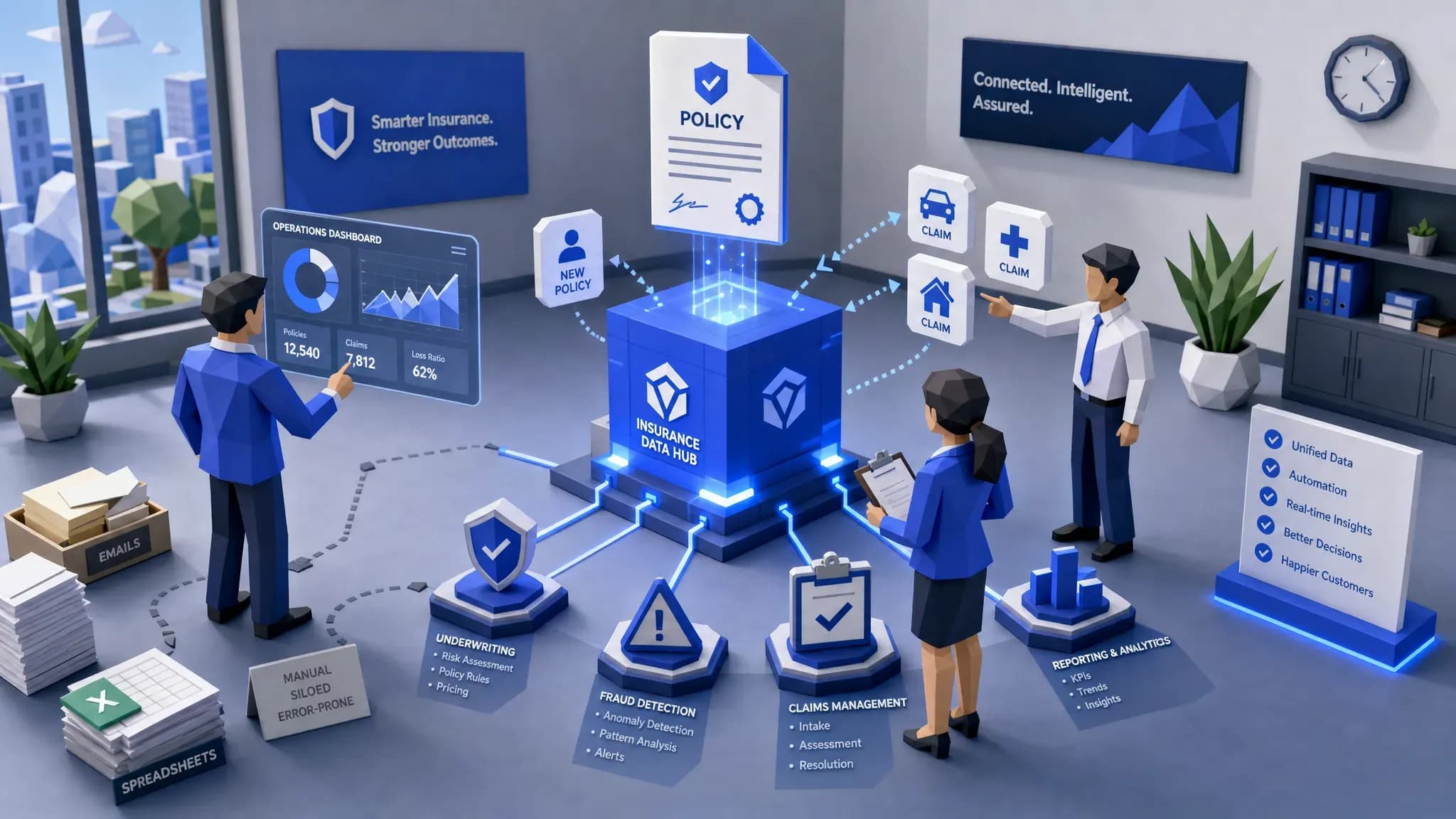
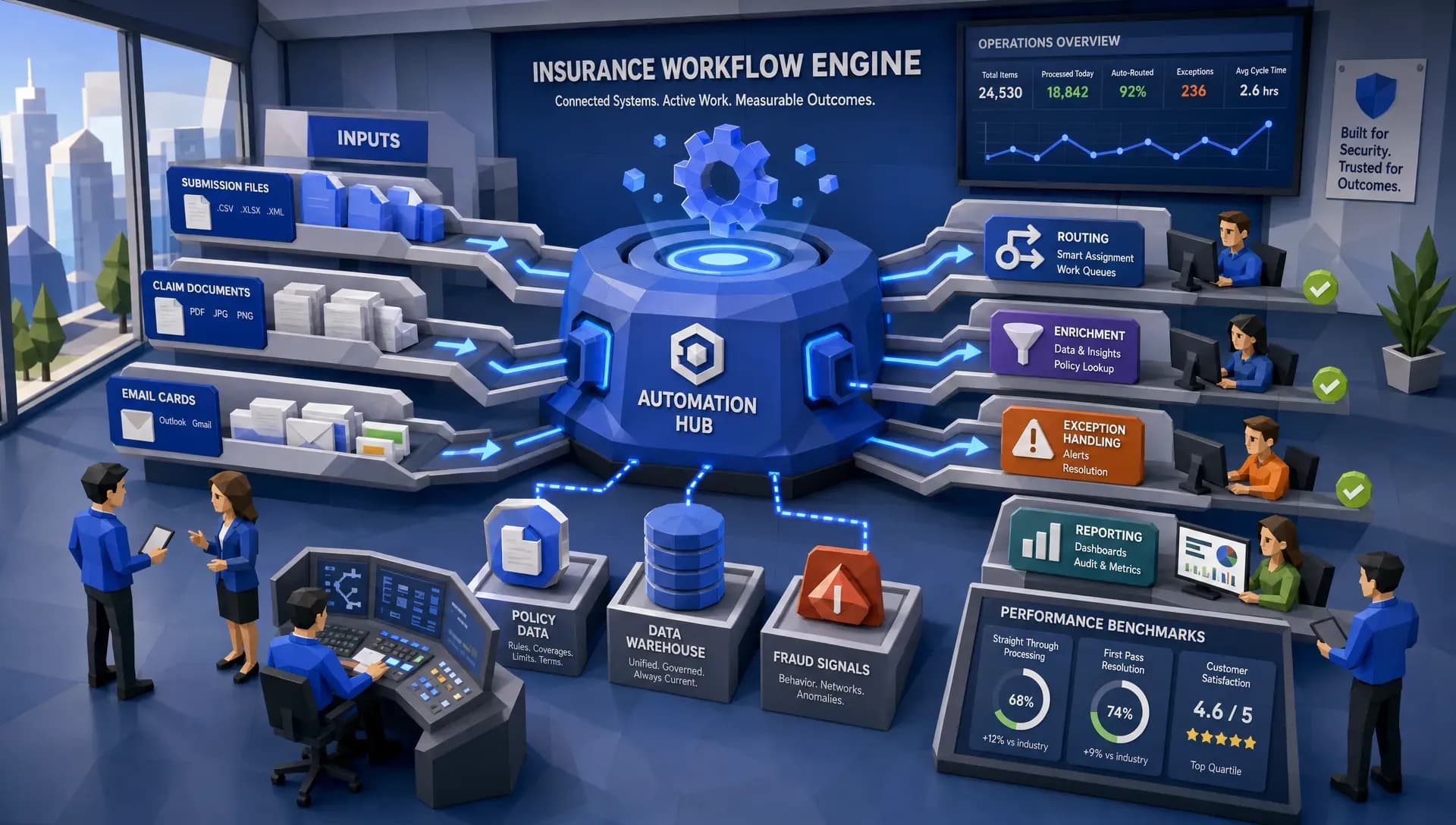
Inaza’s platform is built to integrate with existing systems, automate workflows across underwriting, claims, customer service, and operations, and capture the data created in those workflows. That matters because workflow automation is only the first win. The larger value comes when the business can see what is happening in real time through a unified data warehouse and analytics dashboards.
The platform includes 250+ workflow templates, supports all file types, and offers pre-built API templates for data sources such as Verisk, LexisNexis, HazardHub, and others. It also allows insurers to configure their own workflows without the usual endless proof-of-concept loop. Inaza can deploy a production-ready workflow on a single call with a user, which is exactly the kind of practical speed insurance teams need.
Benchmarks are another underrated piece. When teams can compare performance against relevant market benchmarks, including sources such as Aon, Munich Re, Howden, and others built into the system, the conversation changes. Renewal and reinsurance discussions become less about defending a spreadsheet and more about explaining a portfolio.
The board-level reason this matters in 2026
In 2026, slow decisions are not just an operations inconvenience. They affect growth, loss ratio, customer retention, fraud leakage, and capital conversations.
Accenture has reported that a large majority of insurance CEOs are investing in AI for claims and underwriting. That tells us the market is not debating whether automation matters. The better question is whether insurers are automating isolated tasks or connecting the decisions that run the business.
My bet is that the winners will not be the teams with the flashiest tools. They will be the teams that remove decision debt. They will know where work is stuck, why it is stuck, what data is missing, and how each operational choice affects the portfolio.
That is not glamorous. It is better than glamorous. It is profitable.
Frequently Asked Questions
What are disconnected insurance systems? Disconnected insurance systems are platforms, tools, inboxes, and databases that hold important information but do not share it smoothly. In insurance, this often means underwriting, claims, policy administration, fraud, billing, and reporting teams each have part of the truth.
Why do disconnected insurance systems slow underwriting? They force underwriters to gather, rekey, validate, and reconcile information manually before they can assess the risk. The underwriting decision may be quick, but the preparation becomes slow and error-prone.
Can insurers connect systems without replacing their core platform? Yes. In many cases, insurers can integrate existing systems, automate targeted workflows, and create a shared data layer without a full core replacement. This is usually faster, less risky, and easier for teams to adopt.
How do connected systems improve claims decisions? Connected systems bring policy data, FNOL details, documents, images, invoices, fraud signals, and workflow status into a more complete view. That helps adjusters triage faster, escalate earlier, and settle straightforward claims with less friction.
What should insurers connect first? Start with a high-volume decision that has clear pain, such as submission intake, claims triage, attorney demand handling, renewal checks, or fraud referrals. The best first project is one where speed, accuracy, and visibility can be measured quickly.
Ready to make every decision faster?
If your teams are still stitching together underwriting, claims, fraud, and reporting data by hand, the problem is not effort. It is architecture.
Inaza helps insurers, MGAs, and brokers connect workflows across existing insurance systems, automate routine work, and turn operational data into real-time insight. If you want fewer handoffs, faster decisions, and better visibility into what is really happening across your business, it may be time to connect the system behind the work.