Here is my slightly unpopular opinion: the insurance companies that gain most from automation are not always the biggest carriers, the flashiest insurtechs, or the firms with the largest innovation decks.
The real winners are the companies with boring, repetitive, expensive operational friction. The ones with overflowing inboxes, messy loss runs, urgent claims, manual eligibility checks, and underwriters who spend more time copying data than judging risk. In other words, the companies with the most “why are we still doing this by hand?” moments.
After a decade around insurance operations, I have learned that automation does not magically fix strategy. It fixes drag. And some type of insurance companies have a lot more drag than others.
My hot take: automation follows friction, not company size
If your process is high-volume, rule-heavy, document-heavy, or deadline-heavy, automation can make a visible difference fast. If your process depends on three senior experts debating one unusual risk per month, automation may still help, but the ROI will be slower and narrower.
That is why I look less at company category and more at operational symptoms. Are people re-keying the same data into three systems? Are submissions sitting untouched because no one has time to triage them? Are adjusters chasing missing photos and invoices? Are underwriters manually checking data sources that could be queried automatically?
McKinsey has noted that underwriters can spend a large share of their time on administrative work rather than risk assessment, with automation offering a path to reduce that burden (McKinsey). Anyone who has watched a skilled underwriter hunt through a 42-page PDF for one vehicle schedule knows this is not theoretical. It is Tuesday.
So, which companies benefit most? Let’s get into it.
MGAs with delegated authority are near the top of the list
If I had to pick one winner, I would put many P&C MGAs right near the front.
MGAs live in the awkward middle of the insurance ecosystem. They need carrier-grade discipline, broker-speed responsiveness, and startup-level resourcefulness. That is a spicy combination. They also tend to handle a steady flow of submissions, endorsements, renewals, eligibility checks, bordereaux, and policy documents, often across multiple carrier relationships.
The automation opportunity is obvious because the work is repeatable, but rarely clean. A broker sends a PDF, another sends a spreadsheet, a third sends a half-complete email with “see attached” and no attachment because apparently insurance must keep its sense of humor.
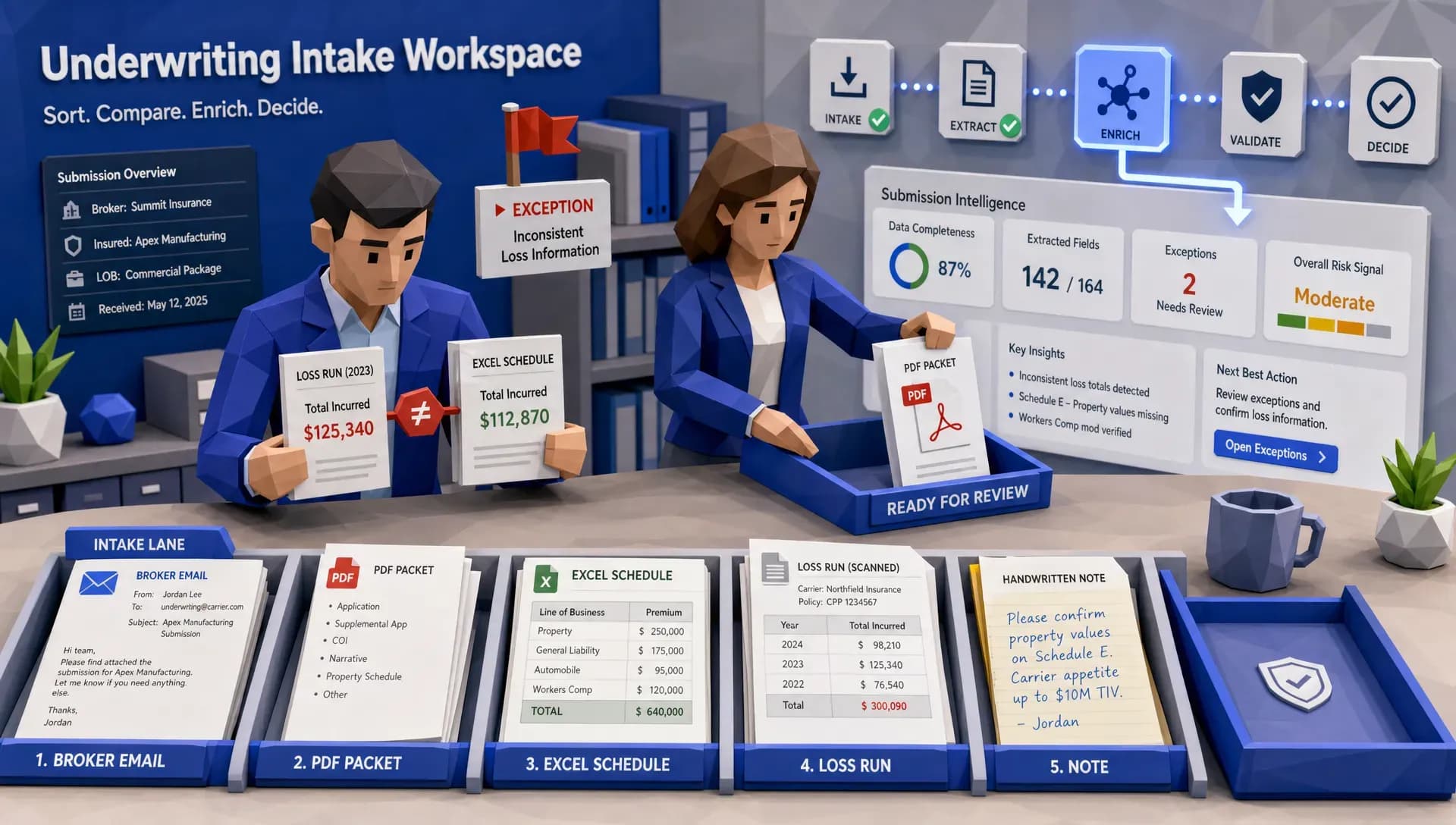
I once saw an underwriting team spend the better part of a morning normalizing a fleet schedule where the same vehicle appeared under three slightly different VIN formats. Nobody needed a PhD in risk theory to solve it. They needed clean intake, validation, and routing. That is exactly where automation shines.
For MGAs, the biggest gains usually come from faster submission triage, automated data capture, eligibility checks, risk enrichment, quote preparation, policy issuance, and bordereau reporting. The underwriter still owns judgment. The machine handles the scavenger hunt.
That distinction matters. Good automation does not replace underwriting authority. It protects it from spreadsheet archaeology.
Carriers with high claims volume, especially in auto and property, are another obvious winner.
Claims automation has a direct line to expense ratio, customer satisfaction, leakage, and fraud control. FNOL intake, claim routing, photo review, invoice checks, coverage validation, repair estimates, status updates, and fraud flags all create opportunities for automation.
The numbers explain why this matters. The FBI estimates that insurance fraud costs the United States more than $308 billion annually (FBI). That figure includes more than claims fraud, but claims teams feel the pain every day. A staged accident, inflated invoice, reused damage photo, or exaggerated injury claim can turn a routine file into a very expensive lesson.
Then there is speed. J.D. Power’s 2024 auto claims research found that average repairable auto claims cycle time remained above 30 days, with long cycle times continuing to affect customer satisfaction (J.D. Power). Policyholders do not care that the claim touched six systems. They care that their car is still in the shop and nobody has called them back.
For high-volume P&C carriers, automation can reduce the early chaos: collect complete FNOL data, check coverage, classify severity, verify photos, flag suspicious documents, and route files to the right adjuster. Simple claims can move faster. Complex claims can get human attention sooner. That is the claims version of sorting the mail before the house catches fire.
Commercial auto insurers and fleet programs may see some of the fastest gains
Commercial auto deserves its own spotlight because the data is notoriously messy.
Fleet schedules, driver lists, loss runs, garaging addresses, vehicle usage, prior claims, MVRs, VINs, endorsements, radius of operation, and coverage changes all need to line up. When they do not, underwriting slows down or, worse, the insurer prices the risk using incomplete information.
This is where automation is not just a productivity tool. It becomes a risk selection tool.
A commercial auto underwriter can make better decisions when loss history is structured, VINs are validated, drivers are checked, vehicle data is enriched, and missing fields are flagged before quote time. A claims team can also benefit when historical underwriting data connects to FNOL and claim outcomes.
The business case is strong because commercial auto often combines high document volume with meaningful loss ratio pressure. If you can speed up quote turnaround while reducing bad data, premium leakage, and avoidable claims surprises, the impact is not cosmetic. It shows up in the portfolio.
Brokers and wholesale brokers gain from automation, but in a different way
Brokers are not insurance companies in the carrier sense, but for this conversation, we have to include them because they sit at the center of operational traffic.
Retail and wholesale brokers can gain a lot from automation because their bottleneck is often coordination. They are managing client requests, carrier appetites, renewal timelines, submission packs, quote comparisons, endorsements, certificates, follow-ups, and all the glorious ambiguity of email.
The broker value proposition is relationship and advice. But too many broker teams lose hours to administrative matching: this email belongs to that account, this attachment belongs to that submission, this quote is missing that schedule, this renewal needs that loss run.
Automation helps brokers respond faster and present cleaner submissions to markets. It can classify emails, extract submission data, check completeness, chase missing information, and keep status visible. That does not make the broker less human. It gives the broker more time to be useful.
One broker once told me, “Our best producer is also our most expensive admin assistant.” That line stuck with me because it is painfully common. Automation gives that producer their calendar back.
Reinsurers and reinsurance brokers are underrated automation winners
Reinsurance is not always the first place people look for automation because the workflows feel more analytical and relationship-led. But there is a big opportunity here, especially around portfolio data, bordereaux, exposure files, claims triangles, renewal packs, and market submissions.
Reinsurance decisions depend on credible data and clear narratives. If a cedent cannot explain portfolio movement, loss development, underwriting changes, or claims trends quickly, negotiations get harder. The same applies to reinsurance brokers trying to shape a clean story for markets.
Automation helps by structuring messy inputs, reconciling data, surfacing trends, and preparing dashboards that make portfolio performance easier to understand. This is where an insurance data warehouse becomes more than a nice-to-have. It supports the actual commercial conversation.
At Inaza, this is one reason we care about capturing data from automated workflows rather than just moving tasks from one queue to another. Workflow automation is useful. Workflow automation that feeds analytics, benchmarks, and portfolio intelligence is much more powerful.
Specialty insurers and niche programs benefit when rules are complex
Specialty insurers often have lower volumes than personal lines carriers, but that does not mean automation is irrelevant. In many specialty lines, the advantage comes from consistency, documentation, and controlled decision-making.
Think about niche programs where eligibility rules are specific, policy documents are unusual, or submissions contain highly variable attachments. Automation can help standardize intake, identify missing information, apply guidelines, and escalate exceptions.
This also applies when insurance intersects with legal, intellectual property, entertainment, media, or brand-related exposures. Specialty underwriters should pay attention to how adjacent professional services are using technology to monitor risk evidence and deadlines. For example, a technology-enabled intellectual property practice can show how structured workflows, monitoring, and automated reminders are becoming normal in areas where documentation and timing matter.
For specialty insurance, the point is not to force straight-through processing on every file. Many risks deserve expert review. The point is to make sure experts are reviewing the actual risk, not wasting half the morning discovering which version of the document is final.
Personal lines carriers gain most when volume meets customer expectations
Personal auto, homeowners, renters, and similar lines are strong candidates because the volume is high and customers expect speed.
Nobody wakes up excited to file an insurance claim. If they are filing, something has already gone wrong. That means delays feel worse than they look on an internal SLA dashboard.
Automation can support instant intake, faster coverage checks, photo-based damage review, automated status updates, and simple claim settlement workflows. On the underwriting side, it can help validate data, reduce abandoned quotes, prefill information, and route edge cases for review.
The key is knowing where not to automate blindly. If a claim involves injury, disputed liability, suspected fraud, or a distressed customer, the best process may be automation plus human escalation. “Press 0 for human” is not a failure if the system passes context properly. It is good manners.
Who benefits least from automation?
The companies that benefit least are usually not defined by line of business. They are defined by operating model.
If a company has very low transaction volume, highly bespoke underwriting, minimal repeatable workflow, and clean data already flowing through modern systems, automation may still help, but the gains are likely incremental.
The bigger concern is companies that want automation without process discipline. If your eligibility rules are unclear, your data definitions change by department, and nobody agrees what “complete submission” means, automation will expose the mess quickly. It will not politely hide it under a rug.
I have seen firms try to automate a broken workflow and then blame the technology when the result is faster confusion. The lesson is simple: standardize what should be standard, escalate what needs judgment, and measure both.
The best first automation target is usually the most boring one
Here is another hot take: your first automation project should probably not be the most glamorous one.
Start with the workflow that is frequent, measurable, and painful. Loss run extraction. Fleet schedule validation. FNOL intake. Email triage. Invoice review. Proof of prior checks. Policy document generation. Bordereau ingestion.
These workflows are not cocktail party material, unless you attend very unusual cocktail parties. But they create fast operational value because the baseline is easy to measure: time spent, error rate, backlog size, cost per transaction, quote turnaround, claim cycle time, leakage, and escalation volume.
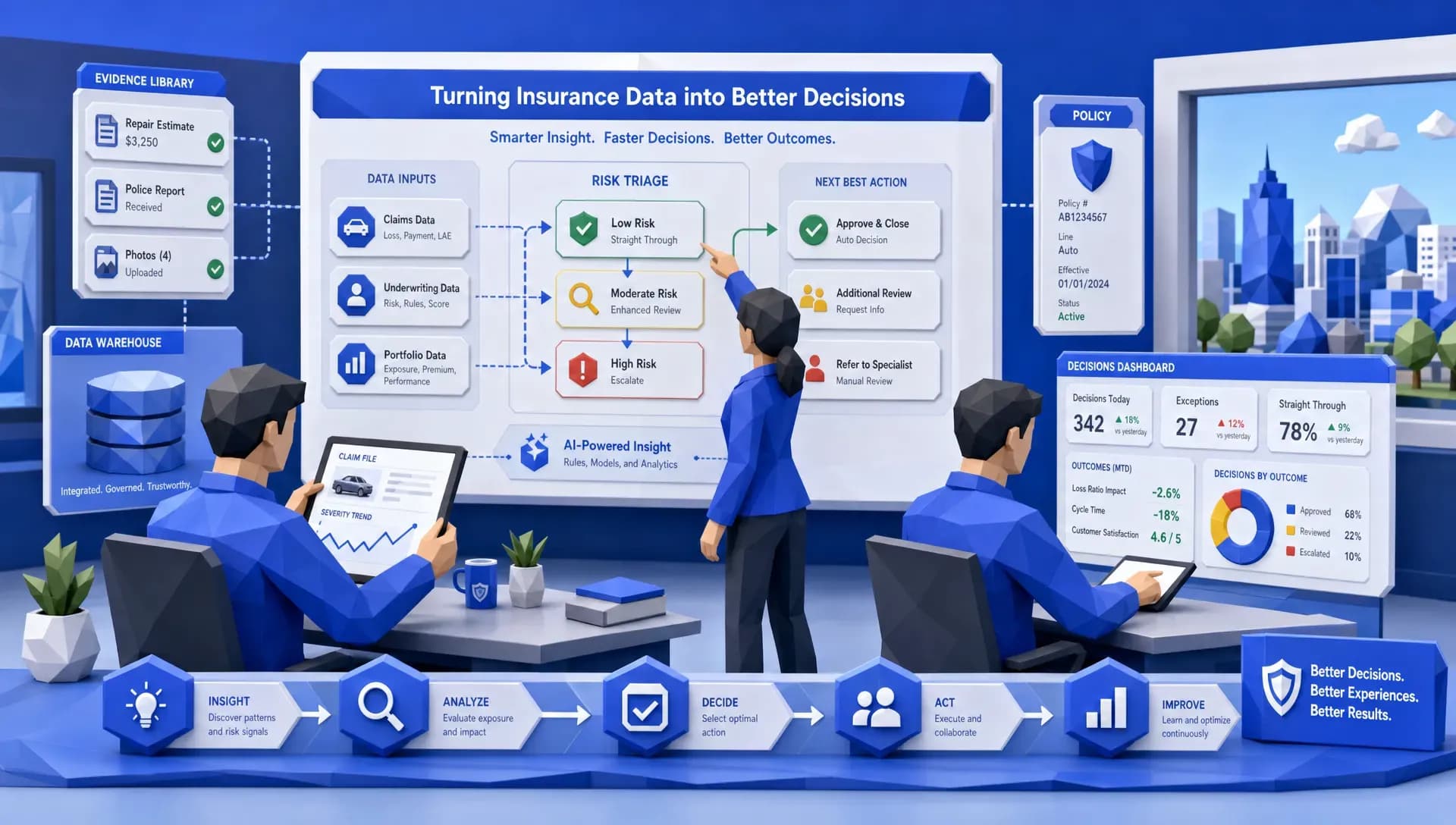
Once those workflows are automated, the data they generate becomes even more valuable. You can see where submissions stall, which brokers send incomplete information, which claim types trigger delays, which underwriting rules cause unnecessary referrals, and which portfolio segments are drifting from plan.
That is where automation starts to become management intelligence.
Where Inaza fits
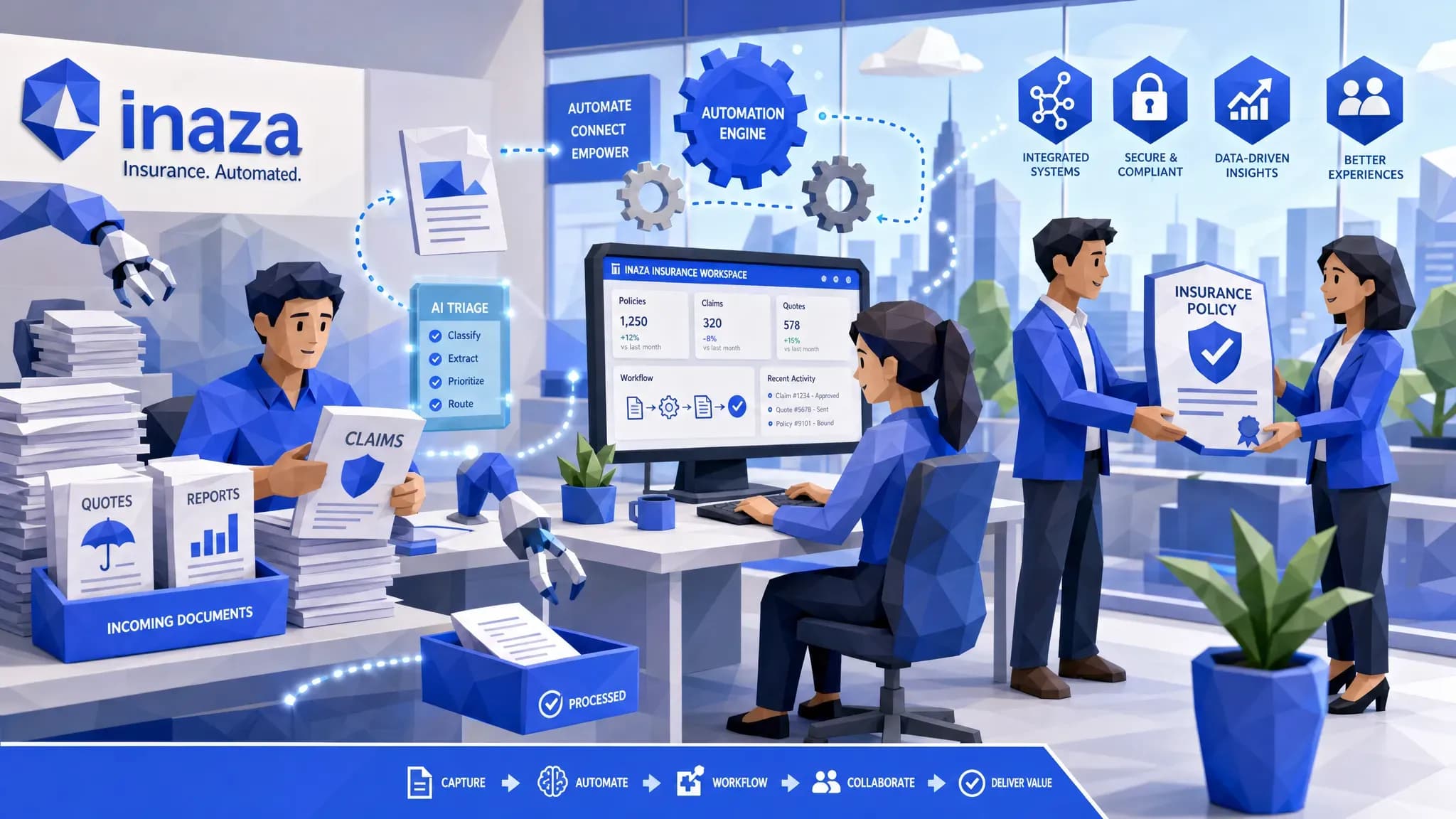
Inaza is built for insurers, MGAs, and brokers that want practical automation without ripping out every existing system first.
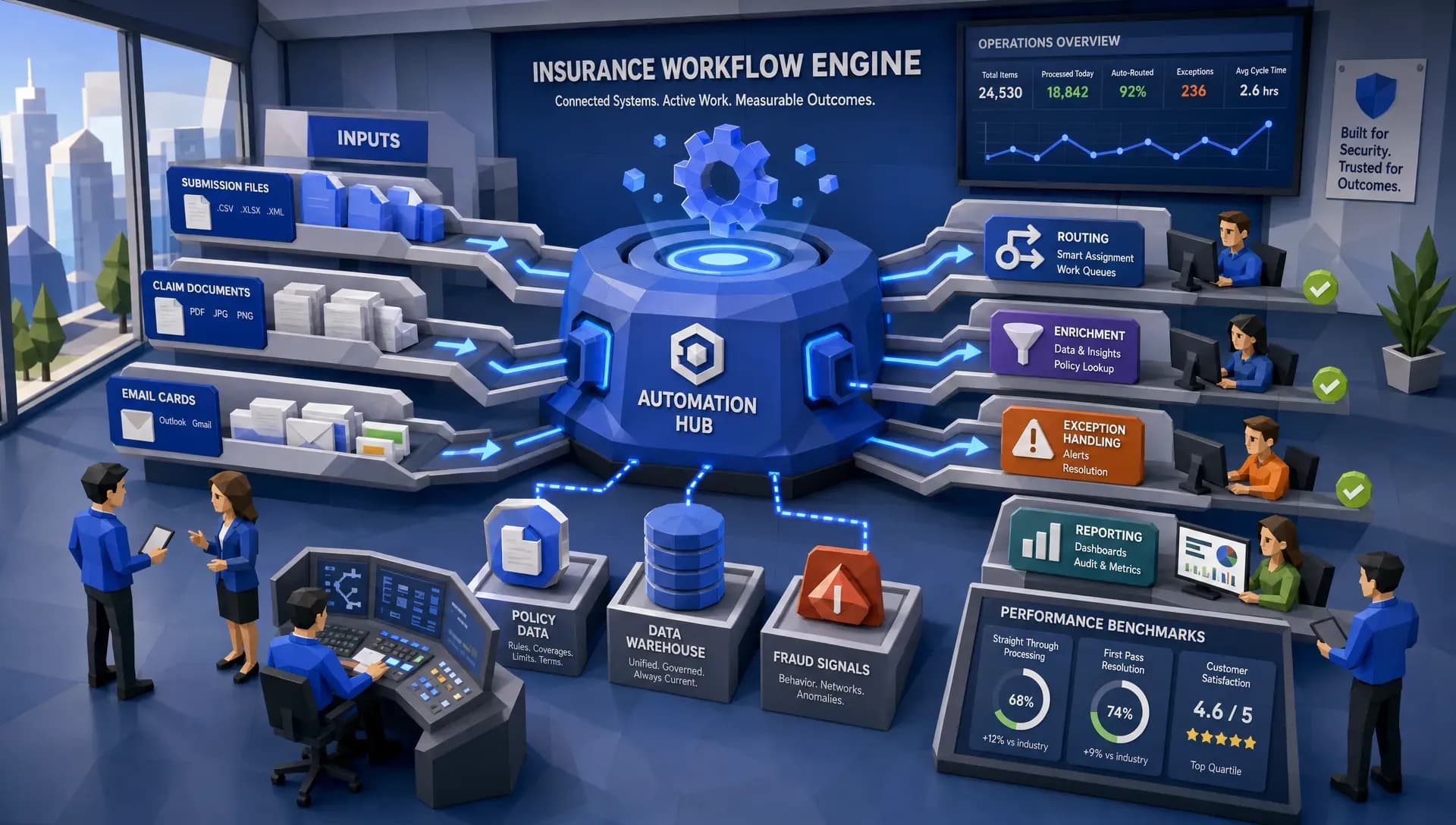
The platform supports underwriting automation, claims process automation, customer service automation, data capture, reporting, analytics, and workflow customization. It integrates with existing systems and is underpinned by a unified data warehouse, so operational workflows can feed real-time dashboards and business intelligence.
That matters because the goal should not be “we automated a task.” The goal should be “we improved the business.” Faster quote handling is good. Faster quote handling with better data quality, fewer errors, clearer referrals, and portfolio-level visibility is better.
Inaza also offers pre-built workflow templates and API templates for data enrichment, which can help insurers move faster without turning every automation idea into a six-month science project. For teams that have lived through endless proof-of-concept loops, that alone may be worth a small round of applause.
Frequently Asked Questions
Which type of insurance companies gain most from automation? MGAs, claims-heavy P&C carriers, commercial auto insurers, brokers, and data-intensive reinsurers often gain the most because they handle repeatable workflows, messy documents, high transaction volume, and expensive handoffs.
Do smaller insurance companies benefit from automation too? Yes. Smaller insurers and MGAs can benefit significantly if they have manual intake, slow quoting, claims bottlenecks, or reporting burdens. In fact, smaller teams often feel the productivity lift faster because every saved hour matters.
Is automation mainly for claims or underwriting? Both. Claims automation can reduce cycle times, improve fraud detection, and speed communication. Underwriting automation can improve submission intake, data validation, eligibility checks, risk enrichment, and policy issuance.
What should insurers automate first? Start with workflows that are frequent, measurable, and painful. Good examples include loss run extraction, FNOL intake, fleet schedule validation, proof of prior checks, invoice review, email triage, and bordereau ingestion.
Does automation replace underwriters or adjusters? No, not when it is implemented properly. The best automation removes repetitive administrative work and gives specialists better data, faster routing, and clearer escalation points.
Ready to find your automation advantage?
The type of insurance companies that win with automation are not simply the ones with the biggest budgets. They are the ones honest enough to identify where work gets stuck and disciplined enough to fix it.
If your team is spending too much time re-keying data, chasing documents, reviewing routine claims, or building reports manually, Inaza can help you turn those workflows into structured, measurable automation.
Get in touch with Inaza to explore how automation can improve underwriting, claims, customer service, and operations without forcing a full-system replacement.