Here’s my slightly unpopular view: most quote to bind automation does not break because the rating engine is bad. It breaks because the workflow around the rating engine is held together with email threads, copy-paste, and heroic underwriters who know where every skeleton is buried.
I have seen beautiful quote screens sit idle while an underwriter hunts through a broker’s PDF, an Excel fleet schedule, three loss runs, and a note that says, “same as expiring,” which is possibly the most expensive phrase in insurance operations. If we want quote-to-bind automation to actually work, we have to stop treating it as a shiny front-end project and start treating it as an operational plumbing project.
That sounds less glamorous. It is also where the money is.
McKinsey has estimated that underwriters can spend up to 60% of their time on administrative work rather than risk assessment. In P&C, that is not a minor inconvenience. That is your quote turnaround, broker experience, premium accuracy, and underwriter morale all being quietly taxed.
What quote to bind automation should actually mean
Quote to bind automation is the process of moving a submission from intake to quote, referral, acceptance, and bind with as little manual friction as possible. In a perfect world, it captures data, checks eligibility, enriches risk information, applies rating logic, routes exceptions, generates documents, and records every decision for audit and analytics.
In the real world, many insurers automate one piece and call it done. They add a portal, but brokers still email attachments. They connect a rating engine, but underwriters still re-key data. They build appetite rules, but referral logic lives in someone’s notebook. They issue quotes faster, then stall at bind because documents, subjectivities, or payment checks are missing.
That is why some teams feel like they bought quote to bind automation and somehow ended up with a faster way to find the same old bottlenecks.
The goal is not to remove underwriters from the process. I would not trust a system that did that blindly, and neither should you. The goal is to stop wasting underwriter judgment on tasks that do not require judgment.
Breakdown 1: submission intake is still chaos with a nicer front door
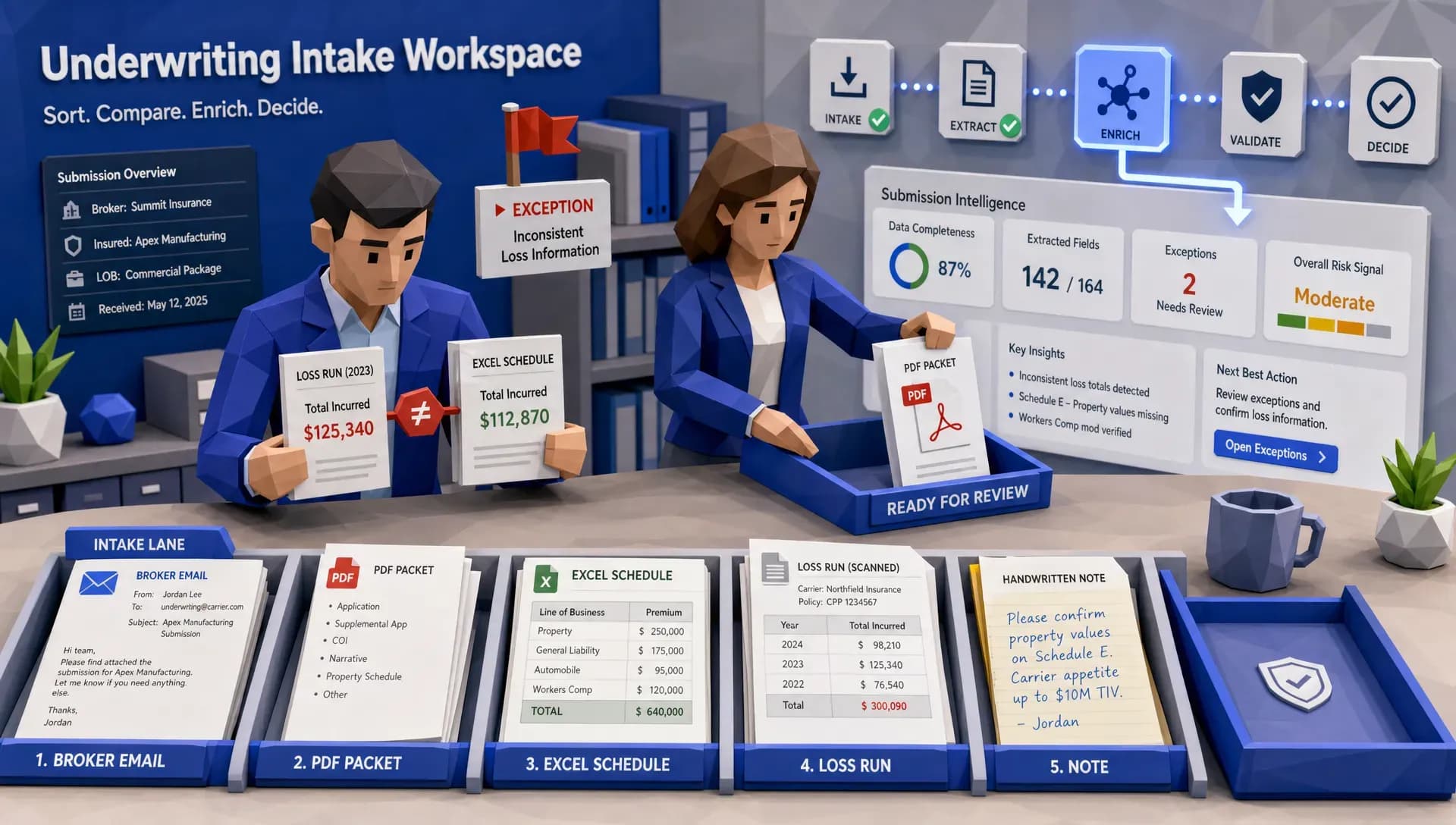
The first breakdown usually happens before anyone has touched risk selection. Submissions arrive through broker emails, portals, PDFs, spreadsheets, scanned documents, ACORD forms, loss runs, supplemental applications, and the occasional mystery attachment named “final_final_v3.xlsx.”
I once worked with a commercial auto team where two underwriters could look at the same fleet schedule and come away with different vehicle counts. Not because either of them was careless. The schedule had duplicate VINs, inconsistent garaging states, and one tab that looked like it had been designed during a fire drill. That submission was never going to fly through automation without cleanup.
The fix is to create a single intake layer that accepts the mess as it arrives, then turns it into structured, validated data. Do not force brokers into one perfect behavior on day one. Brokers are busy, and if your portal feels like homework, they will go back to email. Instead, capture from the channels they already use and normalize the data behind the scenes.
Good intake should identify the submission type, extract key fields, flag missing items, detect duplicates, and create a clean case file. If a VIN is invalid, a driver record is missing, or a loss run has an open claim with no reserve detail, the system should surface that immediately. No one should discover it 36 hours later after the broker has already asked for status twice.
Breakdown 2: eligibility rules live in too many places
Eligibility is where automation often gets oddly political. Every carrier, MGA, and program has rules. The problem is that those rules are often scattered across underwriting guides, spreadsheets, tribal knowledge, and the collective memory of the senior underwriter everyone is afraid to bother before coffee.
That creates two bad outcomes. Either automation becomes too rigid and declines submissions that deserve a look, or it becomes too loose and punts everything to referral. Both are frustrating. One loses profitable business. The other pretends to automate while still dumping the hard work on humans.
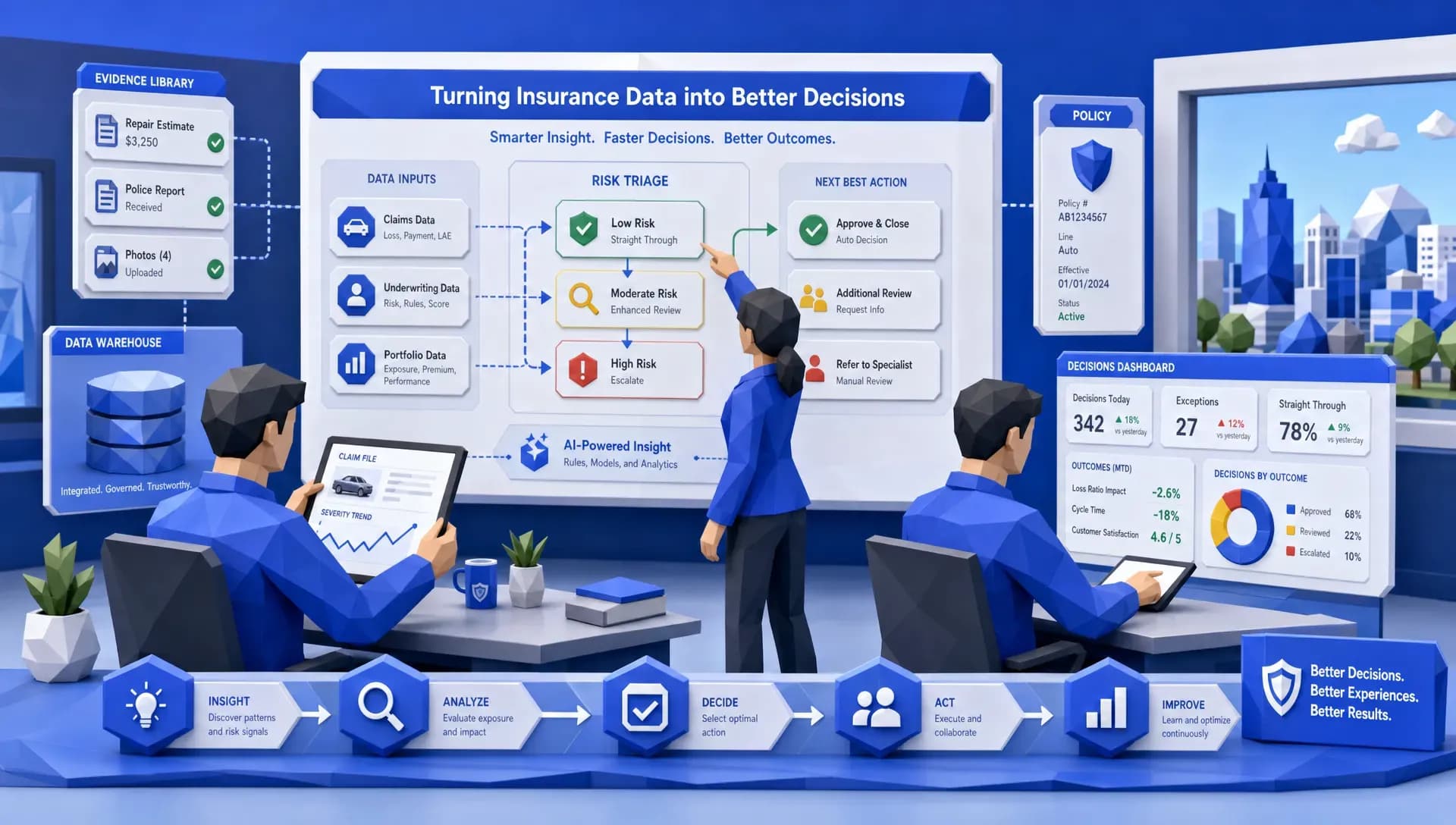
The fix is to codify appetite and referral logic in a way that mirrors how the business actually works. That means separating clear declines, clear accepts, and true judgment calls. A five-vehicle artisan contractor with clean losses should not wait in the same queue as a distressed fleet with prior cancellations and unresolved BI claims.
A practical automation workflow should explain why it routed something. If a submission is referred because of radius, garaging, prior loss severity, driver age, occupancy, or missing prior coverage, the underwriter should see that reason instantly. “Needs review” is not a reason. It is a shrug wearing a suit.
Breakdown 3: third-party data is treated like a side quest
This is a big one. Quote to bind automation often breaks because third-party data is available, but not orchestrated. Underwriters still jump between vendor portals for VIN data, MVRs, property hazards, court records, business details, prior insurance, sanctions checks, and loss history.
When enrichment is manual, two things happen. First, turnaround slows down. Second, enrichment becomes inconsistent. One underwriter checks a source because they remember to. Another skips it because the submission looks simple. A third checks it after quote but before bind, which is a great way to create awkward broker conversations.
The fix is to bring enrichment into the workflow at the right moment. Some checks should happen at intake. Some should happen only after the submission passes initial appetite. Some should happen before bind. The sequence matters because data calls cost money, time, and attention.
Here is a simple example outside traditional auto. If a commercial insured stores tools, inventory, or temperature-sensitive goods in shipping containers, the details matter. A basic dry container, a refrigerated unit, and a modified high-cube unit are different risk stories. Even when someone checks ordinary supplier information like shipping containers for sale, the useful details should not stay buried in a note. They should become structured underwriting data that can support pricing, referrals, and documentation.
That is the larger point. Enrichment should not be a scavenger hunt. It should be an event in the workflow, with the result stored, timestamped, and available for future decisions.
Breakdown 4: quote speed improves, but bind still drags
I have a soft spot for bind teams because they live in the gap between what sales promised and what operations can safely deliver. A fast quote is wonderful. A fast quote followed by three days of subjectivity cleanup is less wonderful.
Many automation projects focus heavily on generating quotes but underinvest in the bind package. That is where missing signatures, unclear subjectivities, payment confirmations, proof of prior coverage, driver exclusions, endorsements, and document generation can slow everything down.
This is also where premium leakage likes to sneak in wearing a fake mustache. A discount is applied before proof is verified. A driver is excluded in one system but not reflected correctly in documents. A garaging change gets mentioned in an email but never reaches rating. These are small errors individually, but they compound across a book.
The fix is to treat bind as its own controlled workflow, not as the “after the quote” admin step. Bind automation should confirm that required fields, documents, approvals, and subjectivities are complete before the policy is issued. It should also prevent re-keying from quote to issuance. If data was already captured and validated, it should flow forward.
A bind checklist is helpful. A bind checklist that updates itself based on risk type, state, product, broker, and underwriting decision is much better.
Breakdown 5: exceptions are designed as failure states
Every insurer says they want straight-through processing. Fair enough. But in real P&C underwriting, exceptions are not rare. They are the job.
The trouble starts when automation treats exceptions as failures. A submission falls out of the workflow, lands in a generic queue, and waits for someone to decipher what happened. That is not automation. That is a trapdoor.
The fix is to design exception handling as part of the main road. When a case needs human review, the underwriter should receive the relevant data, the reason for referral, the missing items, and the recommended next action. If the underwriter overrides a rule, that decision should be captured with the reason. Over time, those override patterns become incredibly valuable.
For example, if 40% of referrals for a certain class are approved after manual review with no pricing change, maybe the rule is too conservative. If a certain broker’s submissions consistently require missing documents, maybe broker enablement is the issue. If a certain state creates repeated bind delays, maybe the document workflow needs attention.
Exceptions are not just operational noise. They are feedback from the business.
Breakdown 6: broker communication is too vague
One of the fastest ways to lose a broker’s patience is to ask for “missing information” without saying exactly what is missing. Brokers do not have time to play underwriting charades.
Quote to bind automation breaks when communication is disconnected from the case file. The system knows the VIN is invalid, the prior coverage document is missing, and the loss run date range is incomplete, but the broker gets a generic email. Then the broker replies with one item, the underwriter asks for another, and the submission becomes a tennis match.
The fix is specific, contextual communication. If a workflow detects missing data, it should generate a clear request tied to the actual field or document required. If the broker responds, the workflow should update the case automatically rather than forcing someone to manually reconcile the inbox.
This is where many MGAs can win broker loyalty without changing appetite or price. Speed matters, but clarity matters just as much. A clean “we need these three items to bind” beats a fast but confusing quote every time.
Breakdown 7: no one can see where the workflow is leaking
This may be my biggest pet peeve. Teams invest in automation, then measure it with the same old reporting: quote count, bind count, premium, and maybe average turnaround time. Useful, yes. Enough, no.
If you want to fix quote to bind automation, you need visibility into every step. Where do submissions stall? Which data fields are most often missing? Which referral reasons cause the longest delays? Which brokers have the highest quote abandonment? Which underwriters override rules most often, and why? Which products bind quickly but leak premium later?
Without that visibility, teams end up arguing from anecdotes. I enjoy a good underwriting anecdote as much as anyone, but I do not want to run an operation on vibes.
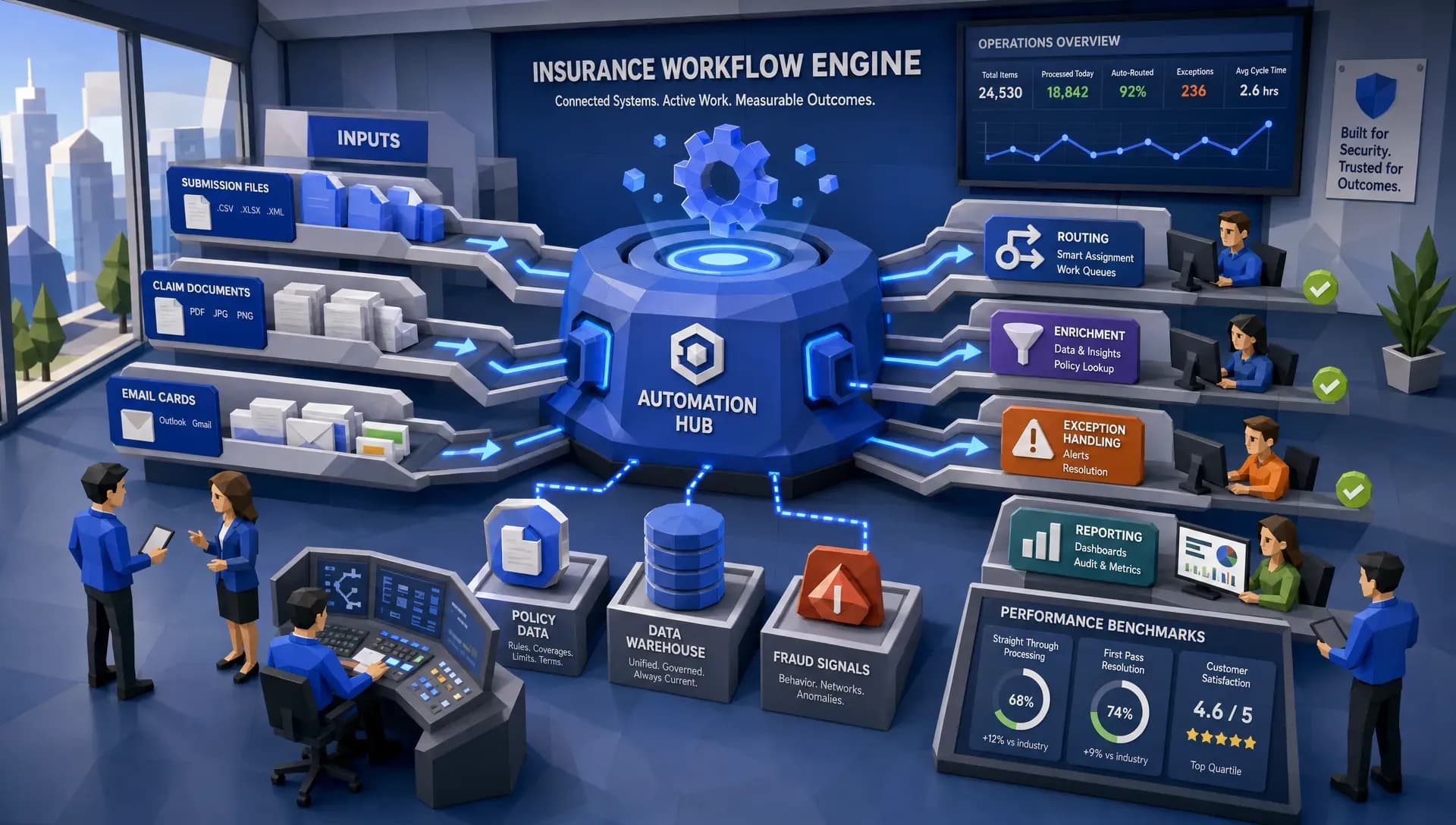
The fix is to capture workflow data as a byproduct of the automation. Every intake event, validation result, enrichment call, referral reason, quote, decline, bind, and override should be available for reporting. This is where a unified data warehouse becomes more than a technical nice-to-have. It becomes the operating system for continuous improvement.
The practical fix: build the workflow around decisions, not screens
If I were redesigning a quote-to-bind workflow from scratch, I would not start with screens. I would start with decisions.
What does the business need to know to clear appetite? What must be verified before pricing? What needs underwriter judgment? What must be complete before bind? What data should be captured for renewal, claims, and portfolio management later?
Once you answer those questions, the workflow becomes much clearer. Intake exists to prepare decisions. Enrichment exists to improve decisions. Referrals exist to protect decisions. Bind controls exist to finalize decisions. Analytics exist to improve the next decision.
The best quote to bind automation usually has a few common traits:
- It accepts submissions from multiple channels without punishing brokers.
- It normalizes messy documents into structured data.
- It enriches risk data through connected sources at the right workflow stage.
- It gives underwriters clear referral reasons and preserves their judgment.
- It carries clean data from quote to bind without re-keying.
- It records decisions, exceptions, and outcomes for audit and analytics.
Notice what is not on that list: asking your team to abandon every existing system overnight. In my experience, rip-and-replace projects are where enthusiasm goes to quietly perish in steering committee meetings.
What to measure once quote to bind automation is live
A good workflow should pay for itself in speed, accuracy, and better broker experience. But you need the right measurements. Average quote turnaround is useful, but averages can hide the ugly bits. I like to look at the workflow in slices.
Track submission-to-triage time, triage-to-quote time, quote-to-bind time, referral rate, referral aging, quote abandonment, missing-data frequency, bind error rate, re-keying volume, and underwriter touchpoints per bound policy. If you can tie those numbers back to class, state, broker, product, and underwriter authority level, now you are actually managing the operation.
You should also measure quality. Faster bad decisions are still bad decisions. Look at premium adjustments after quote, post-bind corrections, endorsement frequency shortly after issuance, early claims signals, and renewal profitability. Quote to bind automation should not simply accelerate business. It should help you understand which business you want more of.
Where Inaza fits
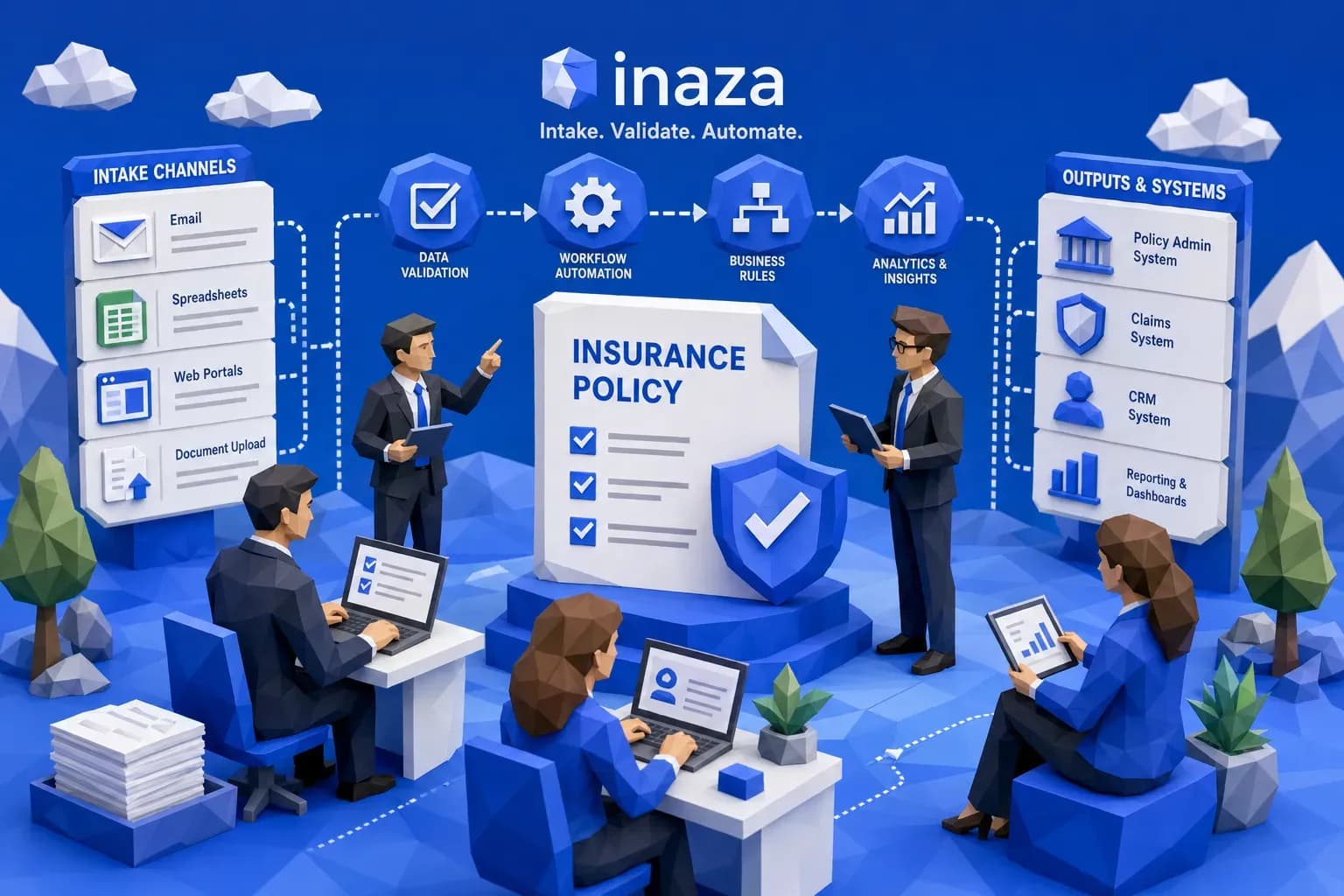
Inaza is built for the messy middle of insurance operations, the place where submissions, documents, data sources, rules, underwriters, brokers, and core systems all have to work together.
The platform supports underwriting automation, claims automation, customer service automation, and operations workflows, while integrating with existing systems rather than forcing a team to relearn its entire day. For quote-to-bind use cases, that means insurers, MGAs, and brokers can automate data capture, validation, enrichment, routing, reporting, and analytics within configurable workflows.
A few things matter here. Inaza has a unified data warehouse underneath the workflows, so the automation does not disappear after a task is completed. The data can feed dashboards and business intelligence. The platform also includes pre-built workflow templates and API templates for common enrichment sources such as Verisk, LexisNexis, HazardHub, and others. That helps teams avoid the classic “six-month integration before we learn anything” problem.
Inaza also supports benchmarking against industry reference points, which is particularly useful when underwriting leaders need to explain portfolio performance, reinsurance narratives, renewal strategy, or operational improvement to stakeholders who do not live inside the daily queue.
In plain English, the point is to move from “we automated a step” to “we can see, control, and improve the whole quote-to-bind path.”
Frequently Asked Questions
What is quote to bind automation in insurance? Quote to bind automation is the use of connected workflows to move submissions from intake through quote, referral, approval, and binding with less manual work. It usually includes data capture, validation, enrichment, routing, document generation, and reporting.
Why does quote-to-bind automation fail? It usually fails because insurers automate the visible front end but leave messy intake, manual enrichment, unclear eligibility rules, re-keying, and bind controls untouched. The workflow looks faster, but the bottlenecks simply move downstream.
Should underwriters still be involved in automated quote-to-bind workflows? Yes. The best workflows use automation for repetitive work and underwriters for judgment. Clear accepts and declines can move quickly, while complex or unusual risks should be routed to humans with the right context.
What is the fastest way to improve quote-to-bind performance? Start with intake and data validation. If submissions are incomplete, duplicated, or inconsistent, every downstream step suffers. Clean data at the start improves quote speed, referral quality, bind accuracy, and analytics.
How should insurers measure quote-to-bind automation success? Measure submission-to-quote time, quote-to-bind time, referral aging, bind error rates, underwriter touchpoints, quote abandonment, missing-data rates, and post-bind corrections. The best teams also connect these metrics to profitability and renewal outcomes.
Final thought: automate the boring parts very, very well
Quote to bind automation is not won by having the flashiest quote screen. It is won by making the boring parts reliable: intake, validation, enrichment, referrals, broker follow-up, bind checks, and reporting.
That may not sound glamorous, but neither is plumbing until the water stops running.
If your team is trying to speed up underwriting without losing control, Inaza can help you build configurable workflows that connect intake, enrichment, decisioning, bind, and analytics across your existing systems. Learn more at Inaza and see how a cleaner quote-to-bind process can reduce friction without asking your underwriters to become data janitors.