Insurance leaders don’t need another list of AI buzzwords. They need to know where AI in the insurance industry reliably improves the combined ratio, reduces cycle times, and creates better customer experiences without turning every initiative into a multi-quarter program.
The fastest value usually comes from AI that removes friction in high-volume workflows: turning unstructured inputs (emails, PDFs, photos, invoices, loss runs) into structured data, validating and enriching it, and routing it to the right decision path with clear auditability. When those automations also feed a unified data layer, you compound the benefit with better visibility, governance, and portfolio intelligence.
What “most value” actually means in insurance AI
In practice, AI creates outsized value when it moves one (or more) of these business levers:
- Expense ratio improvement: fewer touches per file, less re-keying, less back-and-forth, higher throughput per adjuster or underwriter.
- Loss ratio improvement: better risk selection, fewer pricing and rating errors, earlier fraud detection, more consistent claims handling.
- Growth and retention: faster quotes, fewer abandoned submissions, better service responsiveness, fewer disputes.
- Operational resilience: less dependence on scarce specialists, fewer bottlenecks during CAT events, cleaner handoffs between teams.
A useful rule: the most valuable AI is the kind that changes the workflow outcome, not just the user interface.
The highest-ROI AI use cases cluster around “intake, triage, and validation”
Across underwriting, claims, and policy servicing, the same bottleneck repeats: critical information arrives in inconsistent formats, then humans spend time translating it into system-ready data.
That’s why the biggest near-term wins cluster around:
1) Unstructured data to structured, system-ready fields
This includes AI-based document understanding (OCR + NLP), email classification, and extraction from:
- Broker submissions and supplements
- Loss runs
- Claims packs and medical bills
- Invoices and receipts
- Vehicle photos and inspection images
The value is immediate because it reduces manual touch time and eliminates downstream errors caused by re-keying.
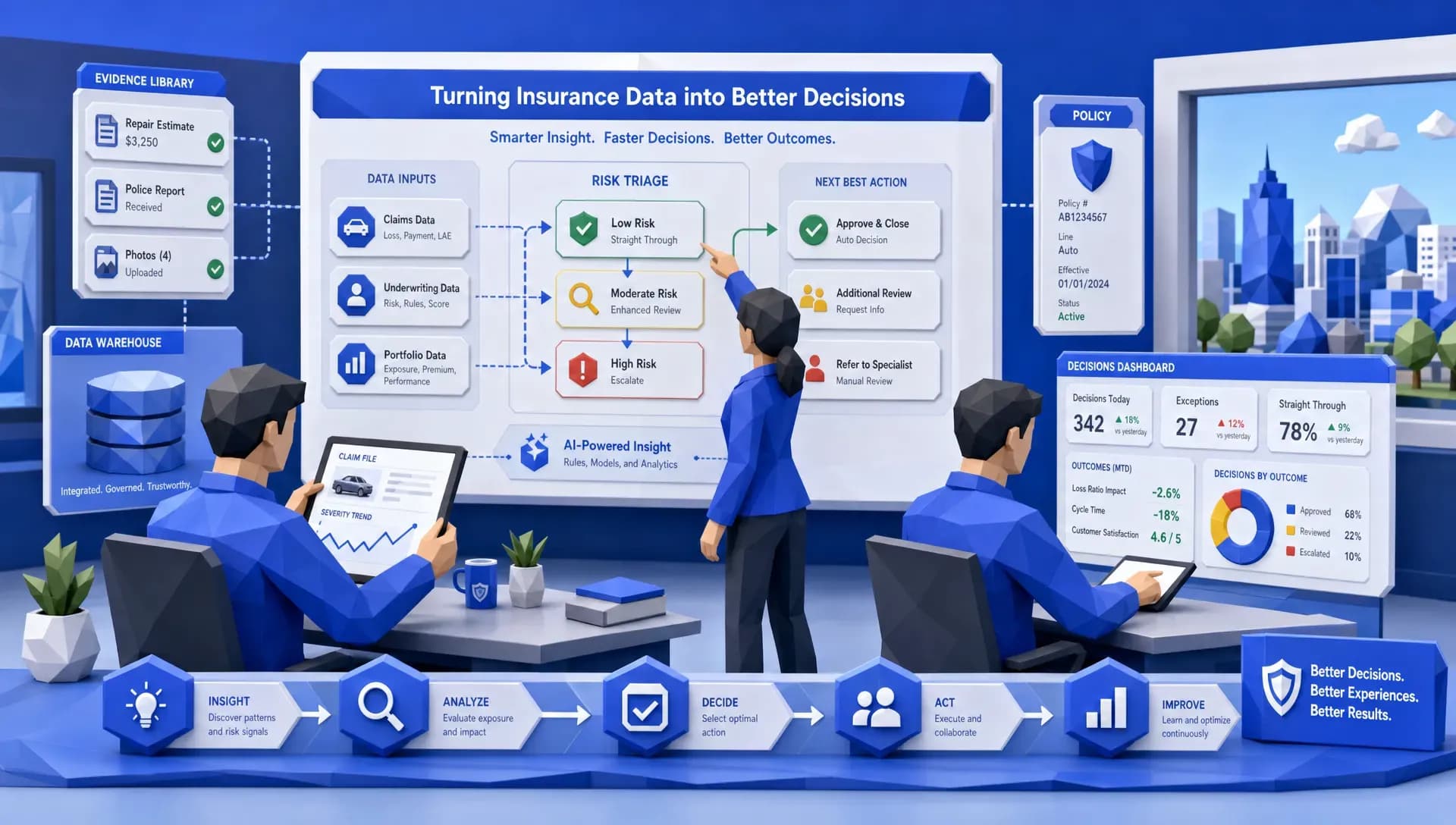
2) Triage and routing that reduces “gray work”
“Gray work” is everything that happens between intake and a real decision: chasing missing fields, re-routing to the right queue, asking for clarifications, and reopening files.
AI-driven triage creates value when it:
- Identifies what the request is (endorsement, cancellation, FNOL, supplemental document)
- Determines completeness and confidence
- Routes to straight-through processing (STP) or escalates to a human
- Produces an auditable rationale for why it routed that way
3) Validation and enrichment before the decision
This is where AI shifts from “faster” to “better.” If you validate and enrich early, you reduce:
- Premium leakage (missed surcharges, misclassified usage, incorrect vehicle or driver details)
- Eligibility mistakes
- Claims severity surprises
- Fraud exposure
Enrichment often depends on reliable third-party data access. Operationally, it’s easier to scale AI when common integrations are already templated.

Where AI creates the most value in underwriting
Underwriting is full of high-volume, high-variance tasks, which makes it perfect for workflow automation. The biggest value typically concentrates in the early stages, before an underwriter even evaluates risk.
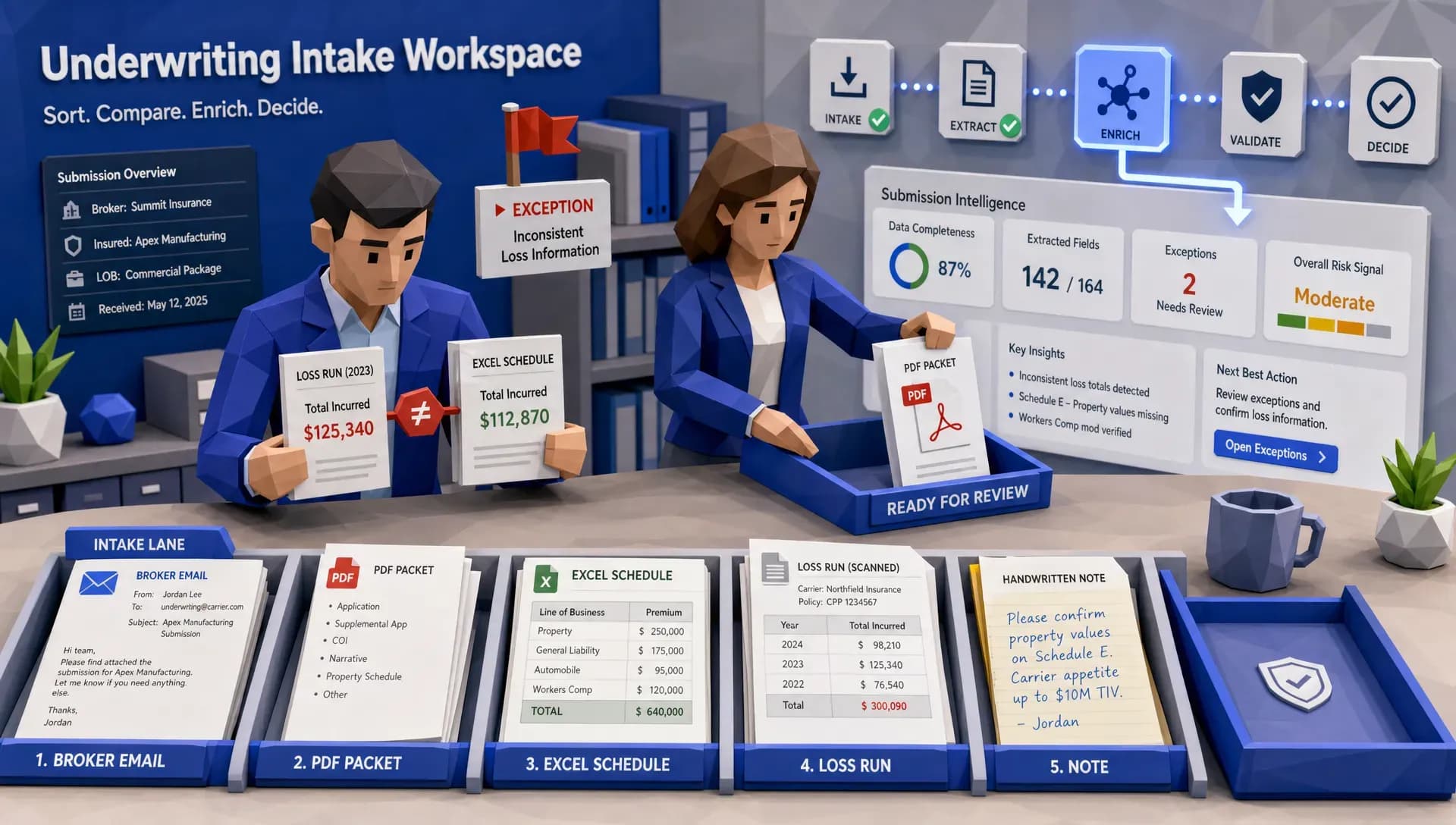
Submission intake and “zero re-keying”
The most common underwriting cost isn’t the decision itself, it’s preparing the file: opening attachments, copying fields, interpreting loss runs, and updating multiple systems.
AI adds value when it can reliably:
- Extract core fields from documents and emails
- Normalize data into consistent schemas
- Push clean data into rating, policy admin, or underwriting workbenches
This is especially impactful for MGAs and brokers handling submissions across multiple carriers with different intake standards.
Pre-bind checks that prevent premium leakage
Leakage often comes from small misses that compound: incomplete VIN details, garaging inconsistencies, missing drivers, misapplied discounts, unverified prior coverage, or incorrect class codes.
AI-driven validation catches issues at the point of intake, so you don’t discover them at audit, endorsement, or claim time.
Straight-through processing for the “low complexity” middle
STP value is not just speed. It’s consistency.
The best underwriting AI programs reserve STP for segments where:
- The risk attributes are well captured and verifiable
- The decision policy is stable and explainable
- Exceptions can be routed cleanly to humans
That design reduces underwriter fatigue and protects quality by ensuring that humans spend time on the risks that truly need judgment.
Renewal underwriting that uses historical signals
Renewal decisions are often where carriers can correct past mispricing and reduce preventable churn. AI creates value by automatically pulling and summarizing:
- Claims patterns (frequency vs severity)
- Endorsement activity (signals of exposure changes)
- Payment and servicing behavior (operational risk signals)
The key is making those signals usable in a workflow, not just available in a report.
Where AI creates the most value in claims
Claims is where AI often shows the clearest customer impact: faster first response, fewer back-and-forth interactions, and more consistent outcomes.
FNOL automation that improves speed and data quality
A faster FNOL is valuable, but a clean FNOL is more valuable.
AI contributes when it can capture structured loss details from:
- Voice or chat conversations
- Emails and attachments
- Photos and supporting documents
Then it can validate for completeness and route the claim to the right path (self-service, desk adjuster, SIU referral, or fast-track).
Image intelligence for damage assessment and fraud screening
Computer vision can flag inconsistencies that humans miss at scale, especially when volumes spike.
The highest-value implementations typically combine:
- Damage detection and severity cues for triage
- Similarity checks to reduce reused or internet-sourced images
- Metadata and consistency checks (where permitted) to identify anomalies
This is not “replace the adjuster.” It’s “screen everything consistently, escalate what matters.”
Invoice review and expense control
Manual invoice review is a classic high-volume bottleneck. AI creates value when it can:
- Extract line items and totals
- Validate against expected ranges
- Flag duplicates, mismatches, and suspicious patterns
This improves both speed and indemnity control, especially in lines with heavy vendor billing.
Litigation and attorney demand workflows
Demand packages are document-heavy and time-sensitive. AI helps by structuring key elements, highlighting missing documentation, and creating standardized summaries that accelerate review.
The value is largest when it reduces cycle time while preserving traceability, since disputes often require a clear audit trail.
Where AI creates the most value in distribution and customer service
Many insurers underestimate how much operational cost sits in “status checks” and simple service requests.
Quote speed and quote abandonment reduction
AI creates value when it reduces the time from submission to first meaningful response:
- Faster extraction and validation of submission data
- Immediate triage (eligible, ineligible, need info)
- Automated follow-ups for missing items
That responsiveness improves conversion and reduces broker frustration.
Omnichannel service with continuous context
When customers switch from email to phone to chat, the cost comes from re-verification and repeated explanations.
AI can maintain continuity by linking interactions to the correct policy or claim context, then assisting agents with summaries and next-best actions.
Proactive retention and servicing at scale
Retention programs work when outreach is timely and relevant. AI can help prioritize outreach based on:
- Renewal timeline and risk changes
- Service friction signals (repeat contacts, unresolved issues)
- Billing or documentation gaps
The operational win is focusing human effort where it actually changes the outcome.
The compounding value: analytics, benchmarking, and a unified data layer
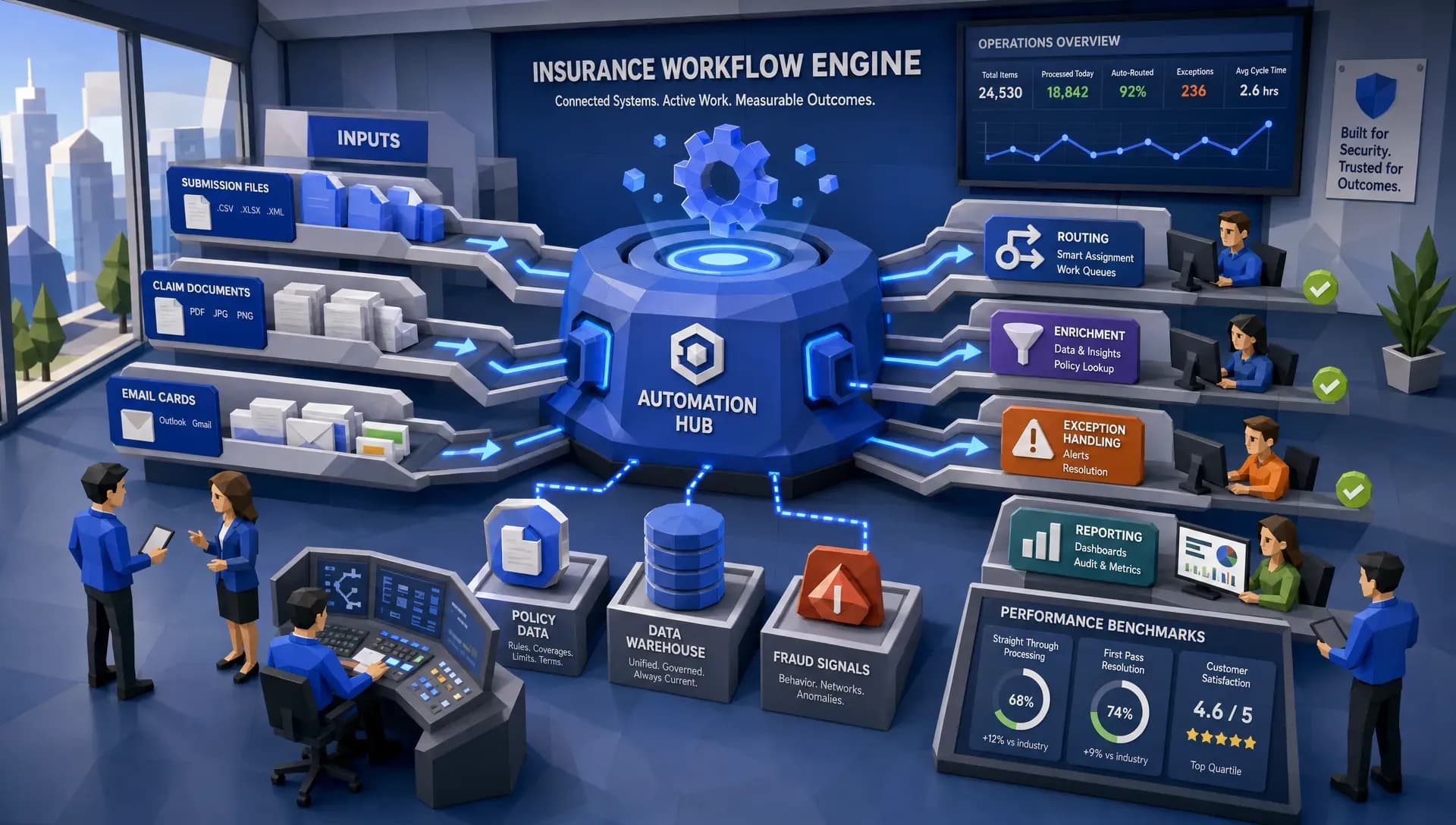
A pattern emerges in successful AI programs: they don’t treat automation as a set of isolated bots. They treat automation as a data capture strategy.
When every automated workflow captures structured fields, timestamps, and outcomes, you can:
- Measure true operational performance (cycle time, touches, reopen rates)
- Identify leakage and error patterns by source
- Audit decisions consistently
- Build reliable executive dashboards without manual reporting projects
This is also where industry benchmarks become powerful. Comparing your throughput, turnaround, and quality metrics to the market helps leaders prioritize fixes and gives a clearer narrative for capacity planning and partner negotiations.
A practical way to prioritize AI projects (without getting stuck in pilots)
If you’re deciding where to invest next, use a workflow-first filter:
Start with one “high-frequency, low-joy” workflow
Choose a process that:
- Has high volume
- Has measurable outcomes n- Has a clear definition of “done”
- Depends on unstructured inputs today
Common examples include submission intake, loss run ingestion, FNOL triage, invoice intake, or email-driven servicing.
Define value in operational metrics before model metrics
Instead of starting with model accuracy targets, start with business outcomes:
- Minutes of touch time per file
- Time to first response
- Reopen rates
- Exception rates (how often humans must intervene)
- Downstream error rates (endorsement corrections, audit findings)
Design escalation paths and auditability from day one
Insurance AI must be safe to operate. That usually requires:
- Clear confidence thresholds
- Human review for edge cases
- Logged inputs, outputs, and workflow actions
If you cannot explain why the workflow did what it did, you will struggle to scale it.
Plan for integration and security as part of the workflow
Most value leaks away when automations stop at a PDF summary and never update the system of record.
If you need support beyond insurance-specific tooling, it can help to bring in implementation and information security expertise. For example, teams like AI implementation and information security consulting can support broader software projects that sit adjacent to insurance operations, particularly when modernization touches multiple enterprise systems.
How Inaza fits into value creation (without disrupting your teams)
Inaza is built around a practical idea: insurers get value when they can automate real workflows quickly, then use the resulting data for ongoing visibility.
Based on the platform capabilities shared, Inaza is typically relevant when you want to:
- Automate underwriting, claims, and servicing workflows using configurable templates (including a large library of workflow templates)
- Support messy real-world inputs (multiple file types, varied formats)
- Integrate with existing systems rather than forcing a rip-and-replace
- Capture structured data into an underlying warehouse for analytics and dashboards
- Enrich automations via pre-built API templates (for sources such as Verisk, LexisNexis, and HazardHub)
- Compare performance using built-in industry benchmarks to understand results versus the market
A key operational differentiator is speed to production: if you can deploy a production-ready workflow with minimal back-and-forth, you can move from “AI exploration” to measurable outcomes faster.

Common mistakes that reduce AI value in insurance
Even strong teams lose ROI when they fall into predictable traps:
Treating AI as a chatbot instead of a workflow
A conversational layer can be helpful, but the value comes when data is extracted, validated, and written back into operational systems with traceability.
Automating without fixing data definitions
If “garage address” means five different things across channels, AI will produce inconsistent outcomes. Normalization and clear schemas matter.
Ignoring exception handling
Every automation needs a plan for what happens when confidence is low, information is missing, or a case is unusual. Exceptions are not edge cases in insurance, they are the business.
Measuring only speed, not quality
Reducing cycle time is great, until it increases disputes, rework, or compliance risk. The best programs track both.
Frequently Asked Questions
Where does AI in the insurance industry deliver the fastest ROI? The fastest ROI usually comes from intake and triage automation: extracting data from emails and documents, validating it, and routing cases to the right queue with fewer manual touches.
Is underwriting or claims a better place to start with AI? Start where volume and friction are highest. For many P&C organizations, that’s submission intake (underwriting) or FNOL and document handling (claims). The best starting point is the workflow with the clearest baseline metrics.
What’s the difference between “AI insights” and “AI automation”? Insights help humans decide. Automation changes the process by moving data, triggering actions, and routing work. Most measurable value comes from automation that is tied to operational systems and SLAs.
How do we avoid the pilot trap? Pick one workflow with a clear definition of done, integrate it into production systems, and measure business KPIs (touch time, cycle time, exception rate). Then expand to adjacent workflows using the same data foundation.
Do we need a data warehouse to get value from AI? You can get initial value without one, but a unified data layer compounds ROI by enabling monitoring, dashboards, benchmarking, and governance across automations.
Turn AI value into production outcomes
If you’re evaluating where AI can move the needle fastest, prioritize workflows where unstructured inputs and manual re-keying slow your teams down. The next step is choosing a platform that can deploy production-ready automations quickly, integrate with your existing systems, and capture clean data for analytics.
Inaza’s AI-powered insurance automation platform is designed for exactly that, underwriting, claims, and operations workflows that can be deployed rapidly and measured over time. To see what a task-level workflow could look like in your environment, explore Inaza at Inaza and connect with the team for a practical walkthrough of your highest-friction process.