Here is my mildly unpopular view: the biggest early ROI from AI for insurance companies rarely comes from the shiny strategic projects everyone wants to present at the board meeting.
It comes from the boring work.
The inboxes. The PDFs. The loss runs. The claim photos. The eligibility checks. The “can someone please re-key this into the policy admin system before lunch?” moments.
I have spent enough time around underwriting and claims teams to know that insurance professionals do not wake up excited to manually compare two spreadsheets or chase missing VINs. Yet that is where time disappears. It is also where errors creep in, quotes stall, claims drag, and leakage quietly takes a seat at the table.
So if you are asking where AI delivers ROI first, my answer is simple: start where the work is repetitive, data-heavy, high-volume, and already painful enough that your team has built workarounds. That is where the payback usually shows up fastest.
The first ROI test: can it reduce touches this quarter?
A good AI use case in insurance should pass a practical test: will it reduce human touches in the next 30 to 90 days without creating new chaos downstream?
That is the line I use because insurers have been burned by big transformation promises before. We have all seen the “platform of the future” project that starts with champagne ambitions and ends with a steering committee, three consultants, and a spreadsheet named Final_v7_REAL_FINAL.xlsx.
The early ROI does not come from replacing judgment. It comes from removing avoidable handling before expert judgment is needed.
McKinsey has noted that underwriters can spend a major share of their time on administrative work rather than risk assessment. That tracks with what I have seen. A senior underwriter should not be paid senior-underwriter money to clean up a fleet schedule that arrived as a half-legible PDF.
The highest-return areas usually share four traits: the work is frequent, the data is messy, the decision rules are known, and the cost of delay is visible. That points us to a few clear starting points.
1. Submission intake and underwriting data cleanup
If I had to pick one place for AI for insurance companies to prove itself first, I would start with submission intake.
Why? Because underwriting ROI is often trapped before underwriting even begins.
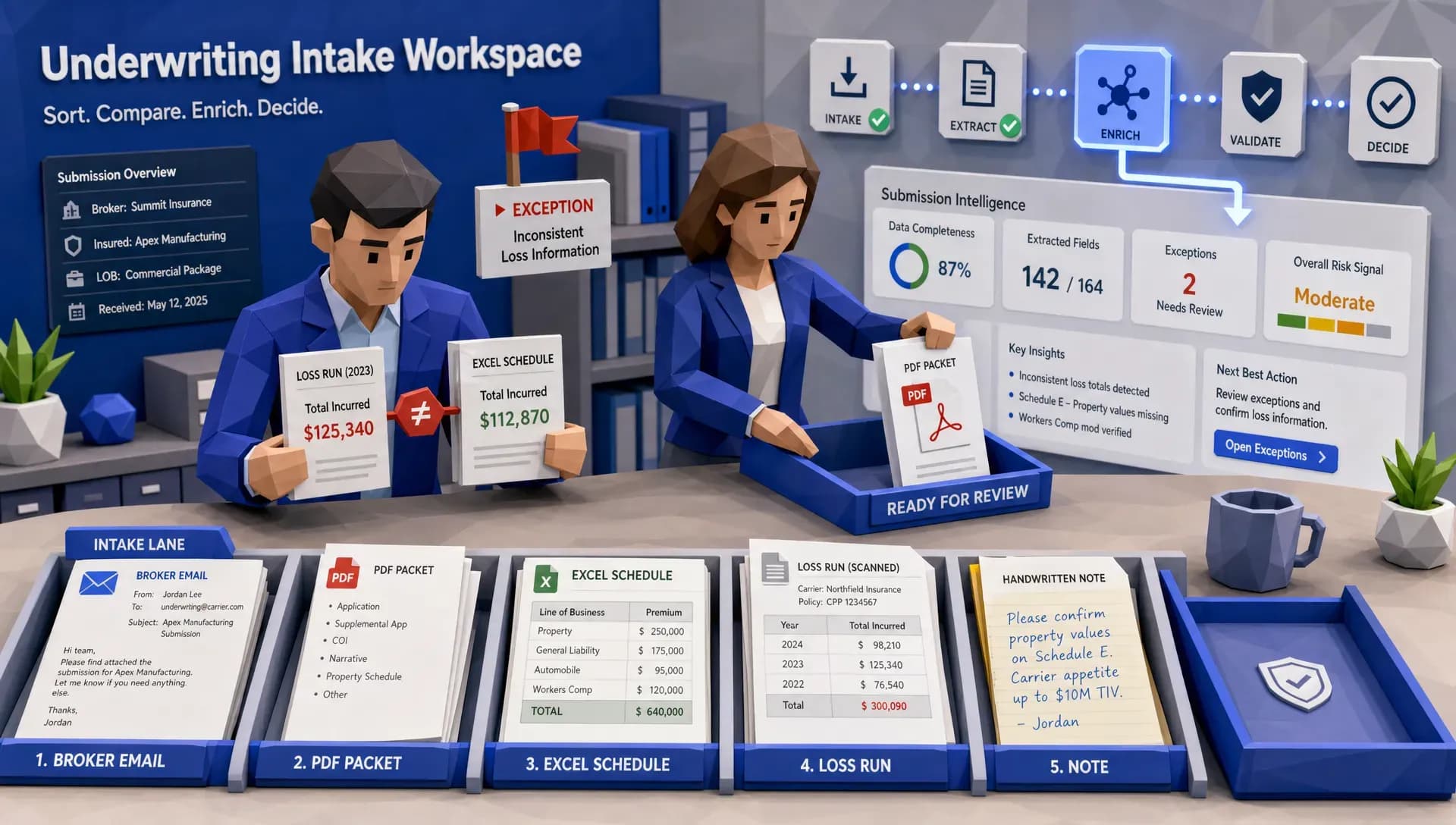
Commercial auto submissions arrive with loss runs, fleet schedules, driver lists, prior coverage documents, supplemental applications, emails, PDFs, Excel files, screenshots, and sometimes a photo of a document that looks like it survived a rainstorm. I am only half joking.
When that data is manually reviewed, copied, reformatted, validated, and entered into another system, the insurer is paying for friction. Worse, the team may still miss the details that matter: garaging changes, inconsistent driver records, missing VINs, suspicious loss patterns, misapplied discounts, or open claims that should change appetite.
This is where AI-driven underwriting automation can deliver quick ROI because the baseline is so inefficient. Automating intake, extraction, validation, and routing helps reduce re-keying, quote delays, and premium leakage. It also gives underwriters cleaner files earlier, which is usually the difference between “we can quote this today” and “we will get back to the broker next week.”
I once watched a team spend the better part of a morning reconciling a fleet schedule where one vehicle appeared three different ways. Same truck, different VIN formatting, different unit number, different garaging address. Nobody was doing bad work. The process was just asking humans to behave like database software, which is a rude thing to ask before coffee.
A useful analogy comes from outside insurance. In apparel, companies like Arcus Apparel Group create value by coordinating the messy handoffs between technical development, sourcing, sampling, and production. Insurance has its own version of that problem. If the handoffs between broker submissions, underwriting rules, third-party data, and policy systems are messy, speed and quality suffer.
For underwriting, ROI shows up in faster quote turnaround, fewer data errors, less manual review, and better risk selection. The best part is that these benefits are measurable quickly.
2. FNOL and claims triage
Claims intake is another obvious first stop. First Notice of Loss is where a claim either starts clean or starts crooked.
A clean FNOL captures the right facts, documents, photos, parties, timestamps, policy details, and next steps. A messy FNOL creates downstream rework for adjusters, frustrates policyholders, and can delay a straightforward claim for reasons that have nothing to do with coverage.
J.D. Power’s auto claims research continues to highlight how much speed, communication, and repair-cycle experience matter to customer satisfaction. That should not surprise anyone. When someone has had an accident, they do not want a masterclass in internal claims routing. They want to know what happens next.
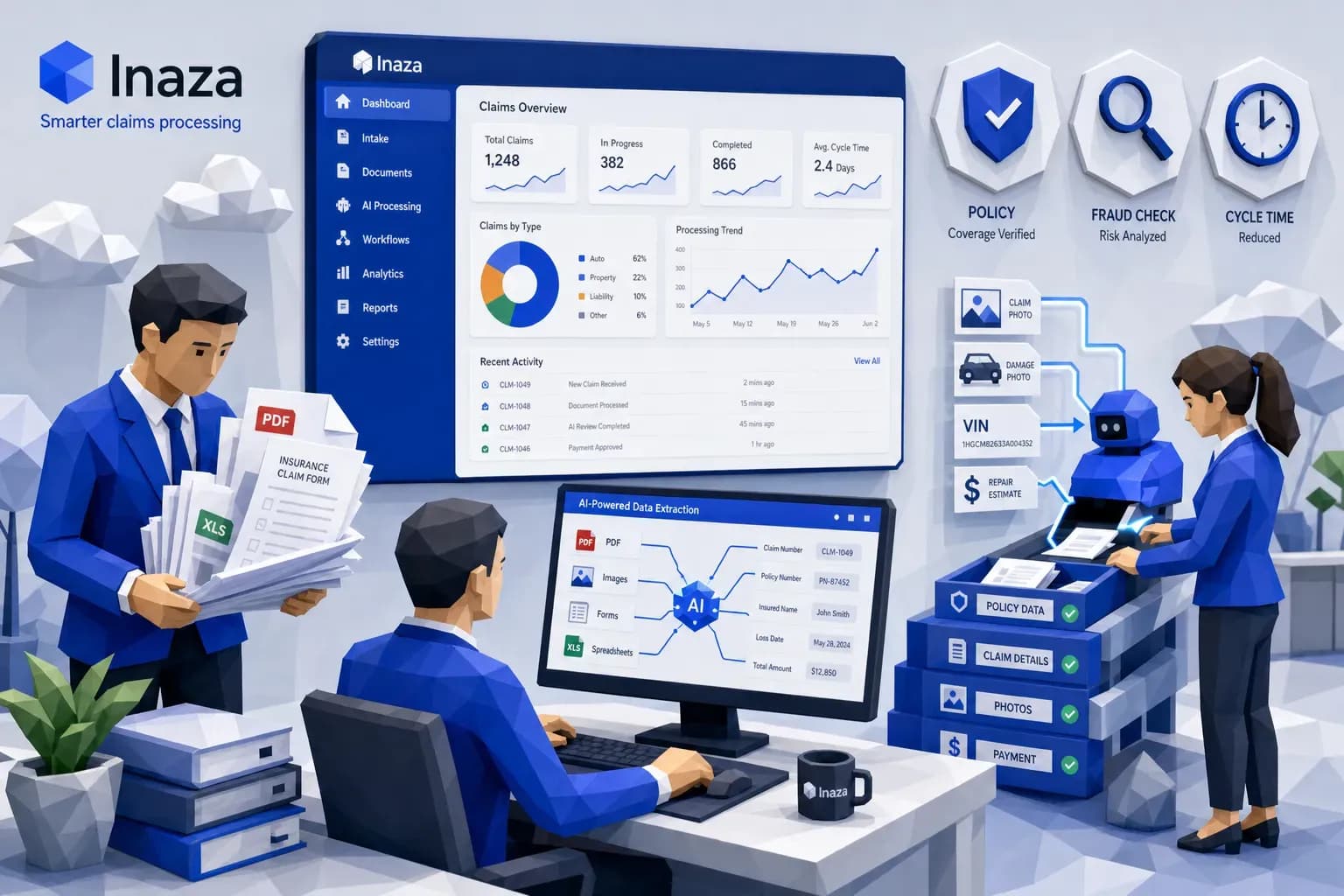
AI can help by capturing claim details through voice, chat, email, or document upload, then routing the claim based on type, severity, coverage, missing data, and fraud indicators. For routine claims, this can support faster straight-through handling. For complex claims, it gives the adjuster a better starting file.
This is one of the cleanest ROI stories because cycle time is already tracked. You can compare pre-automation and post-automation performance on average handling time, claim setup time, adjuster touches, pending inventory, and customer satisfaction.
The mistake I see is treating claims automation as a replacement for adjusters. That is backwards. The stronger business case is giving adjusters fewer bad files and more time for judgment. A cracked windshield should not compete for the same human attention as a bodily injury claim with representation and disputed liability.
3. Fraud screening at the front door
Fraud detection pays back early because every bad claim stopped before payment is immediate value.
The catch is that fraud teams are usually drowning in false positives. Old rule sets can flag too much, too late, or both. Then investigators spend time sorting noise from signal, which is like asking a smoke alarm to detect toast, candles, fireplaces, and actual fires with the same scream.
Modern fraud screening is most valuable at intake, before the claim gets too far into the process. Image checks, invoice validation, metadata review, claimant history, repair pattern analysis, and network signals can all help identify claims that deserve a closer look.
This matters more now because digital fraud is getting easier to attempt. Verisk’s 2025 fraud report found that carriers are increasingly concerned about AI-enabled fraud, including manipulated documents and images. That concern is not theoretical. If fraudsters can create better fakes, insurers need better early screening.
The ROI here is not only in stopped losses. It is also in reducing false positives, which protects honest customers from unnecessary delays. I have seen claims teams become so cautious that simple claims get stuck behind suspicious-looking but innocent details. Good screening should sharpen the queue, not widen the dragnet.
4. Broker, agent, and customer service workflows
Customer service automation often gets discussed as a cost-cutting tool. That is true, but the better ROI story is operational flow.
Every broker email, coverage question, endorsement request, status update, cancellation notice, or proof-of-prior question is a workflow event. If it sits in a shared inbox until someone reads it, interprets it, routes it, and copies the data into another system, the insurer has created a tiny operational toll booth.
One toll booth is fine. A thousand a day is a business model problem.
AI can classify incoming messages, identify the policy or claim, extract key details, suggest next steps, and route the task to the right workflow. In customer service, it can answer routine coverage and status questions while escalating sensitive or complex conversations to a human with context intact.
This is a strong early ROI area for MGAs, brokers, and carriers because the work is high-volume and visible. Response time improves. Teams spend less time searching for information. Customers get fewer “let me check and come back to you” answers.
And yes, there should always be a smart escalation path. I have never met a policyholder who complained that a human stepped in at the right time. I have met plenty who complained when they had to explain the same issue four times.
5. Reporting, dashboards, and the data warehouse effect
Here is the part many teams underestimate: the automation itself is only half the value.
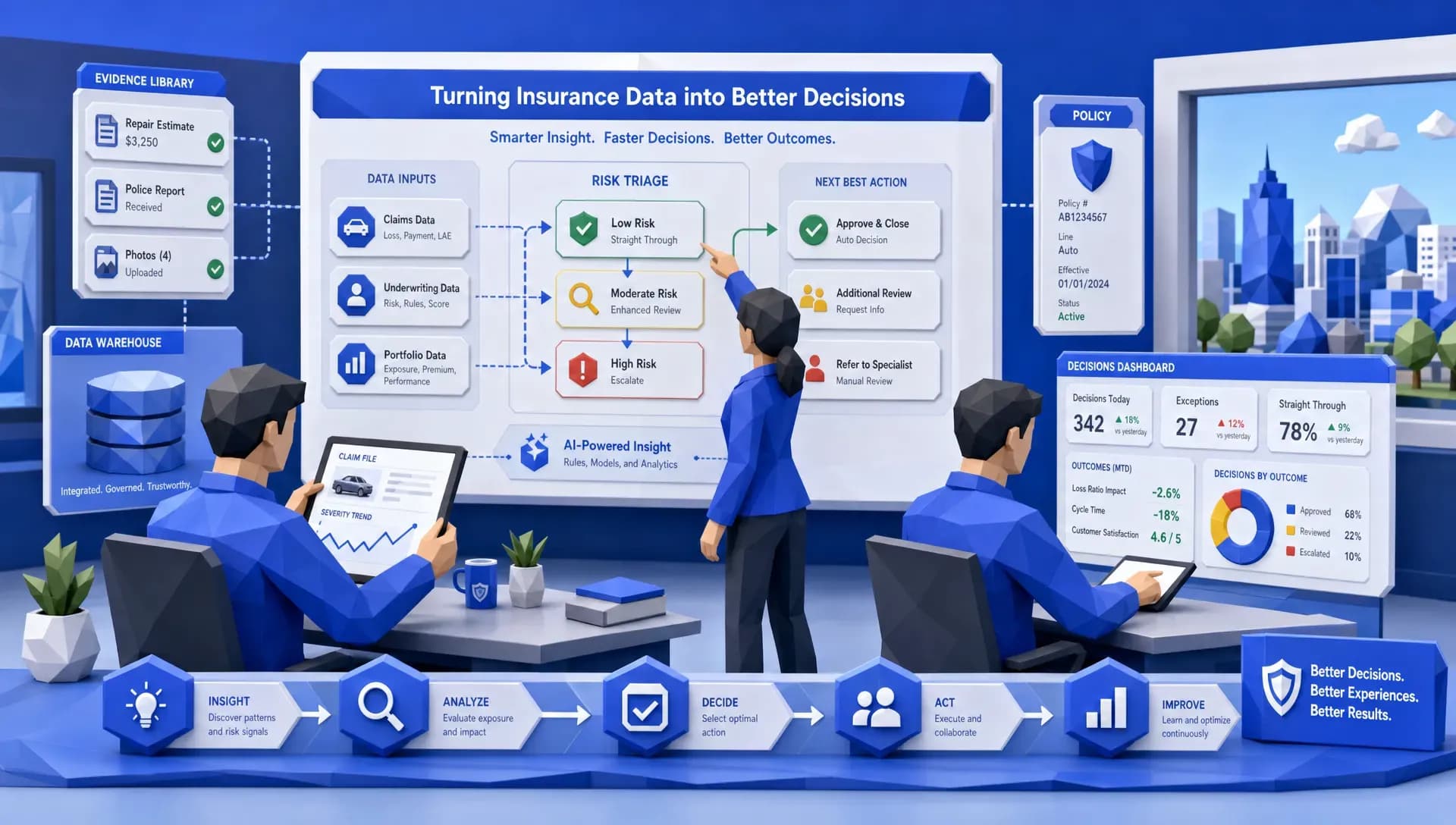
When workflows capture clean, structured data, you start building better operational intelligence. That means dashboards for bottlenecks, leakage, quote turnaround, claims cycle time, fraud referral quality, file completeness, and portfolio performance.
This is where ROI moves from “we saved time on this task” to “we understand the business better.”
For example, underwriting leaders can see which submission sources produce the most rework. Claims leaders can see which claim types stall after FNOL. Operations leaders can see where service-level agreements are being missed. Reinsurance teams can build clearer narratives around portfolio performance and renewals.
This is one of the reasons I like automation platforms that have a data warehouse underneath them. Workflow automation gives you the first win. Structured data makes the wins compound.
Where I would not start
I would not start with a full core-system replacement unless you enjoy spending budget before proving value. I would not start with a broad, vague “enterprise AI strategy” that has no operational owner. I would not start by asking a general-purpose chatbot to make coverage decisions.
Those projects may have a place, but they are not usually the first ROI lever.
The fastest payback tends to come from targeted workflows that sit around the core systems you already use. That approach lowers disruption and makes adoption easier. It also gives leadership the confidence to fund the next phase based on actual results, not slideware.
If you want a simple prioritization rule, look for the workflow your team complains about most often. Then ask whether the pain is caused by missing data, manual review, repetitive decisions, or slow routing. If the answer is yes, you probably have a good candidate.
The metrics that prove ROI early
You do not need a 40-metric scorecard to know whether the first deployment is working. In fact, too many metrics can hide the truth. I would start with a tight set of measures tied to cost, speed, accuracy, and experience.
Useful early metrics include:
- Average handling time per submission, claim, or service request
- Quote turnaround time and bind rate
- Claim setup time and cycle time
- Manual touch count per file
- Data error rate and rework volume
- Fraud referral hit rate and false positive rate
- Cost per transaction
- Customer or broker response time
The key is to measure before and after. I know that sounds obvious, but many AI projects fail the ROI conversation because nobody captured the ugly baseline. If you do not know how long a process takes today, every improvement becomes a debate.
How Inaza fits the first-ROI approach
Inaza is built for the places where insurers, MGAs, and brokers feel operational friction first: underwriting, claims, customer service, and back-office workflows.
The platform can integrate with existing systems, automate data capture across file types, and support customizable workflows without forcing teams into a long retraining cycle. Inaza also offers 250+ workflow templates, pre-built API templates for enrichment sources, and real-time analytics dashboards supported by a unified data warehouse.
That last point matters. If the automation captures key data as work moves through the business, leaders can see what is happening rather than waiting for a month-end spreadsheet archaeology project.
Inaza’s model is especially useful for teams that want production-ready workflow automation without endless proof-of-concept back and forth. Start with a focused process, measure the result, then expand into adjacent workflows. That is how ROI becomes a funding engine rather than a promise.
Frequently Asked Questions
Where should insurers use AI first? Start with high-volume workflows that involve messy data, repeatable decisions, and measurable delays. Submission intake, underwriting data validation, FNOL, claims triage, fraud screening, and shared inbox automation are usually strong first candidates.
How fast can AI for insurance companies show ROI? It depends on the workflow, but targeted automation can often show measurable improvement within weeks or a few months. The fastest results usually come from reducing manual touches, rework, and cycle time in existing processes.
Does AI replace underwriters or claims adjusters? No, not in any sensible implementation. The better use case is removing admin work and improving file quality so underwriters and adjusters can spend more time on judgment, negotiation, customer communication, and complex risk decisions.
What is the biggest mistake insurers make when chasing AI ROI? Starting too broad. A vague enterprise initiative is harder to measure and easier to stall. A focused workflow with clear baseline metrics gives you proof, confidence, and a stronger case for expansion.
What data do insurers need before starting? You do not need perfect data, but you do need access to the documents, emails, system fields, and decision rules involved in the workflow. A good automation platform should help structure and validate messy data rather than expecting your team to fix everything first.
Find the first ROI lever in your insurance operation
The best place to start is usually hiding in plain sight. It is the workflow your team already knows is slow, manual, and expensive.
If you want to see where automation can pay back first, Inaza can help map the right underwriting, claims, customer service, or operations workflow and turn it into a measurable production-ready process. Start small, prove value, then scale the wins that actually move the numbers.