My hot take after a decade around insurance operations: most teams do not have a CSIO form problem. They have a back-and-forth problem wearing a PDF costume.
The CSIO form itself is not the villain. In fact, standard forms are one of the few things in insurance that try to keep everyone speaking the same language. The trouble starts after the form leaves the broker’s desk. It lands in an inbox, gets downloaded, re-keyed, checked, forwarded, questioned, corrected, attached again, and sometimes printed by someone who “just thinks better on paper.” We have all met that person. Sometimes, I have been that person.
In 2026, that workflow should feel a little embarrassing. CSIO form automation should let MGAs, carriers, and brokers move from “Can you resend page three?” to “Here are the exceptions that need judgment.” That is a very different workday.
CSIO exists to support standardized data and forms for the Canadian P&C insurance industry. If you work in U.S. workflows, think of CSIO as playing a similar standards role to ACORD, but for a different market. The aim is sensible: create common structure so brokers and insurers can exchange information more cleanly.
And yet, somehow, the standardized form still becomes operational confetti.
Why? Because standardization at the form level does not automatically mean automation at the workflow level. A completed CSIO form can still arrive as a scanned PDF, a flattened attachment, a photo of a document, an older version, a partial submission, or one of those “creative” files where the broker has typed important risk context into the margin. I once saw a commercial auto submission where the most important note, the fact that two vehicles were seasonal and off-road for half the year, was buried in an email sentence between “Thanks” and “Have a great weekend.” That sentence changed the underwriting conversation. It also nearly got missed.
That is the gap. CSIO forms organize intent, but insurers still need to capture, validate, enrich, route, and analyze the data. If that work is manual, the back-and-forth survives.
Underwriters and operations teams are not losing time because CSIO forms are hard to understand. They are losing time because every missing field creates a mini investigation.
Is the driver date of birth missing? Email the broker. Is the VIN unreadable? Email the broker. Is the garaging address different from the mailing address? Email the broker. Is the prior carrier name inconsistent with the proof of prior? Email the broker, then wait, then follow up, then maybe quote after lunch tomorrow.
McKinsey has estimated that underwriters can spend a large share of their time on administrative work rather than risk assessment. Anyone who has sat near a submission inbox does not need much convincing. The inbox tells the story.
The hidden cost is not just labor. It is speed-to-quote, broker satisfaction, quote abandonment, premium leakage, and underwriter morale. A good underwriter did not spend years learning risk selection to copy postal codes from one system into another. That is like hiring a chef and asking them to peel stickers off apples all day.
Good CSIO form automation should feel boring in the best possible way. It should quietly take the repetitive work off the team’s plate, surface the right issues, and leave humans to make the decisions that actually require experience.
At a practical level, that means the workflow should be able to:
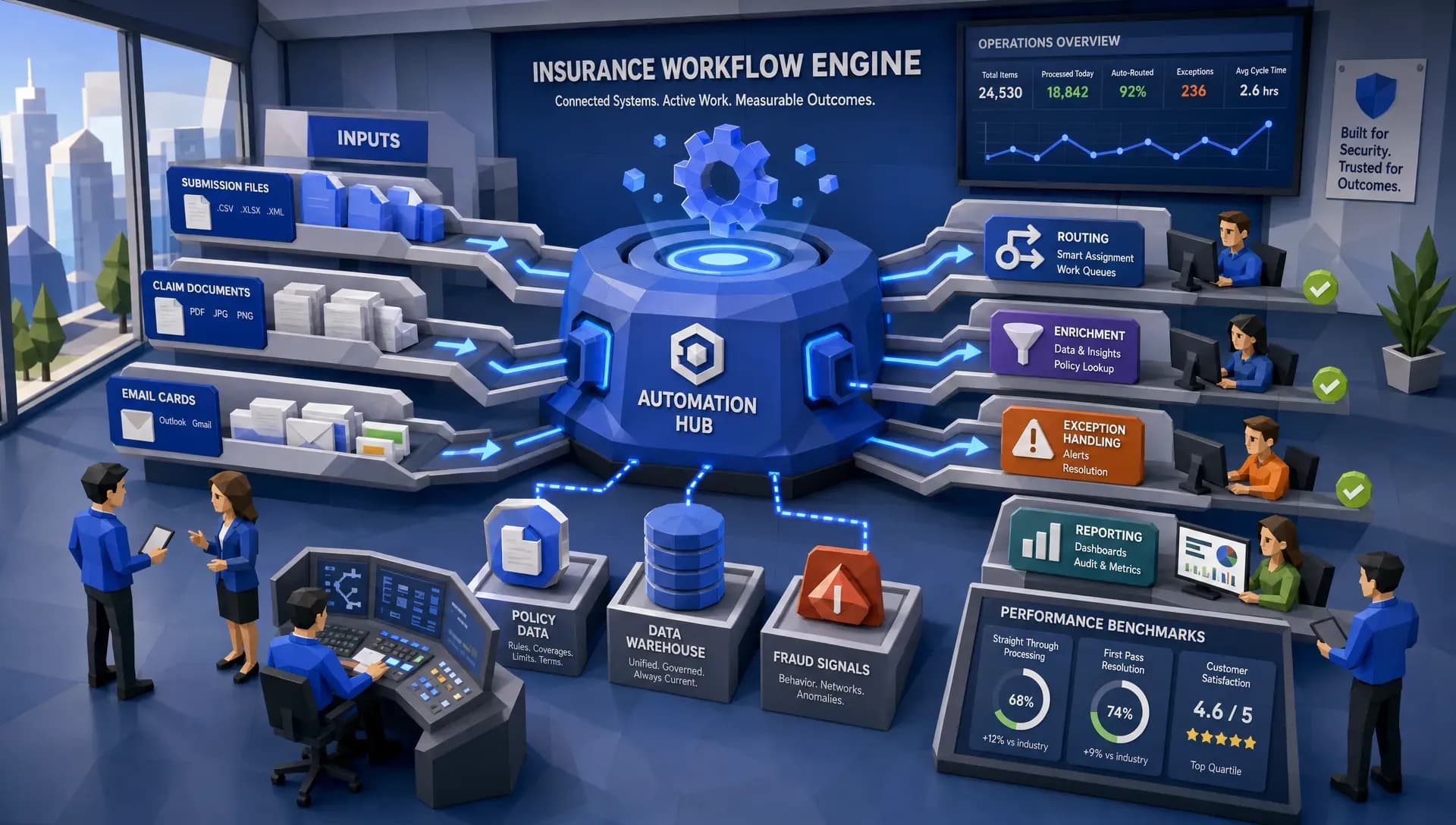
- Ingest CSIO forms from email, portals, PDFs, spreadsheets, scans, and other file types.
- Extract key fields such as applicant details, policy information, drivers, vehicles, locations, coverage selections, prior insurance, and loss history references.
- Normalize those fields so they can be used downstream without re-keying.
- Validate submissions against underwriting rules, required fields, and cross-field logic.
- Enrich the submission through external data sources where appropriate.
- Route clean submissions, referrals, and exceptions to the right person or system.
That is the simple version. The better version also captures every decision, every missing field, every override, and every repeated broker issue so leadership can see what is actually happening in the operation.
This is where I think many automation projects go wrong. They focus on “reading the document” and stop there. Reading the form is table stakes. The value comes from turning the form into usable underwriting data, then making sure the next action happens without someone nudging the process along manually.
Stop making brokers change channels just to help you automate
Here is another opinion that may annoy a few transformation committees: if your automation strategy depends on every broker perfectly adopting a new portal, you are probably in for a long year.
Brokers already deal with too many portals, passwords, appetites, appetite exceptions, supplemental questions, and carrier-specific quirks. A broker once told me, only half-joking, that every carrier portal felt like “another gym membership I forgot to cancel.” I laughed because it was funny. I winced because it was true.
The smarter approach is to automate around the way submissions already arrive. If brokers email CSIO forms, automate the inbox. If they attach schedules, automate schedule extraction. If they include context in the body of the email, capture that too. If they upload through a portal, great, but do not make portal adoption the single point of failure.
Inaza’s approach is built around this reality. The platform supports all file types, integrates with existing systems, and is designed so teams do not need to be retrained just to get value. For MGAs and carriers, that matters. The best workflow improvement is the one people actually use.
This same principle shows up outside insurance. Complex, document-heavy transactions work best when someone coordinates the process end-to-end instead of leaving customers to chase paperwork. For example, Australians navigating UAE property or business setup often lean on Dubai investment and business setup guidance because local documentation, legal steps, and money movement need orchestration. Insurance submissions are different, of course, but the operational lesson is the same: reduce handoffs, reduce confusion, and the whole process gets calmer.
Data enrichment is where the back-and-forth really dies
The most frustrating broker email is the one asking for information the insurer could have checked itself.
If a VIN can be decoded, why ask the broker to confirm the year, make, and model three times? If a property location can be enriched with hazard data, why leave the underwriter switching between systems? If prior insurance or driver data can be verified through an approved source, why wait for a PDF to be resent with a clearer scan?
That does not mean every field should be accepted blindly. It means automation should separate what can be verified from what needs clarification.
Inaza includes pre-built API templates for data providers such as Verisk, LexisNexis, HazardHub, and others, where appropriate for the workflow. That allows CSIO form data to be enriched rather than merely extracted. The difference is important. Extraction tells you what the broker submitted. Enrichment helps you understand whether the submission makes sense.
A practical example: a broker sends a personal auto CSIO form with a vehicle listed at one garaging address and the applicant’s mailing address somewhere else. Manual handling often means a note, an email, and a delay. An automated workflow can flag the mismatch, enrich the location data, check the rules, and route only the true exception to an underwriter. If the mismatch is expected under your rules, the file keeps moving. No drama. No “just circling back.”
And can we retire “just circling back” as an industry phrase? I believe we can heal.
The best automation creates an underwriting memory
Most CSIO automation conversations start with efficiency. That is fair. Faster intake and fewer touchpoints are obvious wins.
But the bigger value comes from the data you capture along the way.
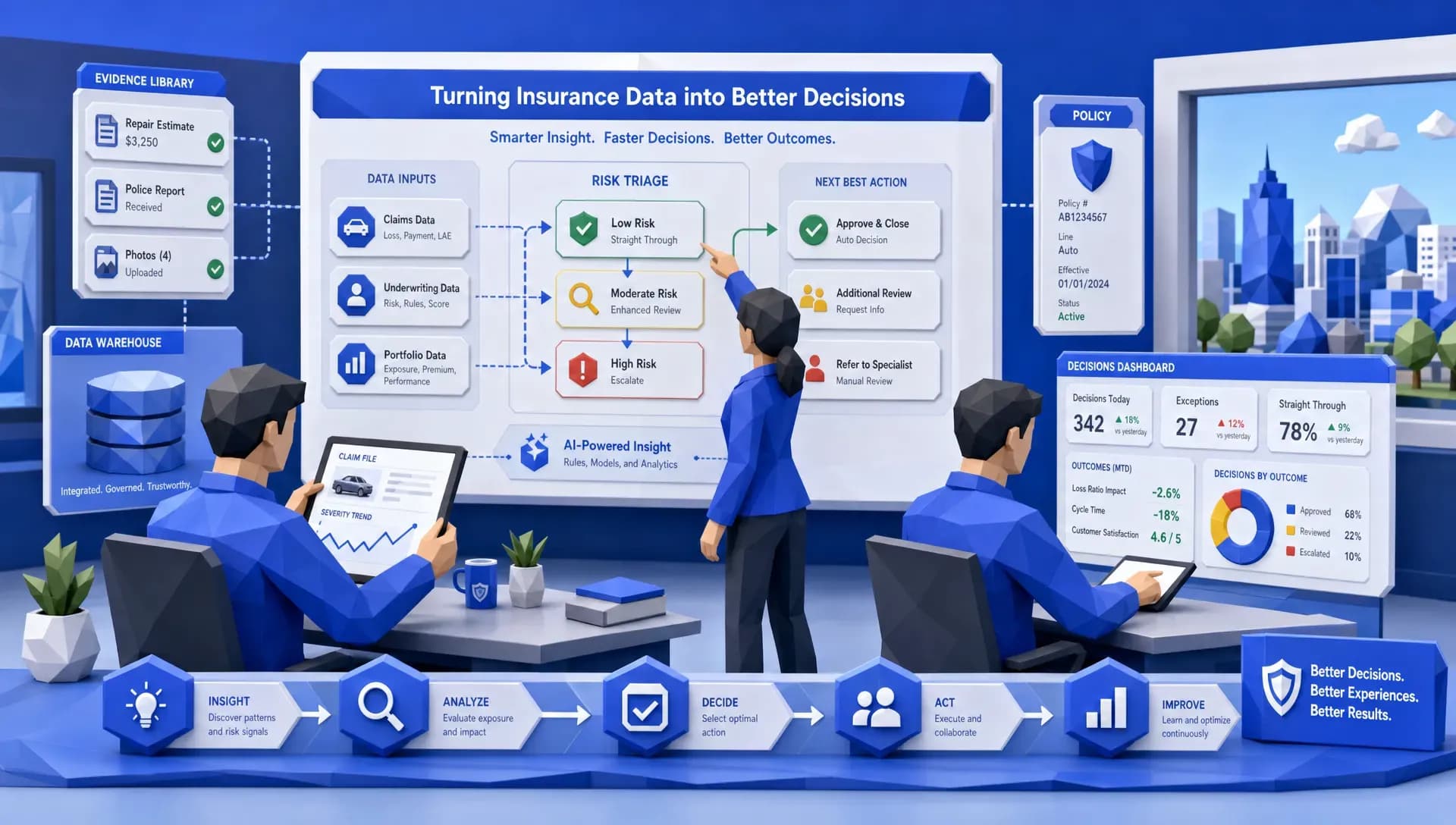
Every CSIO form contains signals: common missing fields, recurring broker errors, appetite mismatches, coverage selections, referral reasons, turnaround delays, quote outcomes, and bind patterns. If that information stays trapped in PDFs and inboxes, it disappears. If it flows into a unified data warehouse, it becomes operational intelligence.
This is one of Inaza’s differentiators. Workflow automation is only the starting point. The platform has a data warehouse underneath it, so key data points from automations can feed dashboards, reporting, and analytics. That gives underwriting leaders a clearer view of where submissions slow down, which brokers send the cleanest business, which classes generate the most exceptions, and where the rules may need tightening or loosening.
For reinsurers, reinsurance brokers, and portfolio managers, that visibility matters too. Inaza also brings industry benchmarks into the system, including benchmarks associated with names such as Aon, Munich Re, Howden, and others. When you can compare your portfolio and workflow performance against market reference points, renewal and reinsurance conversations become less anecdotal. Fewer “we feel good about this book,” more “here is the evidence.”
Evidence tends to travel better than vibes.
What a no-back-and-forth workflow looks like
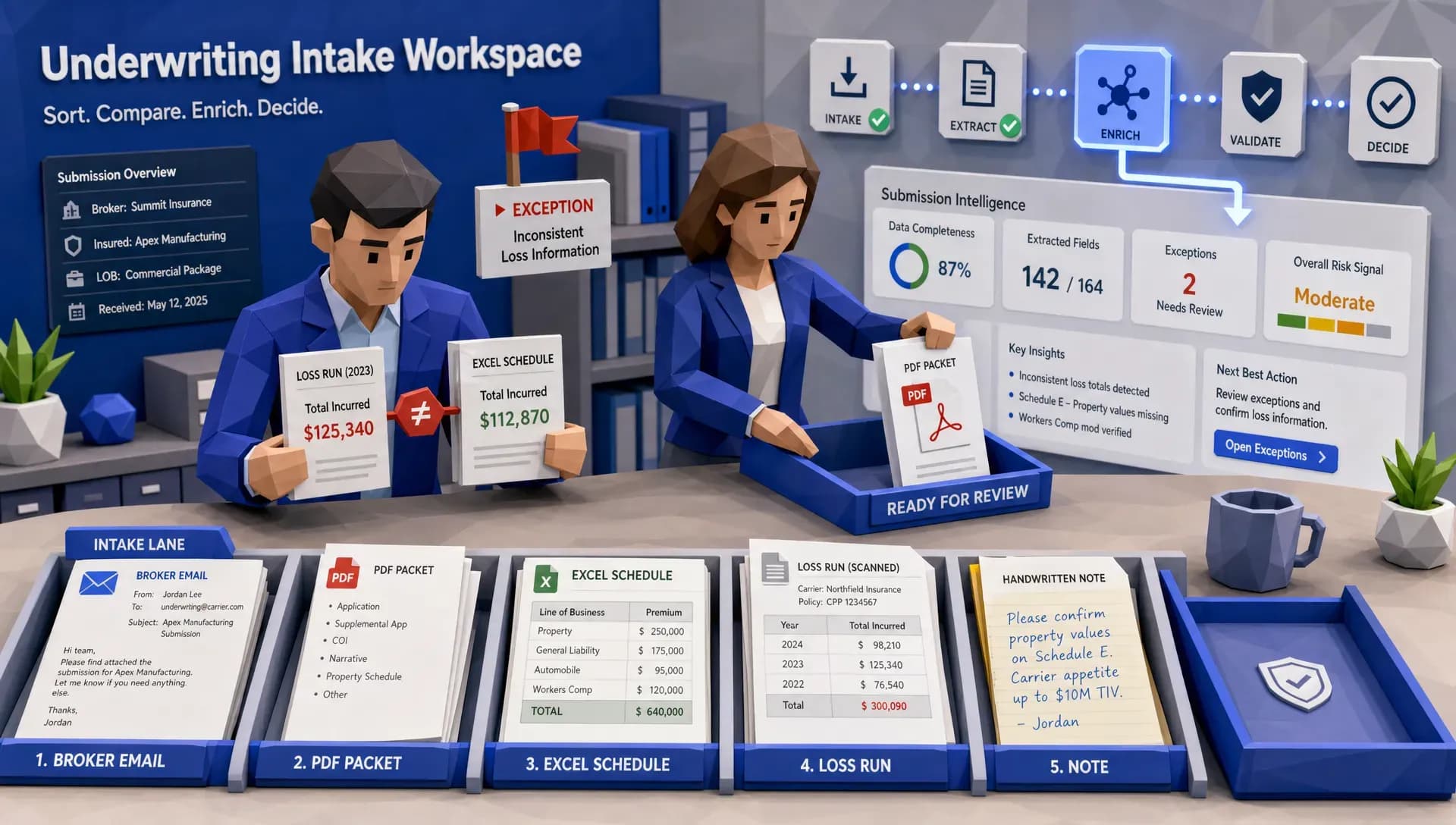
Let’s make this concrete. A broker sends a CSIO application, a vehicle schedule, proof of prior, and a short note asking for a rush quote. In the old world, someone opens the email, saves the attachments, checks the form, re-keys the data, notices missing information, emails the broker, waits, updates the file, and eventually hands it to underwriting.
In a modern workflow, the submission is ingested automatically. The CSIO form is read and mapped to structured fields. The vehicle schedule is parsed. Required fields are checked. VINs, addresses, driver details, or other relevant fields are enriched through approved integrations. Missing or inconsistent items are flagged. Clean items move forward. Exceptions are summarized for the underwriter.
The underwriter does not start with a blank screen and a PDF. They start with structured data, validation results, enrichment outputs, and a clear referral reason. That changes the tone of the day.
It also changes the broker experience. Instead of getting five separate questions over two days, the broker gets one clear request, if a request is needed at all. Better yet, the system can catch issues earlier and prompt for only the missing information.
I have seen teams reduce friction simply by changing the question from “Can you resend the form?” to “Can you confirm this one item?” That sounds small, but in submission-heavy operations, small things become enormous by Friday.
Do not turn automation into another six-month science project
Insurance has a bad habit of making simple workflow improvements feel like infrastructure moon landings. I say that with affection and mild trauma.
A CSIO form automation project should not require months of workshops before anyone sees a production workflow. Yes, governance matters. Yes, data security matters. Yes, compliance matters. But there is a difference between responsible implementation and endless proof-of-concept theater.
Inaza is designed to avoid the usual PoC back-and-forth. For defined use cases, Inaza can work with a user to deploy a production-ready workflow quickly, including on a single call. That is a meaningful shift. It lets teams move from “we should automate this someday” to “let’s automate this submission path now.”
The reason that matters is simple: form workflows are measurable. You can track intake volume, average handling time, missing-field rates, referral rates, quote turnaround, bind rates, and rework. Once one CSIO workflow is working, you can expand to additional forms, products, states, provinces, broker segments, or operational teams.
Start with the place where the pain is obvious. The inbox usually knows.
Where underwriters still belong
Let me be clear: I do not want automation making every underwriting decision in a vacuum. Neither do most serious insurers.
Underwriters still need to evaluate nuance, unusual risks, coverage intent, broker relationships, and edge cases. They also need to challenge bad data. Automation should not remove underwriters from judgment. It should remove the repetitive work that prevents judgment from happening soon enough.
The best setup is simple: automate the intake, validation, enrichment, routing, and reporting. Keep people in the loop for exceptions, authority decisions, complex accounts, and cases where the data tells an odd story.
That is especially important for MGAs, where appetite, authority, and speed all need to coexist. A sloppy automated workflow can create risk. A well-designed one creates consistency, evidence, and faster escalation.
Signs your CSIO workflow is ready for automation
If you are wondering whether this belongs on your roadmap, look for the symptoms. They are rarely subtle.
- Your team manually re-keys CSIO form data into a policy admin, rating, CRM, or underwriting system.
- Brokers often receive follow-up emails for missing or unclear information.
- Underwriters spend more time preparing files than assessing risk.
- Submission status is hard to see without checking inboxes or spreadsheets.
- Leadership cannot easily report on missing fields, exception reasons, or broker submission quality.
- Data from CSIO forms is not feeding analytics, dashboards, renewals, or portfolio reviews.
If three or more of those sound familiar, automation is not a futuristic initiative. It is basic operational hygiene.
Frequently Asked Questions
What is CSIO form automation? CSIO form automation is the process of capturing data from CSIO insurance forms, validating it, enriching it where possible, and routing it into underwriting or policy workflows without manual re-keying.
Does CSIO form automation replace underwriters? No. The better goal is to remove low-value administration so underwriters can focus on risk assessment, exceptions, pricing judgment, and broker strategy.
Can CSIO form automation work with existing systems? Yes, if the automation platform is built for integration. Inaza is designed to connect with existing systems and workflows, so teams can automate intake and data movement without forcing a full system replacement.
How does automation reduce broker back-and-forth? It checks required fields, detects inconsistencies, enriches data from approved sources, and summarizes only the items that truly need clarification. That means fewer scattered follow-up emails and cleaner submissions.
How quickly can a CSIO workflow be automated? Timelines depend on the complexity of the workflow, systems, and data sources involved. For defined workflows, Inaza can help deploy production-ready automation quickly, including working with a user on a single call.
CSIO forms were designed to create structure. The next step is making that structure operationally useful.
If your team is still chasing missing fields, re-keying submissions, and trying to manage underwriting from inboxes, it is time to rethink the workflow. Inaza helps insurers, MGAs, and brokers automate CSIO form intake, validation, enrichment, reporting, and analytics without ripping out existing systems or retraining the entire team.
Want to see what CSIO form automation looks like without the back-and-forth? Connect with Inaza and let’s turn the submission inbox into something your underwriters do not secretly resent.