Here is my hot take after 10 years around P&C underwriting: general liability does not feel uncertain because the risks are always mysterious. It feels uncertain because the evidence arrives like a junk drawer.
A broker email says one thing. The ACORD form says another. The loss runs are in a PDF that looks like it was faxed during the Clinton administration. The insured describes operations as light contracting, then casually mentions subcontracted roofing work on page seven of a supplemental. Wonderful. Everyone grab a coffee.
That is where general liability underwriting automation earns its keep. Not by replacing judgment. Not by pretending every risk can be rubber-stamped. The real value is simpler and, frankly, more useful: automation should remove the guesswork before the underwriter makes the call.
The problem with GL underwriting is not judgment, it is evidence
Commercial general liability underwriting depends on context. Two businesses can share the same top-level class description and look completely different once you understand how they operate.
A restaurant with alcohol sales, late hours, live entertainment, delivery exposure, and a patio is a different animal from a lunch-only cafe in an office park. A janitorial contractor cleaning office buildings at night is not the same as a construction cleanup crew working on active job sites. A distributor with incidental product exposure is not the same as a private-label importer with limited quality controls.
The underwriter knows this. The problem is that the data needed to see the difference is scattered across emails, PDFs, loss runs, supplemental applications, inspection reports, certificates, schedules, contracts, and broker notes.
McKinsey has noted that around 60% of underwriter time can be spent on administrative work rather than risk assessment. I believe it. I have watched smart underwriters spend 30 minutes hunting for payroll, receipts, subcontractor cost, and prior carrier details before they even get to the interesting part: deciding whether the risk fits the book.
That is not underwriting. That is clerical archaeology.

What underwriting automation should actually do
There is a lazy version of automation that says: feed in a submission, get a score, move on. I do not like that version. It makes underwriters nervous for good reason, because GL exposures are too nuanced for a black-box answer with no receipt.
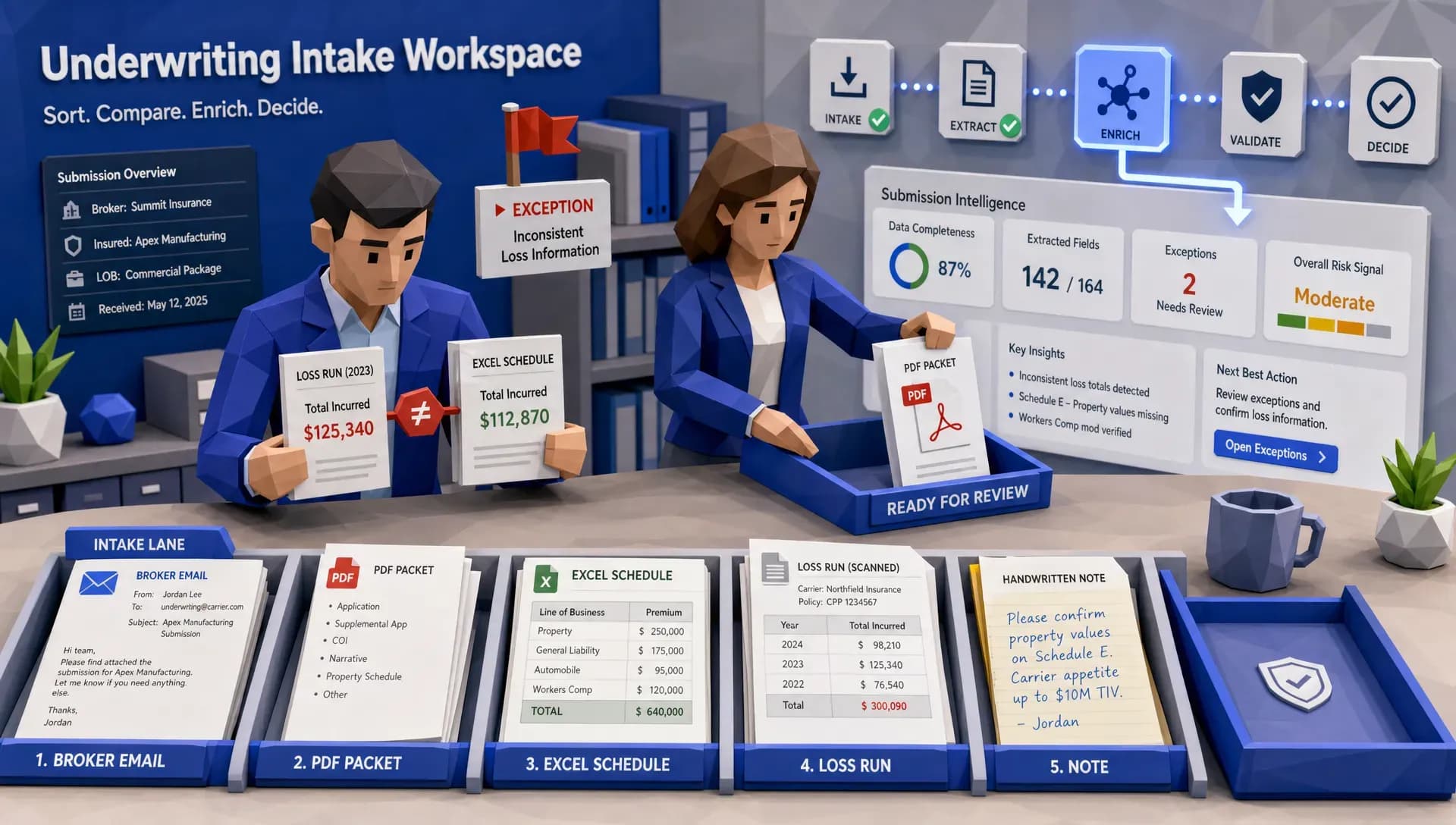
The better version is evidence-first automation. Before a file reaches the underwriter, the system should capture, structure, validate, enrich, and explain the key facts.
For general liability, that usually means pulling together the operational description, class codes, exposure basis, payroll, sales, square footage, location data, prior losses, open claims, subcontractor usage, certificates of insurance, additional insured requirements, contractual risk transfer, prior coverage, requested limits, and any risk control documentation.
That sounds basic until you remember how many submissions arrive with half of that buried in attachments. The work is not glamorous, but neither is flossing. Still important.
Normalize before you rate
The first step is normalizing intake. If one broker sends receipts in a spreadsheet, another sends them in an email body, and another attaches a scanned supplemental, your underwriting team should not have to manually re-key all three.
A strong workflow reads the materials, extracts the relevant fields, and puts them into a consistent structure. It should also flag conflicts. If the ACORD form says $1.2 million in sales and the supplemental says $2.1 million, that is not a small formatting issue. That is a pricing and appetite issue.
This is where general liability underwriting automation starts to feel less like technology and more like good housekeeping. You cannot apply appetite rules, pricing logic, or referral thresholds cleanly if the submission data is messy.
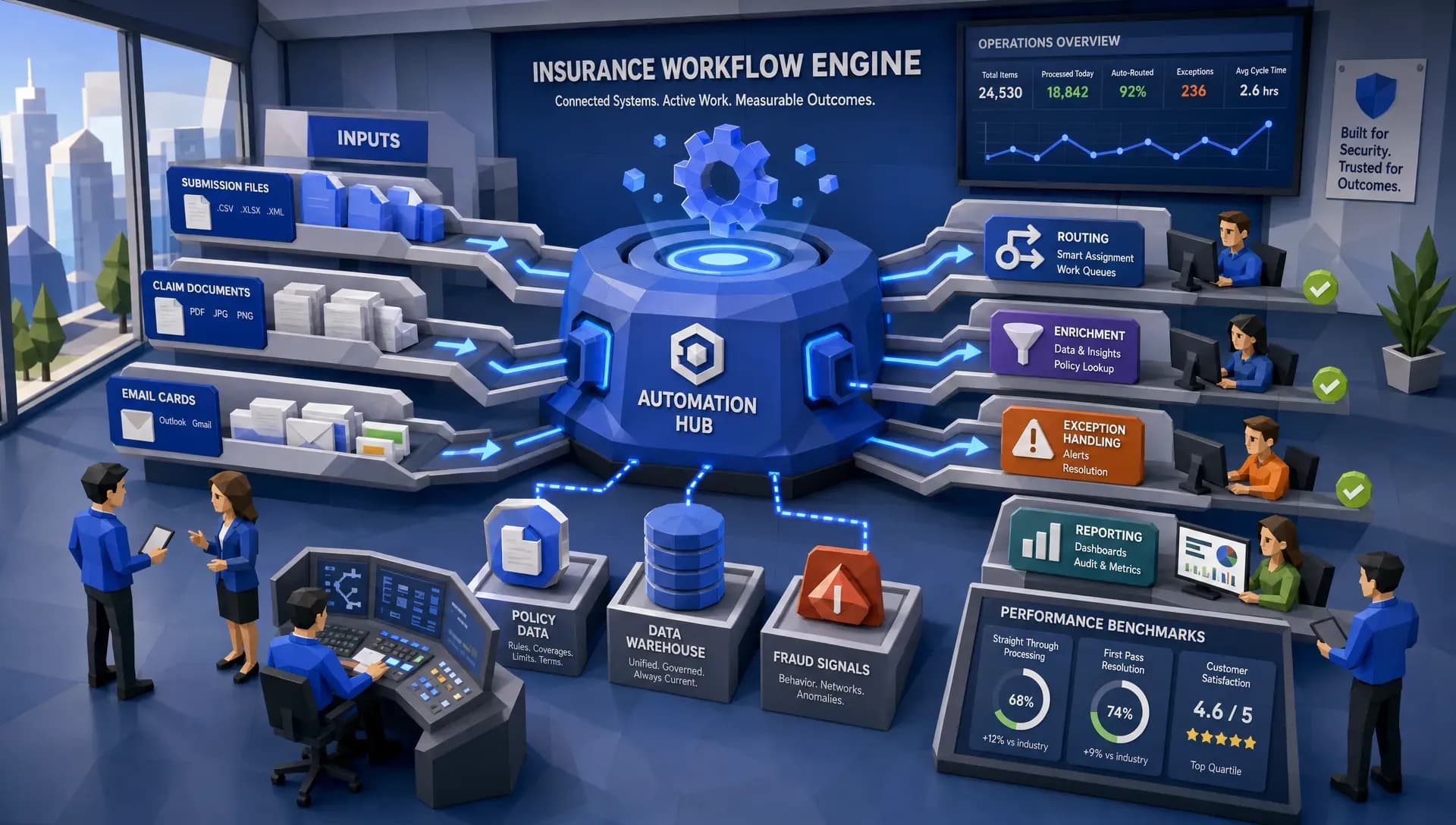
Inaza is built around this practical reality. The platform supports automation across file types and integrates with existing systems, so insurers, MGAs, and brokers do not need to rebuild the entire operation just to stop re-keying the same data six times. That matters because underwriters do not need another portal to babysit. They need fewer loose ends.
Enrich the file before the underwriter opens it
The next step is enrichment. GL underwriting often depends on facts that are not fully supplied by the applicant.
Location matters. Business identity matters. Legal history may matter. Hazard data may matter. Property characteristics may matter. Industry benchmarks matter when you are trying to understand whether an account or segment is drifting away from your intended risk profile.
The trick is not to drown the underwriter in more data. We have all seen dashboards that look impressive and answer nothing. The trick is to add the right data at the right moment.
Inaza’s platform includes pre-built API templates for sources such as Verisk, LexisNexis, HazardHub, and others, which helps automate enrichment without making every integration a custom science project. For a GL workflow, that can mean checking business attributes, location signals, hazard indicators, or other third-party data before a human spends time on the file.
My rule of thumb is simple: if an underwriter would routinely check the same source on 50 similar risks, automate the check and show the result in context.
Triage referrals with reasons, not vibes
Here is where I get opinionated. A referral is only useful if the underwriter knows why it exists.
Too many automated systems produce vague flags. High risk. Needs review. Possible mismatch. Lovely, but why? Is it because the class code conflicts with the operations description? Because prior losses show frequency? Because subcontractor cost exceeds appetite? Because requested limits require senior authority? Because the insured mentions work near airports, schools, healthcare facilities, or other sensitive venues?
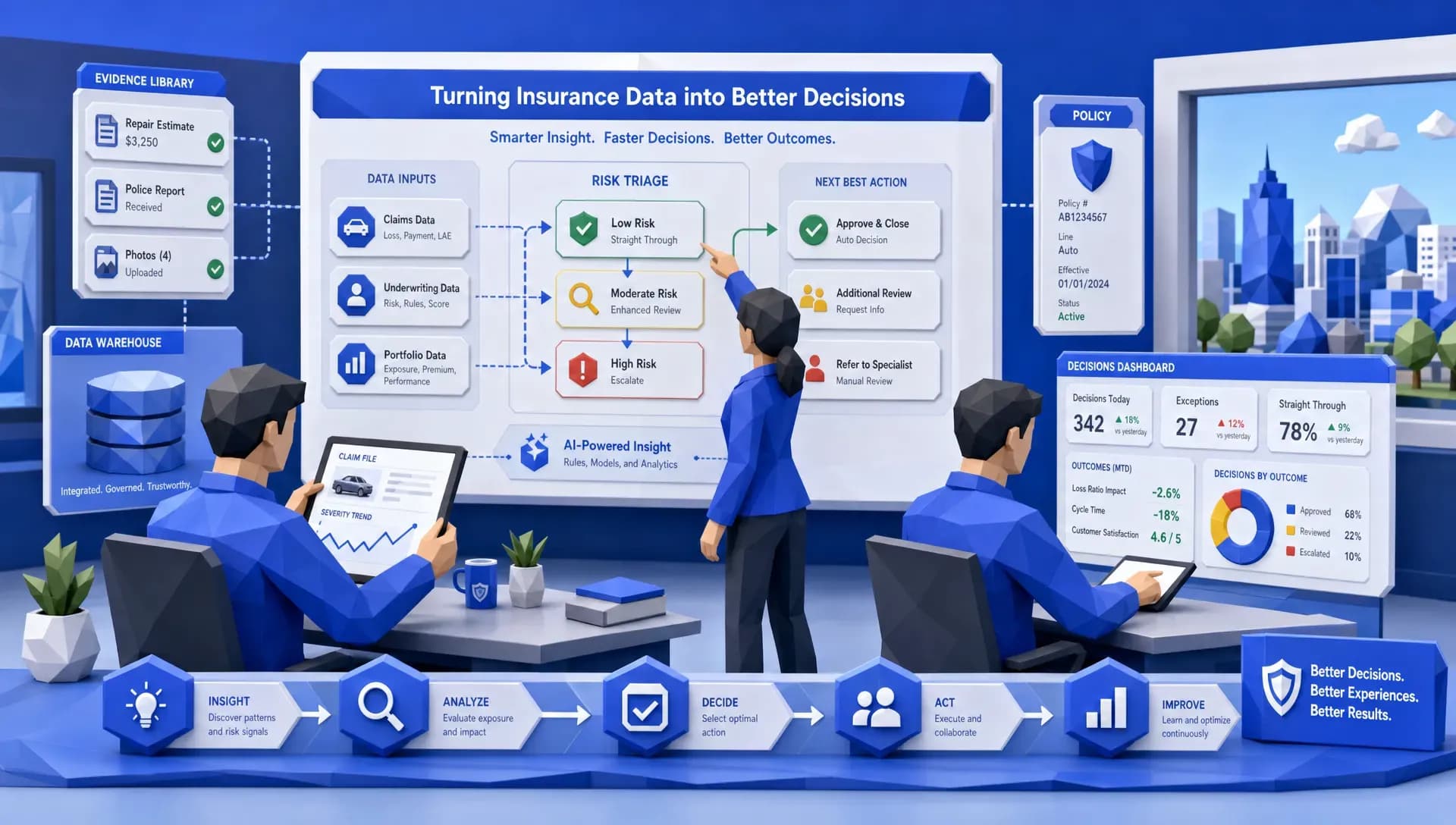
Good automation should route files based on clear rules and evidence. A low-hazard, complete submission inside appetite can move quickly. A submission with missing loss runs, class ambiguity, adverse loss patterns, or contract language that shifts risk in a questionable way should be referred with a plain-English explanation.
This is how you keep underwriters in control. The system does not decide everything. It organizes the work so human attention goes where it creates value.
A simple GL example, because theory gets boring
I once saw a restaurant submission that looked ordinary at first glance. Neighborhood bistro. Decent revenue. No major losses. The broker wanted a quick indication.
Then the attachments told a fuller story. The insured hosted live music on weekends, had a small dance area, allowed private events, used delivery platforms, and had a seasonal patio that extended onto a public sidewalk. None of those details made the account unwriteable by themselves. But together, they changed the conversation.
In a manual process, those details might be found only if the underwriter had time to read every attachment carefully. On a busy Friday afternoon, that is a dangerous bet. And yes, many bad underwriting decisions have been born on Friday afternoons.
An automated GL workflow would pull those details into structured fields, compare them against appetite and referral rules, flag the liquor and event exposure, check loss history, identify missing risk control documents, and route the submission appropriately. The underwriter still decides what to do. The difference is that the underwriter is deciding with the facts on the table.
That is underwriting without guesswork.
Risk controls should be evidence, not checkboxes
General liability underwriting also suffers from checkbox optimism. Does the insured have written safety procedures? Check. Do they conduct training? Check. Do they inspect premises? Check.
Fine. But where is the evidence?
For some accounts, especially public entities, healthcare organizations, infrastructure operators, campuses, venues, and large private-sector facilities, emergency preparedness and exercise documentation can strengthen the risk story. If an insured says they run emergency drills, tabletop exercises, or incident response reviews, documentation gives the underwriter something more concrete than trust me.
That is why tools like Preppr’s emergency management exercise platform are interesting in a broader risk-control context. A platform that helps organizations design, deliver, and document preparedness exercises can create a clearer record of operational readiness. For GL underwriters, that kind of documentation can support a better narrative around premises risk, event exposure, crisis response, and management discipline.
Again, the point is not to reward paperwork for its own sake. The point is to separate insureds that can prove good controls from insureds that simply know which box to tick.
The hidden win: portfolio intelligence
Most GL automation conversations focus on speed. Faster submission intake. Faster quote turnaround. Faster referral routing. All good.
But the real win comes later, when every workflow leaves behind structured data.
If your automation captures why risks were declined, what data was missing, which brokers submit clean files, which classes generate the most referrals, how loss patterns compare by segment, and where pricing exceptions are happening, you stop managing the portfolio by anecdote.
That is a big deal for carriers, MGAs, brokers, and reinsurers. One underwriter saying the contractor book feels worse this quarter is useful. A dashboard showing loss frequency, referral reasons, premium adequacy signals, and market benchmark comparisons is much better.
Inaza has a unified data warehouse underneath its automation layer, which means the data captured during workflows can feed pre-built or custom dashboards. The platform also includes industry benchmarks, including benchmarks associated with firms such as Aon, Munich Re, Howden, and others. For GL portfolios, that can help teams compare performance against the market, explain portfolio movements, and support clearer renewal or reinsurance narratives.
That last part matters. I have sat in portfolio meetings where everyone had a theory and nobody had a clean dataset. Those meetings are character-building, in the same way airport delays are character-building.
How to start without turning implementation into a saga
The best place to start is not a grand transformation program. Start with one GL segment where the pain is obvious: contractors, hospitality, habitational, public entity, professional offices, or whatever class creates the most rework.
Then map the questions underwriters ask before they can quote. What data is always missing? Which documents get reviewed every time? Which third-party sources are checked? Which appetite rules cause referrals? Which exceptions require senior authority? Which fields are re-keyed into the rating or policy system?
Once that is clear, automate the boring parts first. Intake. Extraction. Validation. Enrichment. Referral routing. Audit trail. Reporting.
This is one of Inaza’s differentiators that I think matters in the real world: teams can deploy their own workflows without the usual proof-of-concept back and forth. In many cases, a production-ready workflow can be configured quickly with a user in a focused working session. That is the right spirit. Insurance teams do not need another six-month innovation theater project. They need working workflows.
With 250+ workflow templates, customizable automation, system integration, and no need for broad team retraining, the practical path is to meet underwriters where they already work and remove friction around them.
What to measure if you want proof
No one should buy underwriting automation because it sounds modern. Measure it.
For general liability, I would track submission completeness, time from submission to quote, time spent on manual data entry, referral rate by class, referral reason, quote-to-bind ratio, premium leakage indicators, underwriter touches per file, audit exceptions, and loss ratio by segment over time.
The metric I like most is decision confidence. That sounds soft, but it can be measured through proxy data: fewer missing-field referrals, fewer post-bind corrections, cleaner audit trails, and fewer cases where underwriters have to reopen files because the original submission was misunderstood.
If automation does not improve confidence, it is just a faster way to be wrong.
Frequently Asked Questions
Can general liability underwriting automation make binding decisions? Yes, but it should be used carefully. The best starting point is to automate intake, validation, enrichment, and routing. Straight-through decisions can work for complete, low-complexity risks that fall clearly within appetite, while nuanced or higher-severity accounts should still go to an underwriter.
Will automation replace GL underwriters? No. It should remove repetitive administrative work so underwriters can focus on risk selection, pricing judgment, coverage terms, and broker relationships. In GL, human judgment still matters because operations, contracts, and risk controls often require context.
What data matters most for GL underwriting automation? The core data usually includes operations description, class code, sales, payroll, premises information, loss history, subcontractor exposure, prior coverage, requested limits, contracts, certificates, and risk control documentation. The exact data depends on the segment and appetite.
How do insurers avoid black-box underwriting decisions? Use workflows that show the source data, validation checks, enrichment results, referral triggers, and decision history. Every automated recommendation should be explainable and auditable, especially when it affects pricing, eligibility, or authority.
Where should an MGA or carrier start? Start with a segment that creates heavy rework or inconsistent decisions. Automate the intake and validation steps first, then add enrichment, referral routing, dashboards, and portfolio analytics. The goal is fast operational value without disrupting the whole stack.
Want GL underwriting without the spreadsheet séance?
General liability underwriting will always require judgment. But judgment should not begin with missing data, duplicate entry, and mystery PDFs.
Inaza helps insurers, MGAs, and brokers automate underwriting workflows, capture and enrich submission data, route exceptions, and turn operational activity into usable business intelligence. If your team wants faster GL decisions without sacrificing control, auditability, or common sense, it may be time to see what a cleaner workflow looks like.