Commercial underwriting is fundamentally a data job. The quote, the price, the terms, and the confidence behind the decision all come down to what you know, when you know it, and whether you can defend it later.
But in many P&C organizations, “having data” still means hunting through PDFs, emails, loss runs in inconsistent formats, and spreadsheets that only one person understands. The result is familiar: slower turnaround times, more referrals, more rework, more leakage, and less trust in what the numbers are saying.
Better data does not just mean more fields. For commercial underwriters, better data means information that is decision-ready: structured, validated, enriched, traceable, and usable across the entire lifecycle.
The real problem: underwriting data is often not decision-ready
Underwriters rarely lack information entirely. They lack reliable information that is:
- Consistent across brokers and submission channels
- Comparable across accounts and time periods
- Timely enough to influence decisions before bind
- Connected to downstream outcomes (claims, endorsements, renewals)
- Explainable to auditors, reinsurers, and internal stakeholders
If any of those break, underwriters compensate with judgment, manual workarounds, and conservative assumptions. That keeps the business moving, but it quietly raises expense, slows growth, and can distort risk selection.
A useful way to think about “better data” is: what should the data enable the underwriter to do immediately?
1) Faster triage without sacrificing risk intent
Commercial underwriting is increasingly a throughput game. Winning accounts often comes down to speed and clarity.
Better data enables triage that is:
Complete enough to avoid back-and-forth
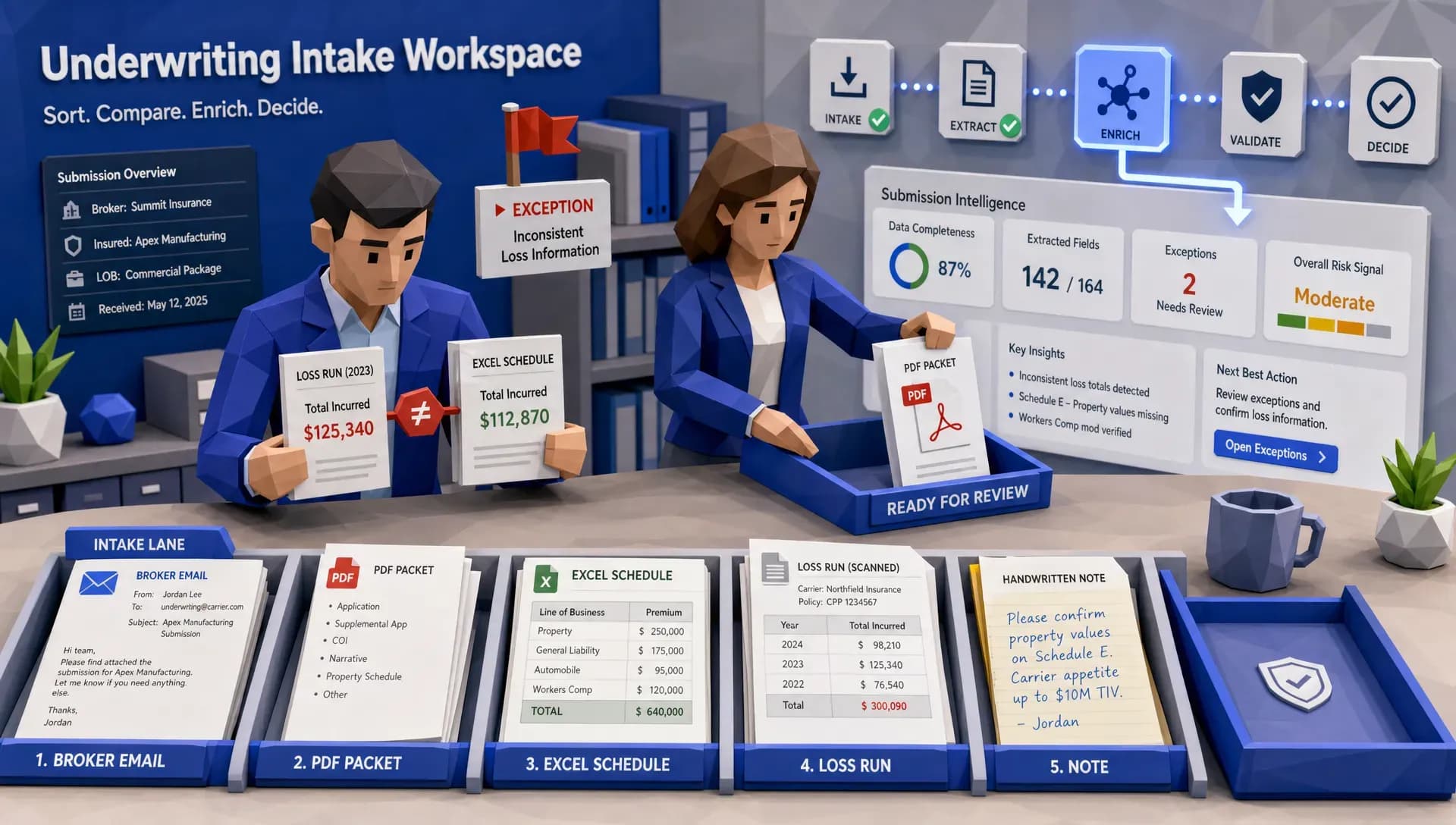
A surprising amount of cycle time is lost to preventable follow-ups: missing driver lists, unclear operations descriptions, incomplete schedules, mismatched limits, or outdated loss runs.
Decision-ready data should:
- Identify missing fields instantly (not after a human review)
- Flag inconsistencies (garaging vs. territory, class code vs. narrative, schedule totals vs. stated values)
- Tell the underwriter what is needed next, with minimal ambiguity
Structured enough to route work intelligently
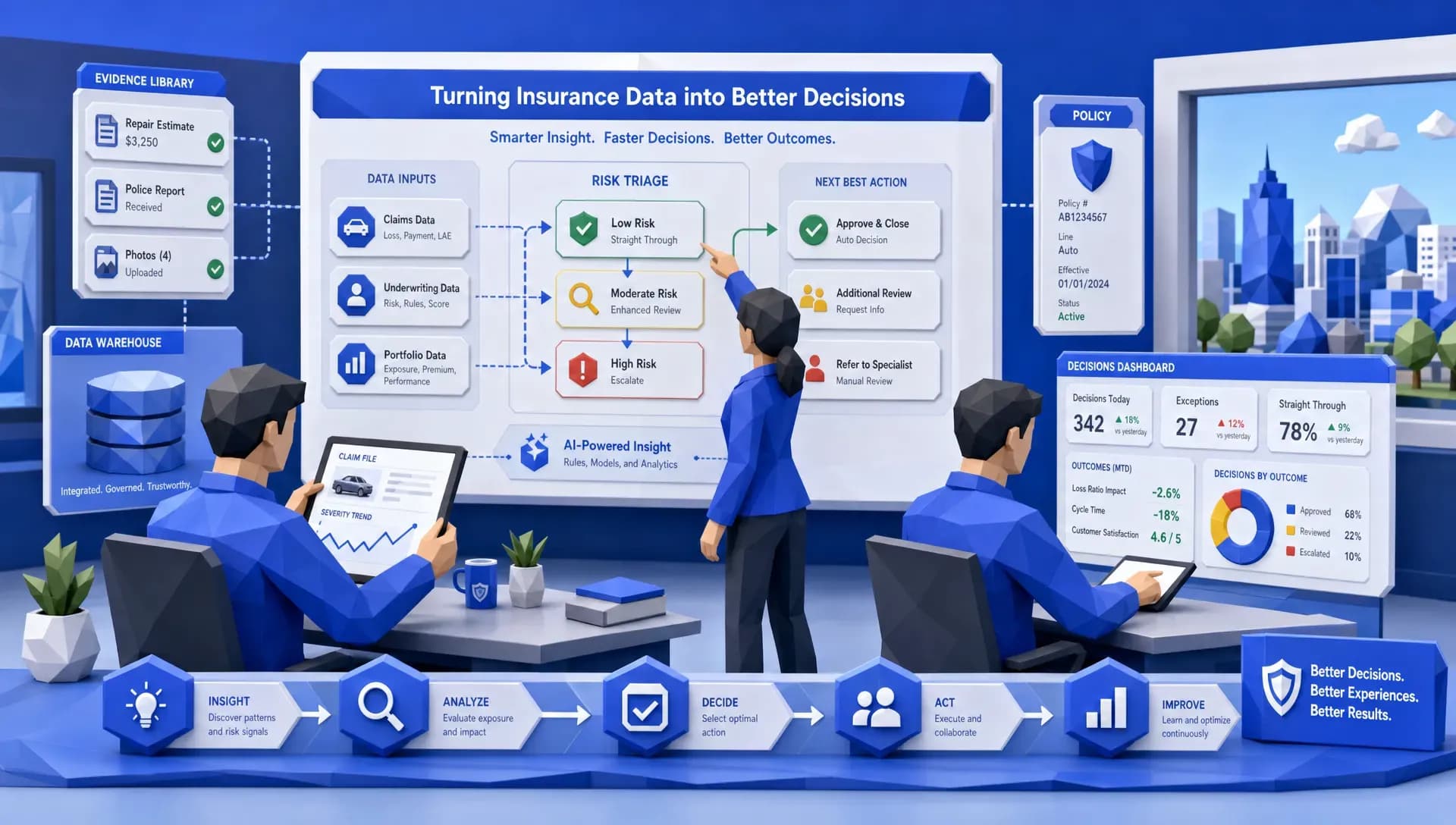
Triage is not just “decline vs. quote.” It is also “straight-through vs. human review,” “junior underwriter vs. senior,” and “standard pricing vs. bespoke.”
That kind of routing requires structured signals, not narrative blobs.

Commercial submissions are inherently variable. Even within the same line, the data can arrive as:
- ACORD forms
- Supplemental apps
- Loss runs (PDFs, scans, carrier portals)
- Fleet schedules (Excel, CSV, PDFs)
- Property schedules, statements of values
- Email threads with key details buried in replies
“Better data” means normalizing these into a consistent schema so you can compare risks, measure performance, and automate the boring parts.
Standardization should answer:
- Are dates in consistent formats and time zones?
- Do cause-of-loss codes map consistently across carriers and TPAs?
- Are entities, vehicles, locations, and drivers represented uniquely (not duplicated under slight name variations)?
- Are exposures tied to the right policy periods and coverages?
Without that, analytics become fragile and automation becomes risky.
3) Enrichment that is easy to operationalize
Commercial underwriters want enrichment, but they do not want another portal, another swivel-chair step, or another vendor process that slows quoting.
Enrichment is only “better data” if it is:
Embedded in the workflow
The best enrichment shows up exactly where decisions are made, for example:
- Business identity verification and entity matching
- Address and geospatial hazard signals
- Loss history verification and claims context
- Vehicle and fleet intelligence
Repeatable and consistent
If enrichment depends on one person’s process, it will not scale. If it is inconsistent across teams, you cannot trust portfolio analysis.
This is where pre-built integrations matter. For example, platforms like Inaza support workflow enrichment via pre-built API templates (including providers such as Verisk, LexisNexis, and HazardHub), so underwriting teams can pull external signals without rebuilding the same connectors repeatedly.
4) Explainability, lineage, and auditability by default
Commercial underwriting decisions get questioned. Sometimes immediately (by brokers). Sometimes months later (by claims). Sometimes during audits, litigation, or reinsurance negotiations.
Better data should let an underwriter answer:
- What data did we use at the time of decision?
- Where did it come from (source system, document, API)?
- What transformations or validation rules were applied?
- What changed later (endorsements, corrections, claim development)?
This is not just governance overhead. It directly impacts:
- Dispute resolution speed
- Confidence in automation
- Regulatory and compliance posture
- Portfolio narratives for reinsurers
In practice, underwriters need decisioning systems that create audit trails automatically, instead of asking teams to reconstruct context from emails and attachments.
5) Feedback loops from claims back into underwriting
Many organizations still treat underwriting and claims as separate worlds. That separation hides useful truth:
- Which underwriting signals actually predicted severity?
- Which submission attributes correlate with litigation, BI escalation, or delayed reporting?
- Where did the submission data prove inaccurate once the claim happened?
Better data makes claims outcomes usable upstream.
That requires two things:
A shared, structured data foundation
If underwriting data is unstructured and claims data is locked in another system, feedback loops turn into ad-hoc projects.
Consistent identifiers and mapping
You need reliable ways to tie a policy and its exposures to downstream claim behavior. Without clean linking, you get misleading conclusions and underwriter distrust.
A connected data approach (where structured data is captured as workflows run) makes this far easier to implement than one-off reporting exercises.
6) Portfolio visibility that helps underwriters steer, not just quote
Underwriters are increasingly asked to manage profitability, not just evaluate individual accounts. Better data should support:
- Segment-level loss ratio and rate adequacy views
- Referral reasons by class, broker, or territory
- Leakage indicators (missed exposures, inconsistent schedules, pricing exceptions)
- Operational metrics like touch count and time-to-quote
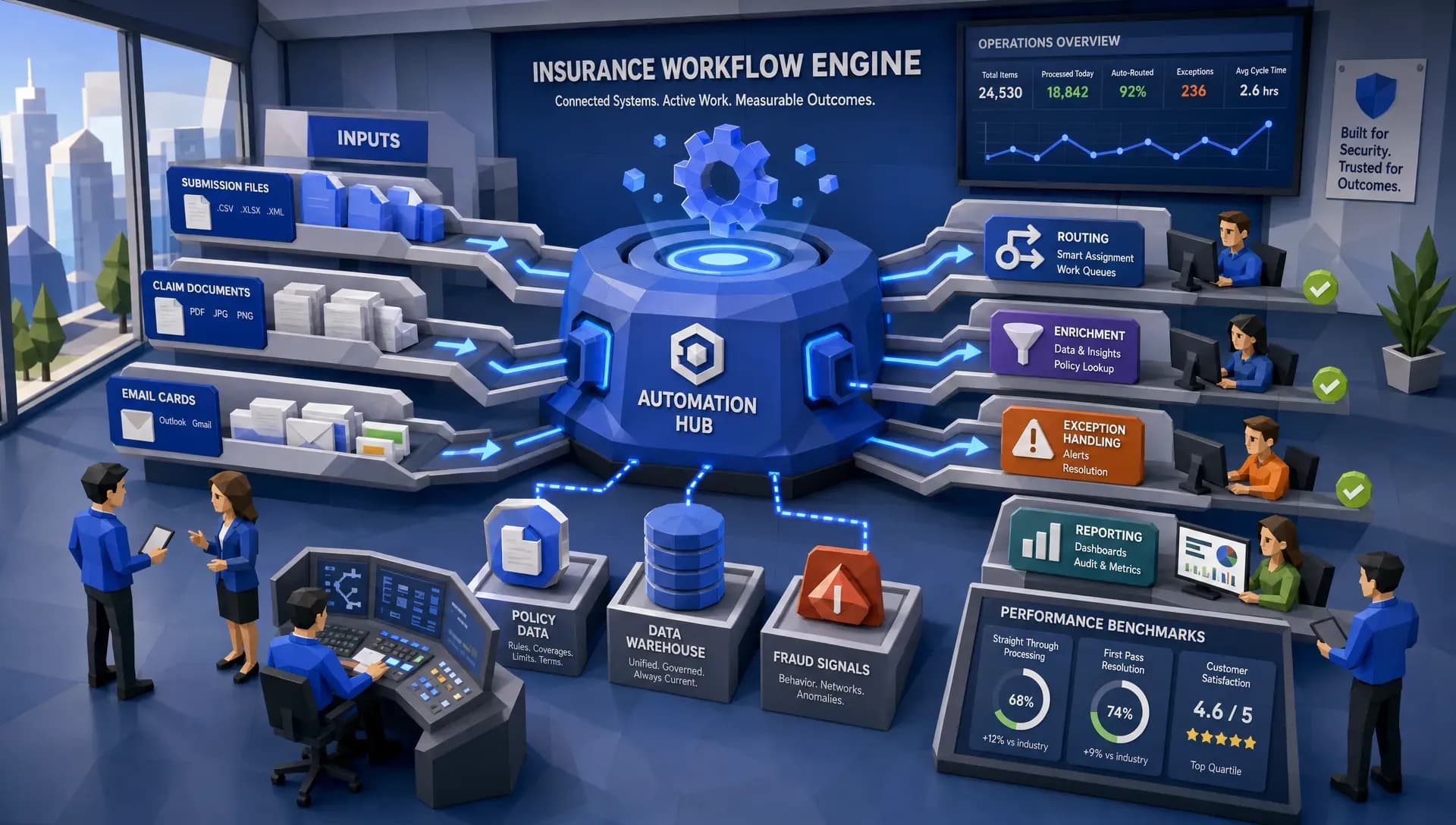
This is where a unified data warehouse becomes a competitive advantage.
If your data foundation captures key fields from workflows as they happen, you can build dashboards that reflect reality, not stale extracts. Inaza, for example, pairs workflow automation with an underlying data warehouse so teams can move from “we automated intake” to “we can measure and improve underwriting performance continuously.”

7) Benchmarks that contextualize performance
Internal metrics are helpful, but underwriters and leaders often need a simple answer to: “Are we doing well compared to the market?”
Benchmarks can sharpen conversations around:
- Quote and bind timelines
- Touch count and operating expense signals
- Portfolio mix shifts and risk concentration
- Renewal performance and pricing adequacy
When benchmark data is embedded into analytics, underwriting leaders can build clearer narratives for capacity partners and reinsurance discussions.
(As one example of this direction, Inaza includes built-in industry benchmarks in its system, citing sources such as Aon, Munich Re, and Howden, to help insurers understand performance relative to broader market context.)
What “better data” looks like in practice: a short checklist
If you are evaluating data improvements for commercial underwriting, use these questions to separate cosmetic fixes from real capability upgrades:
- Can we turn inbound documents into structured fields automatically, across file types?
- Do we validate completeness and cross-field consistency before an underwriter touches the file?
- Can we enrich submissions via APIs without custom projects every time?
- Do we have an audit trail showing source, transformation, and decision context?
- Is underwriting data stored in a way that supports analytics without manual reconciliation?
- Can we link outcomes (claims, endorsements, renewals) back to the original submission?
- Can teams deploy or adjust workflows quickly, without months of back-and-forth?
If multiple answers are “no,” the priority is not another report. It is a more connected data workflow.
A note on people: data improvements still require underwriting fluency
Even with strong automation, better data changes how underwriters work, what they trust, and how they explain decisions.
Many teams find they benefit from targeted upskilling in analytics, workflow design, and AI fundamentals, especially for underwriters moving into portfolio and strategy roles. Programs like the UpSkilling academy’s live, expert-led learning paths can be a practical way to build that capability without relying on ad-hoc internal training.
Frequently Asked Questions
What do commercial underwriters mean by “better data”? Better data is decision-ready data: structured, validated, timely, and enriched with clear lineage, so underwriting decisions are faster, more consistent, and easier to defend.
Why is unstructured data such a problem in commercial underwriting? Unstructured data (PDFs, emails, scanned loss runs) slows triage and creates inconsistency. It is difficult to validate, compare across accounts, and reuse for analytics or automation.
What is the biggest operational benefit of better underwriting data? Reduced cycle time and rework. When submissions are complete, standardized, and validated upfront, underwriters spend less time chasing information and more time making decisions.
How does better data reduce underwriting risk? It improves consistency, makes enrichment repeatable, and creates traceable audit trails. It also enables feedback loops from claims outcomes back into underwriting, improving selection and pricing over time.
Do we need to replace core systems to improve underwriting data? Not necessarily. Many insurers improve underwriting data by integrating automation and a connected data layer on top of existing systems, rather than doing a full replacement.
Turn better data into better underwriting decisions
If you want better underwriting data, focus on systems that make data usable at the moment of decision: ingest any file type, validate and enrich automatically, and store the resulting structured signals in a unified data foundation for analytics.
Inaza’s AI-powered insurance automation platform is designed to do exactly that: streamline underwriting workflows, capture structured data as automations run, and support analytics through an underlying data warehouse, while integrating with existing systems. To explore what this could look like for your team, visit Inaza and request a walkthrough of an underwriting workflow tailored to your submission types.