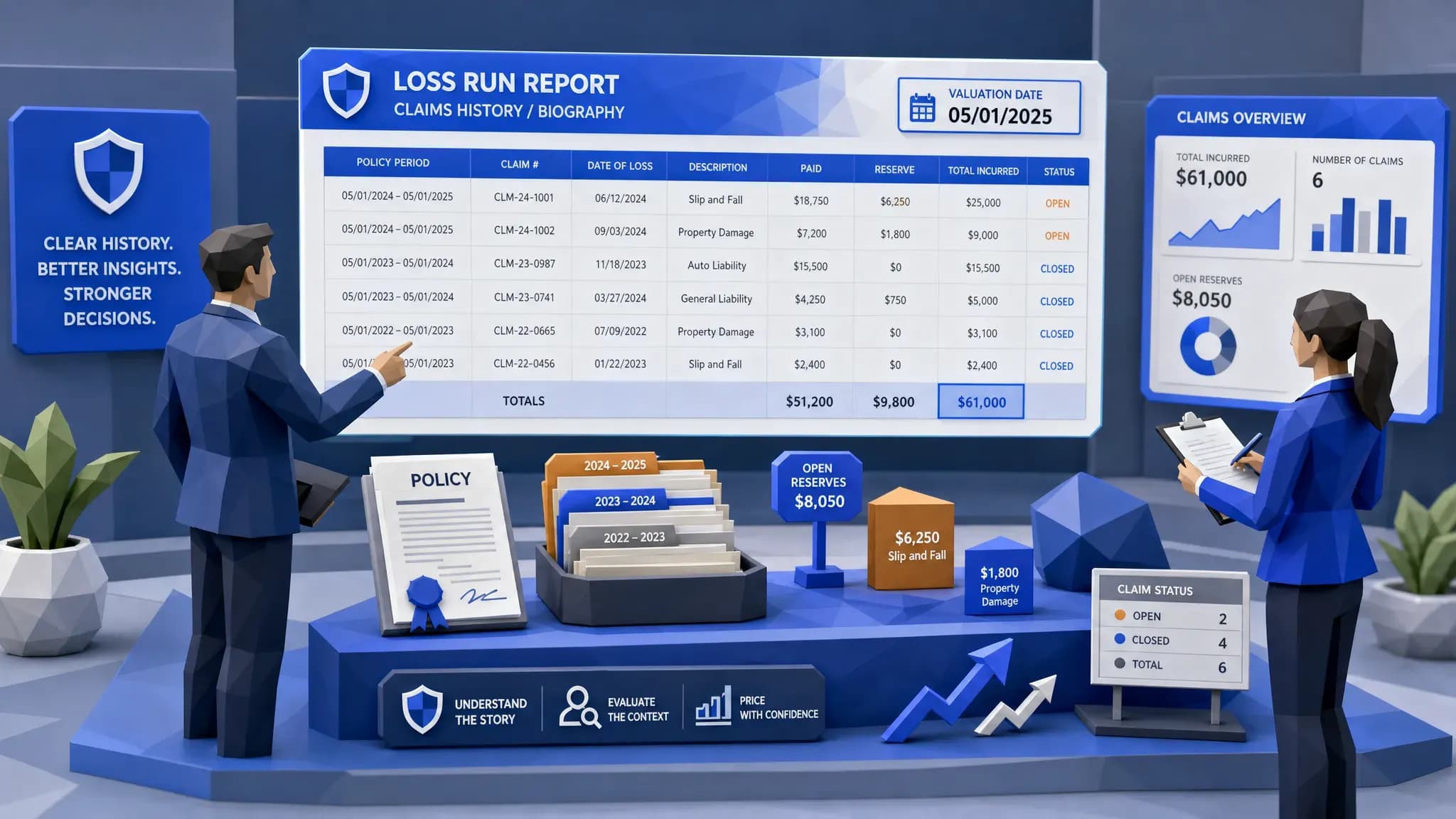
An insurance loss run report looks simple until it ruins your afternoon.
A few columns. Some dates. Paid losses, reserves, incurred totals. Maybe a claim description that says something deeply unhelpful like “fall” or “vehicle damage.” Then someone asks, “So, is this a good risk?” and suddenly the room gets quiet.
Here is my hot take after a decade around underwriting and claims: most bad reads of a loss run happen because people treat it like a scorecard instead of a claims biography. A loss run is not just telling you what happened. It is telling you how often it happened, how expensive it became, how quickly it was reported, how well it was managed, and whether the insured learned anything from it.
I have seen pristine-looking loss runs hide ugly problems, and ugly-looking loss runs reveal well-managed accounts that deserved a second look. The trick is knowing where to look first, what to ignore temporarily, and which questions separate actual insight from spreadsheet theater.
What an insurance loss run report actually is
An insurance loss run report is a claims history report, usually issued by a carrier or administrator, showing claims activity for an insured over a defined period. Underwriters, brokers, MGAs, reinsurers, and risk managers use it to evaluate past losses and predict future performance.
In plain English, it answers: “What claims did this account have, when did they happen, what did they cost, and what is still unresolved?”
Most reports include policy periods, claim numbers, dates of loss, report dates, claim status, paid amounts, reserves, total incurred, recoveries, and short descriptions. Depending on the line of business, you may also see claimant names, coverage type, cause codes, litigation indicators, expense payments, deductibles, and location or vehicle details.
That sounds tidy. It rarely is.
Loss runs come in different carrier formats, PDFs, spreadsheets, scans, exports from legacy systems, and sometimes the dreaded “photo of a printed report.” I once received a loss run where the totals were cut off because someone scanned it slightly crooked. Naturally, that was the one account everyone wanted bound by Friday.

Start with the valuation date, not the total incurred
If you remember one thing, make it this: the valuation date is the first number you should trust, or distrust.
The valuation date tells you when the loss run was generated or when the claim values were current. A report valued 18 months ago is not useless, but it is stale. Open claims may have developed. Closed claims may have reopened. Subrogation may have reduced the net cost. A bodily injury claim that looked modest last year may now have an attorney, medical specials, and a reserve that suddenly grew teeth.
I learned this the hard way early in my career. We reviewed a commercial auto account with what looked like a manageable loss picture. The incurred total was acceptable, the loss ratio was not alarming, and the broker was, shall we say, enthusiastic. Then someone noticed the valuation date was nearly a year old. Updated loss runs showed one open BI claim had developed materially. The deal did not die, but the pricing conversation changed fast.
Before you interpret anything else, confirm these basics: the valuation date, the policy years included, whether the report is currently valued, and whether all lines of coverage are shown. If you are missing a year, missing a line, or working from an old report, you are not underwriting. You are guessing with formatting.
Understand the core fields before making a judgment
Every insurance loss run report has its own layout, but the core fields usually mean the same thing. The names may vary, but the underwriting logic does not.
- Date of loss: When the incident occurred.
- Report date: When the insured or claimant reported it.
- Paid loss: What has actually been paid so far.
- Reserve: What the carrier expects may still be paid.
- Total incurred: Usually paid plus reserves, although recoveries and expenses may be treated differently by report format.
- Claim status: Whether the claim is open, closed, reopened, or in litigation.
- Cause of loss: The event type, such as collision, slip and fall, theft, fire, water damage, or injury.
- Recovery or subrogation: Amounts recovered from another party, salvage, deductible reimbursement, or other offsets.
The most common beginner mistake is reading “paid” as the real cost. Paid is what has left the building. Incurred is the broader estimate of what the claim has cost or may cost. On open claims, incurred is often more useful than paid, but it is still an estimate, not a prophecy carved into stone.
Also be careful with allocated loss adjustment expense, often called ALAE. Some reports include claim handling and legal expense in total incurred. Others separate it. If you compare two accounts without knowing how expenses are treated, you can make one account look cleaner simply because the report format is doing cosmetic work.
Paid, reserves, and incurred are a three-part conversation
Paid losses tell you what has already happened financially. Reserves tell you what the claims team believes could still happen. Total incurred blends the two.
A closed claim with $50,000 paid and $0 reserve is relatively straightforward. An open claim with $5,000 paid and $95,000 reserved is a different animal. The actual cash out the door is small, but the risk signal is loud.
This is where underwriters and claims teams sometimes talk past each other. Claims people know reserves move as facts develop. Underwriters sometimes want a crisp answer today. Unfortunately, claims do not care about our calendar invites.
When I read reserves, I ask: Is the reserve proportionate to the injury or damage description? Is the claim newly opened or long-running? Has it been litigated? Is there a pattern of late reserve strengthening? Are reserves consistently released at closure, suggesting conservative reserving, or consistently increased late, suggesting surprises?
A single high reserve is not automatically a bad account. But unexplained reserve volatility is a warning sign. It may indicate poor claim reporting, incomplete facts, litigation risk, or simply a line of business where development takes time.
Frequency usually tells the better story
Severity gets attention because big numbers are dramatic. Frequency pays the bills, often in the worst way.
If an account has one large claim in five years, I want to understand whether it was a freak event, a true exposure, or a preventable failure. But if an account has 22 small claims with similar causes, I get more interested. Repetition is the loss run tapping you on the shoulder.
A restaurant with one major fire loss might have upgraded suppression systems and improved controls. A restaurant with repeated slip-and-fall claims near the same entrance has a different problem. That is not bad luck. That is probably a mat, drainage, lighting, cleaning, or supervision issue trying to introduce itself.
The same applies by industry. A manufacturer with specialized machinery may show fewer but more severe property or equipment-related losses. If you are underwriting a business that relies on precision components such as custom shafts and rollers, you should read the claim descriptions with operational context in mind. A “mechanical breakdown” loss may mean something very different there than it would for a small office risk.
Frequency also reveals behavior. Late reporting, repeat driver incidents, recurring water losses, repeated theft at the same location, or multiple claims involving the same coverage can point to weak controls. The dollars matter, but the pattern matters more.
Timing can change the whole interpretation
Dates are not clerical details. Dates are underwriting evidence.
Compare the date of loss with the report date. A claim reported the same day tells one story. A claim reported 45 days later tells another. Late reporting can increase claim cost, reduce investigation quality, and create coverage uncertainty.
Then look at claim age. A 30-day-old open claim deserves caution because it has not had time to develop. A three-year-old open claim deserves a different type of caution because something may be stuck, disputed, litigated, or unresolved.
This is especially important in casualty lines. Property damage often develops faster. Bodily injury, general liability, professional liability, and workers’ compensation can take much longer. A clean current-year loss run may not mean a clean year. It may simply mean the claims have not arrived yet.
That is why I prefer reviewing at least three to five years of loss runs where possible, with current valuation. For long-tail lines, I want enough history to see development, not just snapshots.
Calculate the useful metrics, but do not worship them
Metrics help, but they can also make smart people lazy. I like loss ratios, frequency rates, average claim size, and open claim counts. I just do not like pretending they explain everything.
Loss ratio is the classic starting point: incurred losses divided by earned premium. If an account produced $300,000 in incurred losses against $500,000 in earned premium, that is a 60% loss ratio before expenses and profit load. Useful? Absolutely. Complete? Not even close.
You should also look at claim frequency per exposure. For auto, that may be claims per vehicle. For workers’ compensation, claims per payroll band or employee count. For property, claims per location. For GL, it may be tied to revenue, foot traffic, units sold, or another exposure base.
Average claim size can help separate frequency problems from severity problems. Closure rate tells you whether claims are moving. Open claim aging tells you where uncertainty sits. Litigation rate can reveal a claims environment that will not show up neatly in paid losses yet.
The best read combines numbers with narrative. If the loss ratio is poor, ask why. If the loss ratio is excellent, ask why again. Sometimes an account is truly well controlled. Sometimes it has high deductibles, missing claims, immature years, or a reporting issue hiding in plain sight.
Ask the questions that change the underwriting decision
A loss run should lead to better questions, not instant conclusions. When I see a questionable report, I try not to jump straight to “decline” or “surcharge.” I want the explanation.
For open claims, ask what the current status is and whether reserves are likely to move. For repeated claims, ask what corrective actions were taken and when. For large losses, ask whether the exposure still exists. If a fleet had a severe accident involving a driver who is no longer employed, that matters. If three similar accidents happened after that, it matters more.
For property losses, ask about repairs, inspections, protection systems, and maintenance changes. For liability claims, ask about contracts, safety procedures, training, documentation, and litigation trends. For auto, ask about driver selection, telematics, radius of operations, vehicle use, and maintenance.
And always ask about deductibles or self-insured retentions. A loss run may only show losses above a threshold, or it may include first-dollar activity. Those two reports can look wildly different while describing the same underlying risk.
Red flags I never ignore
Some loss run issues are not automatic deal-breakers, but they deserve attention. Missing valuation dates, missing policy periods, unexplained gaps, inconsistent totals, and reports without carrier or TPA identifiers should slow you down.
So should claim descriptions that are too vague to be useful. “Accident” is not a cause of loss. It is a shrug wearing a tie.
Watch for open claims with old dates, sudden reserve increases, repeated claims from the same location or driver, and clean years that appear right after ugly years. That last one may be legitimate, especially if operations changed. But it may also mean you are seeing immature data.
Fraud is another reason to read carefully. The FBI estimates insurance fraud costs the United States more than $300 billion annually, and loss runs can surface patterns worth investigating, especially repeated questionable claims, staged-looking incidents, or inconsistencies between reported facts and claim outcomes.
Again, the point is not paranoia. The point is disciplined curiosity.
Where automation helps, and where it does not
Here is another mildly spicy opinion: the industry does not need underwriters spending premium brainpower re-keying loss runs. We need them interpreting loss runs.
McKinsey has reported that underwriters spend a large share of their time on administrative work rather than risk assessment, which should make every underwriting leader wince a little. When skilled people are copying claim rows from PDFs into spreadsheets, we are using jet fuel to light a barbecue.
This is where automation can help. Not by replacing judgment, but by removing the sludge around it. A good workflow can extract loss run data, normalize fields across carrier formats, flag missing years, identify open claims, summarize trends, and push the structured data into underwriting systems or dashboards.
For insurers, MGAs, and brokers, that matters because loss runs rarely arrive alone. They come with schedules, applications, emails, bordereaux, endorsements, inspection reports, and sometimes a broker note that says “please rush.” Inaza helps insurance teams automate data capture from these kinds of documents, connect the data into existing systems, and use a unified data warehouse for reporting and analytics. That means underwriters can spend less time cleaning the report and more time asking the questions that actually affect pricing, terms, and appetite.
The human still owns the decision. The workflow should make sure the human is looking at the right facts.
A simple reading sequence I trust
When I need to read a loss run quickly, I use the same order almost every time.
First, I validate the report. Current valuation date, complete years, correct insured, correct lines, credible source. Then I scan total incurred and open reserves, but I do not make a decision yet. Next, I separate frequency from severity. After that, I review open claims, old claims, litigated claims, and repeated causes. Finally, I connect the claims to exposure: vehicles, payroll, locations, revenue, operations, or whatever actually drives risk.
Only then do I calculate whether the pricing, deductible, limits, exclusions, risk controls, or referral decision makes sense.
That sequence has saved me from both overreacting and underreacting. One large claim is not always a bad risk. One clean loss run is not always a good risk. The job is to understand which one you are looking at.
Frequently Asked Questions
What is an insurance loss run report? An insurance loss run report is a claims history document showing losses for an insured over a specific period. It usually includes claim dates, paid amounts, reserves, incurred totals, claim status, and descriptions of each loss.
How many years of loss runs should an underwriter review? Three to five years is common for many P&C accounts, but longer-tail lines may require more history. The key is having enough data to understand frequency, severity, development, and whether recent years are mature enough to trust.
What is the difference between paid and incurred losses? Paid losses are amounts already paid on claims. Incurred losses usually include paid amounts plus outstanding reserves, although recoveries and expenses may vary by report format. For open claims, incurred is often more useful than paid alone.
Why does the valuation date matter on a loss run? The valuation date tells you how current the claim values are. An old report may understate open claims, miss reserve changes, or fail to reflect recoveries and closures. Always confirm the report is current before relying on it.
Can automation read loss runs accurately? Automation can extract and organize loss run data far faster than manual review, especially across inconsistent formats. The best use is to handle data capture and trend surfacing so underwriters can focus on judgment, context, and final decisions.
Turn loss runs into decisions, not detective work
Reading an insurance loss run report well is part math, part claims sense, and part healthy skepticism. The goal is not to find the biggest number and panic. The goal is to understand what the claims history says about future risk.
If your team is still manually extracting loss runs from PDFs, spreadsheets, emails, and scans, there is a better way. Inaza helps insurers, MGAs, and brokers automate insurance document intake, structure claims history, integrate data into existing workflows, and build analytics around the information that matters.
Less re-keying. Fewer guessing games. Better underwriting conversations.
That is the kind of loss run reading we can all live with.