2026 is shaping up to be a “prove it” year for insurance technology. Not because carriers, MGAs, and brokers are suddenly less interested in innovation, but because the environment is forcing clarity. Loss costs are still volatile, claimant expectations keep rising, and regulators are paying closer attention to how automated decisions get made.
The trends that matter most in 2026 are the ones that directly move operating metrics: cycle time, expense ratio, leakage, fraud savings, compliance effort, and customer experience. Below are the insurance technology shifts worth prioritizing, plus practical ways to evaluate them.
What “matters” in insurance technology trends (and what doesn’t)
Plenty of tools can demo well. Fewer can survive production realities: messy submissions, fragmented cores, state-by-state compliance, edge-case claims, and humans who need to stay in the loop.
In 2026, the most valuable insurance technology is:
- Workflow-native (built to run underwriting, claims, and servicing processes end to end, not just analyze data).
- Integration-first (fits the existing ecosystem instead of forcing a rip-and-replace).
- Audit-ready by design (clear decision traces, data lineage, and controllable automation).
- Measurable (dashboards tied to business outcomes, not vanity AI metrics).
Trend 1: Workflow-first automation replaces “AI experiments”
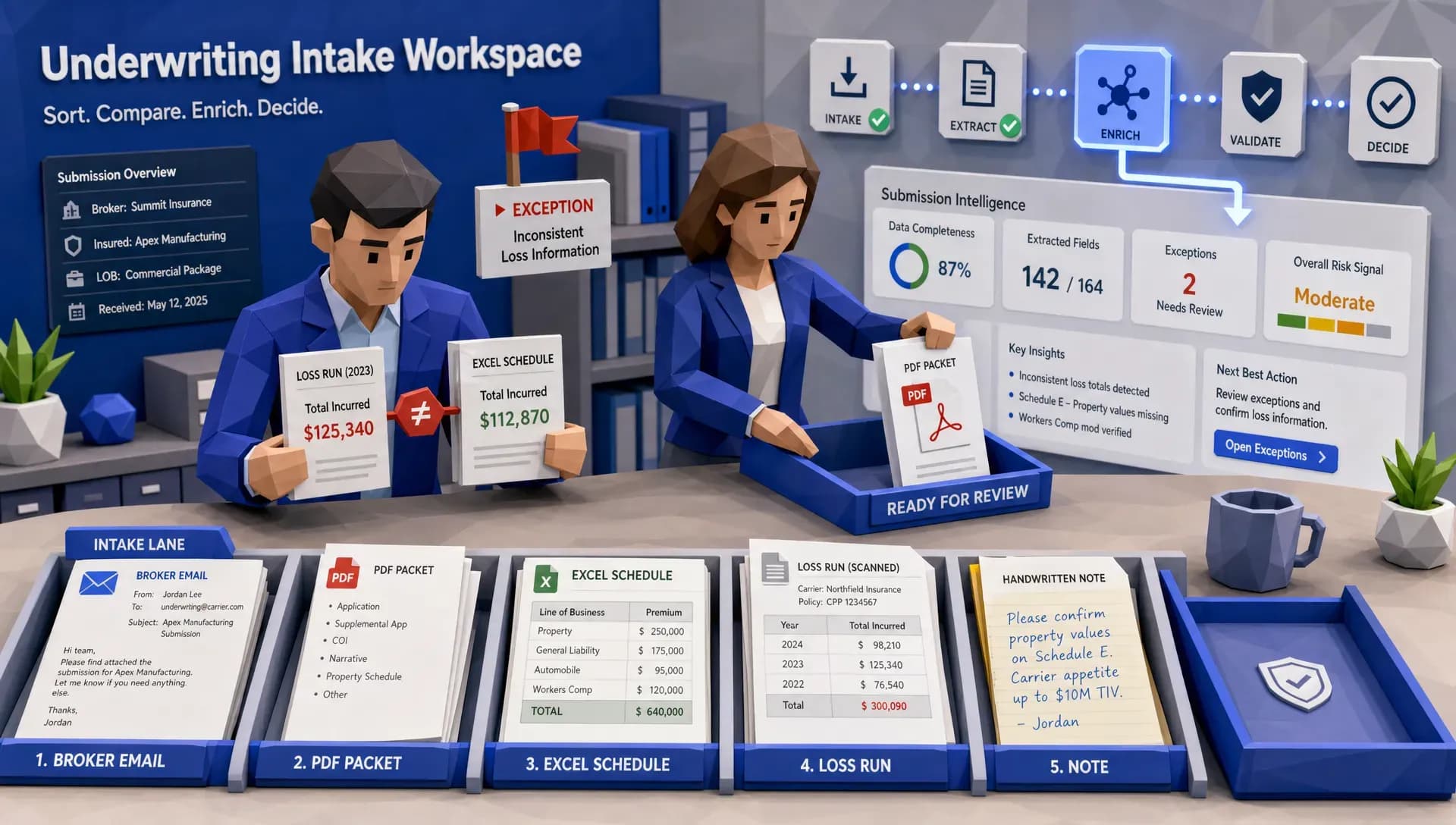
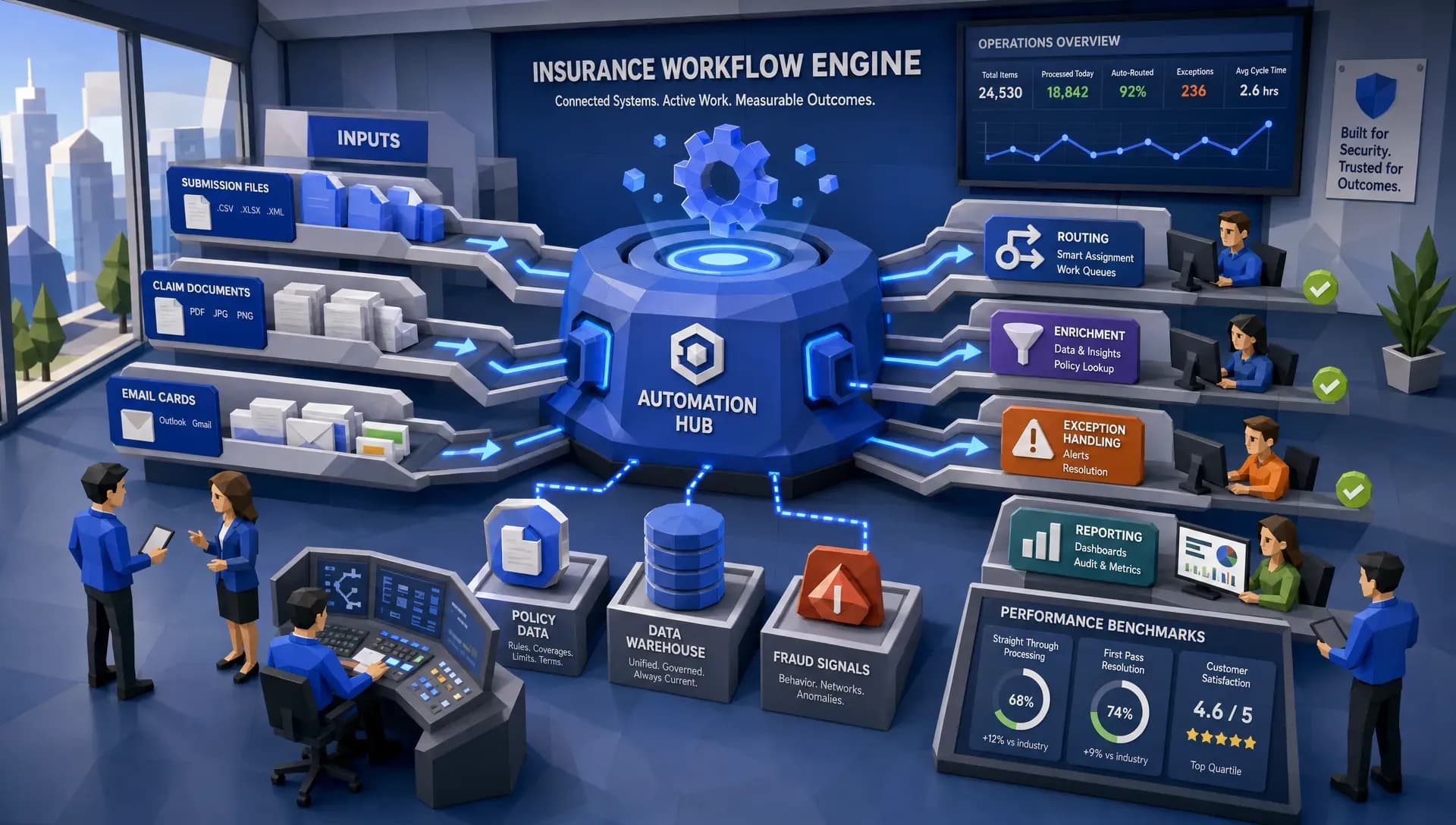
Many insurers spent the last few years piloting point solutions: document extraction here, a chatbot there, a fraud model somewhere else. In 2026, the winning pattern is different: deployable workflows that reduce touches immediately.
Workflow-first automation typically includes:
- Intake (email, portal, PDFs, images, voice)
- Data extraction and normalization
- Validation and enrichment
- Routing and exception handling
- Straight-through processing for low-risk cases
- Human review for ambiguous, sensitive, or high-severity cases
What to look for in 2026 is not “can the model read a document,” but “can we ship a production workflow quickly, and can operations own it afterward?” Platforms that provide reusable templates (and let teams configure without endless back-and-forth) tend to outperform one-off builds.
If you want a deeper view on why connected workflows are replacing siloed automation, see Inaza’s perspective on a connected insurance data platform.
Insurers are rediscovering a classic truth: you cannot automate what you cannot measure, and you cannot measure what you cannot consistently capture.
In 2026, “data platform” is less about a centralized reporting project and more about an operational backbone that:
- Captures structured data from underwriting, claims, and customer interactions
- Stores it with context (policy, claim, submission, communication thread)
- Makes it usable for analytics, automation, and compliance evidence
This is why platforms with an underlying warehouse or lakehouse architecture are getting prioritized. They create a compounding advantage: every automated workflow becomes a new source of clean, queryable data, and that data improves future automation.

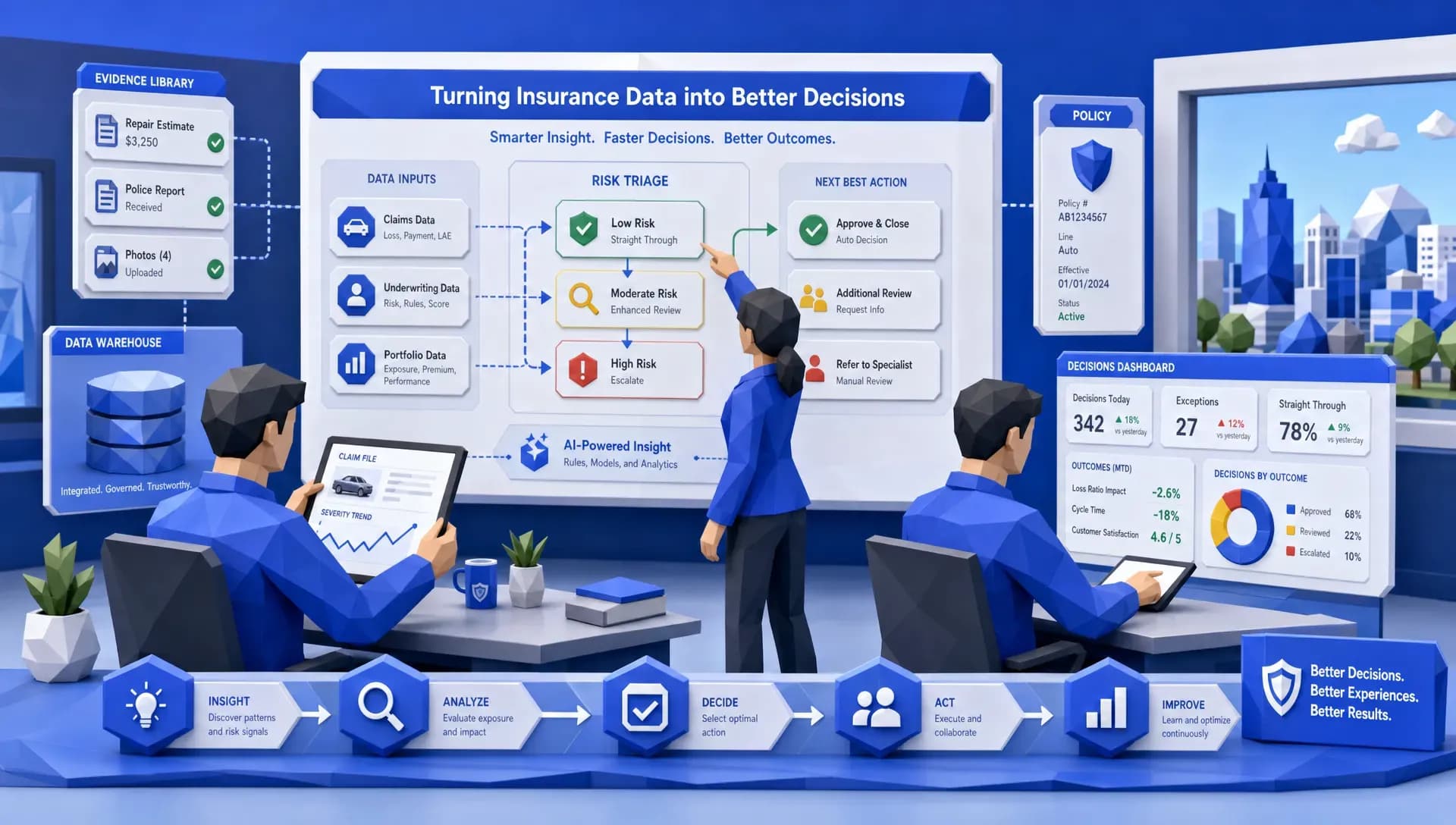
Trend 3: Explainable AI and “audit trails for everything” move from nice-to-have to mandatory
As automation expands into decisioning, more organizations are formalizing how they explain:
- Why a submission was routed to referral
- Why a claim was flagged for investigation
- Why an eligibility check failed
- Why a customer was asked for additional documentation
This trend is being pushed by multiple forces: consumer trust, litigation risk, market conduct scrutiny, and internal model governance requirements.
A useful reference point is the NIST AI Risk Management Framework, which outlines practical principles around governability, transparency, and measurement. Even if you are not “doing GenAI,” you will increasingly be expected to show disciplined controls around automated decisions.
Practical evaluation tip: Ask vendors to demo the “why” path, not just the result. You want to see logs, inputs used, versioning (rules and models), and how exceptions are handled.
Trend 4: Agentic AI enters insurance operations, but with tighter guardrails
“Agentic AI” (systems that can take actions across tools, not just answer questions) is becoming real in insurance operations. The highest-ROI use cases are usually not flashy. They are repetitive, high-frequency tasks such as:
- FNOL intake and follow-up document collection
- Status updates and outbound communications
- First-pass triage and routing
- Creating structured summaries for adjusters and underwriters
The 2026 shift is that carriers and MGAs are getting more specific about controls:
- Identity verification before servicing actions
- Redaction of sensitive PII in transcripts and notes
- Escalation rules for vulnerability, injury severity, and disputes
- Human-in-the-loop checkpoints for sensitive conversations
This is the difference between “a bot” and a production-grade operational agent.
Trend 5: API-driven enrichment becomes standard, not special
In 2026, enrichment is less about “buying more data” and more about making data usable at the exact step it’s needed.
That’s why pre-built API integrations and templates are becoming a serious selection criterion. When enrichment is easy to plug into workflows, teams can add validation checks and risk signals without turning every change into a systems project.
Common enrichment patterns that are getting budget priority:
- Pre-bind eligibility and proof-of-prior checks
- Property and hazard signals for underwriting
- Vehicle and driver intelligence (where applicable)
- Claims-side attorney demand and litigation indicators
- Fraud signals at intake (before adjuster time is spent)
For insurers standardizing enrichment at scale, it helps when a platform already has templates for major providers (for example, Verisk, LexisNexis, HazardHub) rather than treating each integration like a custom build.
Trend 6: Fraud defense shifts toward “synthetic everything” detection
Fraud models trained on yesterday’s patterns are being stressed by a new reality: generative AI makes it easier to produce convincing documents, images, and narratives quickly.
So in 2026, fraud technology is shifting from single-technique approaches to layered defenses:
- Document intelligence (structure, consistency, anomaly detection)
- Image integrity checks (metadata and manipulation signals)
- Behavioral patterns (timing, channel switching, repetition)
- Network signals (shared entities and reuse indicators)
- Real-time decisioning (flag early, route appropriately)
The operational goal is not just “catch more fraud.” It is reduce false positives while preventing wasted adjuster and SIU time.
Benchmarking used to be a quarterly exercise. In 2026, more teams want benchmarks embedded into their analytics so they can answer:
- Are our cycle times drifting compared to the market?
- Is our quote abandonment behavior normal for this segment?
- Do our settlement patterns signal a process issue?
- Are we paying more (or slower) than peers for similar severity bands?
This trend matters because “benchmarked operations” change decision-making. It’s easier to justify investment, redesign workflows, and prepare for renewal and reinsurance conversations when performance can be grounded in market context (including benchmark sets from firms like Aon, Munich Re, and Howden, when available).
Trend 8: Security, privacy, and governance get treated as product features
Security has always mattered, but in 2026 it’s increasingly evaluated as part of operational resilience and customer trust.
Two practical shifts stand out:
- Zero-trust patterns and modern controls are expected when automation touches claims payments, policy changes, and identity workflows. The NIST Cybersecurity Framework 2.0 is a helpful baseline for many organizations aligning controls across vendors.
- Governance is moving closer to the workflow layer: what data is captured, where it’s stored, who can see it, and how automated actions are approved.
When evaluating insurance technology platforms, ask how they handle data retention, access controls, audit logs, and model or rules changes over time.
Trend 9: Talent strategy becomes an insurance technology differentiator
One of the most underestimated trends in 2026 is organizational: insurers are building internal “automation ownership” so value doesn’t disappear after implementation.
The roles getting prioritized tend to be:
- Workflow owners (often in operations, underwriting, or claims)
- Data governance leads (to keep inputs clean and usable)
- Analytics leaders who can tie metrics to dollars
- Security and compliance partners who can approve automation safely
If you are hiring leadership for this shift, working with a specialist executive recruiter can reduce time-to-fill for business-critical roles. Some teams use an international recruitment agency like Optima Search Europe when they need senior commercial, digital, or IT leaders who understand fast-moving technology markets.
A pragmatic way to prioritize these trends (without boiling the ocean)
Trends are only useful if they translate into an execution plan. For most carriers and MGAs, a strong 2026 approach looks like this:
Start with one workflow that has volume and measurable pain
Choose a process where reducing touches clearly saves money or improves service, such as submission intake and triage, policy servicing, FNOL intake, or low-severity claim routing.
Instrument everything, then scale what works
If your automation does not produce structured data and usable reporting, scaling becomes guesswork. A unified data layer and real-time dashboards are what turn early wins into repeatable operating leverage.
Build governance in parallel, not after the fact
Define what must be explainable, what needs human review, and what requires compliance evidence. This prevents rework and helps teams scale automation confidently.
Track business KPIs, not just automation stats
Examples include cycle time, touchless rate, rework rate, cost per transaction, leakage recovered, fraud savings, and customer satisfaction metrics.
Where Inaza fits in the 2026 insurance technology landscape
Inaza’s approach aligns closely with the trends above: deployable workflow automation across underwriting, claims, and customer service, plus a unified data warehouse foundation so automation also becomes a business intelligence engine.
Key elements that map to 2026 priorities include:
- The ability to deploy production-ready workflows quickly (without the typical proof-of-concept loop)
- A warehouse-backed platform that turns workflows into analytics-ready data
- Pre-built API templates for easy enrichment (including providers like Verisk, LexisNexis, and HazardHub)
- Built-in industry benchmarks that help teams compare performance and support portfolio narratives
Frequently Asked Questions
What are the biggest insurance technology trends in 2026? The trends with the most operational impact are workflow-first automation, connected data platforms, explainable AI, agentic operations with guardrails, API-driven enrichment, synthetic fraud defense, and embedded benchmarking.
How do I evaluate an insurance automation platform quickly? Ask to see a real workflow running end to end (intake, extraction, validation, routing, audit logs, exception handling). Prioritize time-to-production, integration effort, and how performance is measured.
What KPIs best prove value from insurance technology? Cycle time, touchless rate, rework rate, cost per transaction, leakage recovered, fraud savings, and customer experience metrics (for example, complaint rate or NPS drivers).
Is GenAI actually useful in insurance operations today? Yes, especially for intake, summarization, communications, and triage. The key is governance: identity controls, PII handling, clear escalation rules, and auditability.
How can insurers modernize without replacing core systems? Use incremental, workflow-layer automation that integrates with existing systems, captures structured data, and scales based on measured ROI rather than a full rebuild.
Next step: make one 2026 trend real in production
If you want to move from “trend watching” to measurable results, start with a single high-volume workflow and insist on three things: fast deployment, clean captured data, and clear analytics.
To see what that can look like in practice, explore Inaza’s AI-powered insurance automation at Inaza and request a walkthrough focused on your underwriting, claims, or servicing priorities.