Claims leaders rarely struggle with knowing what “good” looks like. The real problem is that the insurance claim process often grows organically across channels, teams, vendors, and legacy systems, until every claim requires too many touches, too much re-keying, and too many handoffs.
Streamlining is not just about speed. It is about reducing expense ratio without creating leakage, improving policyholder trust, and making adjusters more effective on the cases where human judgment truly matters.
Below are eight practical ways to streamline the insurance claim process, with a focus on changes you can make in workflow, data, and automation that compound over time.

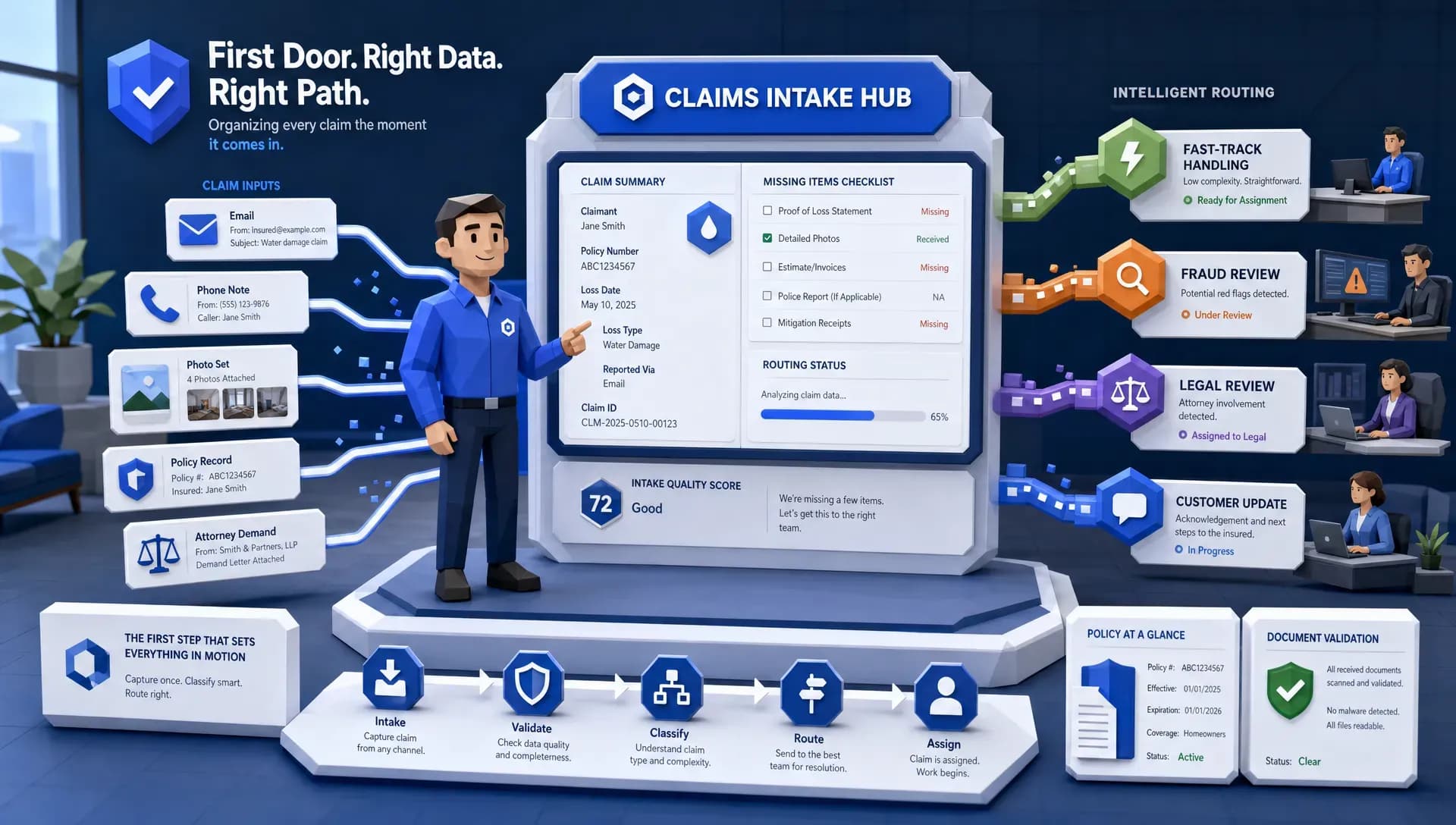
1) Standardize FNOL and make intake truly omnichannel
Most claims inefficiency starts at First Notice of Loss (FNOL). If initial reports arrive through email, phone, agent notes, portals, PDFs, and photos, teams end up spending days correcting basic fields, chasing missing documents, and reopening decisions.
Streamlining starts by defining a consistent FNOL data model (the questions you must answer on day one) and collecting it the same way every time, regardless of channel.
What “standardized intake” looks like in practice:
- The same core fields are captured for every line of business and loss type (with only necessary variations).
- Calls, chats, and web forms map to a single structured record, not free-text that someone later rekeys.
- Missing items trigger immediate automated follow-up, rather than a diary note that gets pushed to “later.”
Automation can help here, but the goal is operational: reduce downstream variability. (If you want a deeper FNOL-focused playbook, Inaza has a practical guide on optimizing FNOL processes with automated systems.)
2) Automate document intake and eliminate re-keying
A surprising amount of claims cycle time is spent on “administrative cognition”: opening attachments, reading forms, copying values into a claim system, then doing it again when new documents arrive.
Intelligent document processing (IDP) streamlines the insurance claim process by converting inbound material into structured data reliably:
- Police reports, repair estimates, medical bills, invoices, letters of representation
- Photos, PDFs, scanned packets, emails with attachments
- Mixed file types coming from vendors and policyholders
The operational win is not just OCR. It is building a repeatable workflow where documents are:
- Classified (what is this document?)
- Extracted (what fields matter?)
- Validated (does it match the claim, coverage, and policy data?)
- Posted to the right system of record
Platforms like Inaza are designed to integrate with existing systems and support all file types, so you can reduce manual handling without forcing teams to change how they receive information.
3) Use smart triage to route by severity, complexity, and risk
Not every claim should move through the same path.
When claims teams talk about streamlining, they often mean “speed everything up.” In reality, top-performing operations separate claims early into lanes:
- Low-severity, low-complexity claims that can be straight-through processed (STP)
- Standard claims that need adjuster review, but minimal investigation
- High-severity or high-risk claims that require senior handling, coverage review, SIU involvement, or counsel
The key is triage that is consistent and explainable. You want routing decisions that are defensible, auditable, and easy to improve.
A practical approach is to combine:
- Business rules (coverage thresholds, line of business routing, jurisdiction triggers)
- Predictive scoring (severity likelihood, litigation propensity, anomaly signals)
- Human-in-the-loop escalation for edge cases and sensitive conversations
This reduces rework because claims land with the right handler earlier, and fewer claims bounce between queues.
4) Enrich claim data upfront with third-party sources (and do it automatically)
A major reason claims slow down is that key verification steps happen late. Adjusters discover missing facts only after reviewing a file manually, then request information, then wait.
Data enrichment reverses that timeline by pulling in third-party signals early so the file is “decision-ready” sooner. In P&C, that can include identity and address validation, property risk data, vehicle data, claims history, and other policyholder context.
Two principles make enrichment actually streamline the insurance claim process:
- Trigger enrichment at the moment of intake or first document receipt, not later in the lifecycle.
- Use pre-built connectors/templates so you are not building a custom integration for every data vendor.
Inaza’s approach here is notable because it supports pre-built API templates (including commonly used sources like Verisk, LexisNexis, and HazardHub) so claims teams can enrich automations quickly without a long integration cycle.
5) Screen for fraud earlier (especially invoices, receipts, and images)
Fraud controls are often bolted on after the file is already moving. That creates an ugly trade-off: either you slow down all claims, or you miss fraud because you screen too late.
A more streamlined model is early screening with exception routing:
- Screen documents as soon as they enter the process
- Quarantine suspicious items before payment steps begin
- Route only exceptions to SIU or a specialized handler, with evidence attached
This is particularly important for invoices and receipts, where payment leakage can happen fast. For a concrete example of how claims ops teams implement this, Docklands AI outlines a practical workflow to stop paying fraudulent claim invoices by screening authenticity early and routing exceptions with forensic evidence.
If you are building this capability internally or with a platform partner, aim for outcomes that help both speed and accuracy:
- Fewer false positives that waste SIU time
- Faster “clear to pay” decisions for clean claims
- A consistent audit trail for why a document was flagged
(For teams looking specifically at the image side of fraud, the FBI has long cited insurance fraud as a major cost driver, which is one reason early, automated screening has become a cycle-time strategy, not just a loss-control strategy.)
6) Reduce policyholder touches with proactive communication and self-service
A hidden driver of claims expense is inbound status traffic: “Did you get my documents?”, “What happens next?”, “When will I be paid?”
When these questions are answered inconsistently, policyholders call more, complain more, and escalate more. That slows adjusters down and increases cycle time.
Streamlining here is less about fancy chatbots and more about predictable, proactive updates:
- Immediate confirmation of FNOL receipt and next steps
- Automated requests for missing items with clear instructions
- Status updates at key milestones (inspection scheduled, estimate received, payment approved)
- Clear handoff points when a human adjuster is needed
This is also where “human-in-the-loop” design matters. Sensitive claims conversations, coverage disputes, or injury complexity require empathy and judgment. Automation should reduce noise, then hand off with full context.
7) Automate payment readiness checks (and control vendor invoice leakage)
Many claims organizations focus on streamlining intake and triage, then lose time at the finish line: payment approvals, vendor invoice checks, and reconciliation.
The streamlined alternative is to define a “ready to pay” gate that can be automated for the majority of claims:
- Required documents present and authenticated
- Coverage and policy checks passed
- Estimate and invoice totals reconcile to expected ranges
- Duplicates and anomalies flagged before payment
The objective is simple: pay faster when the file is clean, and slow down only when risk is real.
Automation platforms can support this by extracting invoice line items, comparing them to benchmarks or historical norms, and routing exceptions with clear reasons. Done well, you avoid both overpayment leakage and unnecessary delays.
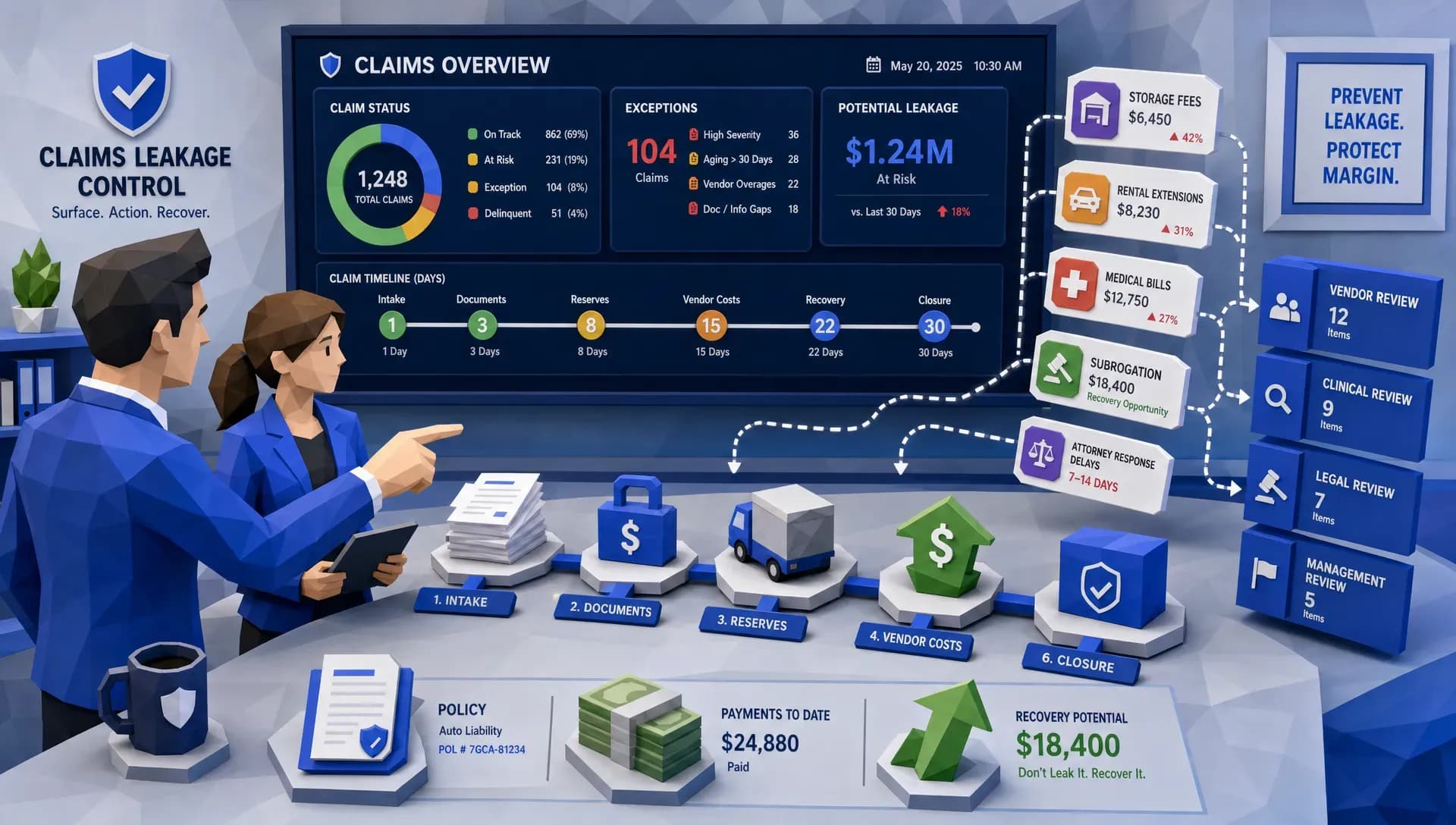
You cannot streamline what you cannot see.
If claims data lives across a claim system, email inboxes, vendor portals, document repositories, and spreadsheets, operational leaders end up managing by anecdote. A unified data layer changes that.
A strong claims data foundation lets you:
- Monitor cycle time by segment (severity, peril, jurisdiction, channel)
- Identify where claims stall (waiting on documents, vendor delays, adjuster queue backlog)
- Track leakage signals (late supplements, unusual invoice patterns, repeat vendors)
- Feed claims learnings back into underwriting and renewal strategy
Inaza’s platform differentiator is that workflow automation sits on top of a unified data warehouse, so each automation also captures structured data points that can flow into real-time dashboards.
Even more valuable for executive and reinsurance conversations, benchmarks help you contextualize performance. Inaza includes industry benchmarks (for example, from firms like Aon, Munich Re, and Howden) so teams can compare operational and portfolio performance to the market and build clearer narratives for renewals and reinsurance negotiations.
Putting it together: a streamlined claim process blueprint
If you want a quick way to sanity-check your current insurance claim process, evaluate whether your operation has these three “compounding” elements:
- Fast, structured intake (standard FNOL plus automated document capture)
- Early decisioning (triage, enrichment, fraud screening before work piles up)
- Closed-loop analytics (warehouse plus dashboards that show bottlenecks and outcomes)
When these are in place, every incremental automation template you add tends to reduce touches and improve speed, rather than adding complexity.
Frequently Asked Questions
What are the biggest bottlenecks in the insurance claim process? The most common bottlenecks are incomplete FNOL data, manual document handling and re-keying, slow triage and routing, and late-stage payment or invoice validation that triggers rework.
How do you streamline claims without increasing fraud risk? Screen earlier, not later. Automate authenticity checks and anomaly detection at intake, then route only exceptions to SIU or senior handlers with evidence, so clean claims stay fast.
What is straight-through processing (STP) in claims? STP is an approach where eligible claims are handled end-to-end with minimal human intervention, using structured intake, validation, rules, and automated decisioning, with escalation for exceptions.
Which metrics should claims leaders track to prove process improvements? Common metrics include cycle time by segment, touch count per claim, reopen rate, supplement rate, litigation rate, expense per claim, first-contact resolution, and time-in-queue at each stage.
Do you need to replace your core claims system to streamline the claim process? Not necessarily. Many insurers streamline by integrating automation and data layers with existing systems, targeting high-friction steps first (intake, documents, triage, fraud screening, communications).
Streamline your insurance claim process with workflow automation that ships fast
If your team is stuck in a cycle of “pilot, rework, pilot again,” the fastest path to results is production-ready workflows that integrate into what you already run.
Inaza helps carriers, MGAs, and brokers automate the insurance claim process across intake, document handling, enrichment, fraud controls, and reporting, with a unified data warehouse underpinning every workflow so improvements are measurable.
Explore Inaza’s platform at Inaza to see how quickly you can deploy a workflow, then scale into analytics and benchmarking without starting over.