If you have ever sat in a claims stand-up and heard someone say, “We’re waiting on the estimate,” “We’re waiting on coverage,” or my personal favorite, “We’re waiting on someone to tell us who we’re waiting on,” then you already know the truth about claims cycle time.
The problem is rarely that adjusters are lazy. In my experience, adjusters are usually doing the insurance version of plate-spinning at a wedding buffet. The real issue is that most claims operations are full of hidden waiting states. A document lands in an inbox. A photo sits in a portal. A repair estimate needs re-keying. A coverage note lives in one system, while the claim file lives in another. Everyone is working, yet the claim is still standing still.
That is why the best insurance claims systems do not simply digitize the old process. They remove the dead air between decisions.
My hot take: if a claims system cannot tell you where a claim is stuck, why it is stuck, and what should happen next, it is not cutting cycle time. It is just giving the bottleneck a nicer login screen.
Why claims cycle time is still stubbornly high
Claims leaders have been chasing faster settlements for years, and for good reason. Speed affects indemnity accuracy, expense ratios, customer satisfaction, litigation risk, and retention. Yet even in 2026, many carriers and MGAs still run parts of the claims process through shared mailboxes, spreadsheets, PDFs, and “ask Lisa, she knows where that file goes” workflows.
That last one is not a joke. I once worked with a claims team where a senior adjuster had sticky notes taped around her monitor with exception rules for different programs. She was brilliant. The system was not. When she went on holiday, cycle time went with her.
Industry data tells the same story. J.D. Power’s 2024 U.S. Auto Claims Satisfaction Study reported that auto claim settlement often stretches beyond 30 days. That is a long time for a customer who needs a vehicle, a repair update, or simply some reassurance that their insurer has not vanished into the Bermuda Triangle.
Meanwhile, Celent has estimated that only about 10-15% of claims are processed straight-through without human intervention. That means most claims still touch human hands somewhere, which is fine. The problem is when every claim touches too many hands, too late, with too little context.
The real enemy is not complexity. It is unmanaged complexity.
Claims are messy by nature. A simple auto claim can include FNOL details, police reports, vehicle photos, repair estimates, rental invoices, coverage questions, prior losses, injury indicators, fraud checks, payment approvals, and customer communications.
Complexity itself is not the villain. We insure the real world, and the real world is very good at creating awkward facts.
The villain is unmanaged complexity. That happens when every claim, simple or suspicious, goes through the same slow path because the system cannot separate routine work from judgment work. A cracked windshield should not wait behind a bodily injury file with attorney representation. A clean low-severity claim should not be treated like a staged accident investigation. And a suspicious claim should not sneak through just because it arrived on a Friday afternoon with a tidy-looking PDF.
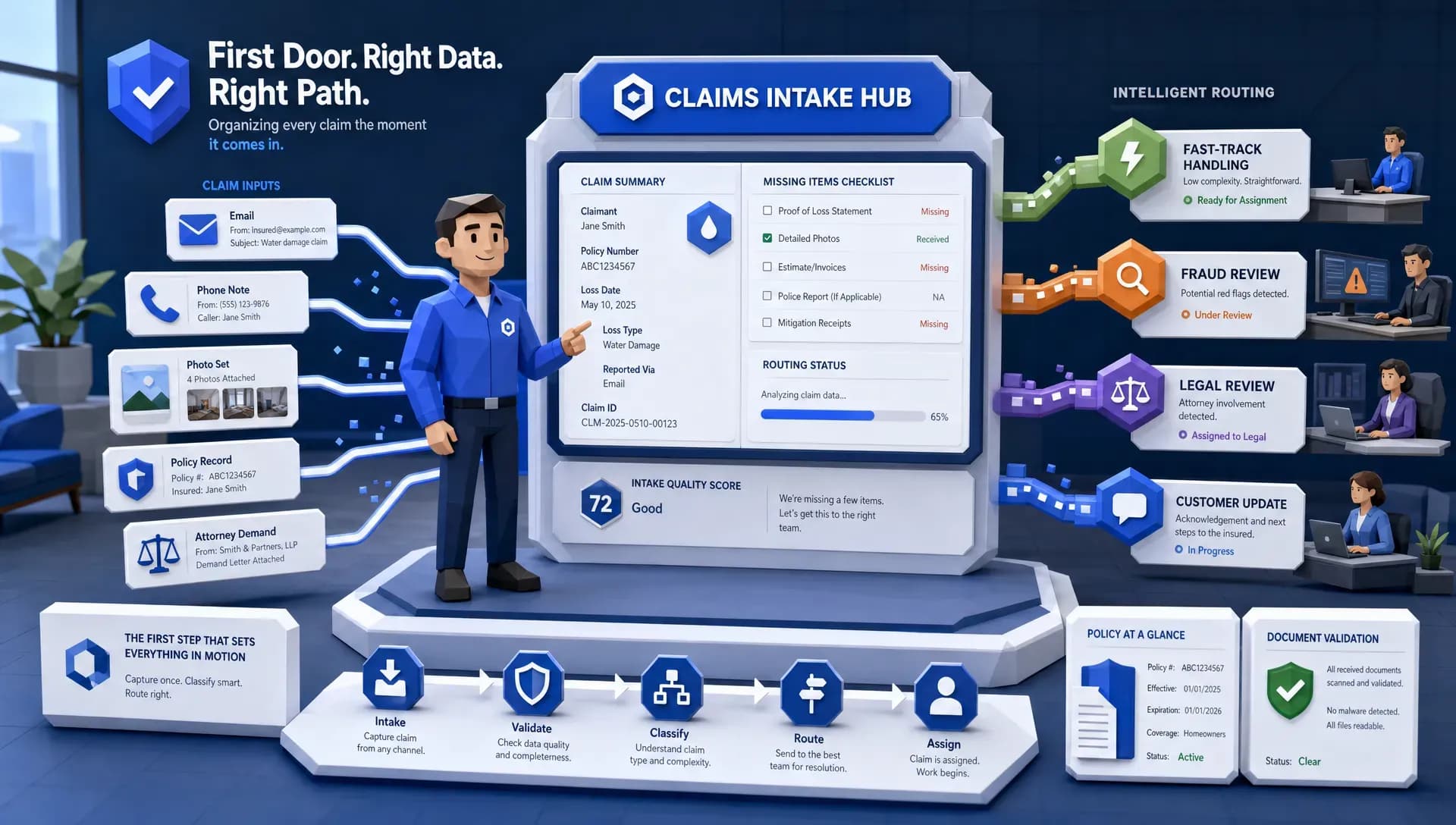
Fast claims systems make these distinctions early. They sort, validate, enrich, and route before the adjuster loses an afternoon doing detective work that software could have done in seconds.
What insurance claims systems need to cut cycle time fast
The best claims systems I see in the market have one thing in common: they are built around decisions, not documents.
Older workflows often ask, “Where do we store this file?” Faster workflows ask, “What decision does this file support, and who needs to act on it?” That shift sounds small, but it changes everything.
A modern claims operation receives information from everywhere: emails, PDFs, photos, loss notices, invoices, call notes, portals, adjuster notes, attorney letters, spreadsheets, and vendor reports. If your system only handles neat structured forms, you have automated the easy part and left the expensive part untouched.
The cycle-time win starts at intake. The system needs to read, classify, and structure incoming claim information without requiring someone to manually retype the same VIN, date of loss, claimant name, policy number, and damage description for the fifth time.
This is where many claims departments quietly lose days. Not in one dramatic failure, but in hundreds of tiny delays. A missing field here. A misrouted document there. A duplicate request to the customer because the estimate was received but not attached to the right claim file. It is death by admin papercut.
They triage claims before humans touch them
Good triage is the difference between a claims operation that feels calm and one that feels like a fire drill with better stationery.
Fast systems look at a claim early and decide whether it appears routine, incomplete, complex, suspicious, or urgent. That routing should be based on the insurer’s own playbooks, not a generic black box that nobody trusts. A low-severity claim with complete documentation may move toward straight-through handling. A claim with attorney involvement, inconsistent images, prior loss concerns, or injury escalation signals should be routed to the right specialist.
This does two things at once. It speeds up legitimate low-risk claims, and it protects the book from leakage. That matters more than ever because fraud is becoming easier to attempt and harder to spot manually. Verisk’s 2025 fraud report found that 98% of carriers believe AI-fueled tools are increasing digital fraud risk. Whether we like it or not, the old “does this photo look weird?” review process is not enough anymore.
They enrich the claim automatically
A claim file is only as useful as the data around it. For auto claims, that may mean vehicle history, driver data, geolocation, weather context, repair benchmarks, prior claims, identity signals, fraud indicators, and coverage details. For property claims, it may mean hazard data, catastrophe mapping, roof characteristics, aerial imagery, or local market repair costs.
The point is not to drown adjusters in more data. We already have enough dashboards in insurance to qualify as a minor skyline. The point is to put the right data into the claim file before a human decision is required.
This is one reason API readiness matters. If a claims system can quickly connect to data sources such as Verisk, LexisNexis, HazardHub, internal policy systems, and vendor platforms, it can reduce the back-and-forth that stretches a claim from “nearly ready” to “still pending” for another week.
They keep humans where judgment matters
Here is another hot take: the goal should not be to automate every claim. That is a great way to create fast mistakes.
The goal is to automate the predictable steps and preserve human attention for the judgment calls. Coverage disputes, bodily injury severity, attorney demands, fraud investigations, vulnerable customers, and unusual loss facts still need people. In those cases, a strong claims system should prepare the file, summarize the key facts, flag the risk, and hand the adjuster a clean working view.
That is how you get faster without becoming careless.
I like to compare it to airport security. Nobody wants every traveler interrogated for 45 minutes, but nobody wants the doors thrown open either. The smart version is risk-based routing: fast lanes for low-risk cases, deeper review for the cases that deserve it.
The fastest systems expose bottlenecks in real time
A claims leader once told me, “Our average cycle time is 18 days.” I asked which stage caused the delay. He paused, smiled, and said, “That is the expensive question.”
Average cycle time is useful, but it is not enough. If you only know the final number, you are staring at the smoke and guessing where the fire started.
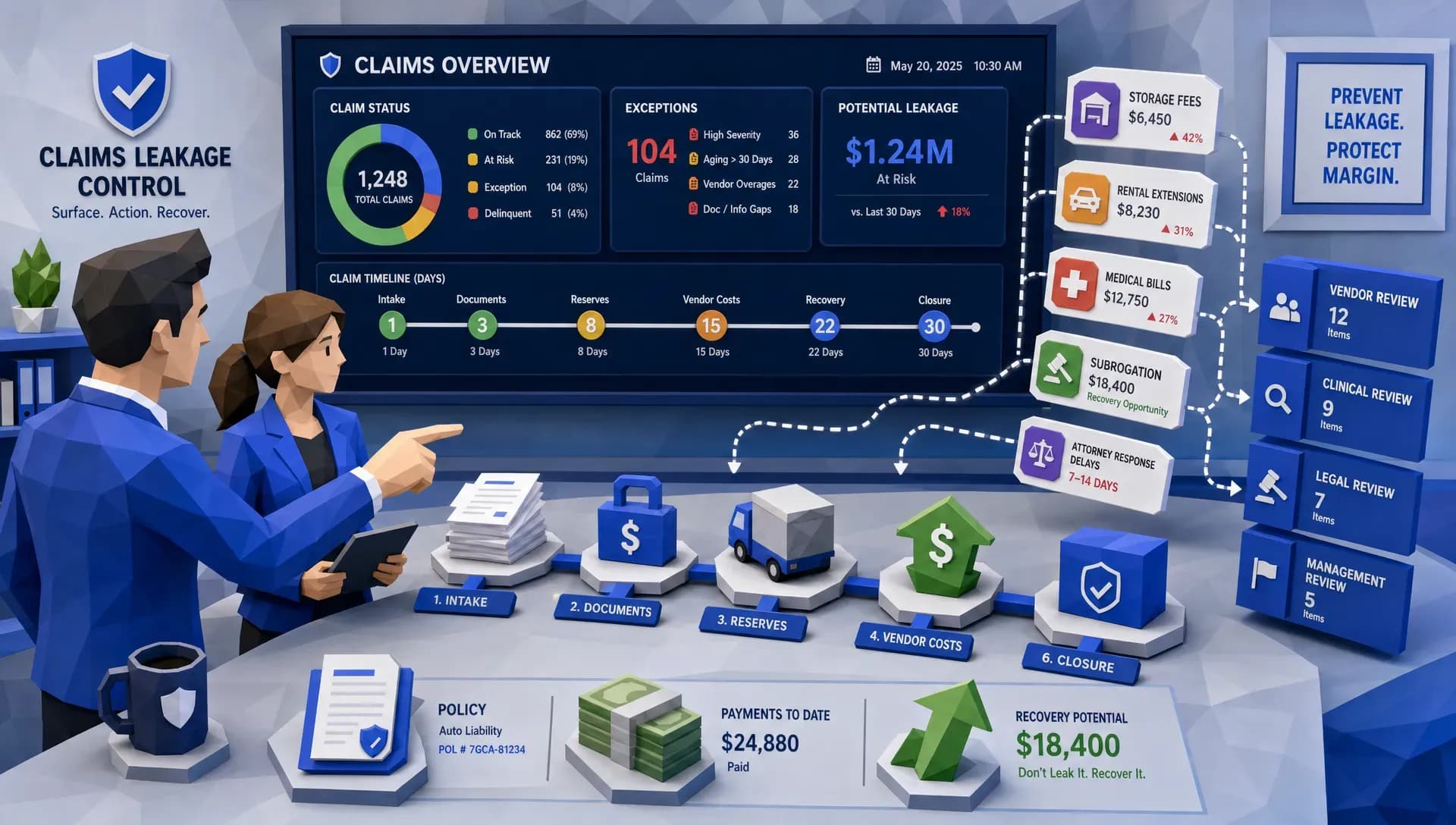
A good claims system should show cycle time by stage: FNOL completion, coverage review, document collection, estimate review, fraud review, customer response, payment approval, and closure. It should also show exception rates, reopen rates, missing-information patterns, adjuster workload, vendor delays, and claims aging by segment.
This is where a unified data warehouse becomes more than a technical nice-to-have. When claims workflow data is captured consistently, operations leaders can see what is happening across the business rather than relying on weekly anecdotes. That visibility also helps with board reporting, reinsurer conversations, market benchmarking, and renewal narratives.
If you are an MGA, that last point matters. Carrier partners and reinsurers do not just want to hear that your operation is “improving.” They want evidence. They want trends, controls, leakage reduction, and proof that the portfolio is being managed with discipline.
Fraud controls cannot slow every claim down
Insurance fraud is a brutal tax on the honest majority. The FBI has warned that insurance fraud costs the industry and consumers billions each year, with broad estimates reaching into the hundreds of billions when all categories are considered.
But here is where claims systems often get the balance wrong. Some carriers respond to fraud risk by adding friction everywhere. More reviews. More approvals. More manual checks. More “just in case” steps.
That approach catches some bad claims, but it also punishes good customers and burns adjuster capacity. The better approach is targeted friction. Let clean claims move quickly. Slow down claims with real risk signals. Make the system explain why a claim was flagged, so fraud analysts and adjusters are not chasing ghosts.
False positives are not harmless. Every unnecessary investigation adds cost, delays settlement, frustrates policyholders, and trains the organization to distrust its own alerts. Fast systems need fraud detection that is precise enough to protect cycle time, not destroy it.
Integration beats replacement when speed matters
I have seen carriers spend years planning a core replacement because they wanted faster claims. Sometimes replacement is necessary. Often, it becomes a very expensive way to postpone operational improvement.
If your goal is to cut cycle time fast, the better move is usually to add an automation and data layer that works with your existing claims systems. That means connecting to the core, document repositories, email inboxes, payment systems, vendor tools, fraud platforms, and analytics environments without forcing the team to relearn their entire working day.
This is one of the reasons Inaza focuses on seamless system integration and customizable workflows. Claims teams should not need a year of retraining before they see value. If a workflow can be deployed quickly, adjusted to your rules, and connected to your existing systems, you can start removing bottlenecks while the broader technology roadmap continues in the background.
Inaza’s platform is built around AI-powered insurance automation for underwriting, claims, customer service, and operations. For claims teams, that means automated data capture, workflow orchestration, API-based enrichment, real-time dashboards, and a unified data warehouse that turns process activity into usable business intelligence. The platform includes 250+ workflow templates and supports all file types, which matters when real claim files arrive looking nothing like the tidy demo file.
Compliance needs to be built into the workflow
Speed without governance is how you end up with a very efficient mess.
Claims systems handle sensitive personal data, medical information, vehicle records, payment details, images, call records, and sometimes legal correspondence. That creates obligations around access control, audit trails, retention, consent, data sharing, and regulatory reporting.
For insurers operating across multiple jurisdictions, privacy and governance cannot be bolted on after deployment. They need to be part of the workflow design. That means every automated decision, routing action, data pull, and user override should be traceable.
If your team is building or modernizing claims workflows in markets with evolving data protection expectations, it can be useful to work with governance and compliance specialists such as Privacy & Legal Management Consultants Ltd., particularly when privacy, cybersecurity, and data protection controls need to be formalized alongside operational automation.
A fast claim that cannot be explained later is not really a fast claim. It is future audit pain wearing running shoes.
The buying test for claims systems
When carriers, MGAs, or brokers evaluate insurance claims systems, I would push past the glossy demo and ask practical questions. The best vendors should be able to show how the system behaves when the file is incomplete, the document is messy, the image is questionable, or the claim needs human review.
Here are the questions I would ask before signing anything:
- Can the system ingest emails, PDFs, images, spreadsheets, forms, and notes without manual re-keying?
- Can it route claims based on our actual playbooks, authority levels, fraud rules, and escalation paths?
- Can it enrich claims using internal and third-party data through APIs?
- Can adjusters see why a claim was routed, flagged, or escalated?
- Can managers view cycle time by stage, team, claim type, vendor, and exception reason?
- Can the workflow be changed without months of development work?
- Can the data support audits, reinsurer reporting, portfolio reviews, and operational benchmarking?
If the answers are vague, keep walking. If the vendor says, “We can probably customize that later,” translate that as “bring snacks, this will take a while.”
Start with the claims that are ready to move
The fastest path to better cycle time is not to automate the most complex claim first. Start with claims that have volume, repeatability, and clear rules.
Glass claims, low-severity auto damage, clean FNOL intake, document collection, estimate validation, payment status updates, and routine coverage checks are often good candidates. Once the team trusts the workflow, you can expand into more nuanced areas such as bodily injury triage, attorney demand handling, image fraud detection, and catastrophe surge workflows.
This is also where pre-built templates help. Starting from a proven workflow template is faster than beginning with a blank page and a conference room full of opinions. I have been in those rooms. The whiteboard always starts clean and ends looking like someone tried to map a subway system during an earthquake.
For more on the operational value of automating the full claims path, Inaza’s guide to straight-through claims processing is a useful next read.
The bottom line: faster claims need fewer handoffs, not louder reminders
Many claims teams try to fix cycle time with reminders, escalation emails, and weekly status meetings. Those tools have their place, but they do not solve the root issue. A reminder that a claim is stuck is not the same as a system that prevents the claim from getting stuck.
Insurance claims systems that cut cycle time fast do a few things extremely well. They capture messy inputs, structure the data, enrich the file, route by risk and complexity, support human judgment, and create visibility into every stage of the process.
That is the real operating model shift. Less chasing. Less re-keying. Less guessing. More claims moving to the right outcome at the right speed.
And if that sounds obvious, good. The best claims improvements usually do. The hard part is finally building the workflow to match the common sense.
Frequently Asked Questions
What are insurance claims systems? Insurance claims systems are platforms that help insurers manage the claims lifecycle, including intake, documentation, triage, coverage review, fraud checks, communications, payments, reporting, and closure. Modern systems also automate data capture and connect with other insurance tools.
How do insurance claims systems reduce cycle time? They reduce cycle time by removing manual data entry, routing claims automatically, enriching claim files with relevant data, identifying missing information earlier, and giving managers visibility into bottlenecks before they become delays.
Should every claim be automated? No. Routine claims can often move through highly automated workflows, but complex claims still need human judgment. The best approach is targeted automation, where simple claims move faster and sensitive or suspicious claims are escalated to the right expert.
What is the best first workflow to automate in claims? FNOL intake, document classification, low-severity auto claims, glass claims, and payment status updates are common starting points because they are high-volume, repeatable, and easy to measure.
How does Inaza help claims teams move faster? Inaza helps insurers, MGAs, and brokers automate claims workflows, capture data from diverse file types, integrate with existing systems, enrich claims through APIs, and monitor performance through dashboards powered by a unified data warehouse.
Cut claims cycle time without replacing your core
If your claims team is still relying on inbox triage, manual re-keying, and heroic adjuster memory, there is a faster way to operate.
Inaza helps insurance teams deploy customizable automation workflows across claims, underwriting, customer service, and operations, while keeping the data visible and usable through real-time analytics and a unified warehouse.
Explore Inaza’s insurance automation platform and see how quickly your claims workflows can move from bottlenecked to measurable.