Here is my mildly spicy underwriting opinion: most blind spots are self-inflicted. Not because underwriters are careless. Quite the opposite. The smartest underwriters I know can smell a bad risk from three emails away. The problem is that the file they are handed is often a scavenger hunt: a PDF from the broker, a loss run in a spreadsheet, a customer email with the real exposure buried in paragraph four, and a rating system that politely pretends none of those things are related.
I learned this the boring way, which is usually how insurance teaches us anything useful. Years ago, I sat with an underwriter on a small commercial auto account that looked tidy. Clean application, reasonable loss history, nothing dramatic. Then we found a vehicle schedule attached to an old email thread showing several units garaged in a different county than the submission stated. The risk had not transformed into a monster, but the priced risk and the actual risk were no longer the same thing. That is the type of blind spot that does not announce itself with flashing lights. It just quietly eats margin.
So when we talk about how to evaluate risk insured with fewer blind spots, my view is simple: stop treating risk assessment as a one-time decision and start treating it as a living evidence file. The goal is not to drown underwriters in more data. The goal is to give them fewer reasons to guess.
What risk insured really means
Risk insured sounds like a neat phrase, but in practice it is messy. It is the person, business, asset, behavior, location, coverage, timing, and documentation that sit behind the policy. In personal auto, that might mean the driver, vehicle, usage, garaging address, accident history, and coverage selection. In commercial auto, it might include fleet composition, radius of operation, driver turnover, commodities hauled, maintenance records, and loss trends. For property, it might be construction type, occupancy, roof condition, wildfire or flood exposure, valuation, security, and local market context.
The trouble starts when we compress all of that into a few fields and call it complete. I have seen beautiful underwriting summaries that were basically wedding cakes made of stale flour. They looked impressive, but one ingredient was off.
A blind spot is any missing or untrusted fact that would change price, terms, appetite, triage, or escalation if it were visible at the right time. That last part matters. A fact discovered after bind or after a loss is still useful, but it is the insurance equivalent of finding your umbrella after the rainstorm.
The hot take: most blind spots are workflow problems
We like to blame data quality, and yes, data quality deserves some of the blame. But my hotter take is that most blind spots are workflow problems wearing a data-quality hat.
If underwriters must open eight systems, chase three broker emails, re-key values from PDFs, and manually check third-party sources, some risk signals will be missed. That is not a personal failure. It is a process design failure.
McKinsey has estimated that underwriters can spend as much as 60 percent of their time on administrative work, rather than actual risk assessment. I have never met an underwriter who joined the profession because they loved copying VINs into a portal. That admin burden matters because every manual handoff creates a place for context to fall out of the file.
Fraud makes the issue more expensive. The FBI has estimated the total cost of insurance fraud in the US at more than $300 billion per year. Meanwhile, digital evidence is getting easier to manipulate, and Verisk's 2025 fraud report found that 98 percent of carriers say new digital tools are fueling fraud. If we evaluate the risk insured using static forms and yesterday's checks, we are bringing a butter knife to a fencing match.
The blind spots I see most often
The intake blind spot
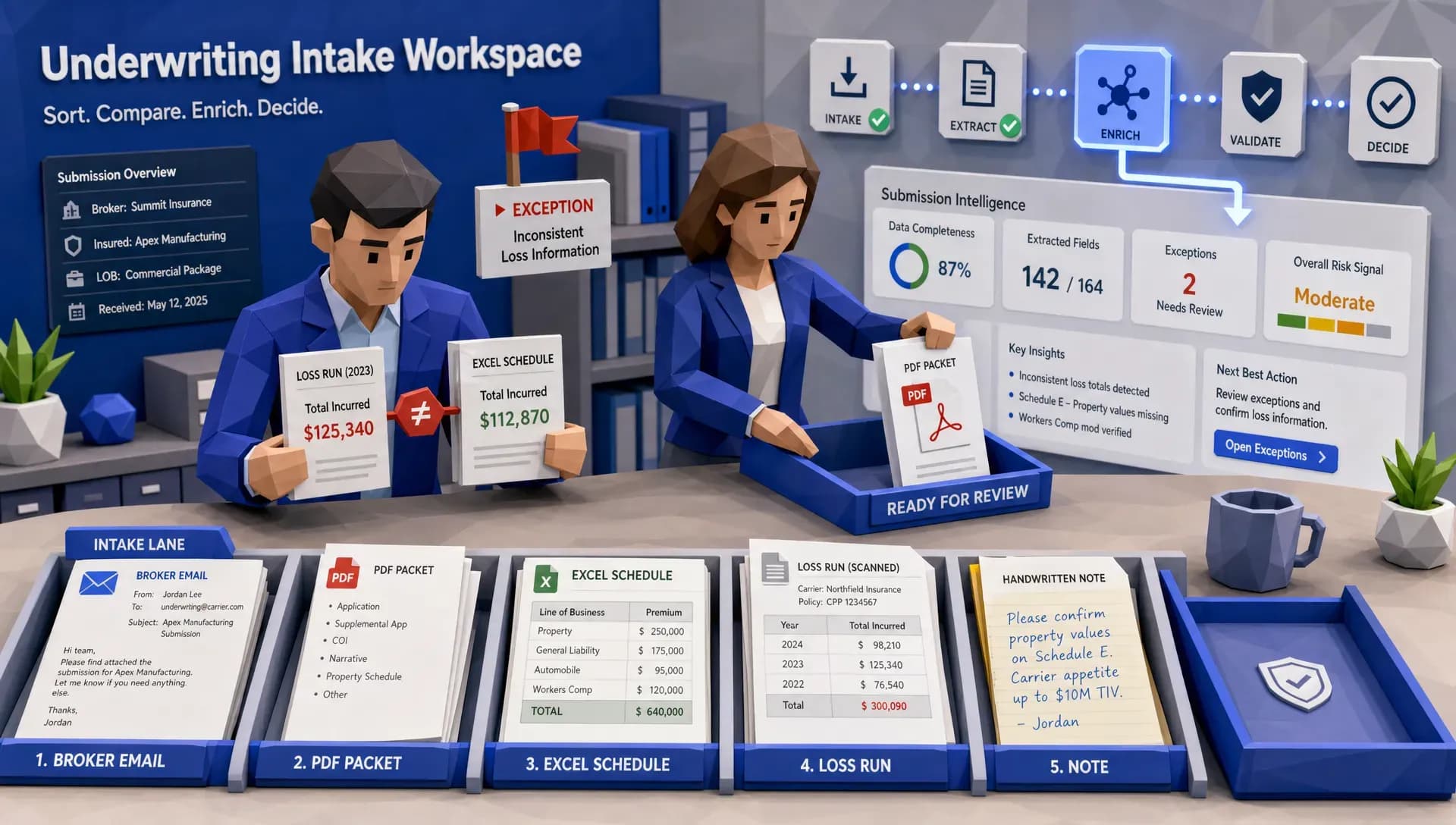
This is the classic one. The applicant or broker provides information in multiple formats: PDFs, emails, spreadsheets, ACORD forms, images, scanned documents, handwritten notes, and sometimes a file name that looks like it was generated during a power outage.
The intake blind spot happens when key facts are captured inconsistently or not captured at all. A fleet schedule says one thing. The application says another. A prior policy document mentions a driver excluded last year. The quote workflow never sees it.
The fix is not asking people to be more careful. People are already trying. The fix is structured intake that can read messy documents, extract the right fields, compare them, and flag conflict before the underwriter has mentally moved on.
The verification blind spot
Self-reported data is useful, but it should not be treated like scripture. The applicant may not intend to mislead anyone. They may simply not know. A driver may forget an incident. A business may describe operations in the way that sounds normal to them, not the way an underwriter would classify exposure.
Verification blind spots are common in driver history, address data, vehicle attributes, prior coverage, property characteristics, business operations, and discount eligibility. The question is not whether you distrust the applicant. The question is whether your workflow can confirm material facts quickly enough to keep the quote moving.
The timing blind spot
Insurance files age faster than people think. A loss run from 90 days ago may miss a newly opened claim. A property inspection may predate a renovation. A fleet schedule may be accurate on Monday and wrong by Friday if vehicles are being added, leased, or reassigned.
Timing blind spots hurt renewals especially. The account you bound last year is not necessarily the account you are renewing today. That sounds obvious, but plenty of renewal workflows still run on last year's assumptions with a fresh date stamped on top.
The portfolio blind spot
An individual risk can look acceptable while the portfolio quietly becomes overexposed. This is where MGAs, carriers, and reinsurance brokers need to be especially careful. A single coastal property, high-mileage fleet, or attorney-represented bodily injury claim might fit appetite. A cluster of them in the same geography, class, or legal environment can change the whole story.
Reinsurance conversations are full of this. I have seen teams scramble to explain portfolio movements because the account-level data existed, but nobody had connected it into a narrative. That is a painful meeting. Coffee helps, but only a little.
The context blind spot
Some exposures do not make sense without local context. Real estate is a good example. A property schedule may show address, occupancy, and valuation, but the surrounding development pattern, investment purpose, construction phase, and local demand can change the risk conversation. In fast-growing UAE property markets, for instance, a specialist such as Azimira Real Estate shows how much nuance can sit behind a simple project description or location.
The same idea applies to auto, small commercial, specialty lines, and catastrophe-exposed property. Context is not fluff. Context is often where the risk is hiding.
A better way to evaluate the risk insured
Forms are necessary, but they are not reality. The real risk insured is what exists in the world, not what was typed into Box 14.
When I review an account, I want to know whether the file answers a few plain-English questions. What is being insured? Who controls it? Where is it used or located? How has it performed? What has changed since the last evaluation? Which facts are verified, and which are still assumptions?
That last question is underrated. Underwriting teams often debate a risk as if all fields carry equal confidence. They do not. A verified VIN is different from a manually entered VIN. A current loss run is different from a stale one. A third-party flood score is different from a customer saying the property has never flooded because they personally have not seen water in the lobby.
Give key facts a confidence level
Here is a simple practice I wish more insurers adopted: tag important facts by confidence. Not every field needs drama. But material items should be marked as verified, conflicting, stale, missing, or inferred.
This changes the underwriting conversation. Instead of asking whether the risk is good or bad, the team can ask whether the decision is supported well enough. That is a better question. It also makes referral rules smarter. A high-value account with two unresolved conflicts should not be treated the same as a clean, verified account with routine exposure.
Confidence tagging is also helpful for claims and fraud teams. If underwriting accepted a risk based on an unverified garaging address, and the claim occurs somewhere unexpected, that history matters. It does not prove fraud, but it gives investigators a better starting point.
Enrich data while the work is happening
Data enrichment should happen inside the workflow, not as a side quest. If an underwriter must leave the submission flow to check vehicle history, hazard data, court records, prior insurance, or property attributes, the chance of missed context rises.
This is why API templates and integrations matter. They are not shiny technology accessories. They are plumbing. Nobody invites friends over to admire their plumbing, but everyone notices when the shower stops working.
For evaluating risk insured, enrichment should answer practical questions quickly. Does the vehicle match the VIN? Is the garaging location consistent with the exposure? Is the property in a flood, wildfire, hail, or crime pattern that changes appetite? Does the loss history match the story in the submission? Are there known fraud indicators, document inconsistencies, or prior claim patterns that warrant review?
Connect underwriting and claims feedback
Underwriting without claims feedback is like coaching a team without watching game footage. You can do it, but why make life harder?
Claims outcomes show where assumptions held and where they failed. Maybe a class code is producing more severity than expected. Maybe a territory is worsening. Maybe attorney representation is spiking in a county that used to be quiet. Maybe a discount is being applied correctly on paper but correlates with poor performance because eligibility verification is weak.
The best risk evaluation loops claims results back into underwriting quickly. Not once a year in a 58-slide review that everyone pretends to enjoy. Continuously, in dashboards and workflows that show what is changing while there is still time to act.
Compare against the market, not just your memory
Experienced underwriters have valuable instincts. I trust those instincts. I also trust my car's backup camera, even though I technically know how to reverse.
Market benchmarks help teams see whether their book is drifting away from expected performance. For MGAs and carriers, benchmarks can support pricing, appetite, portfolio reviews, policyholder narratives, and reinsurance negotiations. This is especially useful when a book is growing quickly and historical internal data is thin.
The trick is to make benchmarks usable inside the operating rhythm. If they live in a slide deck on someone's desktop, they become trivia. If they are connected to account and portfolio dashboards, they become decision support.
Where automation helps, and where it should stay humble
Automation should remove the scavenger hunt. It should not pretend underwriting judgment is obsolete. The best systems capture documents, extract data, check facts, enrich fields, route exceptions, and create a clear audit trail. Then they let skilled people focus on risk decisions, not admin gymnastics.
At Inaza, this is the philosophy we build around. Our platform helps insurers, MGAs, and brokers automate underwriting, claims, customer service, and operational workflows while integrating with existing systems. The useful part is not only that a workflow can run faster. The useful part is that the data generated by that workflow lands in a unified warehouse, which means teams can see what happened, measure it, and improve it.
That matters when evaluating the risk insured because blind spots often live between systems. Inaza supports all file types, offers 250+ workflow templates, and can use pre-built API templates for data sources such as Verisk, LexisNexis, HazardHub, and more. Insurers can deploy customized workflows without forcing teams to relearn everything from scratch. When the process is clear, production-ready workflows can move quickly, often from a single focused working session rather than months of proof-of-concept theatre.
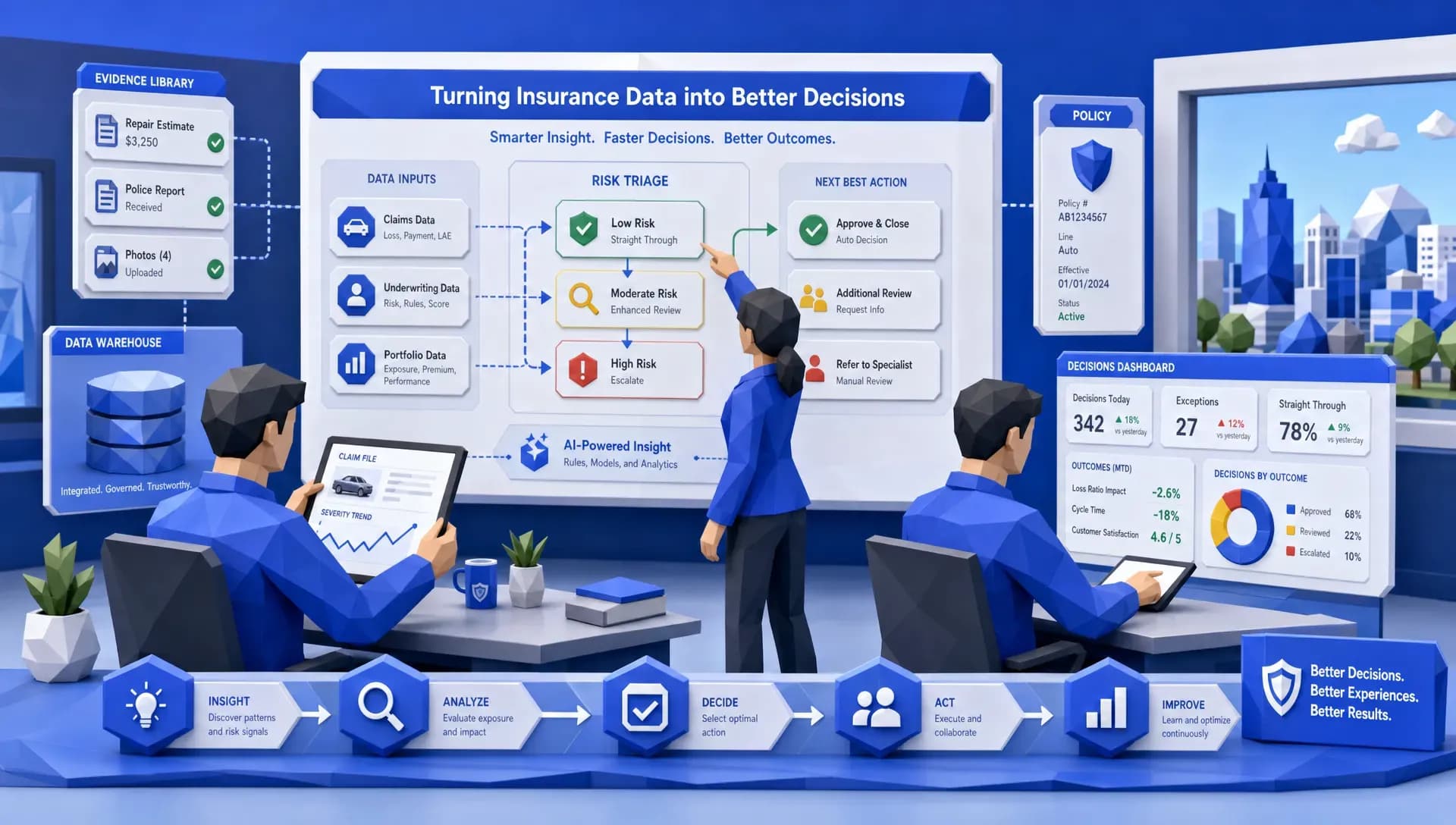
The data warehouse is the quiet hero. Once data from intake, enrichment, underwriting, claims, and operations is captured consistently, dashboards become more than decoration. They show leakage, exceptions, referral patterns, quote abandonment, fraud flags, claims severity, and portfolio movement. They also make benchmark comparisons easier, including industry benchmarks that can support renewal and reinsurance narratives.
My bias is obvious, but I will say it anyway: the insurers that win will not be the ones with the most data. They will be the ones with the fewest unexamined assumptions.
What fewer blind spots look like in practice
A broker submits a commercial auto risk with a fleet spreadsheet, loss runs, driver information, and several supporting PDFs. In a traditional workflow, an underwriter opens the files, re-keys values, checks a few items manually, sends follow-up questions, waits, and hopes nothing important was missed.
In a cleaner workflow, the documents are ingested automatically. The fleet schedule is normalized. VINs and vehicle attributes are checked. Driver records can be requested or verified through approved sources. Loss runs are extracted into structured data. Conflicts are flagged. Missing values trigger targeted questions. The account is compared to appetite, pricing assumptions, prior claims behavior, and portfolio concentration. The underwriter sees the exceptions first, not last.
That is the difference between more data and better visibility. More data says, here are 47 things to review. Better visibility says, these three things could change your decision.
For claims teams, the same logic applies. If underwriting data is connected to claims data, adjusters can see whether the claim matches the original exposure. Fraud analysts can compare stated facts with prior evidence. Operations leaders can see where manual touchpoints create delays or errors. Reinsurance teams can explain portfolio quality with actual support rather than interpretive dance, which is frowned upon in most boardrooms.
The governance piece nobody wants to talk about
Every serious risk evaluation process needs governance. I know, governance is where enthusiasm goes to take a nap. But without it, even a modern workflow can become a faster way to create messy decisions.
Good governance means knowing which data sources are approved, how conflicts are resolved, when humans must review exceptions, how decisions are documented, and how models or rules are monitored over time. It also means being honest about uncertainty. If a field is inferred, say so. If a source is stale, show it. If a decision required judgment, record the reason.
This protects policyholders too. A cleaner process supports fairer pricing, faster decisions, fewer unnecessary referrals, and better explanations. Nobody enjoys being asked for the same document three times. Nobody enjoys a claim delay because the insurer cannot find the facts it already collected. Reducing blind spots is not only an underwriting issue. It is a customer experience issue.
Frequently Asked Questions
What does risk insured mean in underwriting? Risk insured refers to the actual exposure being covered, including the policyholder, asset, location, behavior, coverage, documentation, and timing. It is broader than the data typed into an application because the real-world exposure can differ from the submitted version.
How can insurers reduce blind spots when evaluating risk insured? Insurers can reduce blind spots by structuring intake, verifying material fields, enriching data during the workflow, connecting underwriting and claims feedback, and using dashboards to monitor exceptions, leakage, and portfolio movement.
Which data sources matter most for risk evaluation? The most useful sources depend on the line of business, but common examples include application data, loss runs, vehicle or property records, driver history, geospatial hazard data, prior coverage, claims outcomes, fraud signals, and market benchmarks.
Does automation replace underwriters? No. Done properly, automation removes repetitive admin work and highlights exceptions so underwriters can spend more time on judgment, negotiation, appetite decisions, and portfolio strategy.
Can this approach help with renewals and reinsurance? Yes. A connected view of risk helps teams explain what has changed, where performance is improving or deteriorating, and how a portfolio compares with market benchmarks. That makes renewals and reinsurance discussions more evidence-based.
Evaluate risk with fewer surprises
If your underwriting team is still piecing together risk from emails, spreadsheets, PDFs, and disconnected systems, the issue is not effort. It is visibility.
Inaza helps insurers, MGAs, and brokers automate data capture, workflow decisions, enrichment, reporting, and analytics across underwriting, claims, customer service, and operations. If you want to evaluate risk insured with fewer blind spots, cleaner evidence, and dashboards that actually help the business, it may be time to look at what a connected automation platform can do.