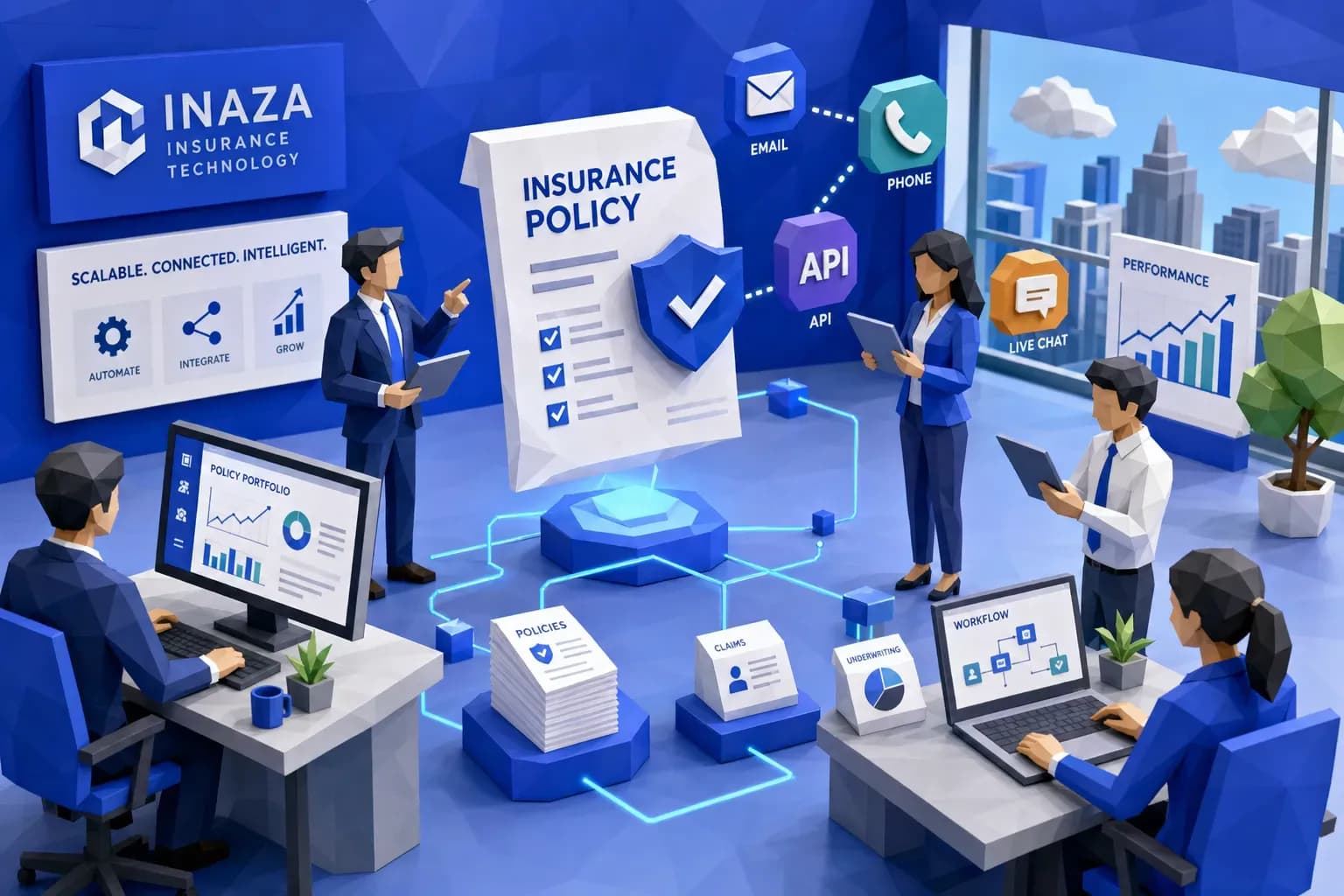
Growth in insurance rarely arrives in a neat, linear way. One quarter you are adding a new distribution partner, the next you are handling catastrophe-driven claim spikes, expanding into new states, or onboarding a book through an MGA acquisition. The software you pick has to scale through all of that, not just run a clean demo.
Choosing insurance company software that scales is less about finding a single “core” system that does everything, and more about building a stack that can absorb volume, complexity, and change without breaking workflows, creating new backlogs, or hiding risk.
What “scales” actually means in insurance operations
In insurance, “scalability” is not just a technical load test. It is the ability to grow the business while keeping service levels, controls, and unit economics intact.
Look for scale across five dimensions:
- Volume: More submissions, endorsements, payments, claims, documents, emails, photos, and calls.
- Complexity: More products, state variations, coverage rules, underwriting exceptions, litigation, and vendor workflows.
- Channels: Brokers, portals, email, APIs, embedded partners, call centers, adjuster apps.
- Speed-to-change: Faster iteration on appetite, pricing inputs, triage rules, fraud flags, and communications.
- Governance: Audit trails, explainability, security controls, and consistent decisioning as you automate.
If a platform scales in volume but not governance, you may move faster while increasing compliance risk. If it scales in workflow depth but not speed-to-change, you will struggle to launch products or absorb partner demands.
Start by mapping the work, not the org chart
Many software selections fail because they mirror departments rather than work.
Before vendor calls, build a “work map” that includes:
- What triggers work (submission arrives by email, FNOL call, attorney demand PDF, broker endorsement request).
- What data is needed (internal policy data plus third-party enrichment).
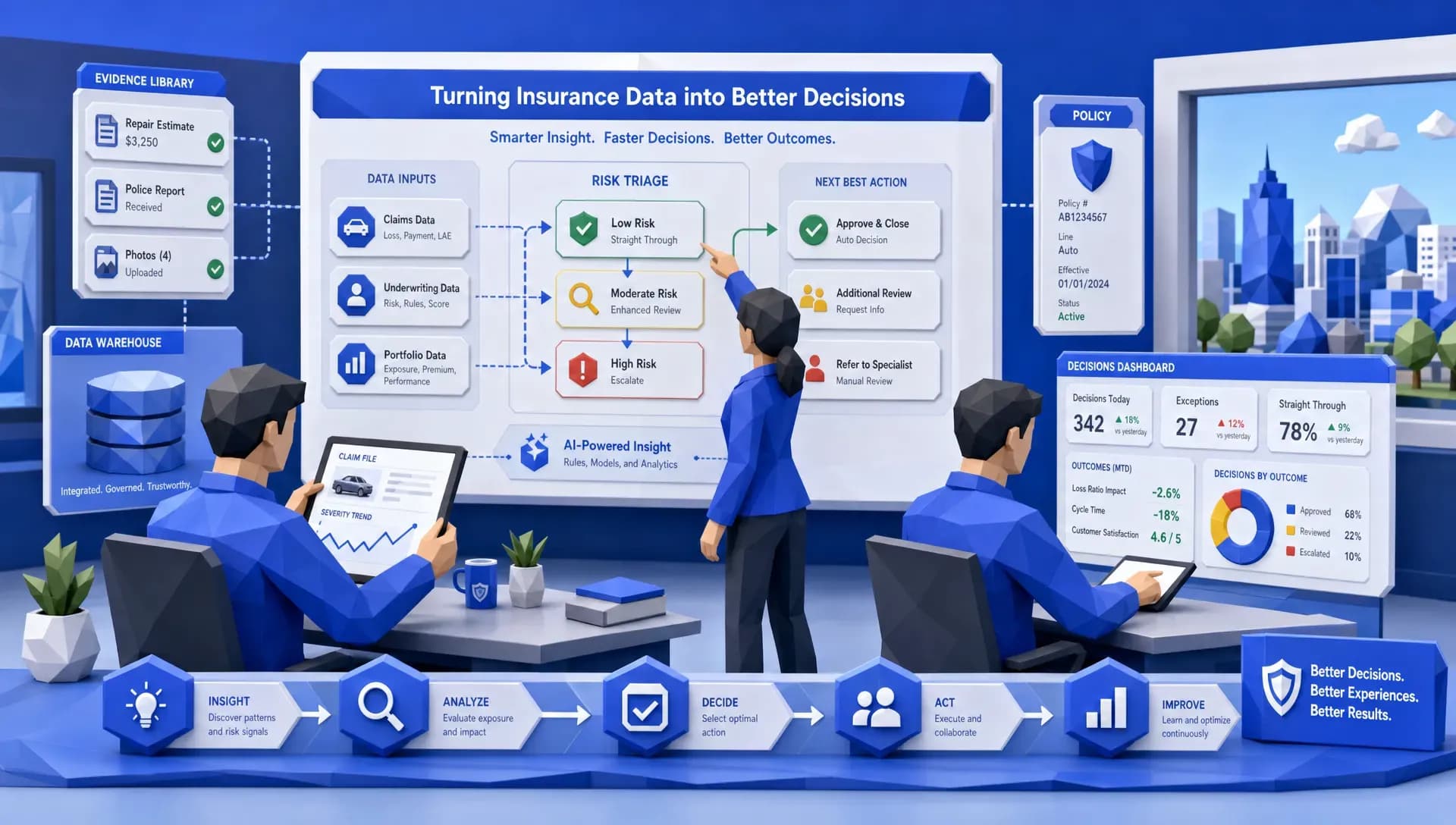
- What decisions happen (straight-through, route-to-human, decline, request-more-info).
- What outputs must be produced (system updates, documents, logs, notifications, downstream analytics).
This prevents you from buying a tool that optimizes one team’s inbox while creating downstream re-keying, duplicate investigation, or data gaps.
A practical way to sanity-check your map is to pick 2–3 “stress case” workflows:
- A catastrophe event that multiplies FNOL volume overnight
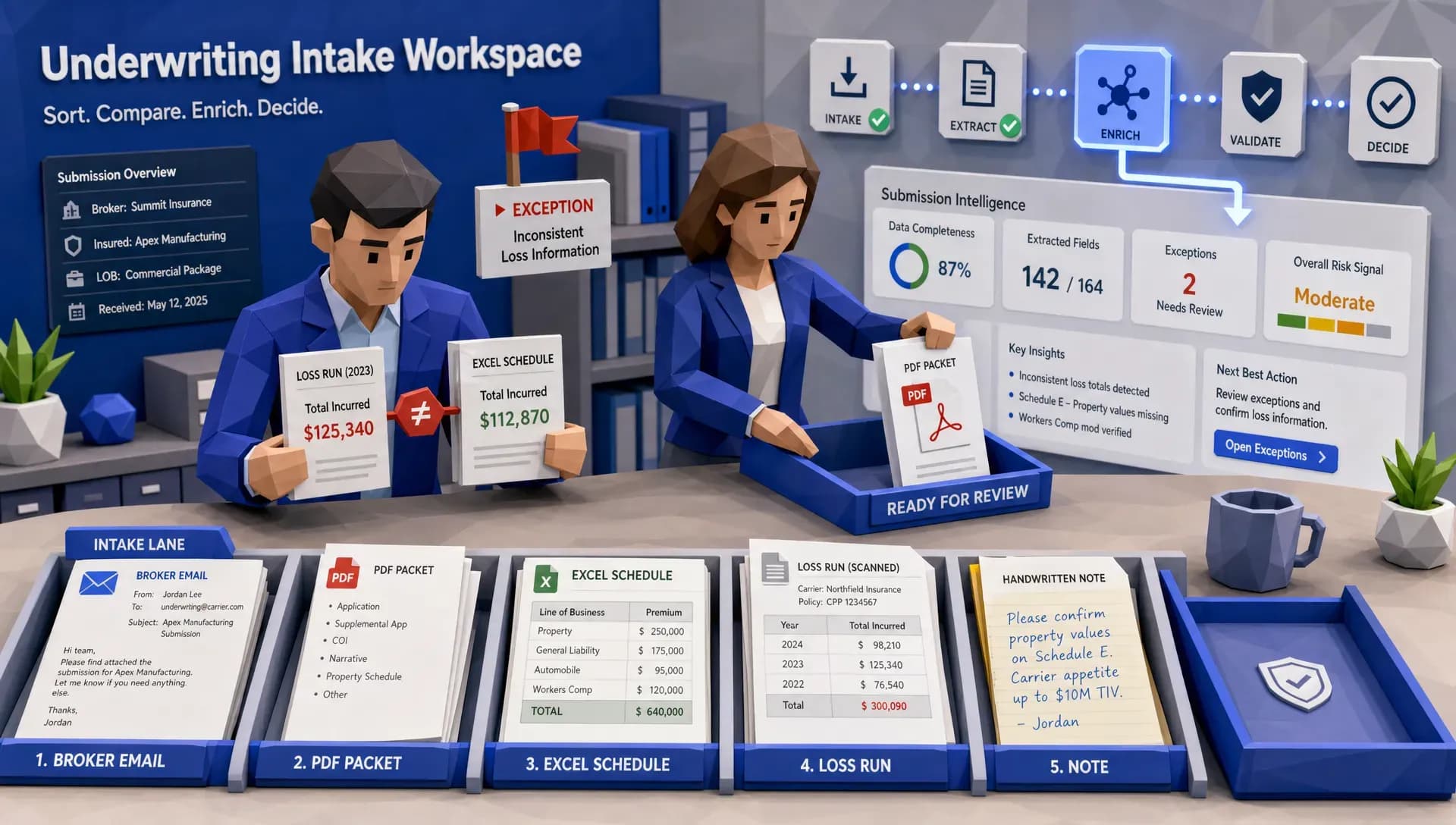
- A surge in broker submissions with inconsistent attachments
- A spike in attorney demands with strict SLA and documentation requirements
Your short list should prove it can handle these without forcing heroics.

The non-negotiables for scalable insurance company software
Most platforms can automate a single task. Scaling requires the foundation underneath the tasks.
1) Workflow deployment that does not bottleneck on the vendor
Scaling breaks when every workflow change requires a long back-and-forth, a bespoke statement of work, or a fragile rules rewrite.
Evaluate:
- How quickly you can deploy a production-ready workflow, including real exceptions
- Whether your team can configure and iterate workflows without waiting weeks
- How the system handles edge cases (missing documents, ambiguous data, conflicting signals)
This is where template libraries help, but only if templates are editable and supported by strong guardrails.
2) A unified data layer (not just workflow logs)
Automation without a true data foundation is hard to scale because every new workflow becomes another silo.
A scalable platform should capture and normalize key data points from operations so you can:
- Measure throughput, leakage, cycle time, and exception rates
- Explain why a decision was made (especially when AI is involved)
- Improve models and rules using real outcome data
If the vendor’s “analytics” are just a few static charts and exported CSVs, you will eventually rebuild a parallel reporting stack. That creates drift between what the business thinks is happening and what is actually happening.
3) Integration that gets easier over time, not harder
Scaling often means adding more data sources and more partners. Your platform should make that simpler as you grow.
Look for:
- Pre-built API templates/connectors for common insurance data sources
- Clear patterns for bi-directional updates (pull data in, push decisions out)
- Support for all file types you actually receive in the wild (PDFs, spreadsheets, images, emails)
If integrations are always “custom,” your roadmap becomes a queue.
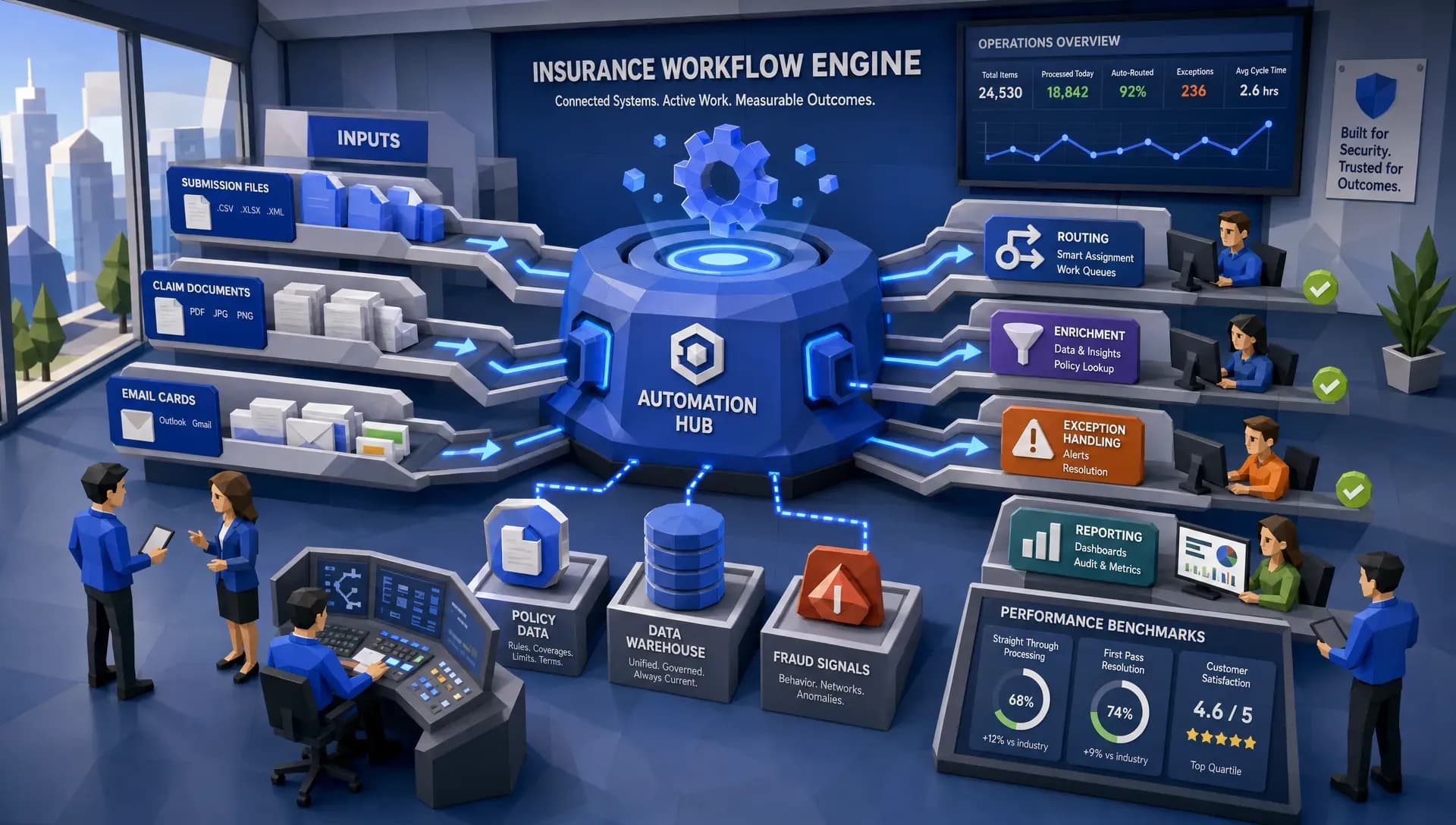
4) Real-time visibility into operations (and the ability to act)
Dashboards are helpful, but scalability requires operational visibility that is tied to action:
- Where work is getting stuck
- Why exceptions are happening
- Which teams are overloaded
- Which partners are sending low-quality submissions
The best systems turn signals into routing changes, validation prompts, and workflow improvements, not just reports.
5) Governance and explainability that stand up to audits
As automation expands, you need confidence that decisions are consistent and defensible.
At minimum, evaluate:
- Audit trails for inputs, outputs, and decision steps
- Permissioning and change logs (who changed what, when)
- Data retention and exportability
- Explainability for AI-driven decisions (human-readable rationale, not just a score)
In P&C, scalability without governance is simply scaling risk.
Architecture choices that determine whether you can scale safely
Modular beats “rip and replace” for most carriers and MGAs
Full core replacements can work, but they also concentrate risk: long timelines, heavy change management, and delayed ROI.
A modular approach often scales better because you can:
- Start with high-friction workflows (intake, extraction, triage)
- Integrate with existing core systems
- Prove impact, then expand
If you want a deeper view on this approach, Inaza has a helpful perspective in their post on why incremental AI beats full-system replacement.
“Human-in-the-loop” is a scaling feature, not a compromise
In real insurance operations, not everything should go straight-through. You will always have:
- Sensitive conversations
- High-severity claims
- Fraud ambiguity
- Regulatory nuance
Software that scales supports clean escalation with context, so humans focus on judgment, not re-keying.
Vendor evaluation: the questions that expose scale limits
Demos are designed to show best-case paths. Your job is to test the worst cases.
Ask vendors to walk through one of your stress-case workflows end-to-end and answer questions like:
- What happens when a submission is missing data? Can the platform request it automatically and track the loop?
- How do you validate and enrich data? Which third-party sources are supported, and how quickly can you add new ones?
- How do exceptions get routed? Can you route by complexity, SLA, fraud risk, or line of business?
- How do you measure accuracy over time? What feedback loop exists to reduce false positives and manual rework?
- What does an audit export look like? Can you show a complete timeline of a decision, including inputs and changes?
- How do you deploy changes? What is the path from a workflow tweak to production, and who can do it?
A strong vendor will be comfortable showing:
- A production-like workflow, not a sandbox trick
- How they handle exceptions, not just straight-through cases
- How they prove results with measurable operational metrics
Don’t ignore the “communication layer” of scaling
As you scale operations, the volume of outbound and internal communication grows too: follow-ups to brokers, claimant updates, vendor requests, compliance notices, and partner documentation.
Your core platform should support automated communications where appropriate, but teams often still need fast, consistent drafting for one-off letters during procurement, rollout, and operational exceptions. Tools like an AI letter generator can help operations leaders produce polished drafts quickly (for example, vendor coordination, customer complaint responses, or internal change announcements) while your core workflows focus on underwriting and claims execution.
A practical “scale readiness” checklist for insurance software
Use this as a final filter when comparing short-listed platforms.
Scale in throughput
- Can it handle peaks without degrading response times?
- Can it parallelize work across teams, vendors, and geographies?
- Does it support automation that reduces touchpoints (not just moves them)?
Scale in flexibility
- Can business users adjust workflows without extensive engineering?
- Are templates truly reusable across products and states?
- Can you launch a new line or partner flow without rebuilding the stack?
Scale in data and insight
- Is there a unified data warehouse or equivalent foundation?
- Can you create dashboards for underwriting, claims, fraud, and operations from the same data?
- Can you benchmark performance over time and by segment?
Scale in integrations
- Are common insurance enrichment sources already supported?
- Is integration “one more connector” or “a new project” every time?
- Can it ingest messy real-world files and still produce structured data reliably?
Scale in control
- Are logs, audit trails, and explainability built in?
- Can you control access and document workflow changes?
- Does it support compliance requirements across jurisdictions?
How Inaza aligns with scalable insurance company software requirements
If you are evaluating platforms specifically for scalable automation across underwriting, claims, and operations, Inaza is designed around the common failure points that show up at scale:
- Fast workflow deployment: Inaza is built to deploy production-ready workflows quickly, reducing the typical PoC drag and repeated back-and-forth.
- Unified data warehouse underpinning the platform: Automation outputs become usable data, enabling pre-built or custom dashboards for operational and portfolio intelligence.
- Pre-built API templates: Integrations can be enriched quickly with templates for sources like Verisk, LexisNexis, and HazardHub (and others).
- Industry benchmarks built into the system: Benchmarks from industry leaders can help you compare performance and support narratives for reinsurance negotiations and renewals.
For teams thinking in terms of “platform” rather than “point solution,” it is also worth reading Inaza’s view on building connected foundations in the road to a connected insurance data platform.

Frequently Asked Questions
What is the most important factor when choosing insurance company software that scales? The most important factor is whether the software can scale workflows and data together. Automation alone is not enough, you also need a unified data layer, integrations, and auditability so growth does not create new silos or compliance risk.
Should we replace our core system to scale? Not always. Many carriers and MGAs scale faster with an incremental approach that layers automation and data capabilities on top of existing systems, proving ROI early while reducing transformation risk.
How do I test scalability during a vendor demo? Bring real “stress case” workflows and insist on exception handling, audit exports, and change deployment walkthroughs. If the demo only covers best-case straight-through scenarios, it is not a scalability test.
Why does a data warehouse matter for scaling insurance operations? Because it turns workflow activity into standardized, queryable data for reporting, benchmarking, and continuous improvement. Without it, each new automation becomes harder to measure and optimize.
What integrations should scalable insurance software support? It should support both internal core systems and common third-party enrichment sources, plus flexible ingestion for real-world files (PDFs, spreadsheets, images, emails). The key is that adding sources becomes routine, not a major project.
See what scalable automation looks like in production
If you want to evaluate scalable insurance automation without committing to a long, disruptive replacement cycle, explore how Inaza approaches workflow deployment, data capture, and benchmarking across underwriting and claims.
Learn more at Inaza and ask for a walkthrough using one of your real high-volume workflows.