After 10 years around insurance operations, I’ve developed a healthy suspicion of beautiful claims workflow diagrams. They always look calm. Then a real claim arrives with three attachments, a missing VIN, a claimant who is “pretty sure” the accident happened on Tuesday, and an attorney letter hiding on page 17.
Here’s my hot take: there is no such thing as one good claims workflow. There are only workflows that fit the claim in front of you, and workflows that create delays, leakage, and awkward Monday morning meetings.
If every type of claim in insurance follows the same path, someone is paying for it. Sometimes it is the insurer through unnecessary handling expense. Sometimes it is the customer through slow settlement. Sometimes it is the adjuster, who gets buried under tasks that a better process should have handled before the file ever landed on their desk.
What we really mean by “type of claim in insurance”
When people say “type of claim,” they often mean auto, property, liability, bodily injury, theft, catastrophe, or workers’ compensation. That is a decent start, but in practice, claim type is more than the line of business.
It also includes severity, representation status, fraud indicators, jurisdiction, coverage complexity, document type, and whether the claim can be handled straight-through or needs expert judgment.
A $900 windshield claim and a $900,000 commercial auto bodily injury claim both begin with a notice of loss. That is roughly where the similarity ends.
One needs coverage validation, image review, repair pricing, and fast payment. The other may need liability analysis, medical chronology, reserve strategy, attorney demand tracking, litigation risk review, and a very awake human being. Treating them the same is like using the same recipe for toast and wedding cake. Technically, both involve heat. That does not make it a plan.
The unpopular opinion: one claims workflow is a leakage machine
Early in my career, I watched a cracked windshield claim sit in the same general queue as litigated bodily injury files. It waited three days for an adjuster to touch it. Three days. For glass. The customer was annoyed, the adjuster was annoyed, and the only winner was probably the hold music vendor.
That same week, a low-speed auto loss was routed as a routine physical damage claim because the initial vehicle estimate was small. A month later, the file had a soft-tissue injury, treatment escalation, and attorney involvement. The workflow was too light at the moment it needed better triage.
That is the real issue. A generic workflow over-controls simple claims and under-controls complex ones.
J.D. Power’s 2024 U.S. Auto Claims Satisfaction Study continued to show how repair cycle times and communication shape customer satisfaction. Customers do not judge insurers by how elegant the internal process is. They judge by whether the claim moves, whether updates make sense, and whether the outcome feels fair.
Routine physical damage claims should move like a checkout lane
Low-severity physical damage claims are the best place to be ruthless about workflow simplicity. Think glass damage, minor auto damage, small contents losses, straightforward single-vehicle incidents, and simple repair invoices.
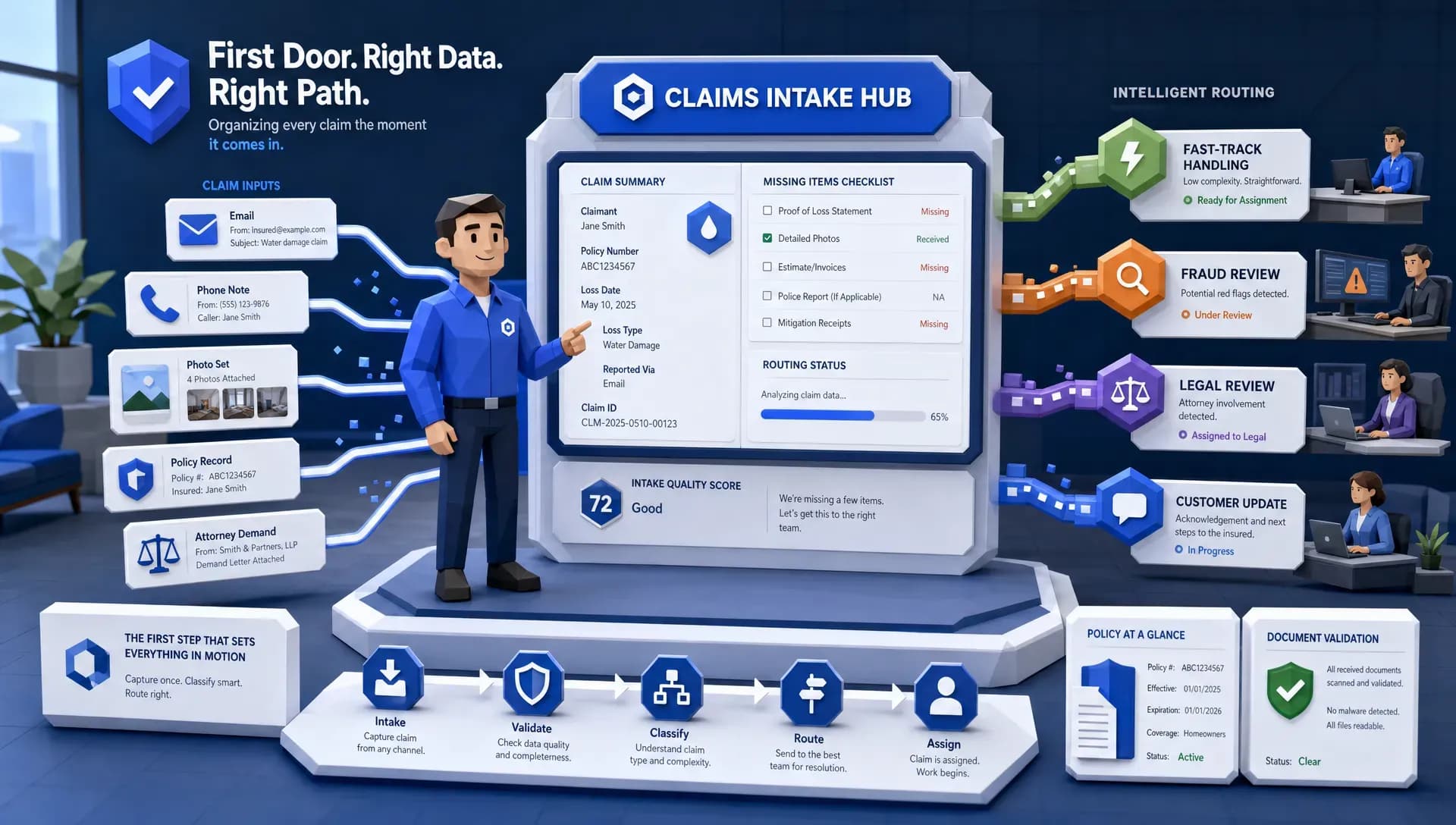
The workflow should focus on clean intake, coverage confirmation, deductible validation, evidence capture, repair estimate review, payment authorization, and exception handling. That last part matters. Straight-through processing does not mean “never look at anything.” It means the workflow knows which files do not need human attention and which ones absolutely do.
A good routine claim workflow should answer the obvious questions quickly. Is the policy active? Is the loss date inside the policy period? Does the damage match the reported event? Are the photos usable? Is the estimate within expected range? Are there duplicate claims or suspicious inconsistencies?
If those answers are clean, the claim should not be touring the organization like a lost suitcase.
Bodily injury claims need severity triage, not speed theater
Bodily injury is where I get fussy. Speed matters, but blind speed is dangerous. The goal is not to close every BI claim fast. The goal is to identify complexity early and route the claim to the right handling path.
A good BI workflow starts with early severity indicators. What injuries are alleged? Was there emergency treatment? Are there gaps in treatment? Is there prior claim history? Is liability clear? Are policy limits exposed? Is an attorney involved? Has a demand arrived, and if so, what deadlines are attached?
This workflow should gather medical bills, treatment notes, accident facts, police reports, photos, repair severity, and coverage information in a structured way. It should help adjusters see whether a claim is likely to stay routine, escalate into a represented claim, or become a litigation risk.
Fraud controls also need to be built into the path, but with care. The FBI’s insurance fraud overview estimates that non-health insurance fraud costs more than $40 billion per year. That number is big enough to deserve attention, but it does not mean every odd-looking claim is fraud. A good workflow flags concerns without turning every customer into a suspect.
BI claims need humans. They also need better preparation before the human gets involved.
Catastrophe and weather claims need surge workflows
Catastrophe claims are their own animal. A hailstorm, flood, wildfire, hurricane, or tornado does not create one claim. It creates an operational event.
The NOAA Billion-Dollar Weather and Climate Disasters database is a useful reminder that severe weather is not a rare edge case for insurers anymore. It is a recurring operational stress test.
A CAT workflow needs to handle volume, geography, vendor coordination, customer messaging, and reserve visibility. It should use loss location, event data, policy exposure, damage type, and claim clustering to prioritize files. It should also recognize that hundreds or thousands of claims may share the same cause of loss, which means the workflow should not pretend each file exists in isolation.
Communication becomes especially important here. Customers are stressed, phone lines are overloaded, and field resources are stretched. For claim notices, status updates, and compliant customer outreach, insurers may also need coordinated mail, email, SMS, and reporting. In that context, an omni-channel direct mail platform can be useful for teams that need to manage physical notices alongside digital communication during high-volume events.
In a catastrophe, one bad communication template becomes ten thousand confused customers. Ask me how I know.
Attorney-represented claims need deadline control
Attorney-represented claims and formal demands should never be handled like normal correspondence. They are deadline-driven, document-heavy, and expensive when mishandled.
The workflow should extract and track key dates, demand amounts, claimant details, alleged injuries, policy limits, venue, medical specials, liability arguments, and response requirements. It should route the file to the right adjuster, supervisor, legal reviewer, or negotiation authority based on exposure and urgency.
Calendaring is not clerical work here. It is a financial control.
I have seen demand letters arrive in shared inboxes with subject lines like “documents attached” and no clear urgency. That is not a workflow. That is a trap wearing a PDF costume.
A strong attorney demand workflow creates visibility from intake through response. It logs communications, flags missing information, supports valuation review, and keeps an audit trail. When the file is later questioned, and many will be, the insurer can show what happened, when it happened, and why.
Suspicious claims need a detour, not a dead end
Fraud workflows are tricky because a red flag is not a verdict. If every flagged claim gets thrown into a slow manual review pile, honest customers suffer and adjusters lose trust in the system.
A better workflow separates fraud signals by confidence and severity. A mismatched timestamp on a photo might require a quick metadata check. A repeated injury pattern across connected parties may require SIU review. A suspected staged accident needs evidence preservation, link analysis, recorded statements, and careful documentation.
The workflow should preserve images, documents, call notes, metadata, claim history, payment records, and external data checks. It should also keep the adjuster informed. Nothing frustrates claims teams more than a file disappearing into a fraud process with no explanation and no SLA.
Fraud workflows should protect claim integrity while keeping legitimate claims moving. That balance is where good operations teams earn their coffee.
Commercial and specialty claims need account context
Commercial auto, fleet, property, cargo, specialty liability, and other complex P&C claims often need more context than personal lines files. The claim may involve multiple vehicles, scheduled drivers, endorsements, certificates, layered coverage, contractual risk transfer, loss runs, and broker communication.
The workflow should not only ask, “What happened?” It should ask, “How does this loss affect the account?”
For MGAs, carriers, brokers, and reinsurers, commercial claims data feeds underwriting, pricing, renewal strategy, and portfolio management. If the workflow captures loss cause, claimant type, driver data, vehicle class, reserve movement, litigation status, and closure reason cleanly, underwriting gets a far better view of risk.
Claims are not only a cost center. They are underwriting feedback with receipts.
Design the workflow around the decision, not the document
A lot of claims workflows are built around documents. FNOL form arrives, then estimate, then police report, then invoice, then medical bill, then correspondence. That sounds logical until the team is drowning in files and nobody knows which decision is blocked.
The better question is: what decision needs to happen next?
For a routine auto claim, the decision may be whether to approve payment. For BI, it may be whether to increase reserves or escalate to a senior adjuster. For an attorney demand, it may be whether the response deadline is at risk. For catastrophe claims, it may be whether the file can be desk-adjusted or needs field inspection. For suspected fraud, it may be whether the claim should move to SIU or continue with normal handling.
Once you know the decision, the workflow can gather only the evidence needed to support it. That is how you cut noise without cutting corners.
Capture workflow data or lose the plot
Here is another hot take: if a workflow does not create usable data, it is only half-built.
Every claim workflow should capture structured data as work happens. That means intake source, claim type, routing reason, missing documents, cycle time, reserve movement, fraud flags, escalation path, adjuster touches, payment timing, and closure outcome.
Without that data, leaders end up managing by anecdotes. And anecdotes are just spreadsheets wearing a tie.
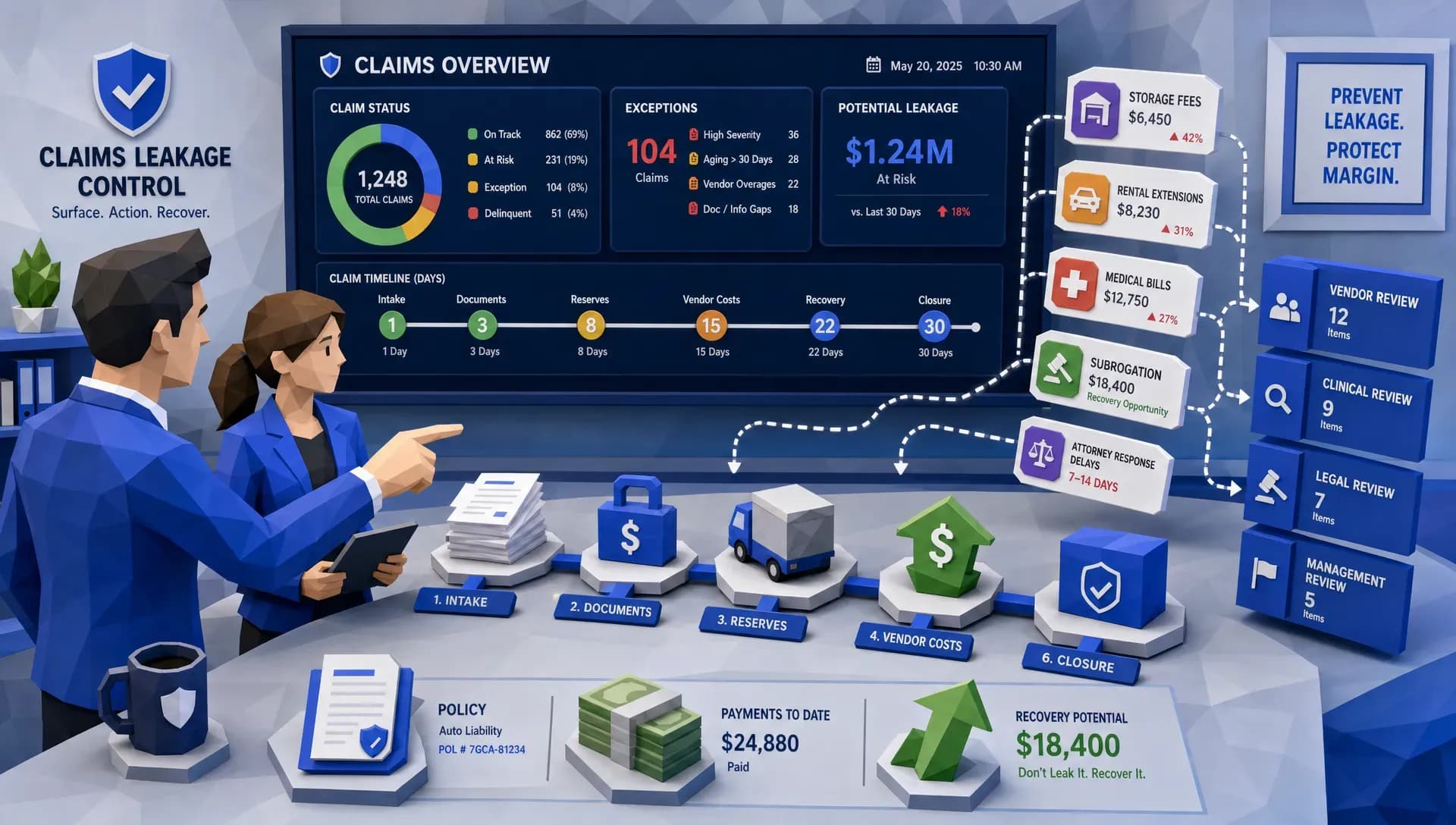
With the right data foundation, claims leaders can see where files stall, which claim types consume the most manual effort, which vendors create delays, where fraud flags are noisy, and where automation is actually improving outcomes. Underwriters can see loss patterns more clearly. Reinsurance teams can build stronger portfolio narratives. Executives can compare performance across teams, states, products, and books of business.
McKinsey has written about the insurance industry’s automation opportunity, especially around reducing administrative work and freeing experts to focus on judgment-heavy tasks. That principle applies directly to claims. The machine should handle repeatable motion. People should handle judgment, empathy, negotiation, and strategy.
Where Inaza fits
This is where claim-type-specific automation becomes practical instead of theoretical.
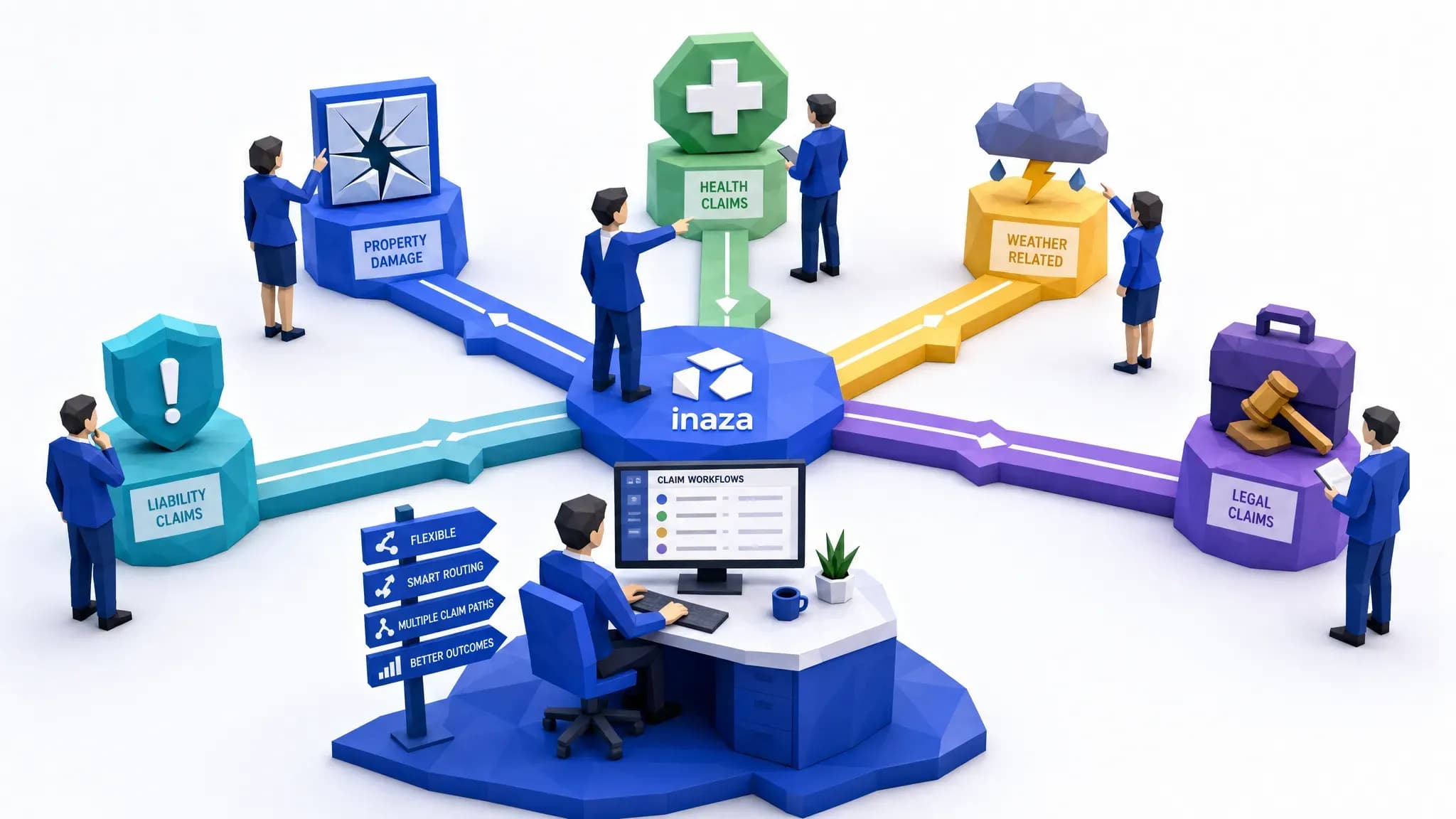
Inaza’s AI-powered insurance automation platform helps insurers, MGAs, and brokers build workflows around the way claims actually behave. The platform supports underwriting, claims, customer service, and operations, but the important part for this discussion is flexibility. Different claim types can have different intake rules, routing logic, data capture steps, integrations, and reporting views.
Inaza offers more than 250 workflow templates, supports all file types, integrates with existing systems, and includes a unified data warehouse with real-time analytics dashboards. Pre-built API templates can enrich workflows with data from sources such as Verisk, LexisNexis, and HazardHub. For teams that want market context, built-in industry benchmarks can help compare performance and support portfolio discussions.
The practical benefit is simple: you do not need one giant claims process pretending to work for every file. You can configure a glass claim workflow, a BI triage workflow, an attorney demand workflow, a catastrophe workflow, or a fraud review workflow without forcing the entire claims team to relearn their jobs.
And yes, speed matters. Inaza is built to help deploy production-ready workflows quickly, without the usual endless proof-of-concept back and forth. That matters because claims teams do not need another innovation theater production. They need fewer queues, cleaner data, and faster decisions.
Frequently Asked Questions
What is a type of claim in insurance? A type of claim in insurance refers to the category of loss being reported, such as auto physical damage, bodily injury, property damage, theft, catastrophe, liability, or attorney-represented claims. In operations, claim type should also reflect severity, complexity, fraud risk, and required handling path.
Why does each claim type need a different workflow? Each claim type needs different evidence, expertise, timing, controls, and communication. A minor glass claim can often move through a fast automated path, while a bodily injury or attorney demand claim needs deeper review, reserve oversight, and deadline management.
Which claims are best suited for straight-through processing? Low-severity, low-complexity claims with clean coverage, complete documentation, reliable evidence, and low fraud indicators are usually the best candidates. The workflow should still include exception handling for missing data, suspicious patterns, or customer escalation.
How should insurers start redesigning claims workflows? Start with one high-volume or high-cost claim type. Map the decisions that slow it down, identify the data needed for each decision, define routing rules, and measure cycle time, leakage, customer satisfaction, and adjuster effort before expanding to other claim types.
How does workflow design help fraud teams? Good workflow design captures fraud signals early, preserves evidence, routes suspicious files appropriately, and avoids overwhelming analysts with weak alerts. It helps fraud teams focus on the claims that deserve investigation while keeping legitimate claims moving.
Build claim workflows that fit the claim
If your claims operation still relies on one general workflow for every loss, you are probably asking simple claims to wait too long and complex claims to reveal themselves too late.
That is fixable.
Inaza helps insurers, MGAs, and brokers automate claim-specific workflows, capture the data behind every decision, and turn claims operations into a cleaner source of insight for underwriting, fraud, service, and portfolio management.
If you want workflows that match the claim instead of fighting it, visit Inaza and see how configurable insurance automation can work inside your existing operation.