Here is my hot take after a decade around insurance operations: the commercial insurance claims process is not slow because adjusters are slow. It is slow because the claim file loses meaning as it moves.
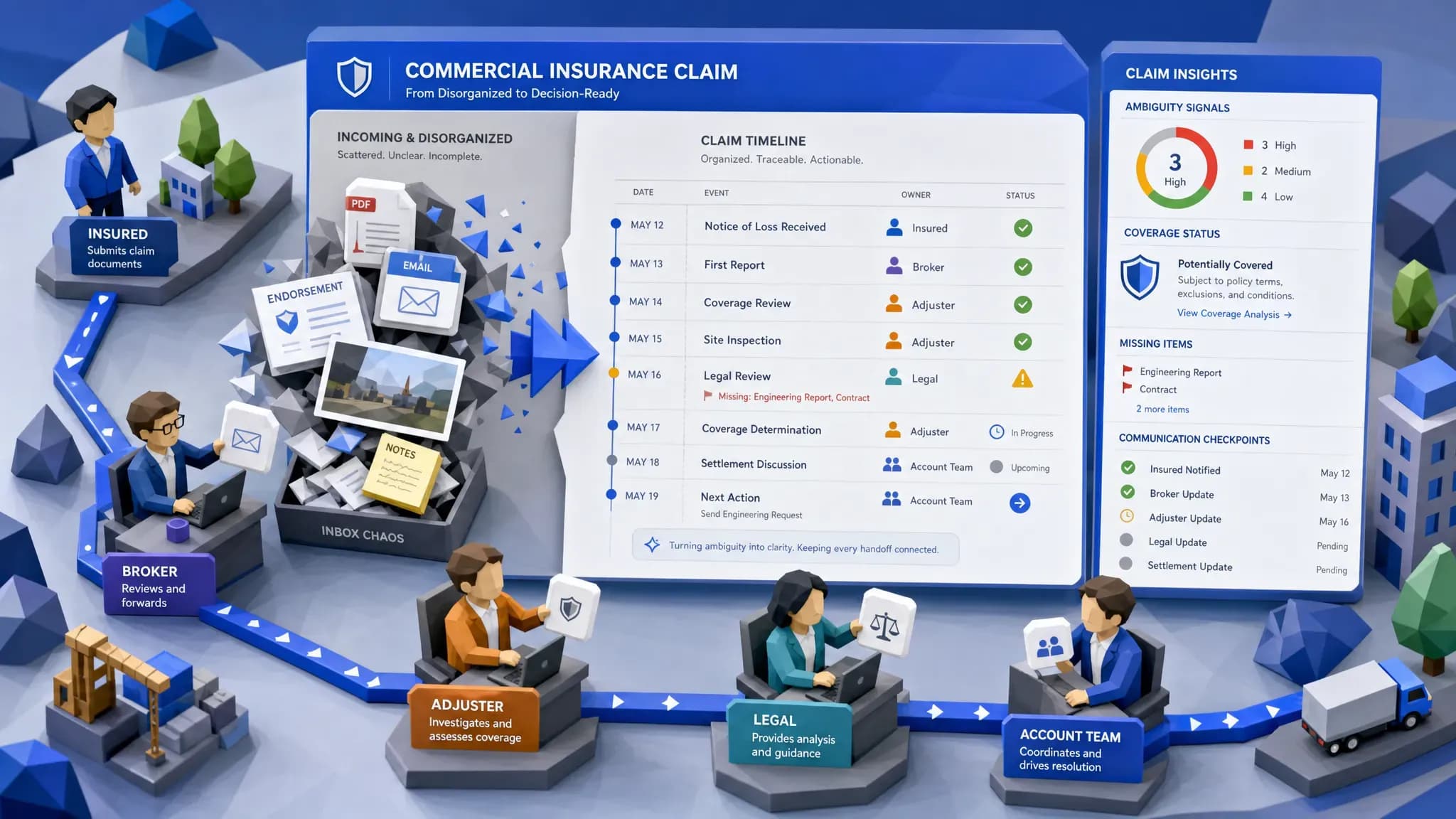
By the time a commercial claim has passed from the insured to the broker, from FNOL to the adjuster, from the adjuster to coverage, from coverage to legal, and from legal back to the account team, half the process is archaeology. Someone is always digging through emails, PDFs, photos, endorsements, loss runs, police reports, repair estimates, and broker notes to answer one embarrassingly basic question: what do we actually know?
I once watched a six-figure commercial auto claim sit for nearly two weeks because everyone had a slightly different version of the accident narrative. The broker thought liability was disputed. The adjuster thought it was clear. The underwriter thought the driver was outside appetite. The file had the documents, technically. What it did not have was a shared view of the facts. That is where the process breaks.
So if we want to fix the commercial insurance claims process, we need to stop worshipping at the altar of faster task completion. The real fix is better claim structure, earlier decisioning, cleaner data, and fewer places for context to go missing.
Start with the real bottleneck: ambiguity
Commercial claims are naturally messy. A personal auto claim may involve one driver, one repair shop, and one claimant. A commercial claim can involve leased vehicles, subcontractors, certificates of insurance, multiple locations, excess layers, contractual risk transfer, attorneys, TPAs, and a broker who needs an update yesterday.
That complexity is not the enemy. Ambiguity is.
A claim can survive being complex if the file clearly says what is known, what is unknown, who owns the next action, and what decision is being worked toward. It cannot survive being vague. Vague files create shadow queues, and shadow queues are where cycle time goes to retire.
Celent has reported that only a relatively small share of claims are processed straight-through without human intervention, often cited around the 10-15% range in industry discussions about straight-through processing in claims. In commercial lines, that figure feels believable. But I do not think the answer is to force every claim into straight-through handling. That is how you end up automating bad judgment at scale, which is a very expensive party trick.
The better answer is to separate routine work from judgment work earlier. Let software gather, classify, and enrich the file. Let people decide the things that actually require experience.
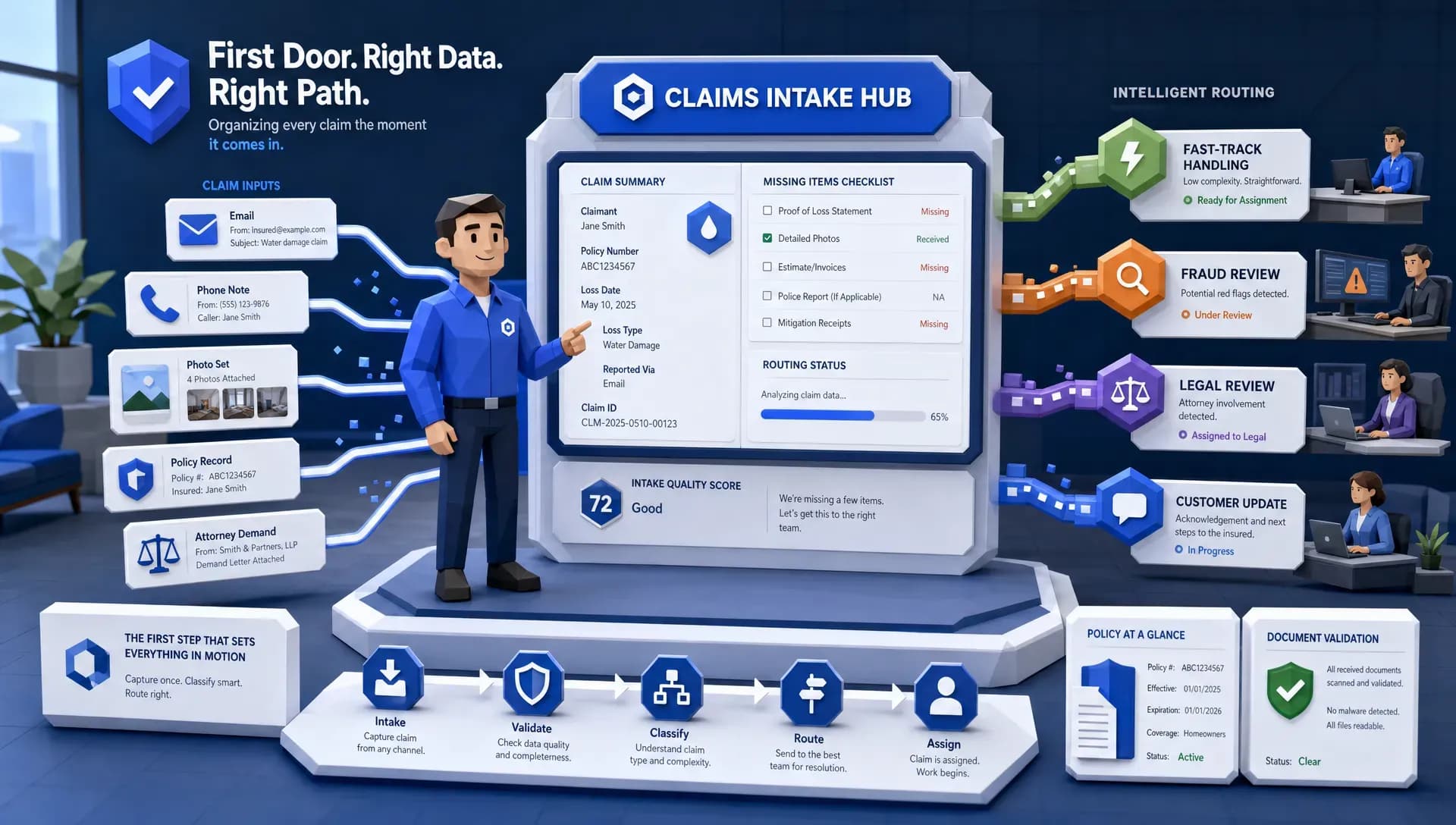
The first notice of loss is where the claim either gets a spine or becomes a pile of attachments.
A good FNOL process does more than capture a date, a policy number, and a brief description. It should create the first operating model for the claim. That means it should identify the type of loss, expected severity, coverage questions, missing documents, potential recovery, attorney involvement, fraud indicators, and any account-level sensitivity.
If that sounds like a lot for intake, good. Intake should be more intelligent than a digital version of a voicemail pad.
The problem is that many teams treat FNOL as a clerical event. Someone opens the claim, attaches the documents, assigns it, and hopes the adjuster will clean it up. But once the claim is assigned, the adjuster is already reacting. They are chasing the insured, checking coverage, reading documents, setting reserves, responding to the broker, and trying to avoid being surprised by a demand letter.
We have written separately about why the claims lifecycle breaks down after first contact, and the short version is simple: context falls out of the process. Fixing FNOL is not about making the form longer. It is about capturing the right facts in a way the rest of the workflow can actually use.
Stop pretending every commercial claim needs the same workflow
This is where I may annoy a few operations committees: the universal claims workflow is a myth.
A routine commercial auto physical damage claim does not need the same path as a litigated general liability claim. A minor property water loss does not need the same handling as a warehouse fire with business interruption exposure. A workers comp medical-only claim should not be dragged through the same process as a catastrophic injury claim with return-to-work complexity.
When teams use one standard workflow for every claim, they usually create two bad outcomes. Simple claims get over-handled, which wastes adjuster time and irritates customers. Complex claims get under-structured, which creates leakage, missed coverage issues, and late escalations.
The fix is to build workflows around claim types and decision points. We should know, at intake, whether the claim is likely to follow a low-touch path, a coverage investigation path, a litigation path, a fraud review path, or a major loss path. Those paths can still be flexible. Commercial claims always find a way to surprise us. But the starting point matters.
If you are redesigning this from scratch, it is worth looking at why each type of claim in insurance needs a different workflow. The most efficient claims teams I have seen do not ask adjusters to remember every variation. They let the workflow surface the next best action based on the claim in front of them.
Make the claim file answer the same questions every time
A commercial claim file should answer a few core questions without requiring anyone to read 38 attachments and three email threads.
What happened? Is there coverage? How bad could it get? Who is responsible for the next action? What is missing? What has changed since the last review? What does the account team need to know?
That last question is often ignored, and it should not be. In commercial insurance, the claim is rarely just a claim. It can affect renewal strategy, broker confidence, pricing, reinsurance conversations, and appetite for the broader account.
I would rather see an incomplete claim file that clearly says what is unknown than a bloated file pretending to be complete. A file with 60 documents and no clear next step is not well documented. It is just heavy.
This is where document automation becomes useful, but only if it turns documents into structured claim data. A PDF sitting in a repository is still a PDF. A loss run, demand letter, repair estimate, police report, or medical bill becomes operationally valuable when key data points are extracted, validated, and routed into the workflow.
McKinsey has made a similar point in its work on automation in the insurance industry: too much expert time is spent on administrative work rather than judgment. In claims, that administrative drag shows up as rekeying, reading, copying, pasting, reconciling, and asking someone to resend the document that was already sent last Tuesday.
Triage by ambiguity, not only severity
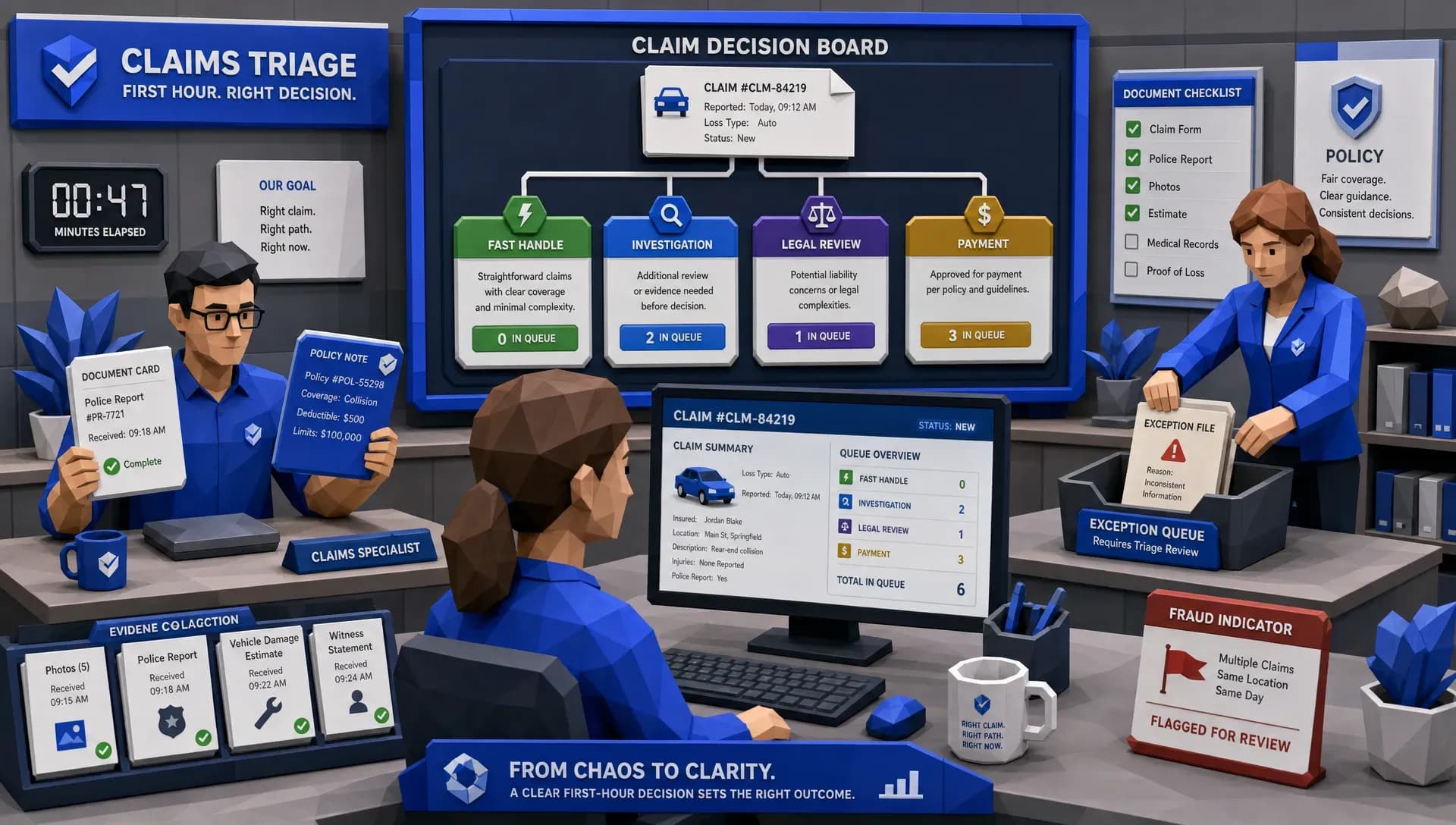
Most claims teams triage based on severity. That makes sense, but it is incomplete.
A $250,000 claim with clear coverage, clear liability, good documentation, and a known resolution path may be less operationally risky than a $35,000 claim with unclear facts, attorney involvement, questionable photos, missing policy endorsements, and an angry broker. The second claim is where people get surprised.
This is why I like ambiguity-based triage. Severity tells you the possible financial impact. Ambiguity tells you how likely the claim is to drift, stall, or explode.
A practical triage model should flag coverage uncertainty, attorney representation, disputed liability, unusual timing, missing documentation, suspicious evidence, venue concerns, multiple claimants, reserve volatility, and account sensitivity. None of those signals automatically mean the claim is bad. They mean the claim deserves structure earlier.
The goal is not to send everything to a senior adjuster. The goal is to stop senior adjusters from finding out too late.

Put fraud controls inside the process, not beside it
Fraud review should not be a mystical side quest that happens only when someone gets a bad feeling.
The FBI notes that insurance fraud is a major cost to the industry and to policyholders. In commercial lines, fraud can be subtle. It may look like inflated repair invoices, staged theft, exaggerated business interruption, manipulated photos, questionable medical treatment, or convenient documentation gaps.
Digital fraud is making this harder. Verisk’s 2025 fraud report highlights how carriers are increasingly worried about synthetic and manipulated evidence. That tracks with what many of us are seeing in the field. The old test of whether a photo looks right is no longer enough. Evidence needs provenance. Metadata, timestamps, source validation, claim history, policy history, and third-party data all matter.
The fix is to build fraud checks into the normal workflow. When a claim is opened, the system should compare facts against policy data, prior losses, location data, vehicle data, entity information, and known risk indicators. If something is off, the claim should be routed for review before the adjuster has spent three weeks treating it like a routine loss.
This does not replace investigators. It gives them better leads.
Use field evidence without creating another evidence swamp
Commercial property, construction, agriculture, fleet, and municipal risks often depend on field evidence. Photos, videos, inspections, repair notes, and site surveys can be the difference between a clean resolution and a month of argument.
But field evidence can become its own mess. I have seen drone imagery, inspection notes, contractor photos, and adjuster reports live in four different folders with four different naming conventions. At that point, the evidence exists, but nobody trusts it enough to make a quick decision.
Drone inspections can be especially useful for roofs, warehouses, yards, hard-to-access property, and post-catastrophe assessments. The key is operational discipline. If a carrier, MGA, or vendor uses drones, the flight plan, checklists, risk assessments, and logs should be auditable before the imagery enters the claim file. A drone operations management platform can help teams keep flight planning, fleet management, safety checks, and reporting organized so inspection evidence does not become another unstructured attachment pile.
Good field evidence should shorten the claim. Badly managed field evidence just gives everyone more to argue about.
Communicate like the broker is part of the workflow
One of the easiest ways to make a commercial claim feel worse than it is: let the broker chase updates.
Brokers do not expect every claim to settle instantly. They do expect to know what is happening, what is missing, and what the likely next step is. When they do not get that, they call. Then the account manager calls. Then underwriting gets pulled in. Then someone updates a spreadsheet that should never have existed.
The best claims operations treat communication as a workflow outcome, not a courtesy. If coverage is pending, say what is being reviewed and when the next update will occur. If documents are missing, specify exactly which documents and why they matter. If the reserve changes, explain the trigger. If legal is involved, give the broker a realistic view of what that means for timing.
This is not just customer service. It protects renewal conversations.
JD Power’s 2024 auto claims research found that repairable claims can take more than 30 days on average, and customer satisfaction is heavily influenced by communication and cycle time in the auto claims experience. Commercial claims are often more complex, but the lesson holds. Silence makes time feel longer.
Feed claims data back into underwriting
Here is another hill I am willing to stand on: a commercial claims process is not fixed until underwriting can learn from it.
Too often, claims data lives downstream. Underwriting sees loss runs, maybe large loss notes, and perhaps a few broker explanations at renewal. That is not enough. The most useful claim insights are often buried in the details: cause of loss, lag time, driver behavior, safety controls, venue, documentation quality, attorney patterns, repair cost inflation, vendor performance, and account responsiveness.
When claims data is structured, underwriting gets smarter. Renewal conversations improve. Pricing decisions become more defensible. Portfolio reviews become less anecdotal. Reinsurance narratives become easier to support. And when a single commercial claim threatens to slow down an entire account, the team has the facts to separate signal from noise.
That is why we have argued that one commercial insurance claim can stall an entire account. Usually, the stall is not about the paid amount alone. It is about uncertainty. If the claim file cannot explain what happened, why it happened, how it is developing, and what it means for the risk, everyone pauses.
Claims should not be a dead-end department. Claims should be one of the best data sources the business has.
Do not start with a rip-and-replace fantasy
If your claims operation is messy, replacing the core system is rarely the fastest fix. Sometimes it is necessary. Often, it is a multi-year distraction with a very expensive steering committee.
The more practical path is to fix the workflow layer around the systems you already use. Start by mapping where claims wait. Not where people work, where claims wait. There is a difference.
Look at the time from FNOL to assignment, assignment to first meaningful review, review to coverage position, coverage position to reserve change, reserve change to broker update, broker update to next action, and final action to closure. The ugly truth will show up quickly. Usually, the delay is not one giant failure. It is a dozen small handoffs with no owner.
Then fix one line of business or one claim type first. Choose something with enough volume to matter and enough repeatability to measure. Commercial auto physical damage, property water losses, or low-complexity liability claims are common starting points. Build structured intake, document extraction, enrichment, triage, communication triggers, and dashboards around that workflow. Prove it. Then expand.
This is where Inaza fits well for insurers, MGAs, brokers, and claims teams that want practical automation rather than another endless transformation program. Inaza can help deploy customizable claims and underwriting workflows that integrate with existing systems, capture data from documents and files, enrich workflows through pre-built API templates, and feed operational data into a unified warehouse for reporting and analytics. The important bit is that automation should leave the business with better data, not just fewer clicks.
What good looks like
A fixed commercial insurance claims process feels calmer.
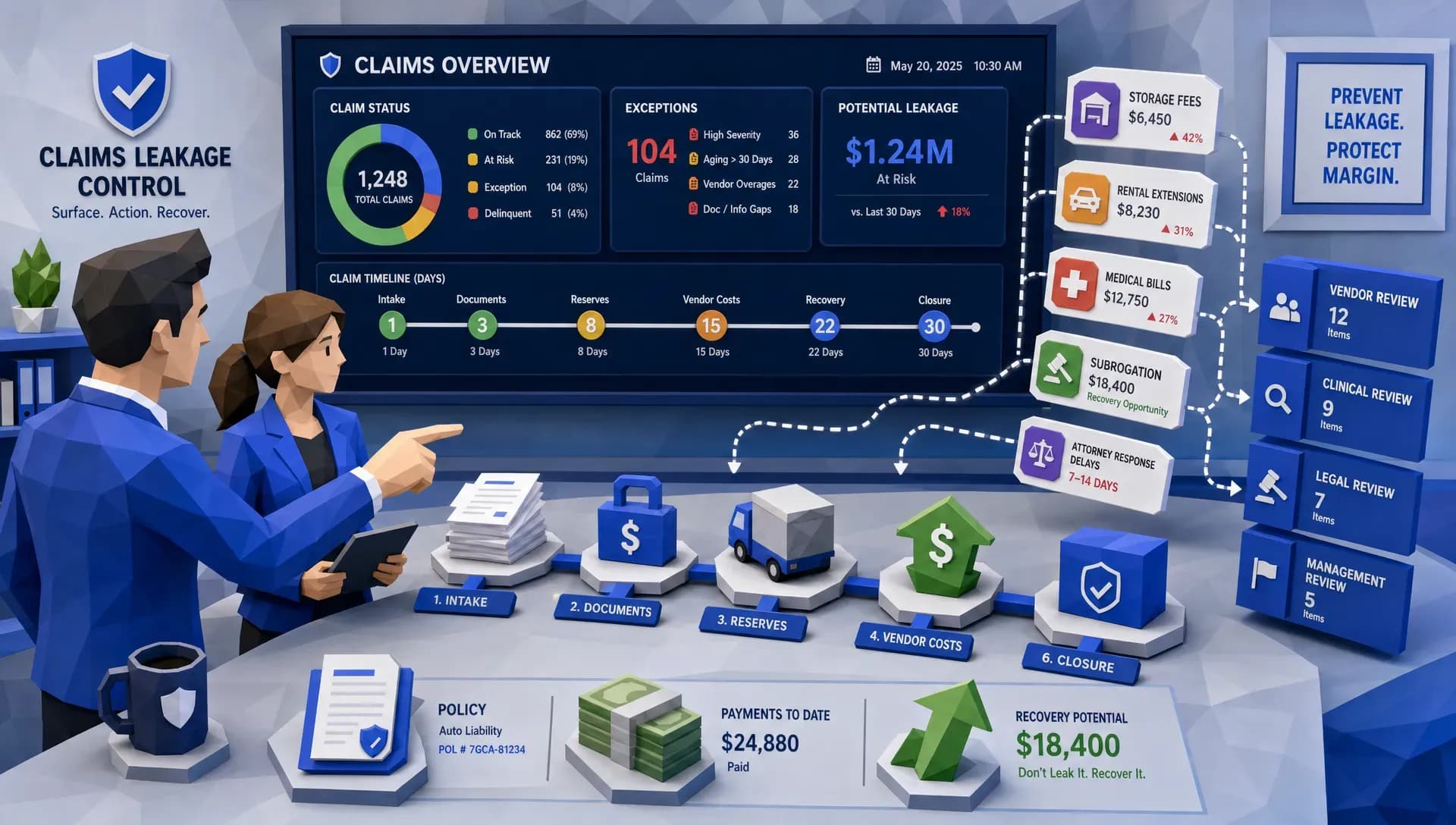
The adjuster opens a file and sees the current facts, missing items, coverage status, severity indicators, fraud flags, and next action. The broker receives updates before they have to ask. Documents are captured once and reused across the workflow. Field evidence is logged and connected to the right claim event. Fraud review is triggered by signals, not hunches. Underwriting can see claim patterns without waiting for a manually cleaned spreadsheet. Management can measure cycle time, leakage indicators, aging, reserve movement, and bottlenecks without launching a forensic investigation every Friday afternoon.
That is the standard. Not perfection. Just fewer mysteries.
And if we are being honest, fewer mysteries would be a massive improvement.
Frequently Asked Questions
What is the biggest problem in the commercial insurance claims process? The biggest problem is usually not one slow person or one bad system. It is ambiguity across the file. Missing context, unclear ownership, unstructured documents, and delayed triage make commercial claims harder to resolve and harder to explain to brokers, underwriters, and insureds.
How can insurers reduce commercial claims cycle time? Insurers can reduce cycle time by improving FNOL intake, routing claims by type and ambiguity, extracting key data from documents, automating routine follow-ups, and giving adjusters a clear view of coverage, severity, missing information, and next actions from the start.
Should commercial insurance claims be fully automated? Some low-complexity tasks can be automated, but full automation is not the right goal for most commercial claims. The better goal is to automate data capture, triage, enrichment, communication triggers, and reporting so claims professionals can focus on judgment, negotiation, coverage, and resolution.
What claims data should be shared with underwriting? Underwriting should receive structured data on cause of loss, severity development, lag time, litigation, coverage issues, fraud indicators, account responsiveness, location patterns, vehicle or property details, and recurring operational issues. That data helps improve renewal, pricing, appetite, and portfolio decisions.
How does claims automation help brokers? Claims automation helps brokers by making updates more consistent, reducing the need to chase status, clarifying missing documentation, and giving the carrier or MGA a better explanation of claim development. In commercial insurance, better claim communication often protects the broader account relationship.
Fix the process before it fixes your margins
The commercial insurance claims process will never be simple, and frankly, that is fine. Commercial risk is complicated. But the process does not need to be foggy.
If your team is still relying on inboxes, manual document review, spreadsheet trackers, and heroic adjusters to hold everything together, it may be time to rebuild the workflow around structured claim data. Inaza helps insurance teams automate the repetitive work, connect claims activity to usable data, and give the business a clearer view of what is really happening across the portfolio.