If you ask ten claims teams what they want from insurance claim processing software in 2026, nine will say faster cycle times. The tenth, usually the most tired person in the room, will say what everyone is thinking: please stop making adjusters copy the same claim number into four different screens.
That is the real buying problem.
My hot take after a decade around insurance operations is this: the best claims software is not the one with the flashiest dashboard. It is the one that removes the most handoffs without making your adjusters feel like they have been dropped into a cockpit. A pretty interface is nice. A workflow that quietly captures data, routes work, checks fraud signals, updates systems, and leaves a clean audit trail is worth considerably more.
So if you are choosing insurance claim processing software in 2026, do not start with vendor logos or feature grids. Start with the messy Tuesday afternoon version of your claims operation. Start with the inbox full of PDFs, repair invoices, police reports, claimant photos, attorney letters, and the one customer who has called three times because nobody can tell them what happens next.
That is where the right platform earns its keep.
Why claims software selection feels different in 2026
Claims has always been part service function, part financial control, part detective work. In 2026, all three jobs are getting harder.
Customers expect Amazon-level updates, even when the claim involves liability disputes, missing documents, weather surge, or a body shop estimate written in hieroglyphics. Fraud is also getting more creative. The FBI estimates that non-health insurance fraud costs more than $40 billion per year in the United States. That is not a rounding error. That is an industry-sized leak.
Then there is digital fraud. Verisk’s 2025 fraud report found that carriers see AI-enabled tools as a growing driver of fake or manipulated claim evidence. You do not need to be a fraud analyst to understand the risk. If a claimant can generate a convincing image faster than an adjuster can open the file, your manual review process is already behind.
At the same time, claims satisfaction still depends heavily on speed and communication. J.D. Power’s 2024 U.S. Auto Claims Satisfaction Study points to cycle time and repair experience as major factors in policyholder satisfaction. In plain English: people forgive a lot when you keep them informed. They forgive very little when they hear nothing.
That is the buying context. You are not shopping for software in a vacuum. You are buying against rising claim volume, thinner margins, fraud pressure, staff fatigue, and customers who can switch carriers faster than you can say supplement estimate.
Start with the claim types you actually handle
One mistake I see often is buying for the demo claim. The demo claim is always tidy. The FNOL is complete, the photo is clear, the policy is active, the claimant is polite, and every attachment is named something sensible like driver_license.pdf.
Real claims are rarely that courteous.
I once sat with a claims team that had three people manually renaming attachments before adjusters could even begin review. One file had a police report saved as final_final_use_this_one.pdf. Another had six images of the same bumper, two repair estimates, and a customer email that simply said, I need this fixed today. The software they were evaluating looked great in the demo. It struggled the moment we fed it a normal day’s work.
Before you compare vendors, write down what your claims operation really needs to process. Are you dealing with high-volume low-severity auto claims? Bodily injury claims with attorney involvement? Property claims after storm events? Commercial auto fleets? Glass repair? Subrogation opportunities? Suspected staged losses? Each claim type needs different routing, evidence checks, data enrichment, and human review.
A good platform should support your claims mix. A great one should help you standardize it without forcing every claim into the same rigid path.

If claims intake is weak, everything downstream becomes expensive.
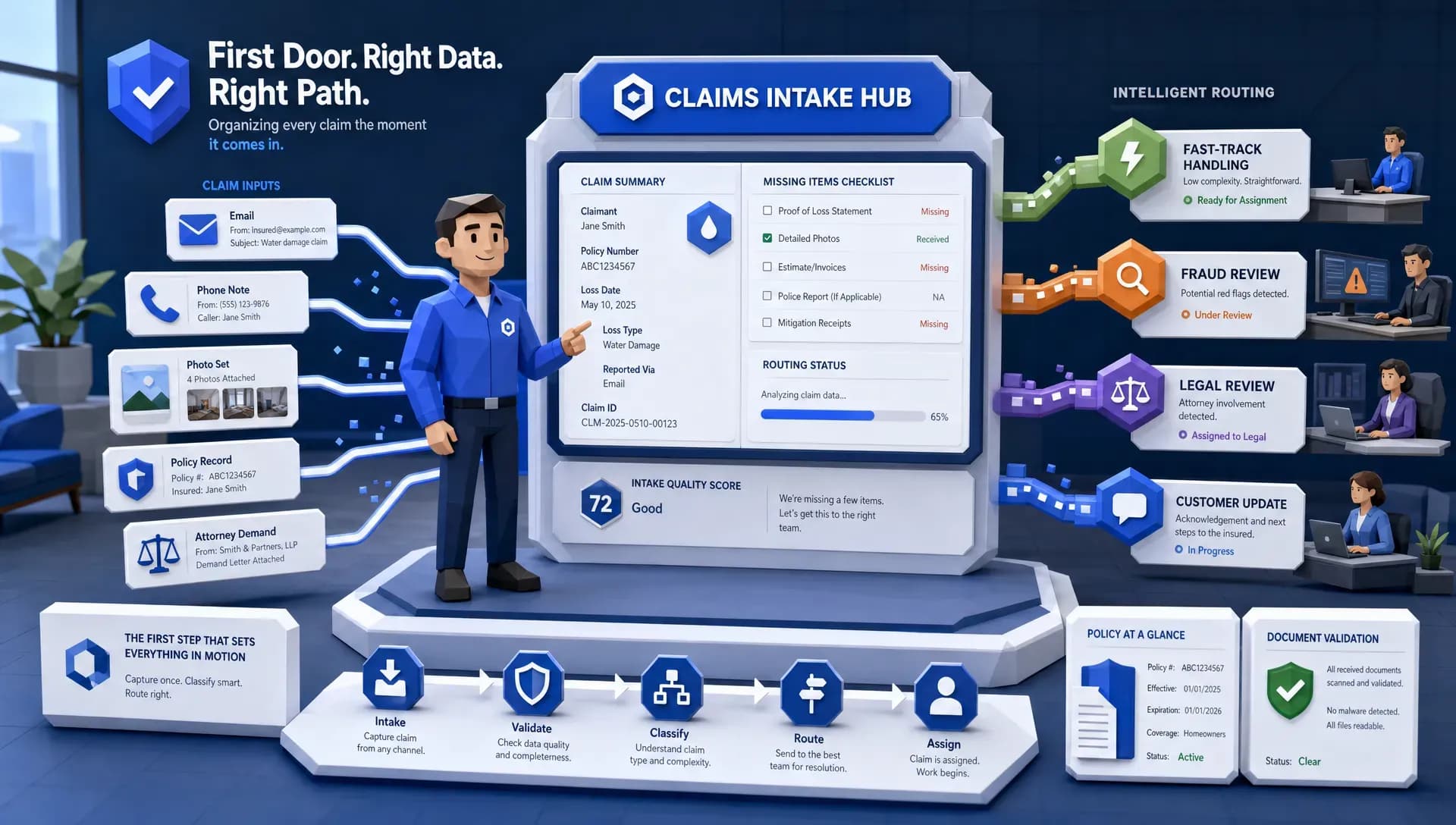
The first thing I would check is whether the software can capture data from the channels your teams actually use: email, portals, PDFs, spreadsheets, images, invoices, call notes, third-party reports, and scanned documents. In 2026, a platform that only works when the claimant fills out a perfect web form is not automation. It is wishful thinking with a login screen.
The software should extract key fields, classify documents, identify missing information, and create structured claim data without constant re-keying. This matters because every manual copy-and-paste is a tiny operational tax. One field is harmless. Thousands of fields across claims, invoices, photos, and correspondence become leakage, delays, and audit headaches.
Ask vendors what file types they support. Then test it. Do not accept a polished sample PDF. Bring the weird stuff. Bring the blurry photo. Bring the repair invoice with awkward formatting. Bring the attorney demand letter with five attachments and no clean naming convention. If the platform cannot survive your real inputs, it will not survive your real operation.
Prioritize workflow control over vendor dependency
Here is another strong opinion: if every workflow change requires a ticket, a workshop, three weeks of back and forth, and someone named Kevin from implementation to become available, you are not buying agility.
Claims rules change. State requirements shift. New fraud patterns appear. New vendor networks come online. A carrier launches a new product. An MGA adjusts authority levels. A reinsurer asks for different reporting. Your claims processing software has to let business users adapt workflows without turning every change into a mini IT project.
You want configurable workflows for routing, escalation, fraud review, document requests, reserve triggers, settlement authority, and customer communication. You also want guardrails, because nobody wants every team building their own private version of claims handling in a corner.
This is where I like a practical middle ground: business-owned workflows with operational governance. Claims leaders should be able to deploy and adjust the process. Compliance, data, and IT should still have visibility into what changed and why.
At Inaza, this is a core philosophy. Insurers can deploy their own workflows, and for suitable use cases, Inaza can help deploy a production-ready workflow on a single call rather than dragging teams through the usual proof-of-concept ping-pong. That speed matters because claims teams do not have six months to prove that automation can read an invoice.
Make integration a deal-breaker
Most carriers, MGAs, and brokers already have core systems. They may not love them, but those systems hold policies, claims records, billing, documents, and years of operational muscle memory. Replacing everything at once sounds brave in a board deck. In real life, it often creates the kind of project that makes people update their LinkedIn profiles.
Your insurance claim processing software should integrate with existing systems rather than demand a full rip-and-replace. That means APIs, pre-built connectors, secure data exchange, and the ability to push and pull information from policy admin, claims management, CRM, payment systems, document stores, fraud tools, and third-party data providers.
Ask very specific integration questions. Can the platform enrich claims with external data? Can it connect to providers such as Verisk, LexisNexis, HazardHub, or other data sources you use? Can it update the claim file automatically after a workflow step? Can it send structured outputs to your data warehouse or reporting layer? Can it operate without making adjusters jump between five screens?
If a vendor says integration is easy, ask them to define easy. If easy means exporting a CSV every Friday, we are using different dictionaries.
For a deeper implementation view, Inaza has a useful guide on claims automation integration that covers how to connect automation to existing insurance systems without creating unnecessary disruption.
Do not separate automation from fraud controls
Fast claims are good. Fast fraudulent claims are less charming.
Any modern claims platform should help you accelerate clean claims while slowing down suspicious ones. That balance is everything. If the system flags everyone, adjusters stop trusting it. If it flags nobody, finance will eventually notice, usually in a meeting with bad coffee.
In 2026, fraud controls should include more than simple rule checks. Look for software that can review image metadata, spot duplicated or manipulated photos, compare invoices against expected patterns, detect unusual claim behavior, and route suspicious files to SIU or specialist adjusters with supporting evidence.
The supporting evidence part matters. A fraud flag that says suspicious is not enough. Adjusters need to know why the file was flagged: mismatched date, repeated vendor, location inconsistency, altered image, duplicate document, unusual injury escalation, prior claim pattern, or missing policy detail. The explanation helps teams act quickly and fairly.
This is also important for customer experience. The goal is not to interrogate every honest claimant like they are starring in a crime drama. The goal is to remove friction for legitimate claims and focus human attention where risk is real.
Demand analytics that come from the workflow itself
I am wary of claims dashboards that look impressive but rely on stale exports, manual tagging, or heroic spreadsheet work in the background. If the data is not captured cleanly during the workflow, the dashboard is just a nice painting of yesterday’s confusion.
Good insurance claim processing software should create usable data as work happens. That means every intake field, document classification, routing decision, escalation, fraud flag, customer touchpoint, payment milestone, and exception becomes part of a structured record.
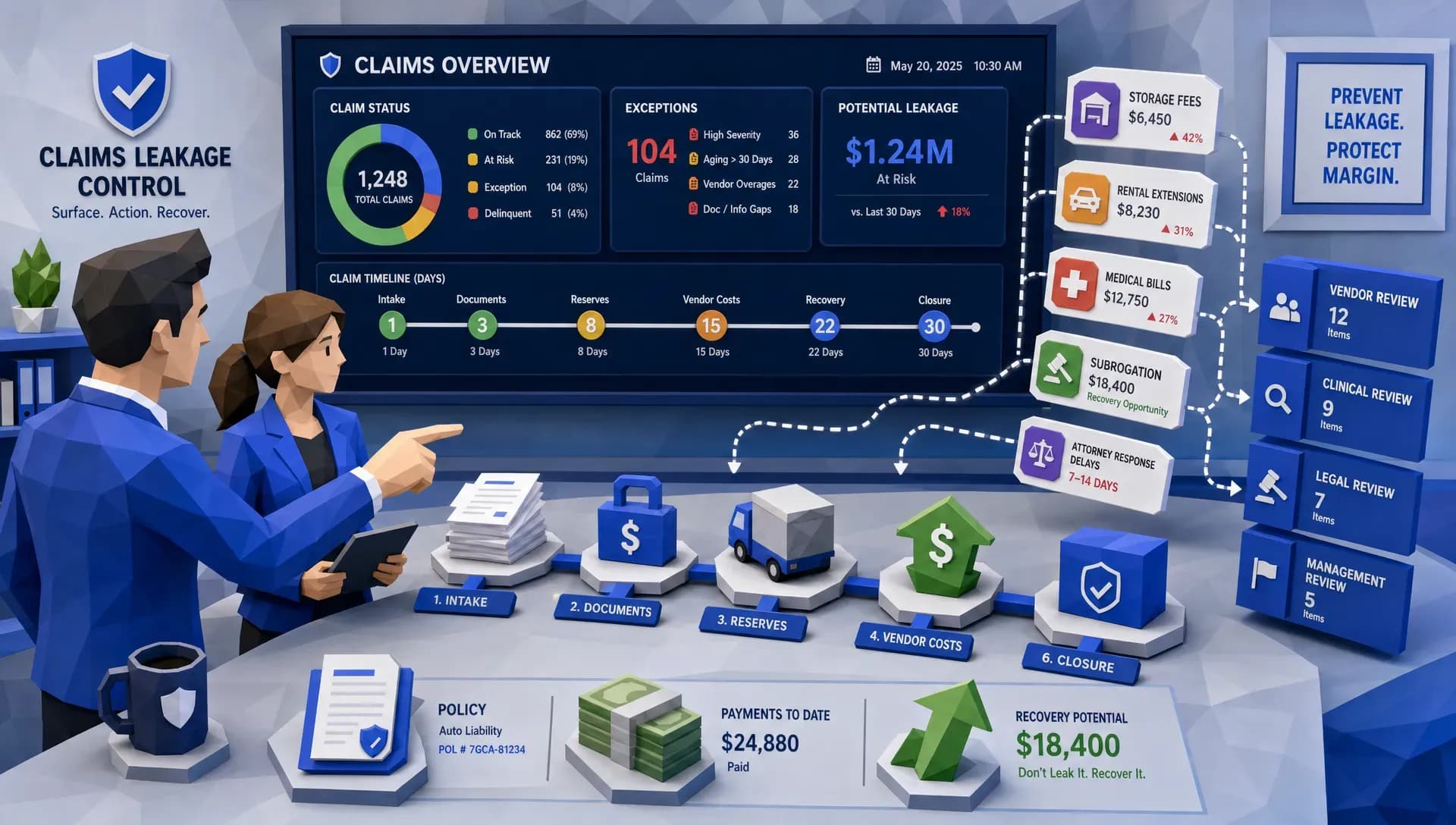
This is one of Inaza’s major differentiators: the platform has a unified data warehouse underpinning the automation. Workflow automation is the starting point. The real long-term value comes from capturing key data points and turning them into real-time dashboards, reporting, and business intelligence.
That matters for claims leaders because the best questions are operationally specific. Where are claims getting stuck? Which vendors drive the most supplements? Which adjusters are overloaded? Which claim types reopen most often? Which FNOL channels produce incomplete data? Where are we seeing leakage? Which portfolios perform better or worse than market benchmarks?
Inaza also includes industry benchmarks from sources such as Aon, Munich Re, Howden, and others, which can help insurers compare portfolio performance against the market. That can be valuable not only for claims management, but also for renewals, reinsurance discussions, and board-level reporting.
Keep humans in the loop where judgment matters
Claims automation should not pretend every claim can be settled like a vending machine transaction.
Some claims need empathy. Some need negotiation. Some need legal review. Some need a senior adjuster who has seen the same pattern before and knows something smells off. The software should support that judgment, not bury it under automated confidence scores and robotic emails.
Look for human-in-the-loop design. That means the system knows when to escalate, passes the full context to the human reviewer, records the reason for escalation, and learns from the outcome. It should make the adjuster faster and better informed, not turn them into a quality-control clerk for the machine.
One simple test: ask what happens when a claimant becomes upset, an attorney demand arrives, or coverage is unclear. If the platform cannot hand off the case with conversation history, documents, extracted fields, and prior decisions intact, your team will end up doing detective work inside its own system.
Run the mess test before you sign
Vendor selection should include a structured demo using your real-world claim scenarios. I call this the mess test. It is not complicated, but it is very revealing.
Bring examples like these into the evaluation:
- A clean low-severity claim that should move quickly with minimal touch
- A claim with missing information, inconsistent dates, and several attachments
- A suspected fraud claim with questionable photos or invoice details
- A bodily injury claim with medical documents and attorney correspondence
- A catastrophe surge scenario where volume spikes and routing rules matter
Watch how the software handles each one. How much data is captured automatically? How many manual corrections are needed? Does it route the claim correctly? Are fraud flags explained? Are customer communications triggered? Is the audit trail complete? Does the data flow into reporting without someone building a spreadsheet afterward?
This is also where you should test time-to-value. Some platforms can show promise in a lab but require months of customization before they help a live claims team. Others, including Inaza, are designed around faster workflow deployment, pre-built templates, and integration with existing systems. If you are evaluating vendors, make them prove how quickly a usable workflow can go live.
Measure outcomes, not software activity
A claims platform can generate plenty of activity while improving very little. More notifications, more dashboards, and more workflow steps do not automatically mean better claims performance.
Before buying, define the metrics that matter. I would usually start with FNOL completion time, claim assignment time, adjuster touches per claim, cycle time by claim type, percentage of claims handled with minimal manual intervention, payment accuracy, reopened claim rate, fraud referral quality, customer response time, cost per claim, and audit exceptions.
If straight-through processing is part of the business case, be realistic. Industry analysts such as Celent have noted that true claims straight-through processing remains limited for many insurers. That does not mean STP is a fantasy. It means you should measure it carefully by claim type and complexity rather than throwing one big percentage into a slide deck and hoping nobody asks questions.
The right goal is not automate everything. The right goal is automate the right work, with the right controls, and prove the improvement in operational and financial terms.
Watch for red flags during procurement
The first red flag is the black-box answer. If a vendor cannot explain how a claim is classified, why a fraud flag was raised, or what data was used in a workflow decision, be careful. Claims decisions need to be defensible.
The second red flag is the perfect-case platform. If it performs beautifully on clean claims but falls apart on missing data, conflicting documents, or customer follow-ups, it will create more work for your adjusters.
The third red flag is forced retraining. Claims teams already know how to handle claims. They do not need a six-week software bootcamp to do their jobs. A strong platform should work with familiar processes and systems where possible. Inaza, for example, is designed so teams do not need broad retraining to start using automated workflows.
The fourth red flag is dashboard-first thinking. Reporting matters, but if the underlying data is still fragmented, the dashboard is lipstick on a filing cabinet.
The fifth red flag is procurement theatre. If every small workflow requires a long proof of concept, a formal change request, and weeks of vendor back-and-forth, ask yourself how the relationship will feel when a regulator, reinsurer, or catastrophe event creates a real deadline.
Think beyond claims: connect underwriting, operations, and reinsurance
Here is where I may annoy a few claims purists: claims software should not live only in claims.
Claims data is one of the richest sources of underwriting truth. FNOL patterns, severity trends, litigation rates, repair costs, fraud signals, and vendor performance all feed back into pricing, renewals, portfolio management, and reinsurance narratives. If the claims platform traps that data inside claim files, the organization loses value.
Modern claim processing software should help underwriting and claims speak the same data language. That does not mean every underwriter needs claim-level noise. It means the organization should be able to see patterns: which segments deteriorate, which territories spike, which coverages leak, which policyholders improve, and which risks need renewed attention.
This is also where a connected data warehouse becomes more than an IT feature. It becomes an operating advantage.
Plan adoption like an operating change, not a software install
Even the best platform can fail if the rollout is treated like a login announcement.
Claims leaders should involve adjusters, supervisors, SIU, legal, compliance, underwriting, finance, and IT early. Each group sees different failure points. Adjusters know which screens waste time. SIU knows which fraud patterns are easy to miss. Compliance knows what regulators will ask for. Finance knows where leakage hurts. Underwriting knows which claims signals should feed pricing and renewal decisions.
I also like borrowing habits from growth and innovation teams: define a hypothesis, test it, measure it, then scale what works. Teams such as User Story apply this kind of growth and innovation thinking in B2B settings, and claims transformation can benefit from the same discipline. Do not roll out automation because it sounds modern. Roll it out because it reduces touches, improves accuracy, speeds payment, or catches leakage.
Start with one workflow where the pain is obvious and the data is available. Prove the value. Then expand.
Where Inaza fits in the evaluation
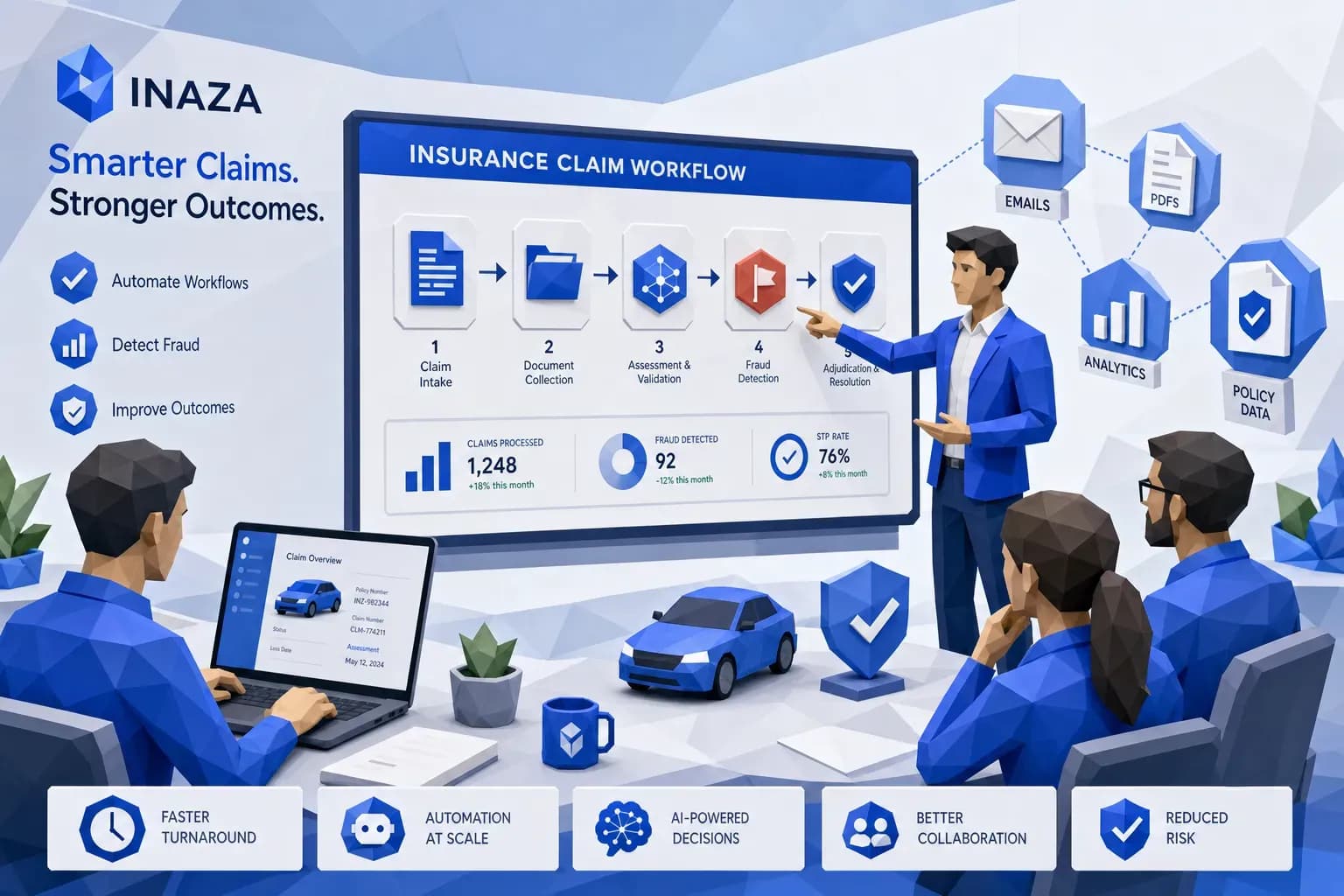
Inaza’s AI-powered insurance automation platform is built for insurers, MGAs, and brokers that want to streamline claims, underwriting, customer service, and operations without ripping apart existing systems.
For claims teams evaluating software in 2026, the relevant capabilities include automated data capture, customizable workflows, support for all file types, seamless system integration, 250+ workflow templates, real-time analytics dashboards, and a unified data warehouse. Inaza also offers pre-built API templates that can enrich automations with external data sources, and industry benchmarks that support portfolio analysis, renewals, and reinsurance discussions.
The main point is not to buy automation for its own sake. The point is to create a claims operation where routine work moves faster, suspicious work gets better scrutiny, and leadership can see what is happening across the business without begging five teams for spreadsheets.
That is what good insurance claim processing software should do in 2026.
Frequently Asked Questions
What is insurance claim processing software? Insurance claim processing software helps insurers manage the claim lifecycle, from FNOL and document intake to routing, review, settlement, reporting, and audit. Modern platforms also automate data capture, fraud checks, customer updates, and analytics.
What features matter most when choosing claims software in 2026? The most important features are flexible intake, workflow automation, strong integrations, fraud detection, human escalation, audit trails, real-time analytics, and the ability to adapt workflows without months of vendor dependency.
Should insurers replace their existing claims system? Not always. Many carriers and MGAs get better results by adding an automation and data layer that integrates with existing claims, policy, and reporting systems. Full replacement can make sense in some cases, but it should not be the default assumption.
How should we evaluate ROI for claims automation? Measure cycle time, adjuster touches, cost per claim, leakage reduction, fraud referral quality, reopened claims, customer response time, audit exceptions, and straight-through processing rates by claim type. ROI should be tied to operational outcomes, not software usage alone.
Can automated claims software handle complex claims? It can help triage, organize, enrich, and route complex claims, but human judgment is still essential for sensitive coverage issues, bodily injury claims, litigation, and fraud investigations. The best systems know when to escalate and provide the context humans need.
Ready to choose claims software without the procurement circus?
If you are evaluating insurance claim processing software in 2026, focus on the messy work: files, handoffs, fraud signals, integrations, audit trails, and reporting. That is where value shows up.
Inaza helps insurers, MGAs, and brokers automate claims workflows, capture structured data, integrate with existing systems, and turn operational activity into usable business intelligence. If your team is ready to move beyond manual claims handling and endless proof-of-concept cycles, we would be happy to show you what a production-ready workflow can look like.