Fraud detection in insurance has a public relations problem. People picture a trench-coat investigator hiding behind a hedge, waiting to catch someone in the act. In real P&C operations, it is usually less cinematic and much more useful: clean data, smart checks, practical routing, and a human being making the final call when the stakes are high.
Here is my hot take after a decade around insurance operations: the best fraud detection does not start by assuming customers are lying. It starts by assuming honest customers deserve speed, and suspicious cases deserve attention before they become expensive messes.
I learned this the old-fashioned way. Years ago, an adjuster showed me two auto claims from different policyholders. Different names, different dates, different loss descriptions. Same cracked bumper photo. Same oil stain on the driveway. The system had not caught it. The adjuster had, mostly because she had a memory like a steel trap and enough coffee to power a small call center. Admirable? Yes. Scalable? Absolutely not.
That is where modern fraud detection in insurance earns its keep. It helps insurers spot what humans miss at volume, without turning every claim into an interrogation.
Why fraud detection matters more than ever
Insurance fraud has always been expensive, but the game has changed. The FBI has long estimated that non-health insurance fraud costs more than $40 billion per year in the United States. That cost does not float off into space. It lands in loss ratios, premiums, expense ratios, and customer trust.
The newer problem is speed. Fraud attempts can now be assembled faster, with cleaner-looking documents, polished claim narratives, and convincing images. Verisk’s 2025 fraud report points to rising carrier concern about AI-fueled digital fraud, including synthetic content and more believable claim materials. In the UK, Admiral reported a sharp rise in suspected fraudulent claims involving AI-generated or altered images, according to BBC coverage.
That does not mean every claimant with a blurry photo is a fraudster. My phone has produced photos that look like they were taken through a potato. It does mean carriers, MGAs, brokers, and claims teams need a detection process that can separate messy reality from deliberate deception.
What fraud detection actually means in the real world
In insurance, fraud detection is the process of finding claims, applications, documents, or behaviors that deserve closer review. Notice the wording: deserve closer review. A fraud flag is not a guilty verdict. It is a professional nudge that says, look here before you pay, bind, renew, or escalate.
Fraud can show up in a few familiar ways. There is hard fraud, like a staged accident or fabricated theft. There is soft fraud, like inflating repair costs, exaggerating injuries, or leaving out a driver at underwriting. Then there are third-party problems, such as inflated invoices, questionable medical billing patterns, or repair networks that somehow always find the most expensive path from dent to payday.
The real-world process is layered. No single signal proves much on its own. A claim filed shortly after policy inception might be suspicious, or it might be bad luck. A photo with missing metadata might be manipulated, or it might have been stripped by a messaging app. A claimant with prior losses might be gaming the system, or they might simply live at a dangerous intersection. Fraud detection works when those signals are combined, weighted, explained, and routed intelligently.
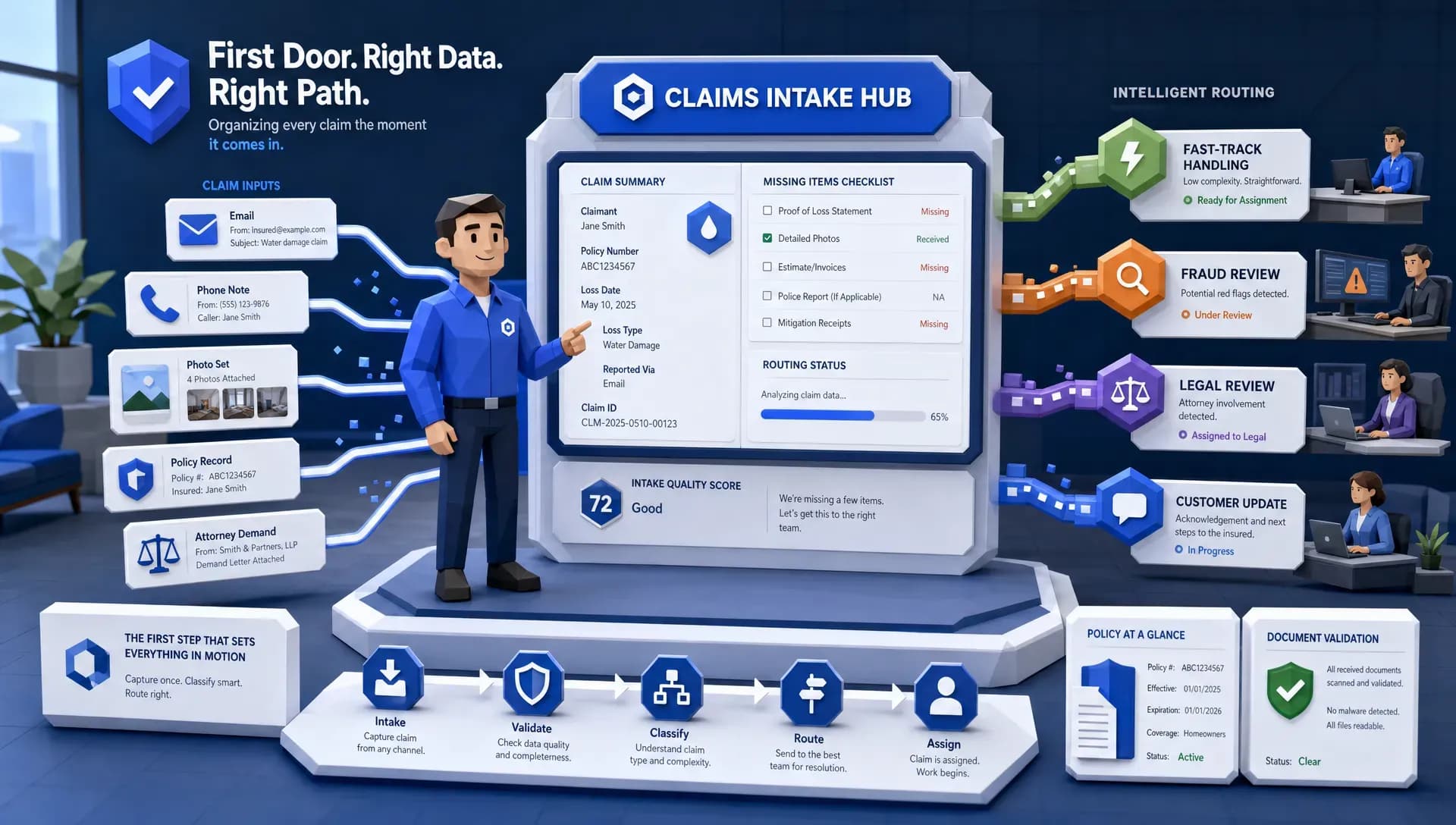
Every good fraud workflow starts at intake. That might be FNOL for a claim, a submission for underwriting, an email from a broker, an invoice from a repair shop, a police report, a medical document, or a phone call transcript.
The boring part matters. If the date of loss is miskeyed, the VIN is incomplete, or the policy record lives in one system while photos live in another, your fraud team is already working with fogged-up glasses. Bad data creates false alarms, missed red flags, and a lot of unnecessary back-and-forth.
This is why automation at intake is not just about speed. It is about evidence quality. McKinsey has noted that a large share of underwriting time can be consumed by administrative work rather than risk assessment, with its insurance automation research highlighting how much value sits in removing manual friction. The same logic applies in claims. If your people spend the morning copying fields from PDFs into a core system, they are not investigating fraud. They are doing clerical archaeology.
A practical intake process captures the facts, standardizes them, and keeps the original evidence attached. That means the claim note, photo, invoice, email, policy record, and third-party data all stay connected.
Step two: verify whether the story matches the evidence
Once the facts are captured, the next question is simple: does the story make sense?
A real fraud detection workflow checks the claim or application against internal and external sources. In auto, that may include policy status, prior claims, VIN data, driver history, vehicle history, repair records, garaging location, weather, accident reports, and known entity relationships. In property, it may include location risk, storm data, contractor history, prior losses, permits, and imagery. In bodily injury, it may include treatment timelines, injury severity, accident details, attorney involvement, and historical settlement patterns.
The important part is context. A mismatch is not proof. I once saw a claim flagged because the reported accident location and the photo location did not match. It looked bad until the adjuster called and found out the vehicle had been towed to the claimant’s brother’s driveway before photos were taken. The system was right to flag it. The human was right to clear it.
This is the healthy relationship between automation and adjusters. Automation raises the hand. People ask the right questions.
Step three: look for patterns humans cannot track manually
Traditional rules still have a place. Claims filed within a short window after policy inception deserve a look. Multiple claims tied to the same phone number, address, repair facility, IP address, medical provider, or attorney network may deserve a look. A low-impact collision paired with high-severity injury treatment might deserve a look.
But static rules can become a museum of old fraud tactics. Fraudsters adapt. If your system only catches last year’s scheme, congratulations, you own a very expensive rearview mirror.
Modern fraud detection uses historical patterns to spot unusual combinations. That might mean claims that resemble previously confirmed fraud, applications that differ from peer norms, invoices that fall outside expected ranges, or networks of parties that show suspicious repeat connections. A fraud analyst might eventually see those links manually, but not at the pace modern claims volumes demand.

Step four: check digital evidence, especially images and documents
Digital evidence is now a front-line fraud battleground. Photos, invoices, loss runs, repair estimates, medical bills, and written statements can all be manipulated, reused, or generated.
For images, insurers can check metadata, timestamps, geolocation, file history, duplicate use, and signs of tampering. For documents, they can look at formatting anomalies, invoice sequencing, entity matches, suspicious edits, and inconsistencies between the document and the claim story.
There is also a broader content problem emerging. Claim narratives, demand letters, and supporting statements can be generated or polished quickly. Fraud teams do not need to become internet detectives, but they should understand the content arms race. Resources like Detection Drama’s overview of AI content detection and humanization tools are a useful reminder that generated content is becoming easier to disguise, which means insurers need evidence checks that go beyond whether a paragraph sounds polished.
That said, do not overreact to style. Some honest customers write oddly. Some attorneys write like they bill by the adjective. The point is to compare content against facts, not judge it by vibes.
Step five: score and route, without pretending the score is the truth
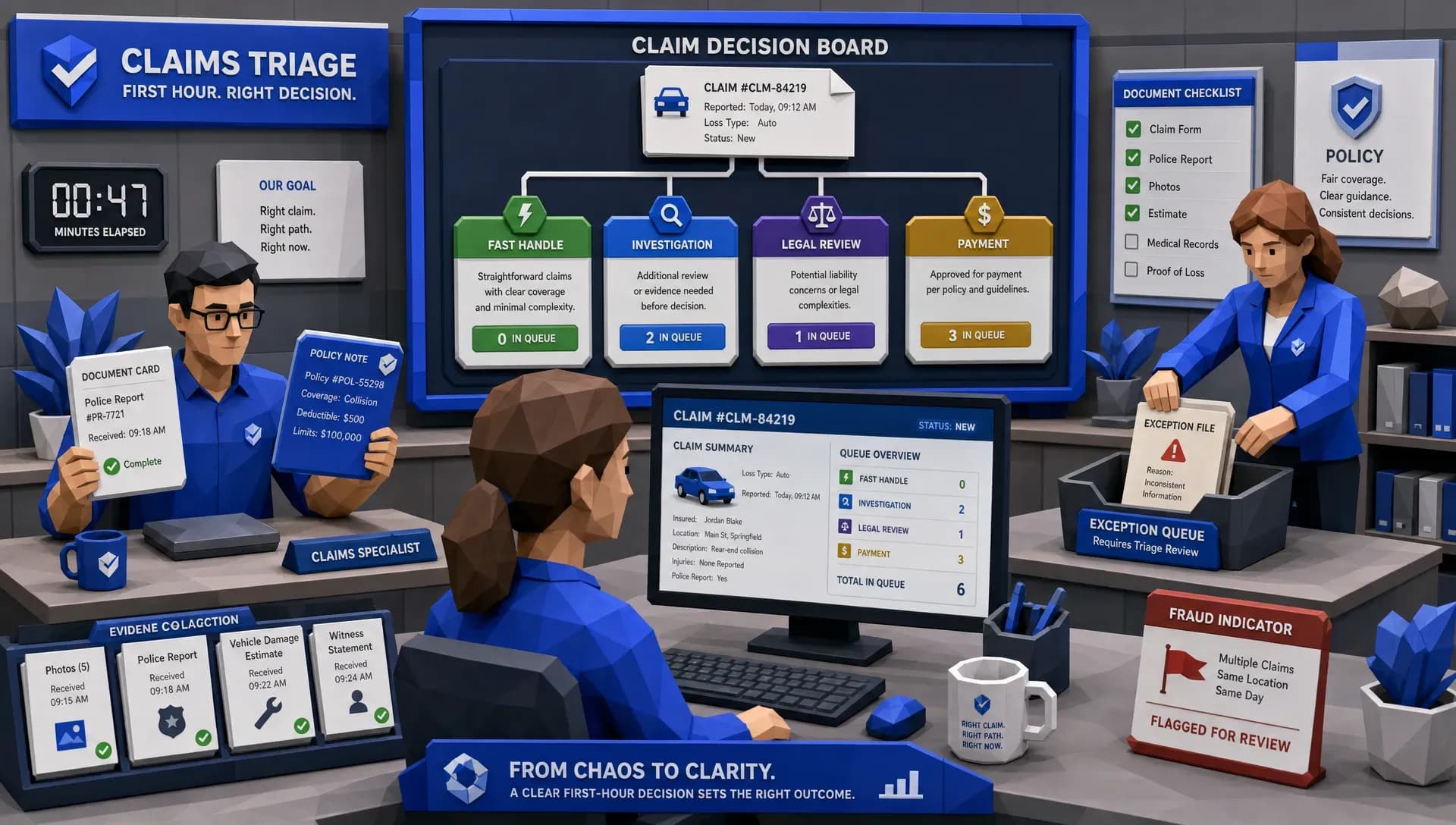
A good fraud workflow turns many signals into a risk score or priority level. Low-risk claims can continue quickly, sometimes straight through. Medium-risk claims can go to an adjuster with clear reason codes. High-risk claims can be routed to SIU or a senior handler.
The phrase clear reason codes matters. If a system says high risk but cannot explain why, it creates distrust and operational drag. Adjusters need to know whether the flag came from photo reuse, policy timing, entity links, invoice anomalies, prior claim history, or missing documentation.
This is also where customer experience is won or lost. A fraud score should not automatically slow every claim. The whole point is to let clean claims move faster while suspicious claims get appropriate scrutiny. If your fraud system delays honest customers, you have solved one problem by creating three more.
Step six: investigate, decide, and feed the outcome back
The human investigation still matters. SIU teams may interview parties, request additional records, review scene details, compare medical timelines, contact vendors, or prepare referrals where appropriate. In sensitive cases, human judgment is not a compliance decoration. It is the control that keeps the process fair.
The part many insurers underinvest in is the feedback loop. Every confirmed fraud, cleared referral, false positive, recovery, withdrawal, denial, and litigation outcome should improve future detection. If the system never learns which flags were useful, it will keep annoying the same people in the same way.
I have seen carriers buy impressive fraud tools and then fail to capture investigation outcomes consistently. That is like hiring a detective and never telling them whether the suspect confessed. Eventually, the detective keeps chasing the same bad leads.
A real-world example: the suspicious auto claim that might still be honest
Let’s say a policyholder files an auto claim eight days after binding coverage. The FNOL says the accident happened in a grocery store parking lot at 6 p.m. on Friday. The claimant uploads three vehicle photos, a repair estimate, and a short description.
The detection workflow checks policy inception, coverage, driver details, VIN, prior claims, location, weather, photo metadata, and repair facility history. Several things pop. The photo timestamp appears to be from Sunday morning. One image resembles a prior claim photo. The repair shop has an unusually high average estimate for similar damage. The claimant’s phone number is linked to another recent claim involving a different policy.
That sounds bad. It might be bad. But here is where real-world insurance work resists easy answers. The timestamp could reflect when the photo was forwarded, not when it was taken. The shop might specialize in higher-end vehicles. The shared phone number could be a family plan. The prior image match could be a false match on a common bumper angle.
So the system routes the claim for review, shows the reasons, and gathers supporting data. The adjuster asks for additional photos, confirms tow details, checks the original file history, and reviews the parties involved. Maybe the claim clears. Maybe it becomes an SIU referral. Either outcome is better than blindly paying or blindly accusing.
What good fraud detection teams measure
The strongest fraud teams do not brag about how many claims they flagged. Anyone can flag claims. I can flag claims with a dartboard and a suspicious attitude. The real question is whether the process improves outcomes without damaging service.
Useful metrics include:
- Referral precision, meaning how many flagged cases produce meaningful findings.
- False positive rate, because every bad flag consumes time and trust.
- Time to triage, especially for early identification before payments go out.
- Cycle time for low-risk claims, since honest customers should benefit from better detection.
- SIU workload per confirmed case, which shows whether analysts are spending time wisely.
- Recovery, avoided leakage, and claim cost impact.
- Audit completeness, including reason codes, evidence trails, and decision history.
The best metric mix balances fraud savings with operational discipline. If fraud savings rise but low-risk claims slow down, the program needs tuning. If referrals increase but confirmed fraud does not, the program is probably creating noise.
The mistakes that make fraud detection weaker
The first mistake is treating fraud detection as a claims-only problem. Fraud often starts at underwriting. Undisclosed drivers, garaging misrepresentation, staged identities, false prior coverage, and inaccurate vehicle use can all shape later claim behavior. Claims and underwriting data need to talk to each other.
The second mistake is relying on rules alone. Rules are useful guardrails, but fraud changes. If your fraud strategy is a long list of if-this-then-that checks written three years ago, you are probably catching the clumsiest fraudsters and missing the professional ones.
The third mistake is hiding the reasoning. Adjusters, underwriters, SIU teams, compliance teams, and executives all need visibility. A fraud flag should come with an explanation and an evidence trail.
The fourth mistake is forgetting the honest customer. Fraud detection should protect the book, but it should also protect service. If every claim gets dragged through the mud, customers will remember that at renewal.
Where Inaza fits into the real workflow
Inaza’s role is practical: connect the data, automate the checks, route the work, and make the outcomes visible. The platform supports underwriting, claims, customer service, and operations, which matters because fraud signals rarely stay politely inside one department.
For insurers, MGAs, and brokers, Inaza can automate data capture from varied file types, integrate with existing systems, and help teams deploy customizable workflows without forcing staff to relearn their entire day job. Its workflow templates and pre-built API templates, including connections to data sources such as Verisk, LexisNexis, and HazardHub, can enrich decisions without turning every implementation into a science project.
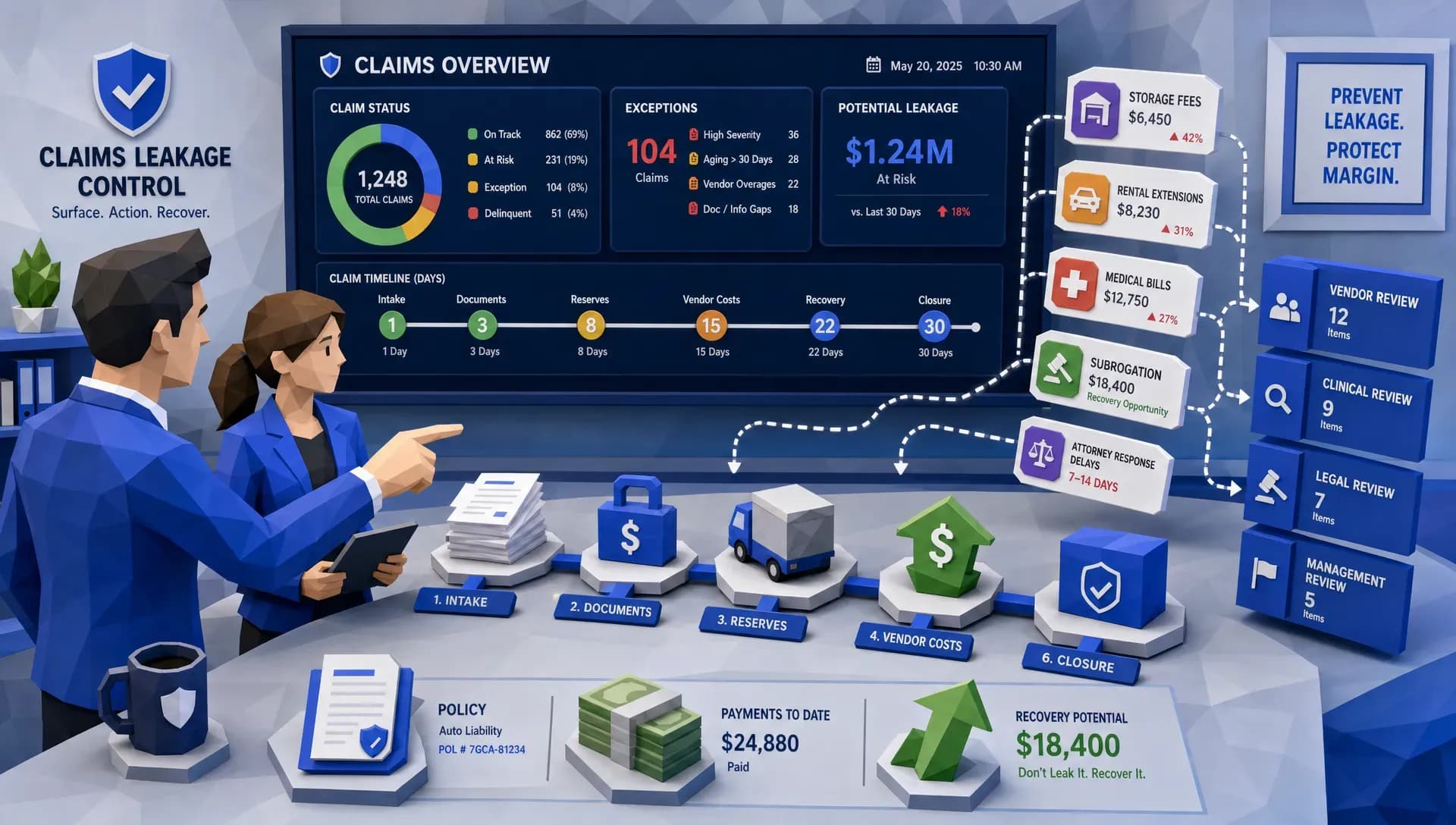
The data warehouse underneath is where things get especially interesting. Fraud detection improves when every referral, outcome, exception, and decision reason can be analyzed later. Dashboards help leaders see whether fraud workflows are reducing leakage, creating too many false positives, or revealing issues upstream in underwriting or policy operations.
That is the grown-up version of fraud detection insurance teams actually need. Less drama. More evidence. Better routing. Cleaner audit trails. Fewer expensive surprises.
Frequently Asked Questions
What is fraud detection in insurance? Fraud detection in insurance is the process of identifying claims, applications, documents, or behaviors that may require closer review due to suspicious patterns, inconsistencies, or known risk indicators.
Can insurance fraud detection be fully automated? Some low-risk checks and routing decisions can be automated, but sensitive decisions should include human oversight. A fraud score should support adjusters and investigators, not replace professional judgment.
What data is most useful for detecting insurance fraud? Useful data includes policy history, claims history, FNOL details, photos, invoices, repair records, driver or property data, third-party enrichment, communications, payment patterns, and prior investigation outcomes.
How do insurers reduce false positives in fraud detection? Insurers reduce false positives by improving data quality, using multiple signals instead of single-rule triggers, showing clear reason codes, reviewing outcomes, and continuously tuning workflows based on confirmed results.
Why does fraud detection matter for honest policyholders? Fraud costs ultimately affect premiums, service speed, and trust. Better detection helps insurers move clean claims faster while focusing investigative resources on cases that truly deserve attention.
Make fraud detection useful, not noisy
If your fraud workflow still depends on memory, spreadsheets, disconnected inboxes, and heroic adjusters, you are asking good people to do an impossible job.
Inaza helps insurers, MGAs, and brokers build connected automation across underwriting, claims, customer service, and operations, with data capture, enrichment, routing, analytics, and dashboards in one workflow. If you want fraud detection that works in the real world, start with the data and build from there.