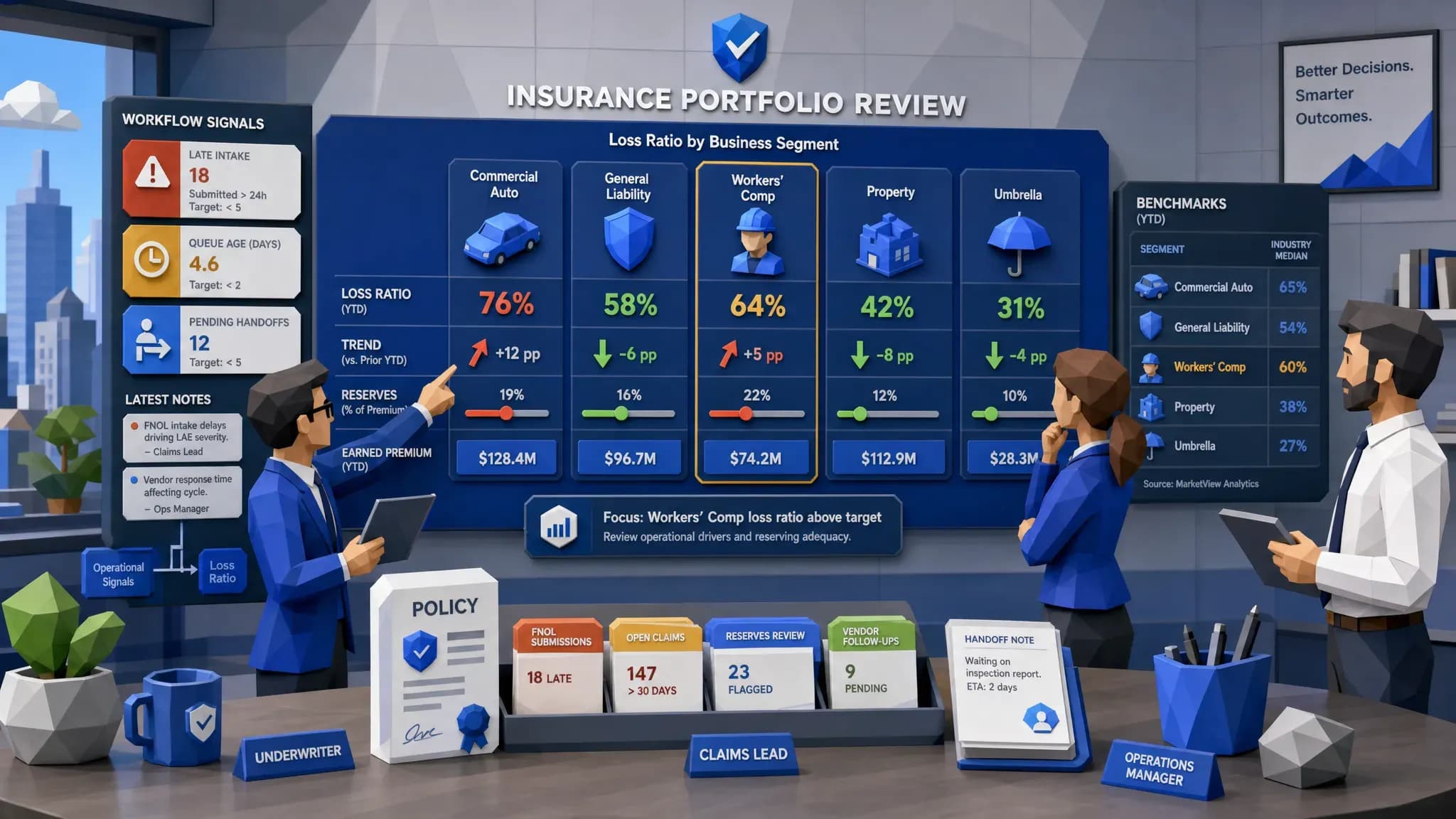
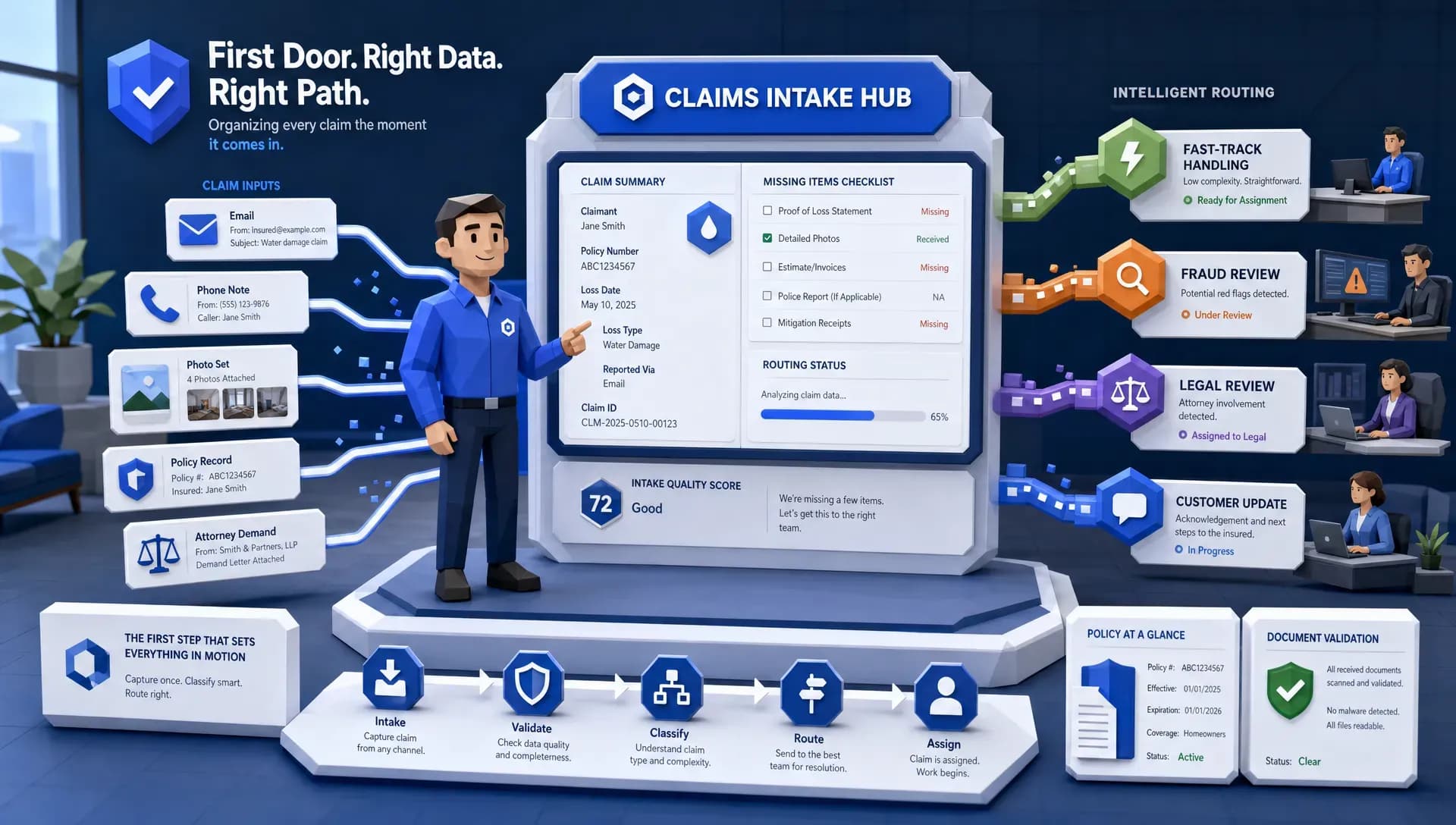
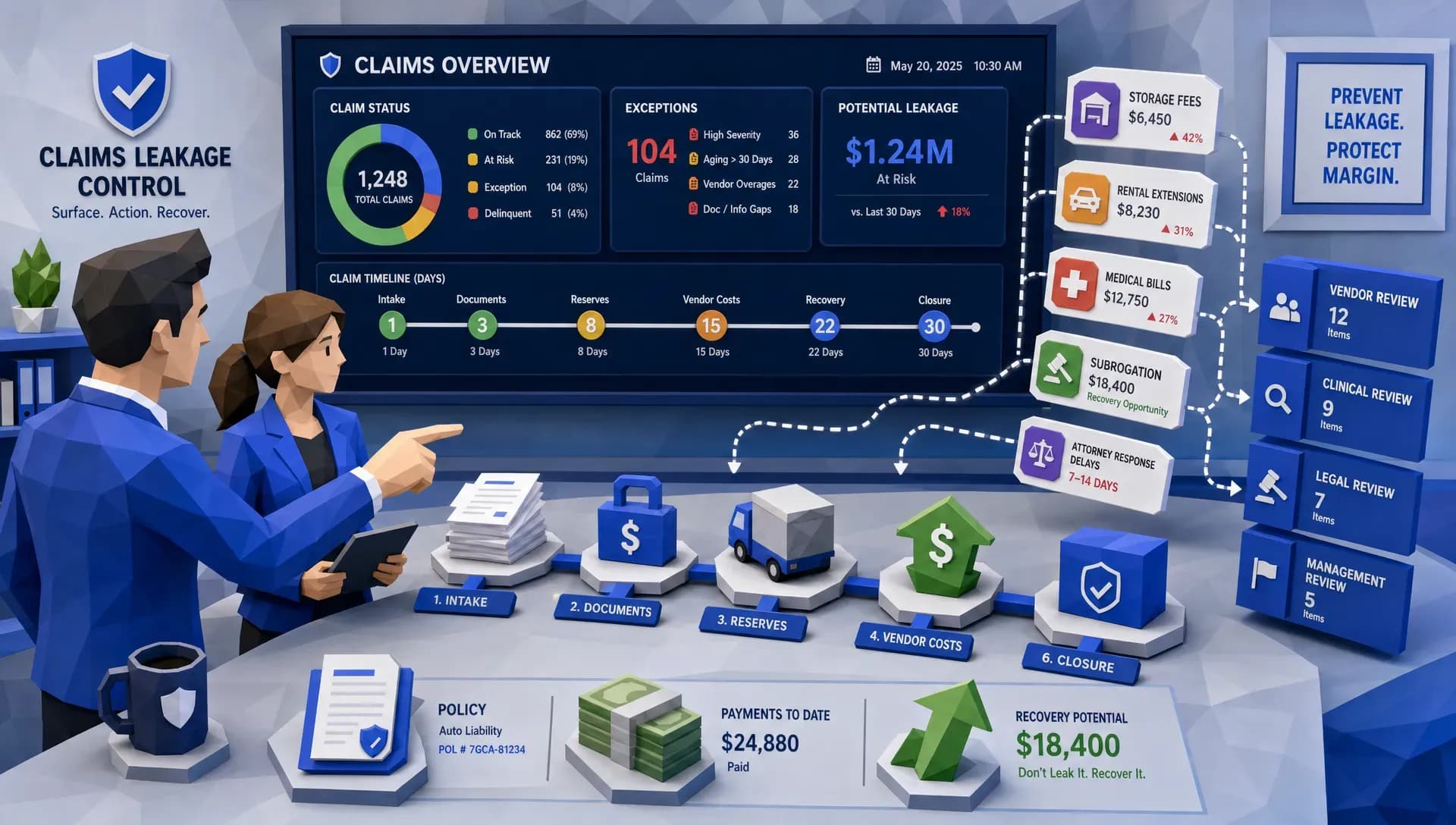
I have a slightly unpopular opinion: the loss ratio is one of the best operations reports an insurer has, even though it usually gets treated like a finance or actuarial artifact.
I learned this the awkward way years ago in a monthly review where everyone blamed a deteriorating commercial auto book on “bad drivers.” Very dramatic. Very boardroom. Three weeks later, we found the real story: MVR data was arriving late, one referral queue had become a black hole, and claims were sitting too long before reserve review. The drivers had not suddenly forgotten how brakes work. The operation had started leaking.
That is what insurance companies loss ratio performance can reveal when we stop reading it like a weather report and start reading it like a smoke alarm. It will not tell you every answer. But it will tell you where to smell for smoke.
First, what loss ratio actually measures
At its simplest, loss ratio is:
Metric | Simple meaning
Incurred losses | Paid claims plus case reserves, and often loss adjustment expenses depending on the calculation
Earned premium | The portion of written premium that applies to the elapsed coverage period
Loss ratio | Incurred losses divided by earned premium
So if a book earns $10 million in premium and incurs $6.5 million in losses, the loss ratio is 65%. That means 65 cents of each earned premium dollar went to losses before expenses, commissions, taxes, reinsurance costs, and profit.
Simple enough. Also dangerously easy to misread.
A 65% loss ratio could mean pricing is roughly working. It could also mean claims are under-reserved, large losses have not developed yet, or a low-quality segment is being masked by a better one. A 90% loss ratio might scream “bad underwriting,” but sometimes it is really “late claims triage,” “messy data capture,” or “we are paying for rental days we could have avoided.”
If you want the clean underwriting distinction between loss ratio, rate, premium, and loss cost, Inaza has a useful primer on what loss cost insurance really means for underwriters. For this article, I want to stay focused on the operational breadcrumbs hiding inside the ratio.
Think of it like investing. A stock’s P/E ratio does not tell you whether to buy the company by itself. You still need context, trend, quality of earnings, and risk. The same discipline applies here, and broader financial education resources like Greek Shares make a similar point for investors: ratios are tools for asking better questions, not magic verdict machines.
My hot take: operations move the loss ratio earlier than pricing does
Pricing changes are important. No argument there. But pricing usually takes time to earn through a book. Operational issues can show up faster, sometimes within weeks.
A claim reported late can inflate severity. A missed fraud signal can turn a manageable file into a circus. A submission rekeyed incorrectly can put the wrong risk into the wrong tier. A handoff between underwriting and claims can lose the one note that would have changed the reserve strategy.
This is why I get twitchy when executives say, “We have a loss ratio problem,” and immediately open the rate filing spreadsheet. Maybe you do have a pricing problem. But before you hit the rate lever, ask whether your operating model is quietly damaging the numerator or starving the denominator.
McKinsey has reported that underwriters can spend a large share of their time on administrative work rather than risk assessment, with its insurance automation research pointing to roughly 60% of underwriter time being consumed by admin tasks. That matters because every hour spent chasing PDFs, cleaning spreadsheets, or rekeying broker submissions is an hour not spent judging risk quality.
In other words, poor operations do not politely wait outside the loss ratio calculation. They walk right in and put their feet on the furniture.
What different loss ratio patterns can reveal
A single loss ratio number is blunt. The trend and segmentation are where the good stuff lives.
Here is the kind of pattern recognition I like to use in performance meetings:
Loss ratio pattern | Operational clue | First place I would look
Frequency rises while severity stays flat | Risk selection or intake rules may be drifting | Submission triage, appetite checks, producer mix
Severity rises while frequency stays flat | Claims leakage, reserving, vendor cost, or litigation may be worsening | Claims handling, attorney involvement, repair networks, reserve reviews
New business performs worse than renewals | Data quality at quote or bind may be weak | Loss runs, third-party data, eligibility checks, quote workflow
One producer or broker channel deteriorates | Submission quality or appetite alignment may be uneven | Broker instructions, referral rules, class codes, documentation
Older accident years keep developing upward | Reserve discipline or claim escalation may be late | Claims diaries, supervisory review, litigation management
Gross loss ratio looks fine but net worsens | Reinsurance or recoverable workflows may be off | Treaty coding, bordereaux quality, recoveries, aggregation checks
None of these clues prove the root cause. They tell you where to start asking smarter questions.
The best insurance operators I know do not ask, “Why is the ratio bad?” That question is too vague. They ask, “Which workflow changed before the ratio moved?” That is the question that usually gets you paid.
Claims operations: the numerator is full of tiny leaks
Claims teams rarely destroy a loss ratio with one dramatic mistake. More often, they lose five dollars here, twelve dollars there, and a few hundred dollars on the files nobody had time to review last Thursday.
In auto, that might be storage fees, rental extensions, supplement delays, or missed subrogation. In property, it might be estimate drift, vendor leakage, or poor documentation on coverage decisions. In casualty, it might be attorney involvement that was predictable from the first notice of loss but not escalated early enough.
This is why I like claims analytics that focus on the boring stuff. Boring is where the money hides. Inaza has written more specifically about insurance claims analytics that reveal hidden leakage, and that framing is useful because leakage is rarely a neon sign. It is usually a slow drip under the sink.
The FBI has long warned that insurance fraud costs the industry and consumers billions of dollars each year, and fraud is one obvious pressure point. But honest inefficiency can be expensive too. J.D. Power’s 2024 U.S. Auto Claims Satisfaction Study noted that auto claims can take more than 30 days to settle on average, and long cycle times create obvious cost pressure through rental, repair, communication, and customer friction.
A quick personal example: I once saw a claim file where the repair itself was not the real problem. The vehicle sat waiting for approval, then waited for a supplement review, then waited again because one document was sent to the wrong inbox. Everyone did their individual job. The process still behaved like a shopping cart with one bad wheel.
That is operational loss ratio pressure. It does not always look reckless. Sometimes it looks like normal work moving too slowly.
Underwriting operations: the denominator has its own problems
When loss ratio worsens, the numerator gets most of the attention because claims are visible and painful. But earned premium deserves suspicion too.
If underwriting intake is slow, good risks may leave before quote. If broker submissions arrive in inconsistent formats, underwriters may spend too much time cleaning data and too little time assessing risk. If third-party data is checked manually, appetite decisions can vary by person, time of day, or caffeine level. I have seen more than one “risk appetite issue” that was actually a workflow consistency issue wearing a fake mustache.
For MGAs and carriers, new business quality is especially sensitive to operational friction. A rushed bind, a missed loss run detail, or an outdated class code can create premium that looks attractive on day one and regrettable by month nine.
This is where clean data capture matters. If loss runs, statements of values, driver schedules, claim notes, photos, attorney letters, emails, and spreadsheets all live in different places, you will eventually make decisions on partial truth. Partial truth is a very expensive underwriting partner.
Handoffs: where good intentions go to disappear
Here is another hill I will happily stand on: many loss ratio problems are handoff problems.
Underwriting sees something relevant but does not pass it clearly to claims. Claims notices a recurring issue but it never makes its way back into appetite rules. Customer service receives updated exposure information but the policy system is not refreshed. A broker clarifies something important by email, but the note never becomes structured data.
Everyone is busy. Everyone is trying. The ratio does not care.
Inaza has a deeper piece on why insurance company operations still break at handoffs, and I agree with the premise: the problem is often not effort. It is lost context.
A loss ratio that deteriorates after a change in staffing, TPA assignment, broker mix, or system migration should always trigger a handoff review. Not a blame session. A review. Blame makes people quiet. Reviews make data talk.
How I would run a loss ratio operations review
If I had 60 minutes with an MGA, carrier, or broker team looking at a worsening loss ratio, I would not start with a 40-slide deck. I would start with a simple table and force the discussion to stay concrete.
Question | Why it matters | Data worth pulling
Which segment moved first? | Overall loss ratio hides profitable and unprofitable pockets | Product, state, class, producer, limit, deductible, vehicle type, occupancy type
Did frequency, severity, or both change? | Each points to different operational causes | Claim count, average incurred, large loss threshold, reopen rate
Did the workflow change before the result changed? | Process changes often precede ratio movement | Staffing, TPA, vendor, system, rules, referral queue, automation changes
Are reserves moving late? | Late development can signal weak review cadence | Initial reserve, latest reserve, diary age, supervisor touchpoints
Are good risks abandoning before bind? | Poor intake can weaken the denominator | Quote turnaround time, decline reasons, bind ratio, missing data rates
Are we comparing against the market? | Internal trends need outside context | Industry benchmarks, competitor behavior, reinsurance feedback
Notice what is missing: vague debate. Vague debate is where meetings go to retire.
The goal is to turn the loss ratio into a trail of operational evidence. Once you do that, the discussion changes. Instead of “claims needs to do better” or “underwriting needs to tighten up,” you get to “we need to automate attorney demand intake,” “we need to flag late reserve movement,” or “we need third-party data enrichment before referral.” Much more useful. Much less theatrical.
Why dashboards matter, but only if the data underneath is trustworthy
I like dashboards. I also distrust them until I know where the numbers came from.
A beautiful dashboard built on inconsistent claim coding, missing loss runs, stale reserves, or manually rekeyed spreadsheets is just a colorful rumor. The executive team may enjoy looking at it, but it will not help the operation improve.
The trick is capturing operational data while the work happens. Not three weeks later when someone exports a CSV and tries to remember why a claim was escalated. While the submission is reviewed. While the claim is triaged. While the attorney demand arrives. While the service request is routed.
That is where an automation platform can make a practical difference, especially for P&C MGAs, carriers, brokers, underwriters, claims adjusters, fraud analysts, and reinsurance teams. Inaza’s platform is built to automate workflows across underwriting, claims, customer service, and operations while capturing the data needed for reporting and analytics. It integrates with existing systems, supports varied file types, and uses a unified data warehouse so the work and the business intelligence are connected.
The part I care about most is not “automation” as a buzzword. It is consistency. If the same rules, data checks, enrichment steps, and reporting logic run every time, your loss ratio review becomes less guesswork and more evidence.
Inaza also offers workflow templates, API templates for data enrichment, dashboards, and market benchmarks that can help teams compare internal performance against broader reference points. For reinsurance brokers and portfolio managers, that context can be especially valuable when explaining performance, renewal strategy, and risk quality.
The better target: an explainable loss ratio
Some teams chase a perfect loss ratio. I think that is the wrong obsession.
A “good” loss ratio that nobody can explain is not comforting. It may be under-reserved. It may be riding favorable weather. It may be hiding one producer’s poor performance behind three strong ones. It may be the insurance equivalent of finding money in a coat pocket and declaring yourself financially disciplined.
An explainable loss ratio is better. If the ratio improves, you know why. If it worsens, you know where to look. If a segment behaves differently from the market, you can explain the operational, underwriting, claims, or reinsurance context behind it.
That is the kind of loss ratio that helps leaders make decisions. It also makes renewal conversations, board reporting, and reinsurance negotiations much less painful.
Frequently Asked Questions
What is a good loss ratio for an insurance company? A “good” loss ratio depends on the line of business, expense structure, growth strategy, reinsurance program, and target combined ratio. A low loss ratio is not automatically good if it comes from under-reserving or overly conservative underwriting that limits profitable growth.
How can operations affect an insurance company’s loss ratio? Operations affect loss ratio through underwriting intake, data quality, claims cycle time, fraud detection, reserving discipline, vendor management, handoffs, and customer service workflows. Small delays or missed signals can increase claims cost or reduce premium quality.
Can automation improve loss ratio? Automation can help when it reduces manual errors, speeds up intake, standardizes decisioning, improves claims triage, and captures better data for analytics. It is most useful when tied to clear workflows and measurable operational outcomes.
Why should MGAs track loss ratio by segment? MGAs often manage specialized books where one producer, class, geography, or coverage feature can materially change performance. Segment-level loss ratio analysis helps identify whether the issue is risk selection, pricing, claims handling, or operational execution.
Is loss ratio enough to evaluate profitability? No. Loss ratio should be read alongside expense ratio, combined ratio, premium growth, reserve development, reinsurance impact, retention, and capital requirements. It is a powerful signal, but it is not the whole income statement.
Turn your loss ratio into an operations advantage
If your loss ratio is moving and your team is still debating which spreadsheet is right, the problem is probably bigger than the ratio.
We built Inaza to help insurance teams automate the workflows that feed underwriting, claims, service, and operations, while capturing the data needed to understand performance. The result is faster work, cleaner reporting, and better visibility into the operational causes behind insurance companies loss ratio trends.
If you want to know whether your loss ratio is being driven by pricing, claims leakage, underwriting friction, or handoff failures, start with the workflows. The ratio is already talking. The real question is whether your operation can hear it clearly.