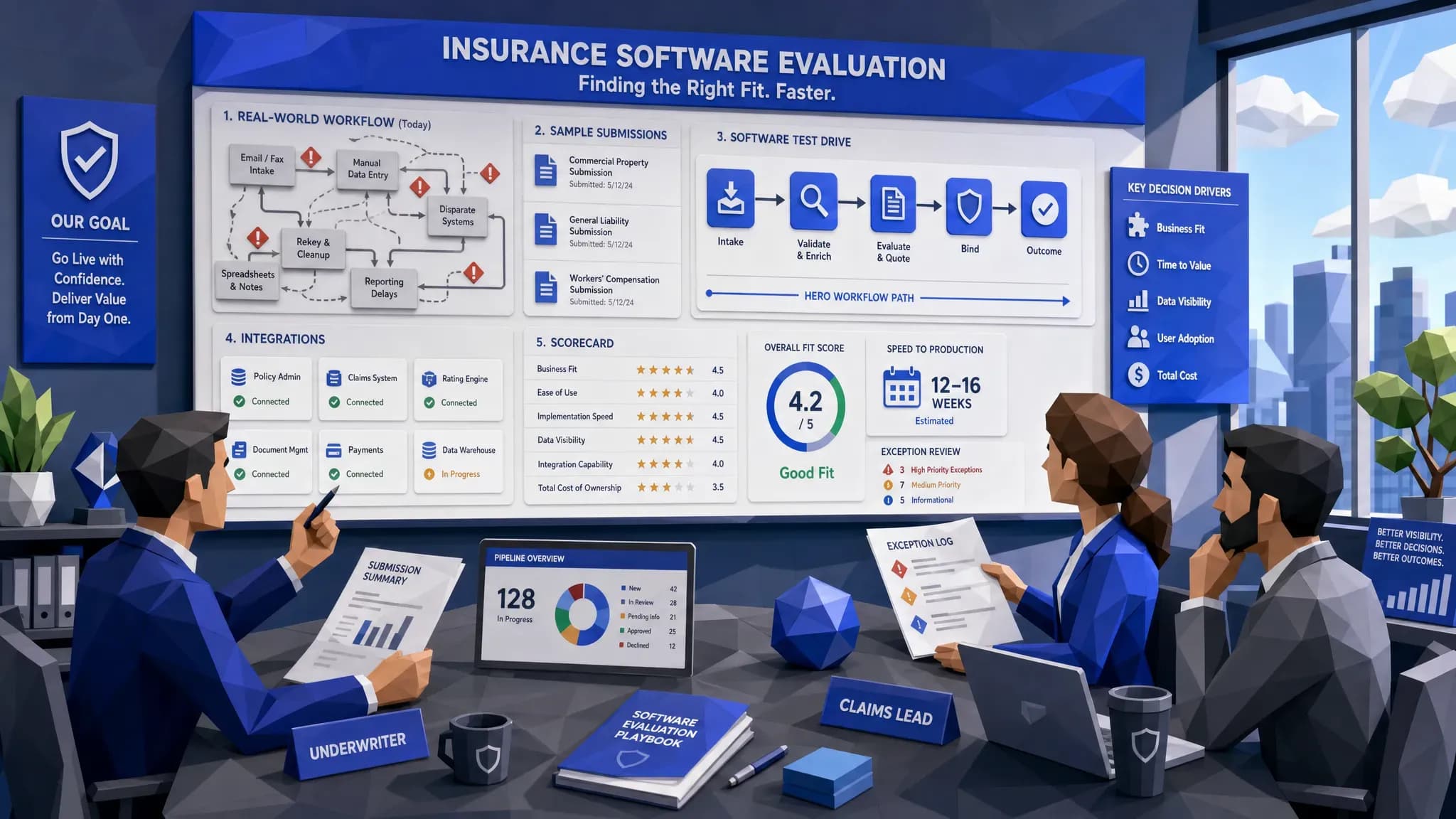
Evaluating insurance software providers in 2026 is less about who has the flashiest demo and more about who can survive contact with your actual inbox.
I have watched enough carrier, MGA, and broker teams sit through vendor demos to know the pattern. Everything looks clean. Every data field is complete. Every workflow moves like a Swiss train. Then Monday arrives, and the first submission has three attachments, two contradictory limits, and a broker note that says please rush.
My hot take after a decade around insurance operations: the RFP is often the least reliable part of the buying process. It rewards confident answers, not operational proof. The better question is simple: can this provider improve a painful workflow with your real data, your rules, your exceptions, and your existing systems?
That matters because the operating pressure is real. McKinsey has written about automation in insurance, including the heavy administrative burden that keeps underwriters away from actual risk assessment. Anyone who has chased missing schedules or copied driver data from PDFs will nod a little too hard at that. Claims teams face a similar squeeze, with higher customer expectations, tighter expense control, and fraud that no longer looks like a bad photocopy and a suspiciously neat neck brace.
So, how should insurers, MGAs, brokers, reinsurers, claims teams, and fraud units evaluate insurance software providers in 2026? I would start with practical proof, not procurement theater.
Start with the workflow, not the software category
The term insurance software providers is broad enough to hide a small village. Some vendors focus on policy administration. Others specialize in claims, rating, document intake, data enrichment, analytics, customer service, bordereaux, payments, fraud, or workflow automation.
That is why I would not begin with a feature checklist. Begin with a workflow that is expensive, slow, or embarrassing.
Maybe your commercial auto underwriting team spends hours reviewing loss runs, vehicle schedules, MVR results, and email attachments before anyone gets to risk selection. Maybe your claims adjusters lose half a day extracting facts from attorney demand packages. Maybe your broker team has quote abandonment because the intake process feels like applying for a mortgage through a fax machine.
Pick one workflow. Put a number against it. How many files per week? How many people touch it? How long does it take? How often does it bounce back because the data is missing or wrong?
If you are trying to avoid expensive shelfware, Inaza has a useful companion piece on choosing insurance software without buying shelfware. The central point is worth repeating: software should be bought to change an operating result, not to decorate a transformation roadmap.
Make providers prove themselves with messy files
A polished demo file is a polite fiction. It has the same relationship to real insurance work that a hotel breakfast photo has to the actual buffet at 8:55 a.m.
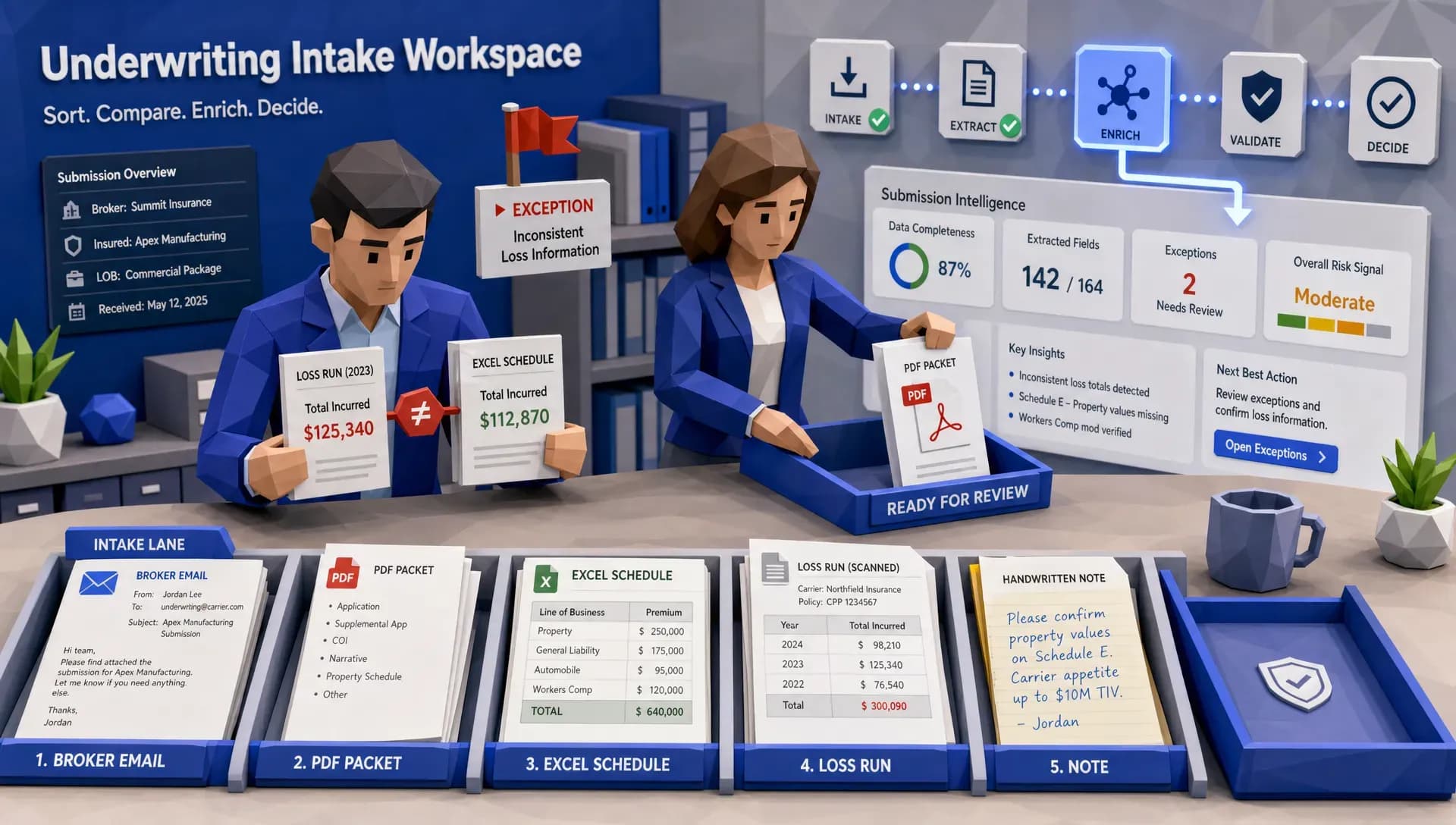
When you evaluate providers, give them real examples. Not the worst file in your company, at least not first. Use a representative mix. Include the PDF that is scanned sideways. Include the broker email with three attachments. Include the loss run with inconsistent naming. Include the claim note where the important fact is buried in paragraph nine.
Then ask the provider to show what happens from intake to output. You should see how the system reads different file types and formats without manual rekeying, what data points it captures, how exceptions are handled, how work is routed when information is missing, and what audit trail remains for compliance, referral, and management review.
That last point is where the truth usually peeks through the curtains. Some providers can make a demo sing, but need months to make your actual process work. In 2026, that is a problem. Business conditions move too quickly for procurement theater.
Test speed to production, not speed to PowerPoint
I once sat with an underwriting manager who had a drawer full of vendor one-pagers. She called it the museum of promising ideas. Every project had a kickoff deck, a steering committee, and a brave target date. Very few had underwriters using the tool six weeks later.
Speed matters, but only if it means usable production speed. Ask providers what they can deploy after one working session with your team. Ask who configures changes. Ask whether a workflow adjustment requires a development sprint, a support ticket, or a small act of divine intervention.
At Inaza, we see this as one of the big dividing lines in the market. A provider should be able to help insurers deploy production-ready workflows quickly, without months of proof-of-concept ping-pong. That does not mean skipping governance. It means the software should be flexible enough to match how insurance teams actually work.
The practical evaluation question is this: if your underwriting appetite changes on Friday, can the workflow reflect it by Monday?
If the answer is no, the software may become another legacy system before the invoice is fully dry.
Look past the logo wall on integrations
Integration slides are the software version of a peacock. Very colorful. Occasionally useful. Often distracting.
Do not ask only whether the provider integrates with your policy admin system, claims platform, CRM, rating engine, data providers, and document storage. Ask how. Ask what data moves, when it moves, who owns the mapping, and what happens when a field changes.
In insurance, integrations are rarely decorative. They determine whether a workflow actually reduces work or simply moves work from one screen to another. I have seen teams celebrate a new system only to discover that someone still has to copy data into the core platform at the end. That is not automation. That is a relay race with nicer shoes.
Where enrichment is part of the decision, look for providers with pre-built API templates for common data sources, such as Verisk, LexisNexis, HazardHub, and similar services. The point is not name-dropping. The point is reducing the time and risk involved in bringing external data into the decision process.
For a broader provider comparison method, this guide on comparing insurance platform providers without guessing is useful because it keeps the focus on evidence rather than vendor charm.
Treat data as the product you will still need in three years
Here is where I get a little opinionated. Many insurance technology purchases are evaluated as workflow tools, but they succeed or fail as data decisions.
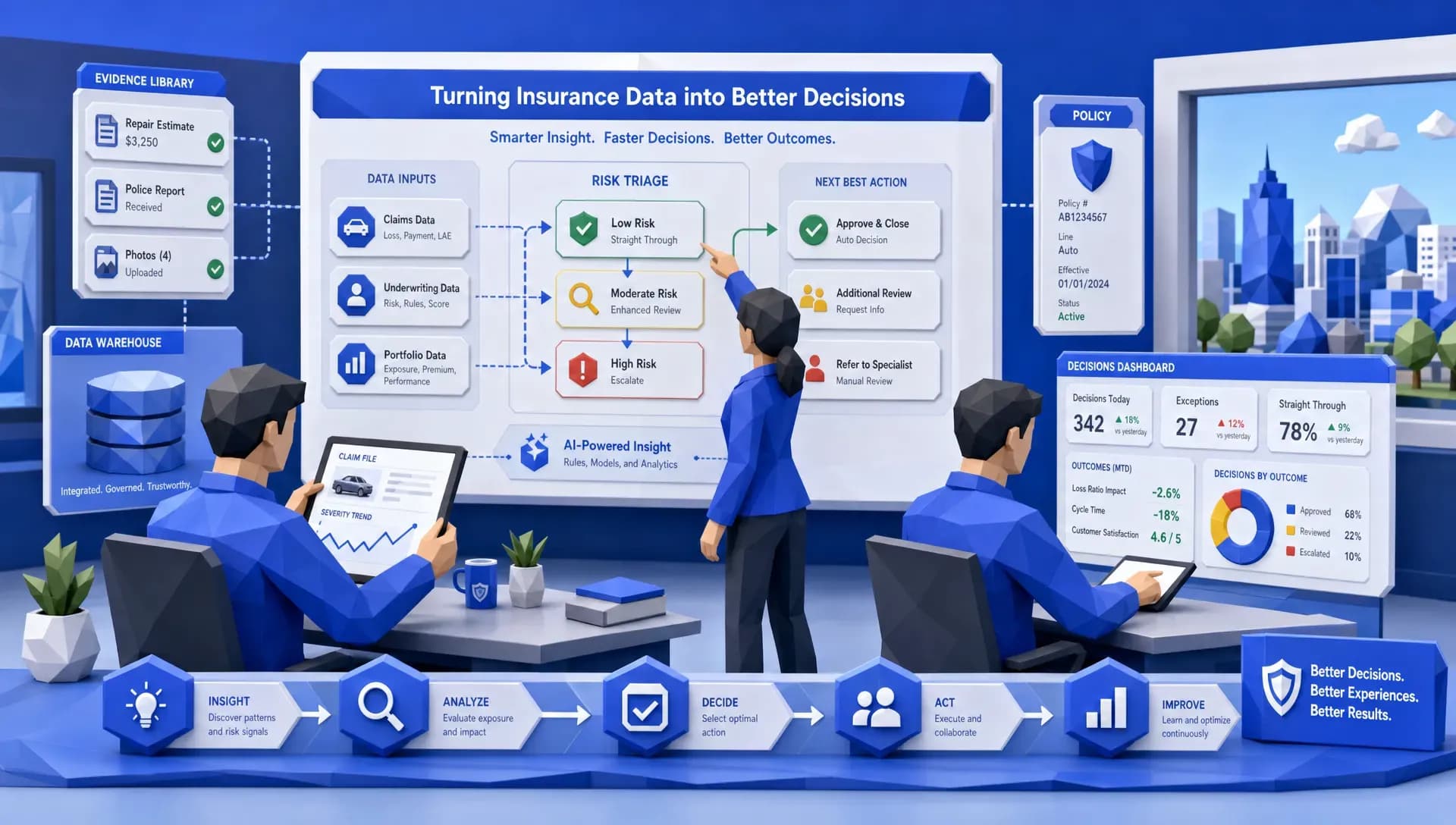
Every submission triaged, every claim routed, every demand reviewed, every fraud flag raised, and every renewal analyzed creates data. If that data disappears into disconnected systems or PDF notes, you lose the chance to learn from it.
A strong provider should help you answer practical business questions. Which broker channels submit the cleanest business? Which underwriting referrals cause the most delay? Which claim types produce leakage or repeated review? Which appetite rules are creating unnecessary friction? How does your portfolio compare with relevant market benchmarks?
That is why a unified data warehouse matters. Workflow automation is useful on day one, but captured operational data becomes more valuable over time. It supports reporting, analytics, portfolio narratives, renewals, reinsurance conversations, and performance management.
This is especially important for MGAs and reinsurers. If you have ever tried to explain portfolio quality using five spreadsheets, two outdated exports, and a prayer, you know the pain. Good data does not just make reports prettier. It changes the conversation.
Claims and fraud deserve their own stress test
Claims software evaluation needs a sharper lens in 2026. Customer patience is shorter. Loss costs are under pressure. Fraud is getting harder to spot. The FBI warns that insurance fraud remains a major cost to the industry and consumers, and Verisk's 2025 fraud report has highlighted how digital tools are raising the stakes for carriers.
The old fraud image in many people's heads is a staged slip-and-fall or an exaggerated whiplash claim. Those still exist, of course. But the modern version can include manipulated photos, synthetic documents, suspicious repair patterns, organized rings, and claimant behavior that only looks odd when compared across a bigger dataset.
When evaluating claims technology, ask providers to run through real claim scenarios. Use a clean low-severity claim, a complex injury claim, an attorney demand, and a file with possible fraud indicators. Watch how the software handles intake, summarization, triage, routing, escalation, documentation, and handoff.
The claims team should not have to become detectives with six browser tabs open just to know what to do next. Good software should reduce cycle time while preserving judgment. For teams focused specifically on claims operations, Inaza's guide to choosing insurance claim processing software in 2026 goes deeper into that buying decision.
Do not compromise on governance and auditability
Insurance is not selling socks online. We have regulators, reinsurers, auditors, boards, complaint teams, and occasionally a very motivated plaintiff attorney. That means every automation decision needs to be explainable enough for the grown-ups in the room.
When a provider says a workflow can approve, decline, route, flag, recommend, or prioritize, ask what record is created. Can you see which rule applied? Can you see what data was used? Can you see who overrode the recommendation? Can you reconstruct the file six months later?
This is not bureaucracy for its own sake. It protects the business. It also protects the people using the system. Underwriters and adjusters are far more likely to trust software when they can understand why something happened.
Permissions matter too. A junior claims handler should not be able to alter fraud rules. A temporary operations user should not have access to sensitive portfolio analytics. A broker portal should not expose internal notes. These are basic controls, but basics are where many operational headaches begin.
Evaluate the provider's insurance fluency
The best insurance software providers understand that insurance is full of exceptions, judgment calls, odd file formats, and market-specific habits. A generic workflow tool may look appealing until you spend months teaching it the difference between a loss run and a lunch menu.
Insurance fluency shows up in small ways. Does the provider understand bordereaux? Can they talk sensibly about referral rules, appetite, claims severity, litigation, subrogation, reserving, renewal packs, policyholder communication, and reinsurance reporting? Do they understand the difference between a carrier's governance needs and an MGA's distribution speed?
This does not mean every provider must have solved your exact problem before. But they should be able to ask good questions quickly. I trust a vendor more when they challenge my workflow assumptions than when they nod at everything. Polite agreement is lovely at dinner. It is dangerous in software selection.
Use a scorecard that measures outcomes
If you need a simple scorecard, keep it painfully practical. I would rate providers against these areas, then force the team to discuss evidence rather than opinions:
- Workflow fit: Can the provider handle the actual process, exceptions, documents, and handoffs that your team deals with daily?
- Time to value: How quickly can a usable workflow go live, and what resources does your team need to provide?
- Integration depth: Does data move cleanly into and out of the systems you already depend on?
- Data quality: Does the platform capture structured data you can use for reporting, analytics, benchmarking, and portfolio decisions?
- User adoption: Can underwriters, adjusters, analysts, and operations teams use it without a heavy retraining burden?
- Governance: Are permissions, audit trails, versioning, and oversight strong enough for insurance realities?
- Provider accountability: Will the vendor commit to measurable outcomes, or only to completed configuration tasks?
Notice what is missing: number of features. Features matter, but they should earn their place. A feature that does not reduce leakage, improve speed, increase quote conversion, improve data quality, or support better decisions is just furniture.
Ask about benchmarks and business intelligence
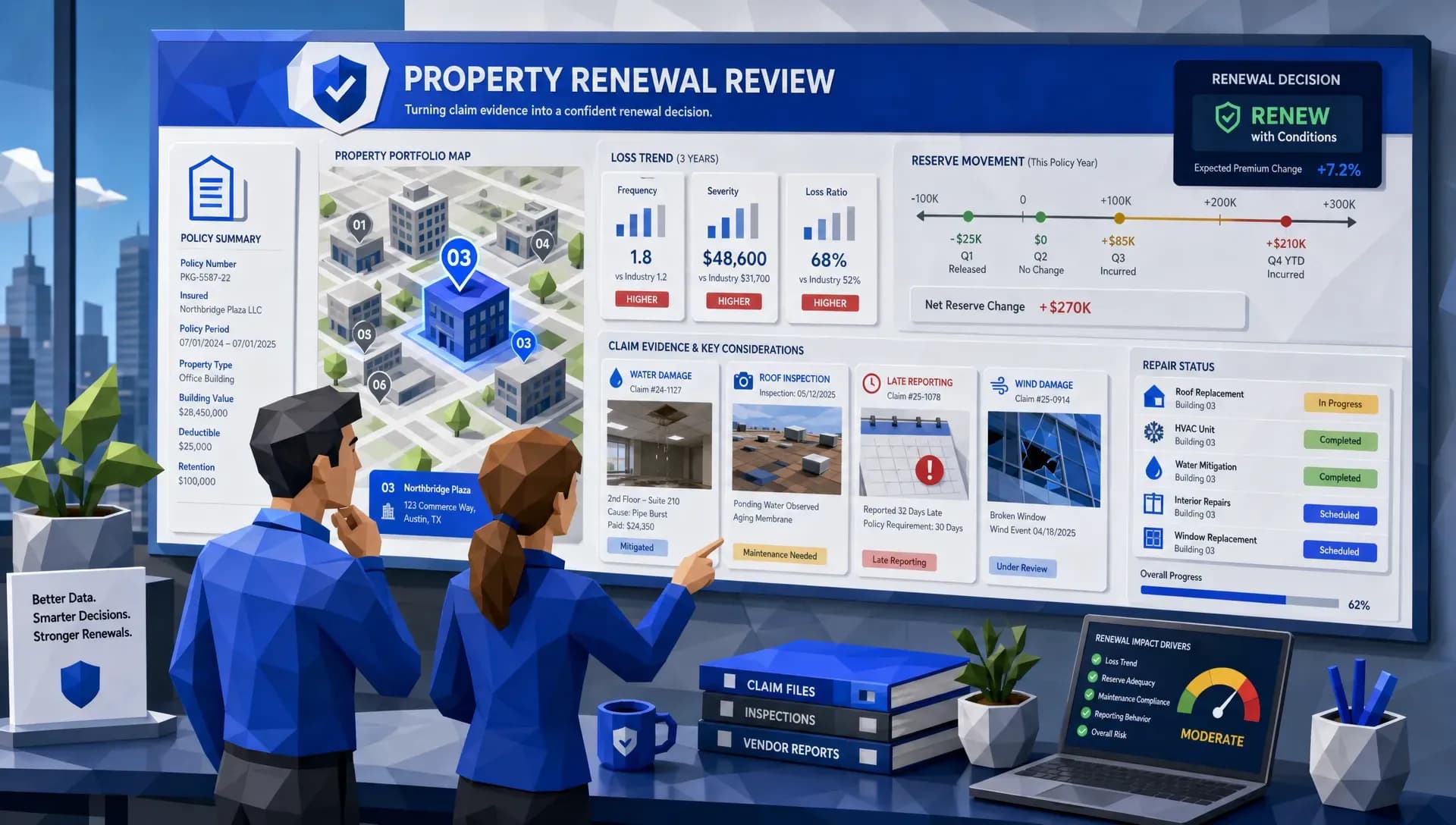
In 2026, I would give extra credit to providers that help you compare performance against useful benchmarks. Insurers and MGAs do not operate in a vacuum. Loss ratios, expense ratios, conversion rates, portfolio mix, claim cycle times, and renewal outcomes all need context.
Benchmarks can be especially helpful when preparing reinsurance narratives or renewal discussions. If you can show how a portfolio performs relative to relevant market indicators, the conversation becomes more factual and less theatrical. That is good for cedents, reinsurers, brokers, and everyone's blood pressure.
Inaza includes industry benchmarks in its system, including sources such as Aon, Munich Re, Howden, and others. Used properly, those benchmarks can help teams explain portfolio performance and policyholder trends with more confidence.
The same applies to dashboards. I am not impressed by dashboards that look good in a board deck but cannot answer the second question. The second question is the one that matters. Someone asks why submission turnaround improved in one region but not another, or why bodily injury severity is drifting, or why quote abandonment spikes after a certain data request. If your reporting cannot get there, you have a pretty picture, not business intelligence.
Watch for the red flags
Most bad software decisions give warning signs. We just ignore them because the demo was smooth and the procurement calendar was tired.
Be careful if the provider cannot show your workflow with your files. Be careful if every customization requires professional services. Be careful if integration answers stay vague. Be careful if users need to leave the system constantly to complete the task. Be careful if reporting depends on exports and manual cleanup. Be very careful if the vendor treats insurance terminology like a foreign language phrasebook.
The biggest red flag, though, is when nobody on your side owns the outcome. If underwriting buys it but operations must maintain it, conflict is coming. If claims leadership approves it but adjusters hate it, adoption will crawl. If IT selects it without business workflow proof, you may end up with a technically elegant system that solves the wrong problem.
A good buying process has a business owner, an operational owner, and a technical owner. They do not need to agree on everything. In fact, they should debate. But they need to agree on the measurable result.
My bottom line
The best way to evaluate insurance software providers in 2026 is to stop treating selection like a beauty contest. Do not buy the nicest demo. Buy the provider that can handle your messy work, connect to your existing systems, capture useful data, support governance, and prove value quickly.
For carriers, MGAs, brokers, reinsurers, underwriters, adjusters, and fraud analysts, the winning provider is the one that makes daily work easier while making the business smarter. That combination is rarer than it should be, but it is exactly where the market is heading.
Frequently Asked Questions
What should I look for first when evaluating insurance software providers? Start with one high-value workflow rather than a broad feature list. Define the current cost, volume, delays, error points, and desired business outcome. Then ask each provider to prove how their software improves that exact workflow.
How many providers should we evaluate before choosing one? Three to five is usually enough if your evaluation is evidence-based. More than that often creates noise. The key is to give each provider the same real files, workflow scenario, integration questions, and success criteria.
Should insurers prioritize speed or configurability? You need both. Fast deployment is valuable only if the workflow fits your business. Configurability is valuable only if changes can be made without turning every update into a mini project.
Are generic automation tools good enough for insurance workflows? Sometimes, for simple internal tasks. But underwriting, claims, fraud, compliance, and reinsurance workflows usually require insurance-specific understanding, data handling, audit trails, and integrations.
How does Inaza fit into the insurance software provider landscape? Inaza provides an insurance automation platform for underwriting, claims, customer service, and operations. It integrates with existing systems, supports customizable workflows, captures data in a unified warehouse, and provides analytics to help insurers, MGAs, and brokers improve operational performance.
Ready to evaluate providers with real operational proof?
If your team is comparing insurance software providers, start with the workflow that is costing you the most time, leakage, or missed opportunity. Then make every vendor prove value against that workflow.
Inaza helps insurers, MGAs, and brokers automate underwriting, claims, customer service, and operations while turning workflow data into useful business intelligence. If you want to see what a production-ready workflow could look like for your team, visit Inaza and bring the messy files. Those are usually where the truth lives.