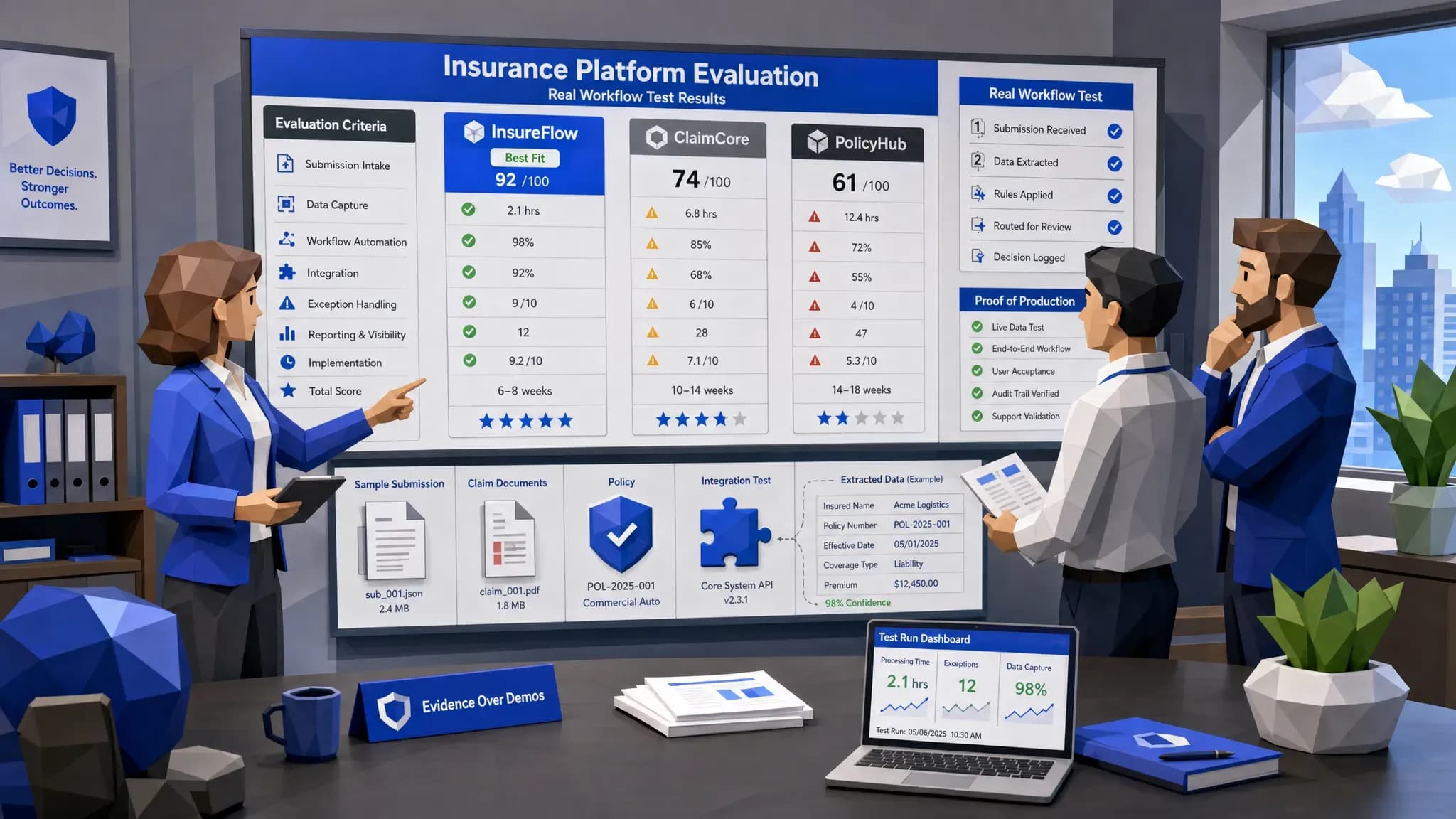
Comparing insurance platform providers should be a sober exercise. In practice, it often turns into demo bingo.
Everyone has APIs. Everyone has dashboards. Everyone has a workflow diagram that looks suspiciously like it was laminated in 2019. After ten years around underwriting, claims, operations, and the occasional procurement meeting that aged me visibly, my hot take is this: most insurers do not choose the wrong platform because they lack options. They choose the wrong platform because they compare polished promises instead of operational proof.
The good news is that you can compare providers without guessing. You just need to stop asking, Can it do everything? and start asking, Can it fix this specific mess we deal with every Tuesday?
A classic vendor comparison starts with a spreadsheet. The spreadsheet has 140 rows. Someone adds weighted scoring. Someone else adds a tab called strategic fit. By week three, nobody remembers why claims intake was worth 4 points and reporting was worth 3.
I have sat in that meeting. One carrier team I worked with spent more energy debating whether a vendor had a configurable dashboard than discussing the fact that their underwriters were rekeying exposure data from PDFs into the policy admin system every morning. The dashboard mattered, sure. But it was not the fire.
The fire was admin drag. McKinsey has estimated that a large share of underwriter time can be consumed by administrative tasks rather than risk assessment. That tracks with what I see on the ground. Smart people are still copying, checking, chasing, and reconciling when they should be pricing, selecting, negotiating, and deciding.
This is why comparison by feature list is dangerous. A provider can tick every box and still fail to move your combined ratio, cycle time, bind rate, leakage, or loss adjustment expense. If you want a broader checklist of platform fundamentals, Inaza has a useful guide on what to look for in a digital insurance platform. But for this article, I want to get sharper: how do we compare insurance platform providers using evidence rather than hope?
Start with the workflow that is costing you money
Before you speak to vendors, choose one workflow that hurts.
Not a vague transformation theme. Not customer experience. Pick something with a beginning, an end, an owner, and a measurable pain point. For an MGA, that might be submission intake for a high-volume niche program. For a carrier, it might be claims triage after first notice of loss. For a broker, it might be quote follow-up where abandonment creeps in because the process takes too long. For a reinsurance broker, it might be portfolio reporting that requires three analysts, six spreadsheets, and one person named Helen who somehow knows where everything lives.
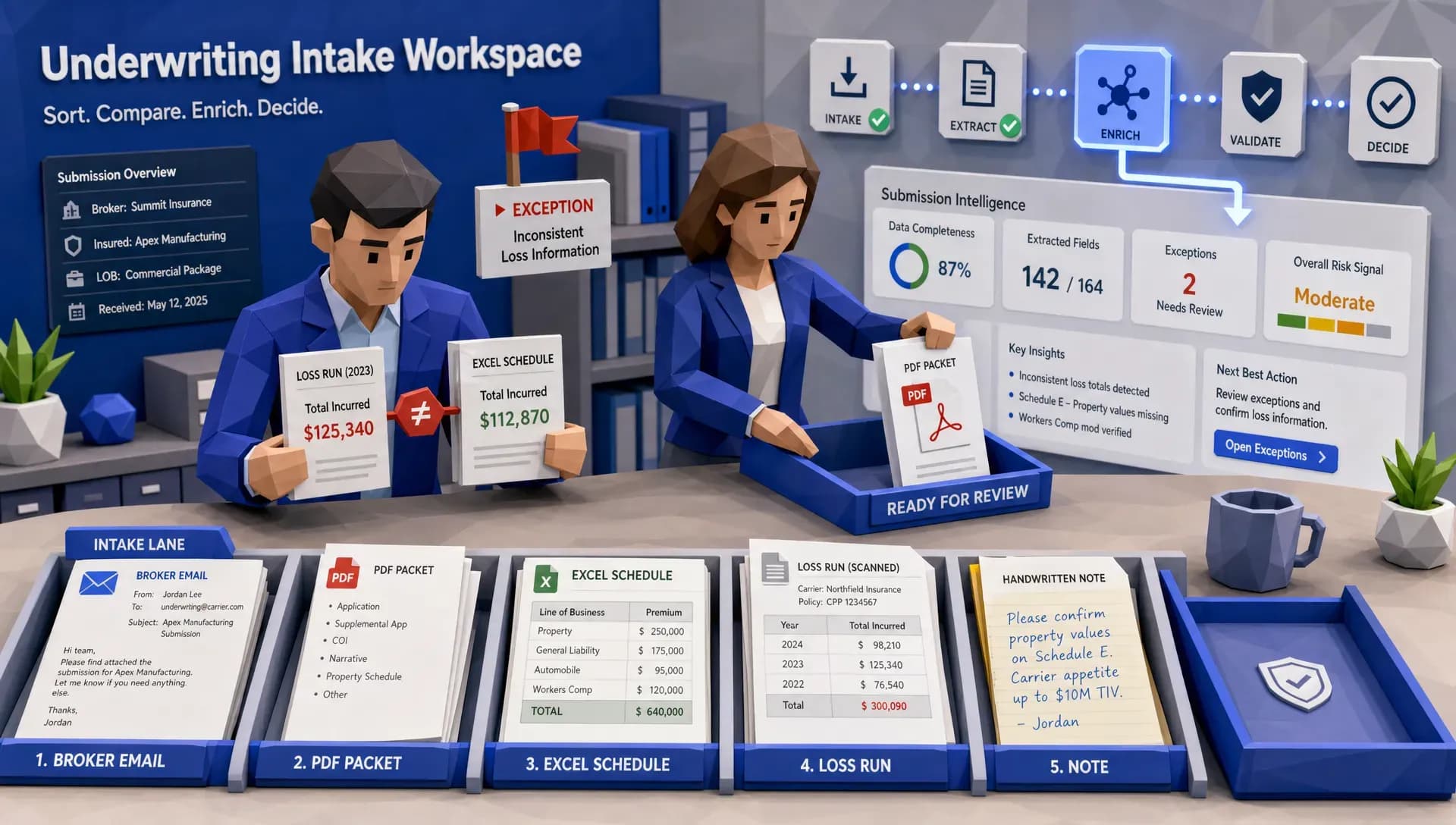
I once watched an underwriting team receive a perfectly ordinary submission package: proposal form, loss runs, statement of values, broker email, and two attachments with almost identical names. It took three people to decide whether it was complete. Nobody was bad at their job. The process was simply held together with Outlook folders and tribal knowledge, which is a terrible operating model but a popular one.
So your first comparison question is not, Do you support underwriting automation? It is, Show me how your platform receives this exact submission, extracts the right data, flags what is missing, enriches it with external data, routes it to the right person, and records what happened.
That framing separates useful providers from demo performers very quickly. It also keeps you out of shelfware territory, where a platform technically works but never becomes part of daily operations. If that risk feels familiar, this piece on choosing insurance software without buying shelfware is worth keeping open during your selection process.
The proof I would ask every provider to show
If you use one list in this whole exercise, make it this one. A credible provider should be able to answer these questions with a live example, a working workflow, or a clear implementation plan, not just a slide.
- Can the platform handle the files we actually receive, including PDFs, spreadsheets, emails, images, bordereaux, loss runs, demand letters, and scanned documents?
- Can it integrate with the systems we already use, without forcing our team to rip and replace core infrastructure?
- Can it enrich decisions with external data sources we already trust, such as Verisk, LexisNexis, HazardHub, or similar providers?
- Can business users adjust workflows without waiting months for a vendor development queue?
- Can it capture clean operational data as work happens, rather than asking teams to create reports afterward?
- Can it show us which exceptions are slowing the process down and why?
- Can it move from evaluation to production without an endless proof-of-concept loop?
The last one matters more than people admit. Proof-of-concept theater is expensive. I do not mind a test. I mind tests that never resemble production. If the vendor only proves success on three clean files, you have not learned much. Insurance operations are not clean. That is part of their charm, if we are being generous.
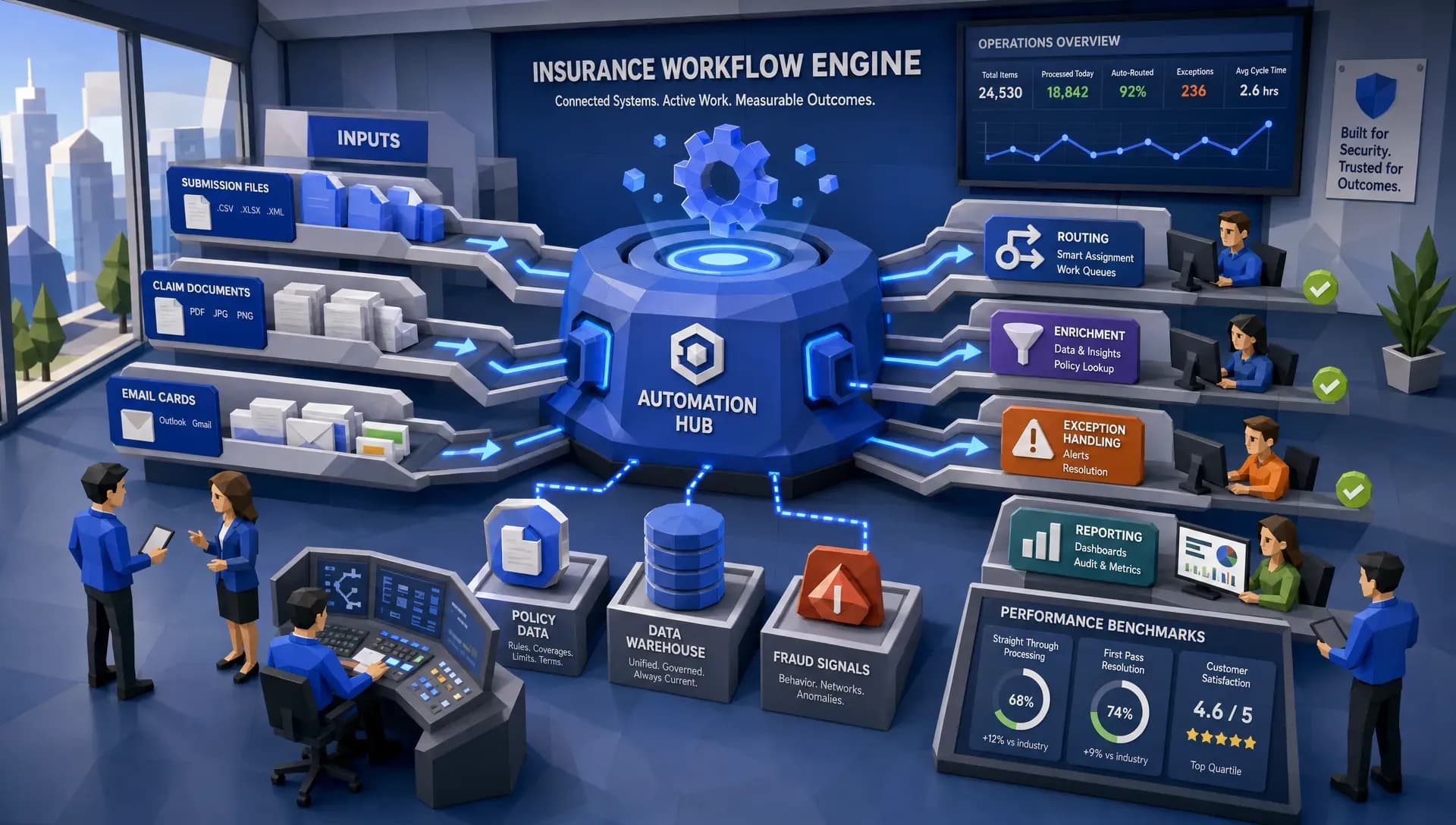
At Inaza, our bias is practical: a provider should be able to help you deploy a production-ready workflow quickly, using your real operating logic, your documents, your handoffs, and your data needs. Inaza’s platform includes 250+ workflow templates, supports all file types, integrates with existing systems, and is built around configurable automation for underwriting, claims, customer service, and operations. The point is not to make your team relearn insurance. The point is to remove the drudge work around it.
Compare the data layer, not just the workflow layer
Here is where many comparisons miss the plot. Workflow automation is useful. But the data created by the workflow is often more valuable over time.
A platform that clears submissions faster is good. A platform that also tells you why submissions stall, which brokers send incomplete packs, which rating factors create referral spikes, and where leakage enters the claim process is far better.
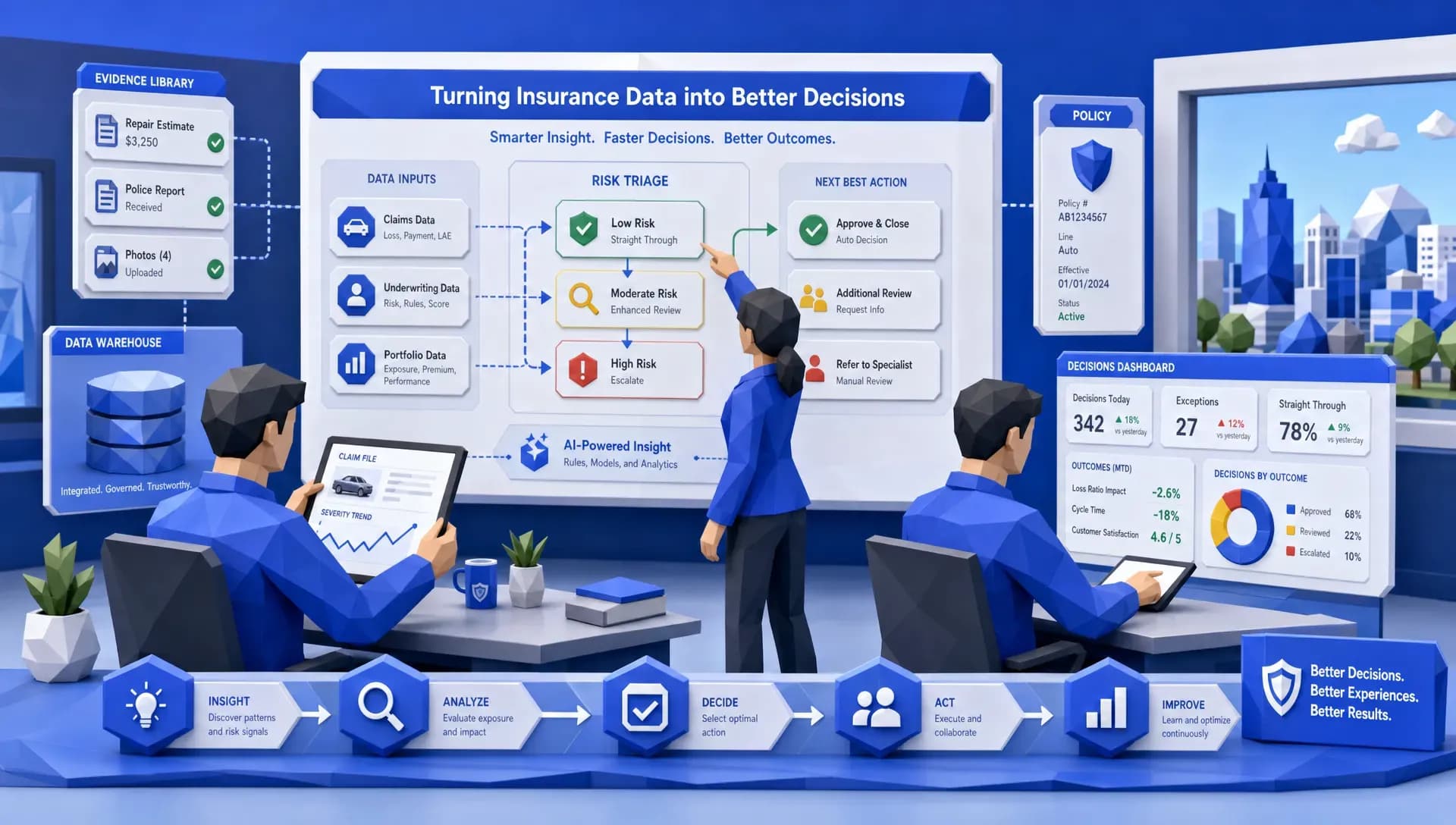
This is why I always ask providers what happens to the data after the workflow runs. Is it trapped in logs? Does it live in a warehouse? Can it feed dashboards? Can it support portfolio narratives for renewals, reinsurance negotiations, and management reporting? Can it benchmark performance against the market?
For underwriting leaders, connected data changes the conversation from did we process the file? to do we understand the risk and our book better than we did last quarter? That is the real prize. If you are thinking along those lines, Inaza’s article on how a connected-data platform can clarify insurance risk goes deeper into the operating value of joined-up data.
Inaza has a unified data warehouse underneath its automation layer, which means workflow events can become business intelligence rather than disappearing into process exhaust. It also includes real-time analytics dashboards and access to industry benchmarks such as Aon, Munich Re, Howden, and others, which can help teams frame portfolio performance against the wider market.
Borrow an evidence standard from claims and litigation
Insurance people understand evidence. We ask for it every day. Photos, estimates, police reports, medical notes, engineering reports, repair invoices, prior losses, geospatial data, fraud indicators, and the small detail in the email thread that suddenly matters a lot.
Yet when we buy platforms, we often accept surprisingly thin evidence.
I like borrowing a mindset from dispute work. In complex building and construction disputes, specialists prepare expert witness reports and Scott schedules so each issue, cost, position, and piece of evidence can be reviewed clearly. That same discipline is useful when comparing platform providers. Do not let the provider sell a general claim. Make them map evidence to each promise.
If a vendor says implementation is fast, ask for the path. If they say integrations are easy, ask which APIs are already templated and which require custom work. If they say the platform improves claims outcomes, ask which claim types, what cycle time reduction, how exceptions are handled, and how humans stay in control when judgment is required.
This is not being difficult. This is underwriting the vendor.
Do the ugly-file test
Every insurer has ugly files. You know the ones. The PDF has rotated pages. The spreadsheet has merged cells. The broker email says, See attached, and attaches six documents with no explanation. The claim photo is blurry, the repair estimate uses local shorthand, and the demand package arrives at 4:57 p.m. on a Friday because apparently time is a social construct.
Bring those files to the provider comparison.
A serious platform should be able to show how it deals with imperfect inputs. For underwriting, that means extracting data, identifying missing fields, comparing information across documents, enriching the risk, and routing exceptions. For claims, it means intake, triage, coverage checks, fraud indicators, document review, reserving support, and escalation where needed. For customer service, it means reducing repetitive queries without losing the ability to hand off gracefully.
This is also where fraud needs attention. The FBI warns that insurance fraud costs the industry and policyholders billions each year. In 2026, fraud is no longer only staged accidents and inflated invoices. Carriers and adjusters are now dealing with synthetic documents, manipulated images, and increasingly convincing digital evidence. Platform providers should be able to explain how their workflows support verification, flag anomalies, and preserve auditability.
Do not accept a perfect demo file. Perfect demo files are the showroom cars of insurance technology. Nice to look at, rarely representative of the commute.
Measure the provider against operating outcomes
A good comparison should translate platform capability into financial and operational outcomes. You do not need a 40-page business case to start, but you do need a few numbers that connect to reality.
For underwriting, compare providers against time to clear a submission, referral rate, quote turnaround, bind rate, data entry error rate, and underwriter capacity. For claims, look at first contact time, cycle time, touchless handling for simple claims, litigation escalation, fraud referral quality, and customer communication. For customer service and operations, look at backlog, repeat contacts, rework, and handoff delays.
J.D. Power’s 2024 U.S. Auto Claims Satisfaction Study is a useful reminder that claims satisfaction is closely tied to communication, speed, and the feeling that the process is under control. Technology cannot fix poor claims philosophy, but it can remove the dead air between steps.
The math does not have to be fancy. If a team processes 5,000 submissions a month and each file requires 12 minutes of manual intake, you are staring at 1,000 hours of intake work before anyone has properly assessed the risk. If a platform cuts that by half, the capacity gain is not theoretical. It is someone’s Tuesday back.
The same logic applies to claims. If adjusters spend less time gathering documents, chasing status, and rekeying data, they can spend more time on judgment calls, negotiation, empathy, and fraud detection. That is where experienced people earn their keep.
Watch for the red flags hiding in polite answers
Some vendor answers sound fine until you translate them.
We can configure that usually means possible, but ask who configures it, how long it takes, and what happens when your product changes. We have an API usually means a technical door exists, but not necessarily that the vendor has ready-made templates for the data sources you need. Our dashboard is customizable can mean anything from helpful self-service analytics to call us every time you want a new view.
Another red flag is forced standardization. Standardization is healthy when it removes unnecessary variation. It is dangerous when it ignores how insurance products, jurisdictions, distribution channels, and delegated authority actually work. An MGA writing a niche commercial program does not operate like a national personal auto carrier. A reinsurance broker preparing renewal narratives has different needs from a claims adjuster triaging bodily injury files.
Good insurance platform providers should respect those differences while still helping you simplify the work. That balance is harder than it sounds.
The 30-day comparison plan I would actually use
If I were running a provider comparison tomorrow, I would not start with a giant RFP. I would start with a 30-day evidence sprint.
In the first week, I would pick one high-value workflow and gather real sample files, stripped of sensitive information where needed. I would define the current baseline: how long it takes, how many people touch it, where errors happen, and what the delay costs.
In the second week, I would ask each provider to walk through the workflow using those samples. Not a generic demo. The real thing. I would pay special attention to how they handle exceptions, not just the happy path.
In the third week, I would test the data story. What data is captured? Where does it go? Can we report on throughput, exceptions, broker behavior, claim stages, fraud flags, or renewal narratives? Can the platform support business intelligence without creating another reporting burden?
In the fourth week, I would compare deployment reality. Who owns configuration? What integrations are already templated? What governance is built in? What would the first production workflow look like, and how quickly could it be live?
That approach will not answer every procurement question, but it will tell you something much more important: which provider can operate in your world.
Where Inaza fits in that comparison
Inaza is built for insurers, MGAs, brokers, reinsurers, underwriters, claims teams, fraud analysts, and operations leaders who want automation that connects to real insurance work. The platform supports underwriting automation, claims process automation, customer service automation, data capture, reporting, analytics, and customizable workflows.
The pieces I would focus on in a provider comparison are the practical ones: fast workflow deployment, integration with existing systems, support for all file types, a unified data warehouse, real-time dashboards, pre-built API templates, and benchmark data that can help teams understand performance against the market.
That combination matters because insurance work rarely lives in one system. The submission arrives by email, the policy data sits in a core platform, the risk data comes from third parties, the decision lives in someone’s notes, and the report is due yesterday. A useful platform should reduce that fragmentation, not add another login to the pile.
Frequently Asked Questions
How do I compare insurance platform providers if our workflows are unique? Use your uniqueness as the test. Bring real sample files, real routing rules, and real exceptions. A provider should show how its platform adapts to your workflow without months of custom development.
Should we prioritize integrations or automation first? Prioritize the workflow outcome first, then verify the integrations needed to support it. Automation without the right data connections creates a faster version of the same manual problem.
What is the biggest mistake insurers make when selecting a platform? Comparing feature lists instead of operational proof. The best question is not whether a feature exists, but whether it improves a measurable process in your business.
How long should a provider comparison take? You can learn a lot in 30 days if you test one real workflow, real documents, data capture, integrations, reporting, and deployment effort. Longer procurement may still be needed, but the guesswork should be gone early.
Insurance is too complex, too regulated, and too margin-sensitive to choose technology based on a beautiful demo and a hopeful spreadsheet.
Compare providers the same way we evaluate risk: with evidence, context, exceptions, and outcomes. Make them run the ugly file. Make them show the data. Make them prove how the workflow gets into production. If they can do that, you are no longer guessing.
And if you want to see how Inaza handles that kind of practical comparison, start with the workflow that is costing your team the most time. We will take it from there.