Here is my hot take after a decade around insurance operations: most claims teams do not have a speed problem. They have a rework problem wearing a fake mustache.
We love to talk about cycle time as if the claim is politely moving from step one to step two to step three. In reality, a claim often moves like a shopping cart with one bad wheel. It gets pulled back to intake because a field is missing, sent to an adjuster who needs more documents, bounced to coverage because the policy data is unclear, paused for fraud review, then returned to the adjuster with a note that says something like please clarify. Everybody is busy. Nobody is happy.
That is where insurance claims software earns its keep. The best systems do not simply make people click faster. They reduce the number of times a claim has to be touched, corrected, chased, reopened, or re-keyed. When rework falls, cycle time usually follows.
Rework is the quiet tax on claims
Rework is not only the dramatic stuff, like reopening a file after settlement because the wrong coverage limit was applied. Most rework is smaller and more annoying.
It is the adjuster asking for a police report that was already uploaded under the wrong label. It is the medical bill that arrives as a scanned PDF and gets typed into the system by hand. It is the FNOL entry that says rear-end collision, while the attached images suggest a multi-vehicle loss. It is the email thread where three people ask the same question in three slightly different ways.
I once watched a straightforward auto physical damage claim bounce between intake, appraisal, and the adjuster four times because the vehicle identification number had one character wrong. The actual decision was not hard. The paperwork was. That claim did not need a genius. It needed a better guardrail.
Customers do not care whether the delay came from a queue, a missing attachment, a vendor portal, or a policy system that refuses to cooperate before coffee. They experience one thing: waiting. J.D. Power’s 2024 U.S. Auto Claims Satisfaction Study highlighted the continuing pressure around long auto claim timelines, with repair and settlement delays still shaping customer satisfaction. In plain English, people remember how long it took.
How insurance claims software attacks the first source of rework: bad intake
Claims rework often starts at FNOL. If the first notice of loss is thin, inconsistent, or scattered across emails, PDFs, portals, and phone notes, the claim is already carrying a time penalty.
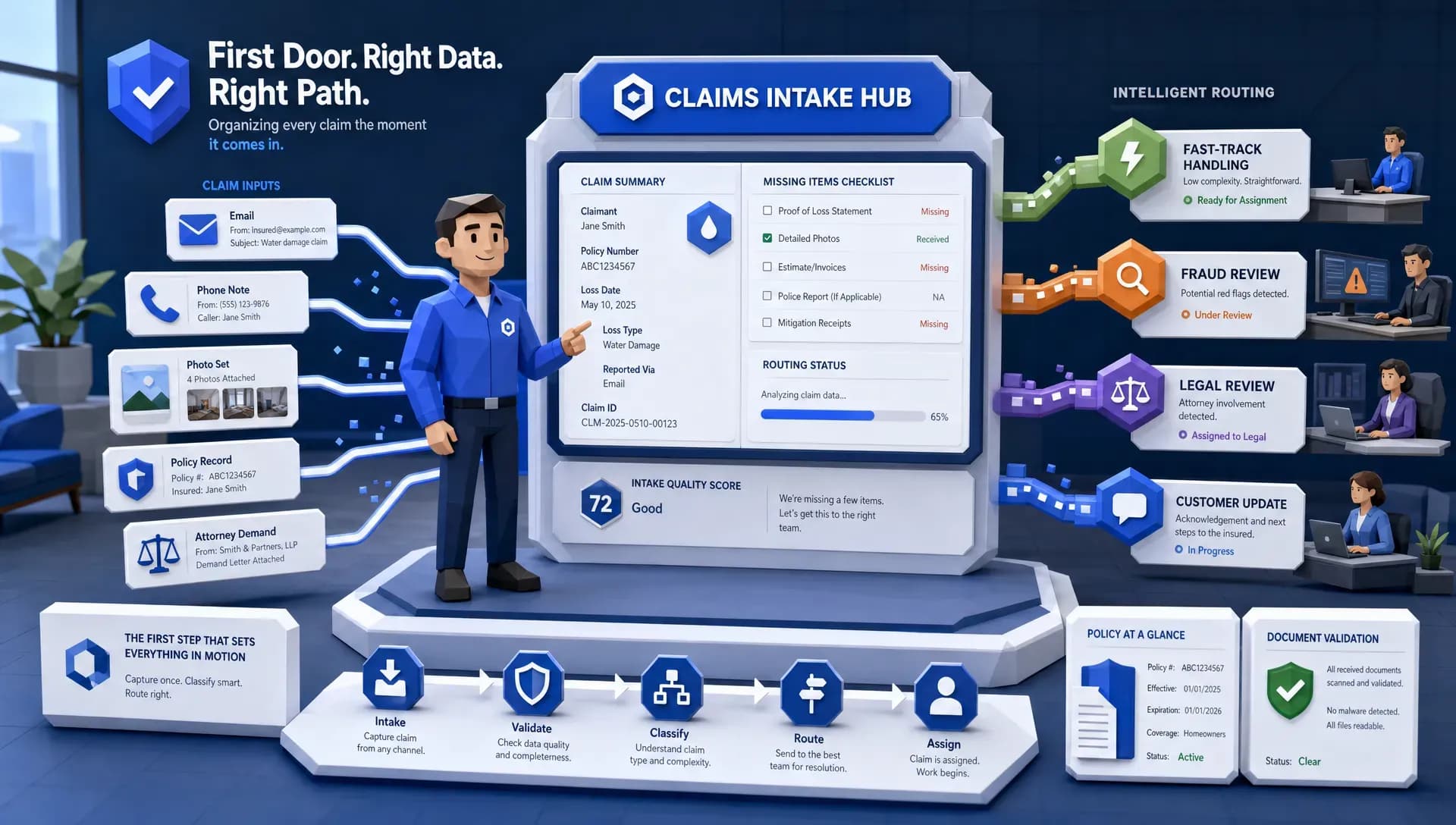
Good insurance claims software does three things at intake. It captures the right information, checks whether the information makes sense, and routes the file based on what is actually in it. That sounds simple, but simple is underrated in insurance. I have seen entire claim departments lose days because the claim type was selected incorrectly at intake. A property water damage claim filed as wind damage is not just a clerical issue. It sends the file down the wrong path.
Modern platforms can read documents, pull out key details, validate fields against policy and loss data, and flag missing items before a human has to babysit the file. That does not remove adjuster judgment. It protects adjusters from becoming professional scavenger hunters.
Inaza, for example, supports all file types and helps automate data capture across claims workflows. That matters because real claims rarely arrive in a neat little box. They arrive as photos, forms, repair estimates, attorney letters, emails, spreadsheets, and occasionally a blurry image that looks like it was taken during an earthquake.
The fastest claim is the one that goes to the right place first
A lot of cycle time hides inside assignment. A claim waits in a general queue, gets picked up, gets reviewed, then gets reassigned because it is complex, litigated, suspicious, commercial, injury-related, catastrophe-linked, or simply above someone’s authority.
Insurance claims software cuts this down by triaging earlier. The system can identify loss type, severity indicators, attorney involvement, coverage ambiguity, policy status, prior claims, fraud signals, and missing documentation at the beginning. Then it can route the claim to the right person or workflow before the wrong person spends half a day discovering that it belongs somewhere else.
This is one reason I am skeptical of claims transformation projects that only focus on adding more adjusters. Sometimes you need more people. Often, though, you need fewer claims landing on the wrong desk.
If you want a deeper dive into how hidden waiting states affect claim outcomes, Inaza has covered the topic in detail in its article on insurance claims systems that cut cycle time fast. The short version is that the biggest delays are rarely labeled delay. They are usually disguised as review, follow-up, pending, or awaiting information.
Once the claim is moving, the next enemy is the handoff. Claims touch policy systems, billing systems, document repositories, vendor portals, fraud tools, payment systems, litigation teams, and sometimes reinsurers. Every handoff is an opportunity for information to decay.
This is why connected workflows matter. If an adjuster updates liability, that update should not live only in a note. If a vendor estimate changes, the claim should not depend on someone remembering to check a portal. If a regulatory or policy page changes online, the operations team should know before a workflow starts producing bad outcomes. For external pages that affect compliance, vendor management, or operational rules, tools such as real-time website change monitoring can help teams catch important web changes before they become another source of rework.
That last point sounds small until it is not. I have seen teams lose a full week untangling work caused by an outdated instruction sheet. Nobody set out to make a mistake. The process just trusted stale information.
Fraud review should be sharper, not slower
Fraud is another place where rework and cycle time collide. We all know fraud is expensive. The FBI estimates insurance fraud costs the U.S. more than $308 billion each year, across multiple lines and schemes. At the same time, most claimants are legitimate customers who want a fair settlement and do not deserve to be treated like suspects because a system cannot separate normal from odd.
The temptation is to slow everything down in the name of control. That is understandable, but it is also a blunt instrument. Better claims software helps by identifying patterns that deserve attention while letting routine claims keep moving. Prior losses, suspicious document patterns, inconsistent statements, unusual timing, image issues, and attorney demand language can all be used to decide whether a claim needs special review.
This matters even more now. Verisk’s 2025 fraud report points to rising concern among carriers about digital fraud and AI-enabled claim manipulation. My view is simple: if the bad guys are getting faster, honest carriers cannot afford slow, manual screening as their main defense.

The data warehouse piece is not optional anymore
Here is where I may sound like the operations nerd at the party, but I will say it anyway: workflow automation without clean data is only half a fix.
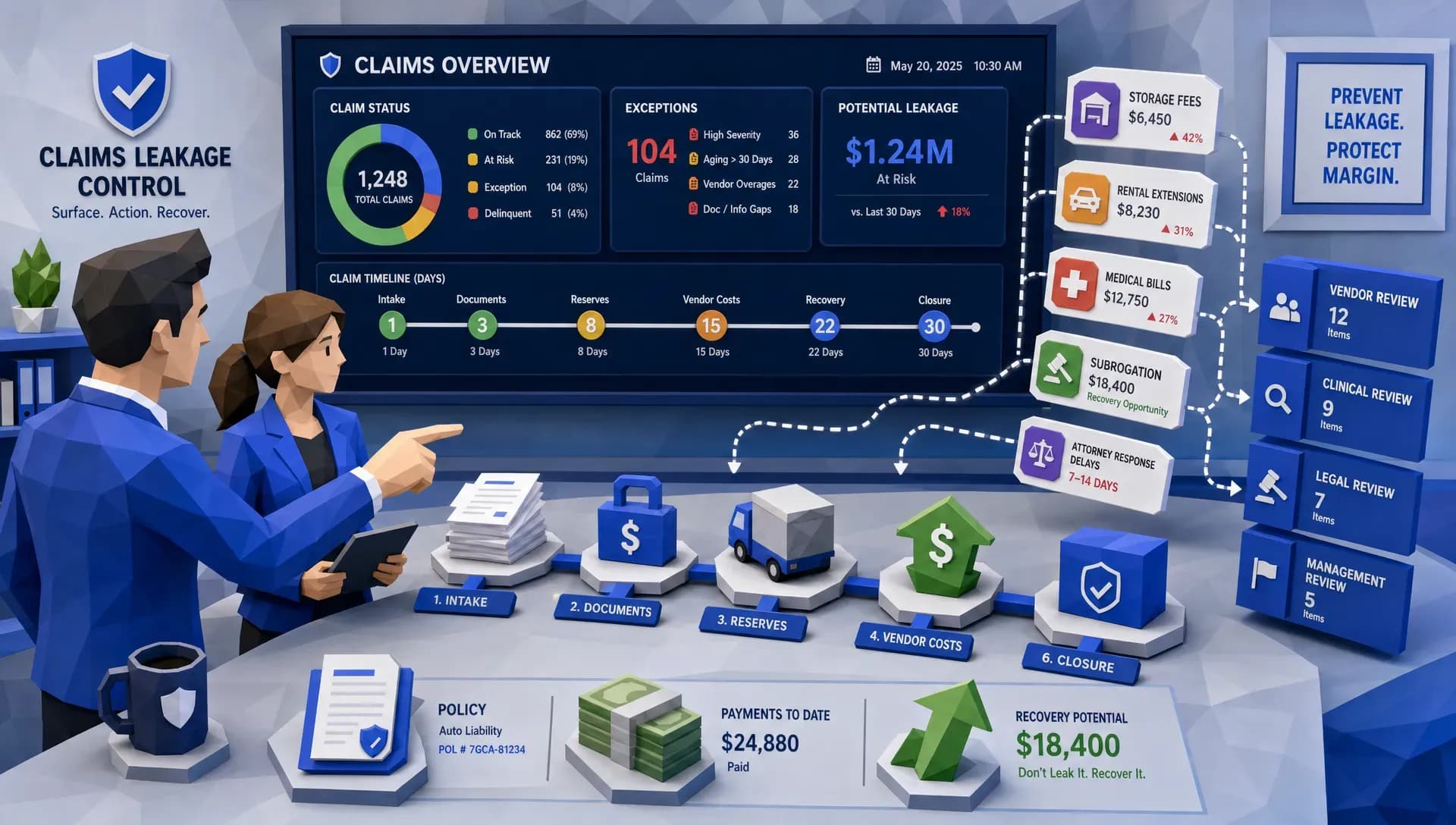
If you reduce rework today but cannot see where the rework used to come from, you will struggle to improve tomorrow. Claims leaders need to know which loss types create the most back-and-forth, which vendors trigger the most follow-up, which adjusters are overloaded, which documents are most often missing, and which steps add days without adding value.
That is why a unified data warehouse matters. Inaza’s platform is built with a data warehouse underneath the workflows, so data captured during automations can feed reporting, analytics, and dashboards. The workflow does the work, but the data explains the business.
This is especially useful for MGAs, carriers, brokers, and reinsurers that need to tell a credible portfolio story. Benchmarks can help leadership understand whether cycle times, leakage, litigation rates, or claims handling patterns are improving relative to the market. Inaza also includes industry benchmarks such as Aon, Munich Re, and Howden, which can support renewal conversations, reinsurance negotiations, and portfolio narratives.
If your claims data is scattered, the answer is rarely another spreadsheet named final_v7_really_final. It is connected data. Inaza has written more about why insurance claims services work better with connected data, and I agree with the premise completely. Fragmentation is where rework breeds.
What I would look for in insurance claims software
If I were buying insurance claims software today, I would not start with the prettiest demo screen. I would start with the messiest claim process and ask whether the software can handle it without forcing the team to pretend real life is cleaner than it is.
First, I would want it to integrate with existing systems. Rip-and-replace projects have a way of turning into long meetings, budget pain, and people quietly going back to spreadsheets. A claims platform should fit into the current operating environment and improve it, not demand that the entire company relearn its job from scratch.
Second, I would look for configurable workflows. Every carrier and MGA has its own appetite, authority levels, jurisdictions, vendors, and escalation rules. A standard workflow is fine as a starting point, but the real value comes when operations teams can adapt workflows quickly. Inaza offers 250+ workflow templates and customizable automation workflows, which is useful because no two claims books behave exactly alike.
Third, I would care about enrichment. A claim decision is only as good as the facts around it. Pre-built API templates for data sources such as Verisk, LexisNexis, HazardHub, and others can help teams enrich claims without building every connection from scratch.
Finally, I would want auditability. Claims are regulated, emotional, and sometimes litigated. If a decision is made, the business should be able to explain what happened, what data was used, who reviewed it, and why the file moved the way it did.
How to measure whether rework is actually falling
Please do not measure success only by average cycle time. Average cycle time is useful, but it can hide more than it reveals. A few severe claims can distort the number, while a pile of slightly inefficient routine claims quietly burns margin.
I prefer watching first-touch completeness, number of touches per claim, percentage of claims returned for missing information, time spent in each queue, reopen rates, pending reasons, and adjuster follow-up volume. If those numbers improve, cycle time improvement is usually real. If average cycle time improves but touches per claim stay high, you may have simply moved the pain somewhere less visible.
Also separate routine claims from complex claims. A glass claim, a low-severity property claim, an attorney-represented bodily injury claim, and a disputed commercial claim should not be judged by the same stopwatch. Good software helps segment the book so leadership can see what is improving and where expert human attention is still essential.
The real win: more judgment, less chasing
The best claims professionals I know are not looking for software to make every decision for them. They want fewer clerical chores, fewer duplicate entries, fewer status meetings, and fewer files that come back like a bad penny.
Insurance claims software cuts rework by making the claim more complete at the start, routing it correctly, keeping data connected, surfacing risk earlier, and showing leaders where the process is breaking. It cuts cycle time because fewer people have to fix yesterday’s avoidable mistake before they can do today’s actual claim work.
That is good for customers, who get clearer communication and faster outcomes. It is good for adjusters, who spend more time applying judgment. It is good for carriers and MGAs, who reduce leakage and operating expense. And frankly, it is good for everyone who has ever had to search an inbox for an attachment named IMG_4821.
Frequently Asked Questions
What is insurance claims software? Insurance claims software helps insurers, MGAs, brokers, and claims teams manage the claim lifecycle, including intake, document handling, triage, assignment, investigation, communication, payments, reporting, and analytics.
How does insurance claims software reduce rework? It reduces rework by capturing cleaner information upfront, validating missing or inconsistent data, routing claims correctly, connecting documents and systems, and creating audit trails so teams do not repeat the same checks.
Does claims automation replace adjusters? No. In practical use, claims automation removes repetitive administrative work so adjusters can focus on coverage, liability, negotiation, empathy, fraud concerns, and complex decisions.
Which claims benefit most from automation? Routine, high-volume claims often see the fastest gains because they follow predictable patterns. Complex claims also benefit when software improves triage, document organization, escalation, and visibility.
How should insurers measure cycle time improvement? Insurers should track cycle time by claim type, but also measure claim touches, queue time, missing information rates, reopen rates, pending reasons, and follow-up volume. Those metrics show whether rework is truly decreasing.
Ready to cut the rework hiding inside your claims process?
If your claims team is busy but files still keep bouncing backward, the problem may not be effort. It may be workflow design, disconnected data, and too many manual handoffs.
Inaza helps insurers, MGAs, and brokers automate claims workflows, integrate with existing systems, capture data, and turn that data into operational insight. If you want faster cycle times without asking your team to work like caffeinated octopuses, it is worth taking a closer look.