Here is my hot take: commercial insurance underwriting automation does not scale because a carrier buys a shiny workflow tool. It scales when the business finally agrees on what good data looks like, what decisions can be automated, and when a human should step in.
I have sat with underwriters who could size up a trucking risk in five minutes, then spend the next forty minutes hunting for VINs, fixing a loss run, checking prior coverage, and asking a broker for a missing radius of operation. That is not underwriting. That is digital archaeology with worse snacks.
And the industry knows it. McKinsey has estimated that roughly 60 percent of underwriter time can be consumed by administrative tasks rather than core risk assessment. In commercial lines, that number feels painfully believable. The bigger the account, the messier the documents. The messier the documents, the more the underwriter becomes a data janitor.
So when we talk about commercial insurance underwriting automation, we should stop asking whether automation can replace judgment. That is the wrong question. The better question is: can automation remove enough repetitive work that expert judgment becomes easier to apply, easier to audit, and easier to scale?
The real scaling problem is submission chaos
Commercial insurance is not neat. Personal auto can be messy too, but commercial submissions have a special talent for arriving like someone emptied a filing cabinet into an inbox.
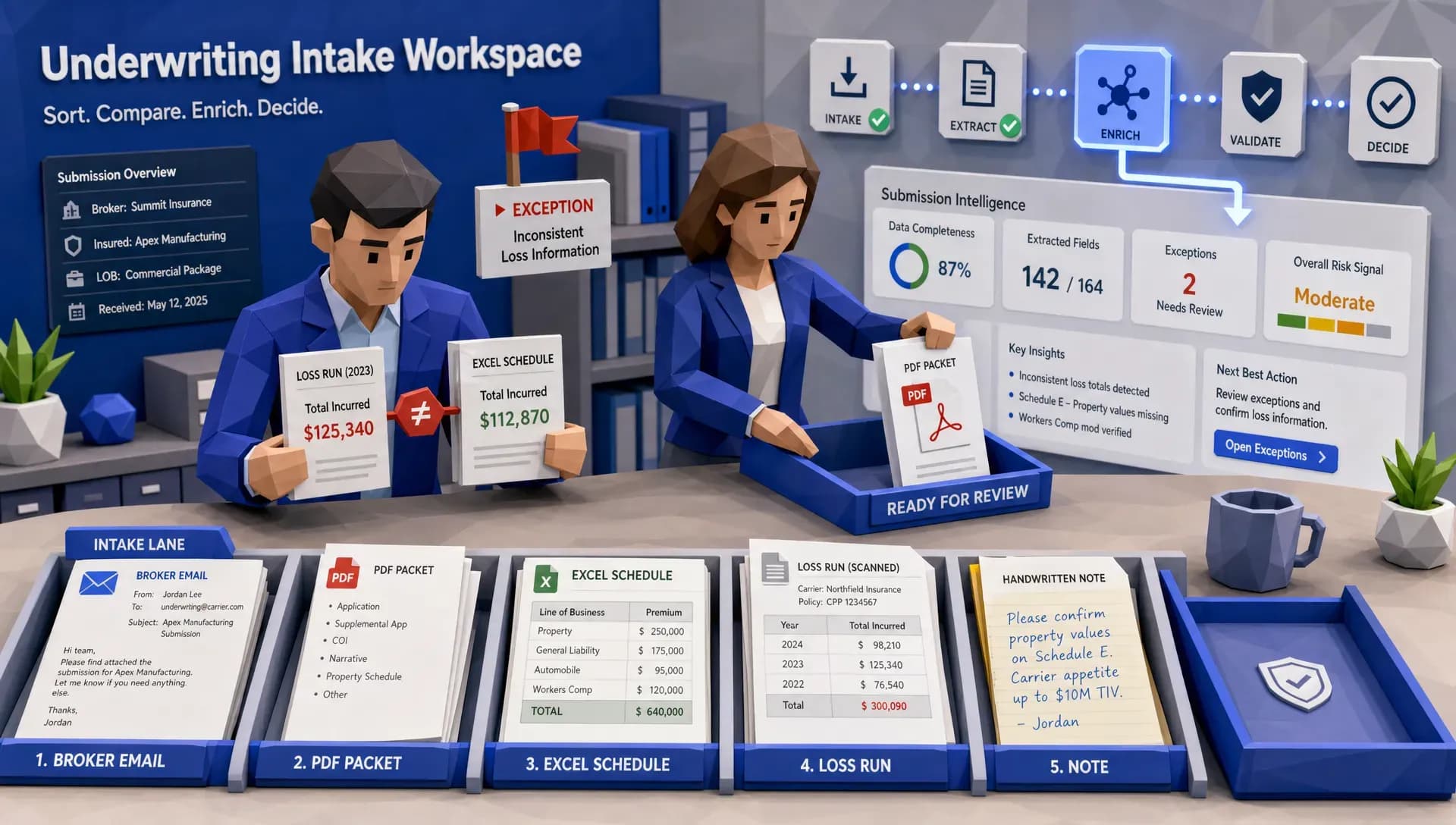
A broker sends an email with three PDFs, two spreadsheets, a loss run from a prior carrier, a fleet schedule with half the column names changed, and a note that says, let me know if you need anything else. Spoiler: you need something else.
The underwriting team then has to extract the data, validate it, enrich it, compare it to appetite, check authority, decide whether to quote, and document the decision. When this happens manually, scaling is simple in the worst possible way: hire more people, accept slower turnaround, or decline good business because the queue is on fire.
That is where automation earns its keep. Not by making every commercial risk straight-through overnight, but by turning unstructured intake into structured underwriting work. Once the submission is clean, the rest of the workflow can breathe.
If you want a deeper dive into the data problem behind this, we have written about why underwriting without good data is just guessing. I stand by that line because I have seen technically strong underwriters make poor decisions simply because the file in front of them was incomplete, stale, or inconsistent.
What scale actually means in commercial underwriting
Scaling underwriting is often misunderstood. People hear scale and think more quotes, faster. That is part of it, but it is not enough.
A commercial underwriting operation scales when it can absorb more volume without adding proportional headcount, handle more complexity without creating chaos, and apply appetite consistently without turning every decision into a rigid rule.
That last point matters. Commercial lines need nuance. A construction fleet with a bad loss year may still be attractive if management changed, driver controls improved, and the current radius of operation is materially different. A rules-only system may kick it out. A good automated workflow should surface the facts, apply guardrails, and refer the case with context.
In other words, automation should make the underwriter faster and better informed. It should not handcuff them to a checkbox.
Step one: automate the front door
The first place commercial insurance underwriting automation scales is intake. If the front door is broken, everything downstream limps.
Submission intake includes emails, PDFs, spreadsheets, ACORD forms, supplemental applications, loss runs, fleet schedules, certificates, photos, and sometimes documents that look like they were scanned during a mild earthquake. A scalable underwriting workflow has to accept that reality.
The job is to capture the file, identify what it contains, extract the relevant fields, and turn that information into a usable record. For commercial auto, that might mean pulling vehicle schedules, garaging addresses, VINs, driver lists, years in business, commodities hauled, prior losses, and coverage limits. For property, it may mean extracting locations, construction type, occupancy, protection class, roof details, and prior claims.
I once watched a team spend most of a Friday afternoon cleaning a 42-vehicle fleet schedule because the broker used Unit, Veh #, and Vehicle ID in the same workbook to mean three slightly different things. Nobody became a better underwriter that day. They just became more familiar with spreadsheet-induced despair.
Automated intake changes the rhythm. Instead of opening every file manually, the team receives structured data, confidence scores, validation flags, and a clear view of what is missing. That means the first human touch can be an underwriting touch, not a clerical rescue mission.
For a practical example of where this starts, see our piece on automating loss run extraction for commercial auto. Loss runs are one of those areas where the value is obvious because every underwriter needs them, and every carrier seems determined to format them differently.
Step two: enrich the file before the underwriter opens it
Once the data is captured, the next scaling move is enrichment. Commercial underwriters need more than what the broker provides. They need third-party signals, historical context, risk indicators, and validation checks.
This is where API integrations matter. Data from sources such as Verisk, LexisNexis, HazardHub, motor vehicle records, property hazard datasets, corporate records, and claims history can help complete the picture. But enrichment has to be disciplined. Dumping ten external reports into a file and calling it progress is like buying a bigger filing cabinet and pretending you cleaned the room.
The useful version is targeted enrichment. If the garaging address looks inconsistent, validate it. If the VIN is incomplete, decode and correct it. If the property location has wildfire, flood, or wind exposure, show the relevant signal at the right point in the workflow. If the prior loss history conflicts with the application, flag it before pricing.
A simple analogy: when a family relocates overseas, they do not want to land first and then start solving housing and school problems. Services that provide rental and school support before arrival are valuable because they sequence the stressful work early. Underwriting is similar. The critical checks should happen before the underwriter is deep into the file, not after three rounds of broker emails.
Pre-underwriting enrichment is one of the biggest differences between automation that looks impressive in a demo and automation that actually scales in production.
Step three: automate appetite, referrals, and authority without flattening judgment
Here is where many automation projects get awkward. They try to turn underwriting into a binary decision tree. Accept or reject. Refer or bind. Green or red.
Commercial underwriting rarely behaves that politely.
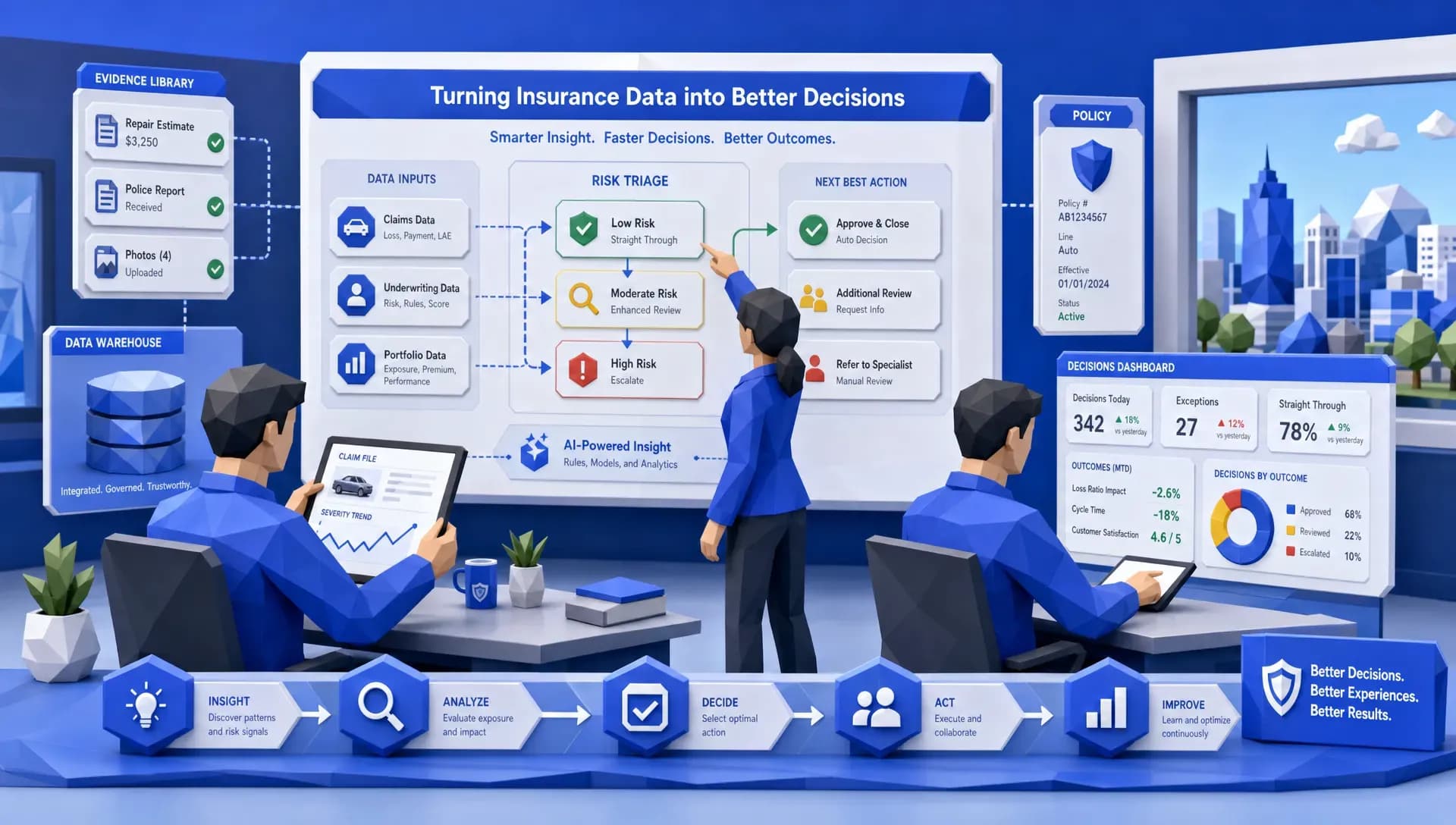
A scalable workflow needs to encode appetite and authority while preserving the ability to handle exceptions. That means the system should understand eligibility rules, minimum documentation requirements, authority thresholds, pricing guardrails, referral triggers, and escalation paths. It should also explain why something was referred.
For example, a submission might pass basic eligibility but trigger referral because the loss ratio is high, the radius of operation has expanded, and two units have invalid VINs. That is useful. An underwriter can act on that. A vague high risk flag is not useful. It creates mistrust and, eventually, workaround spreadsheets.
This is also why the debate between rules and automation needs a bit of maturity. Rules are not bad. In fact, good underwriting operations depend on them. The problem is when rules become brittle and detached from real portfolio performance. We explored this in Rules-Based vs. AI Underwriting: Which One Scales Better for MGAs?, and the short version is that most commercial teams need a hybrid approach.
Use rules for compliance, appetite, and authority. Use automation to gather evidence, detect patterns, suggest routing, and keep the file moving. Let underwriters handle the gray areas with better information.
Step four: make the data warehouse the heart of the operation
This is my strongest opinion in the room: workflow automation without a connected data warehouse creates faster amnesia.
You might process submissions more quickly, but if the data disappears into the policy admin system, the inbox, or a one-off spreadsheet, you lose the strategic benefit. You cannot easily answer which brokers send the cleanest submissions, which referral reasons are increasing, which data fields cause the most delays, where premium leakage appears, or how your book compares to market benchmarks.
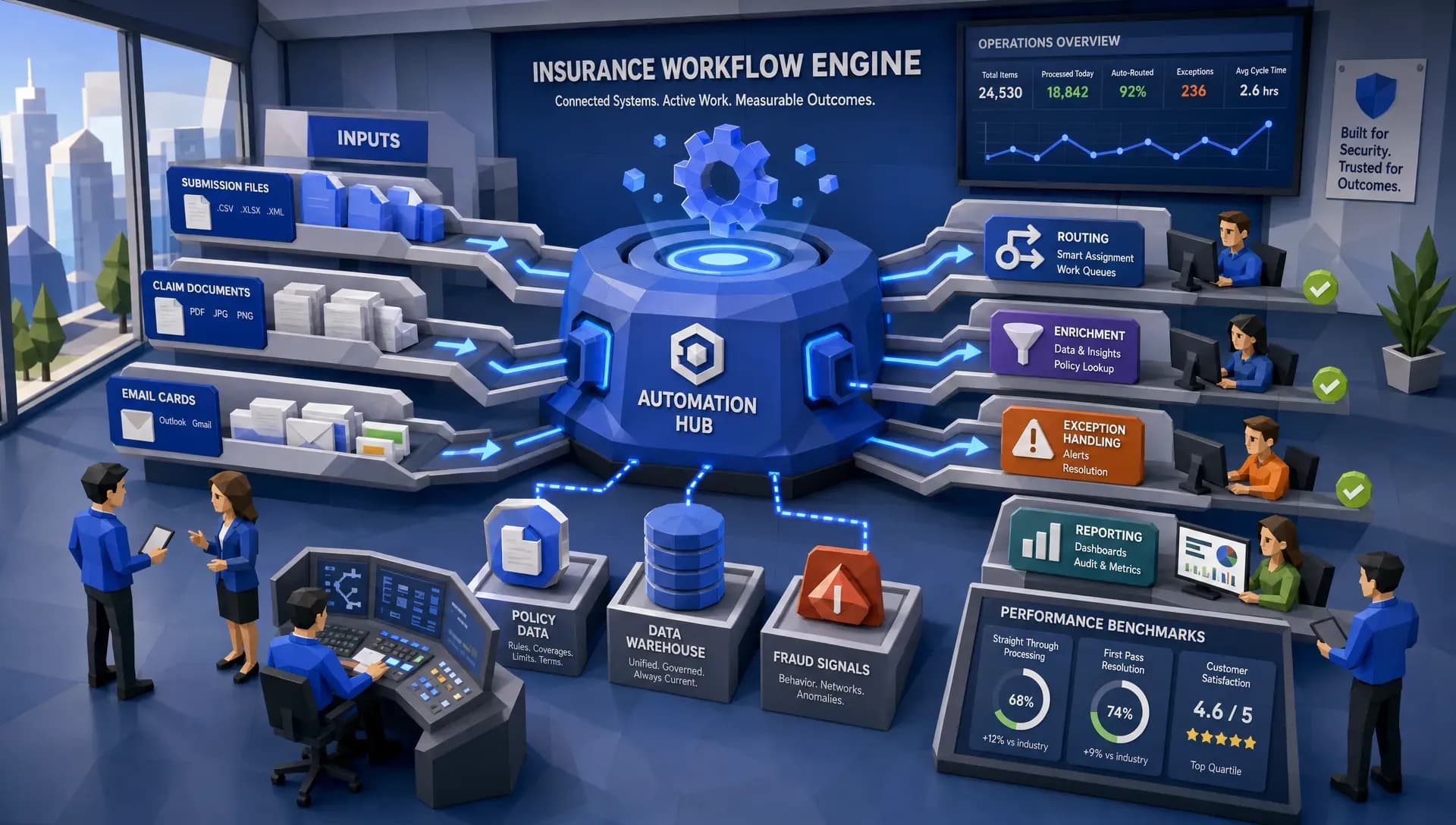
Commercial underwriting automation scales properly when every workflow leaves a usable trail. You want to capture what came in, what was missing, what was enriched, what rules triggered, who reviewed the exception, what was quoted, what was declined, what was bound, and what later happened in claims.
That is where dashboards become more than management decoration. Real-time analytics can show submission volume by channel, quote turnaround, referral rates, missing data patterns, appetite leakage, pricing overrides, broker responsiveness, and portfolio movement over time.
For MGAs, this is especially powerful. Capacity providers want evidence. Reinsurers want narrative. Boards want confidence. If you can show how your portfolio performs against industry benchmarks, and explain why risk selection improved, renewal conversations become much more productive.
Inaza was built with this idea in mind. The data warehouse underneath the workflows matters because automation is only the start. Capturing key data points from automations allows insurers, MGAs, and brokers to use pre-built or custom dashboards, compare performance against benchmarks such as Aon, Munich Re, Howden, and others where relevant, and build stronger narratives around portfolios and policyholders.
I have seen large insurance technology projects stall because everyone tried to solve the entire operating model in one heroic swing. It sounds bold in a steering committee. It feels less bold twelve months later when the business is still arguing over field definitions.
Commercial insurance underwriting automation scales better when you start with a specific workflow and expand from there. Loss run extraction. Fleet schedule validation. Eligibility checks. Broker email triage. Data enrichment. Referral routing. Renewal review. Bordereau ingestion.
Pick a workflow where the pain is visible and the ROI is measurable. Then build the habit of automation. Once one workflow proves itself, the next one is easier because the team already trusts the process, the integrations are in place, and the data foundation is stronger.
This is why I like the start small, scale fast mindset. It respects the reality of insurance operations. You do not need to rip out your core systems to make progress. You need automation that integrates with existing systems, supports the files your teams already receive, and fits the way underwriters actually work.
We have covered this approach in AI for Underwriting: Start Small, Scale Fast, and it remains one of the most practical paths for carriers and MGAs that want results without operational whiplash.
Where underwriting automation usually breaks
Most failed automation projects do not fail because the technology cannot read a PDF. They fail because the business never defined the workflow clearly enough.
If nobody agrees which fields are mandatory, automation will amplify confusion. If referral rules are outdated, the system will route too many files to senior underwriters. If integrations are shallow, teams will still re-key data into policy admin systems. If dashboards measure only speed, the business may quote faster while quietly accepting worse risks.
Another common failure is ignoring the human workflow. Underwriters need to see why a file was flagged. Managers need to adjust rules without waiting six months. Operations teams need exception queues that make sense. Compliance teams need audit trails. Brokers need faster answers, not a portal that feels like homework.
The best automation respects the operating model. It reduces low-value touches while making the remaining human touches more valuable.
What good looks like when automation scales
When commercial underwriting automation is working, you can feel it in the team before you see it in the dashboard.
Underwriters stop asking where the file is. Assistants stop retyping the same data in three places. Brokers get faster feedback on missing information. Managers can see bottlenecks without running a fire drill. Referral queues become cleaner. Decline reasons become consistent. Renewal reviews start with real history rather than scattered notes.
The metrics should confirm the feeling. Watch submission-to-quote time, quote-to-bind ratio, data completeness, manual touchpoints per submission, referral rate, straight-through eligibility rate, rework volume, premium leakage indicators, underwriting expense, broker response time, and loss performance by segment.
Do not measure speed alone. A bad quote delivered quickly is still a bad quote. The goal is faster, cleaner, more consistent risk selection.
How Inaza helps commercial underwriting automation scale
Inaza helps insurers, MGAs, and brokers automate underwriting workflows without forcing teams through the usual PoC ping-pong. The platform is designed to integrate with existing systems, capture and structure data from all file types, and support customizable workflows across underwriting, claims, customer service, and operations.
For commercial underwriting teams, that means you can automate intake, extraction, validation, enrichment, referrals, reporting, and analytics in a way that fits your current operating model. Inaza includes 250+ workflow templates, pre-built API templates for data enrichment sources such as Verisk, LexisNexis, HazardHub, and others, and a unified data warehouse that turns workflow activity into business intelligence.
The key point is speed to production. If a workflow is well-scoped, Inaza can help teams move quickly without months of back-and-forth configuration. That matters because underwriting teams do not need another innovation theater. They need fewer repetitive tasks, better data, and more time to make sound decisions.
Frequently Asked Questions
What is commercial insurance underwriting automation? Commercial insurance underwriting automation uses technology to capture, structure, validate, enrich, and route underwriting data so commercial risks can be assessed faster and more consistently. It supports underwriters by reducing manual data work and improving file quality.
Can automation handle complex commercial risks? Yes, as long as it is designed around referrals and exceptions. Complex risks should not be forced through a rigid straight-through process. Good automation identifies missing data, applies appetite rules, enriches the file, and routes nuanced cases to the right underwriter with context.
Does underwriting automation replace underwriters? No. In commercial lines, the best use of automation is to remove administrative drag so underwriters can focus on judgment, negotiation, portfolio strategy, and broker relationships. Automation handles repetitive work; underwriters handle the gray areas.
What workflows should MGAs and carriers automate first? Start with high-volume, high-friction workflows such as loss run extraction, fleet schedule validation, eligibility checks, submission intake, broker email triage, and renewal data review. These areas usually deliver visible efficiency gains quickly.
How should insurers measure the success of underwriting automation? Measure more than speed. Track quote turnaround, data completeness, manual touchpoints, referral quality, rework, premium leakage, broker responsiveness, bind ratio, underwriting expense, and downstream loss performance.
Ready to scale underwriting without scaling chaos?
If your underwriters are still spending too much time opening attachments, fixing spreadsheets, chasing missing data, and re-keying information, the issue is not talent. It is workflow design.
Inaza helps commercial insurance teams deploy automation that captures data, enriches submissions, routes exceptions, and turns underwriting activity into analytics your business can actually use. If you are ready to scale commercial insurance underwriting automation without replacing your core systems or retraining the entire team, talk to Inaza and see what a production-ready workflow could look like for your team.