Here is my hot take after a decade around P&C claims: most carriers do not have a claims problem. They have a memory problem.
The file forgets what happened at first notice of loss. The adjuster forgets which coverage question was still open. The supervisor forgets why the claim was routed to complex loss. Legal forgets which documents were already requested. Nobody means to drop the ball, of course. The ball just gets passed through too many systems, inboxes, PDFs, portals, and “quick calls” that are never quite as quick as promised.
I know, the phrase “life cycle of insurance claim” sounds like something from a training binder that has not been opened since 2014. But the idea matters. A claim has a beginning, a messy middle, and an ending. The problem is that many insurers manage those moments as separate tasks instead of one connected journey.
A smarter approach is not about making every claim fully automated or treating every claimant like a data point. It is about knowing, at each stage, what decision needs to be made, what information is missing, who should own the next step, and how to avoid asking the customer for the same thing three times. That last part sounds small until you have been on the receiving end of it. I once had a customer tell me, “I’ve explained the accident more times than I’ve told my kids how we met.” Fair.
The claim lifecycle is a chain of decisions, not a checklist
Most claim lifecycle diagrams look tidy. FNOL, coverage review, investigation, evaluation, settlement, payment, closure. Lovely. If only claims behaved like flowcharts.
In real life, a simple auto physical damage claim can turn awkward when a coverage endorsement is missed. A routine property claim can become suspicious when invoices arrive in three different formats with inconsistent dates. A bodily injury file can turn expensive when early notes are thin and the attorney demand lands six months later like a piano from a cartoon window.
That is why I prefer to think of the insurance claim lifecycle as a decision chain. Each stage should reduce uncertainty. If it does not, the claim may be moving, but it is not progressing.
This is where many claims operations accidentally optimize the wrong thing. They track how fast a task was completed, but not whether the task produced usable context for the next person. Speed without context is how we get fast rework.
FNOL: where the claim either gets clean or gets expensive
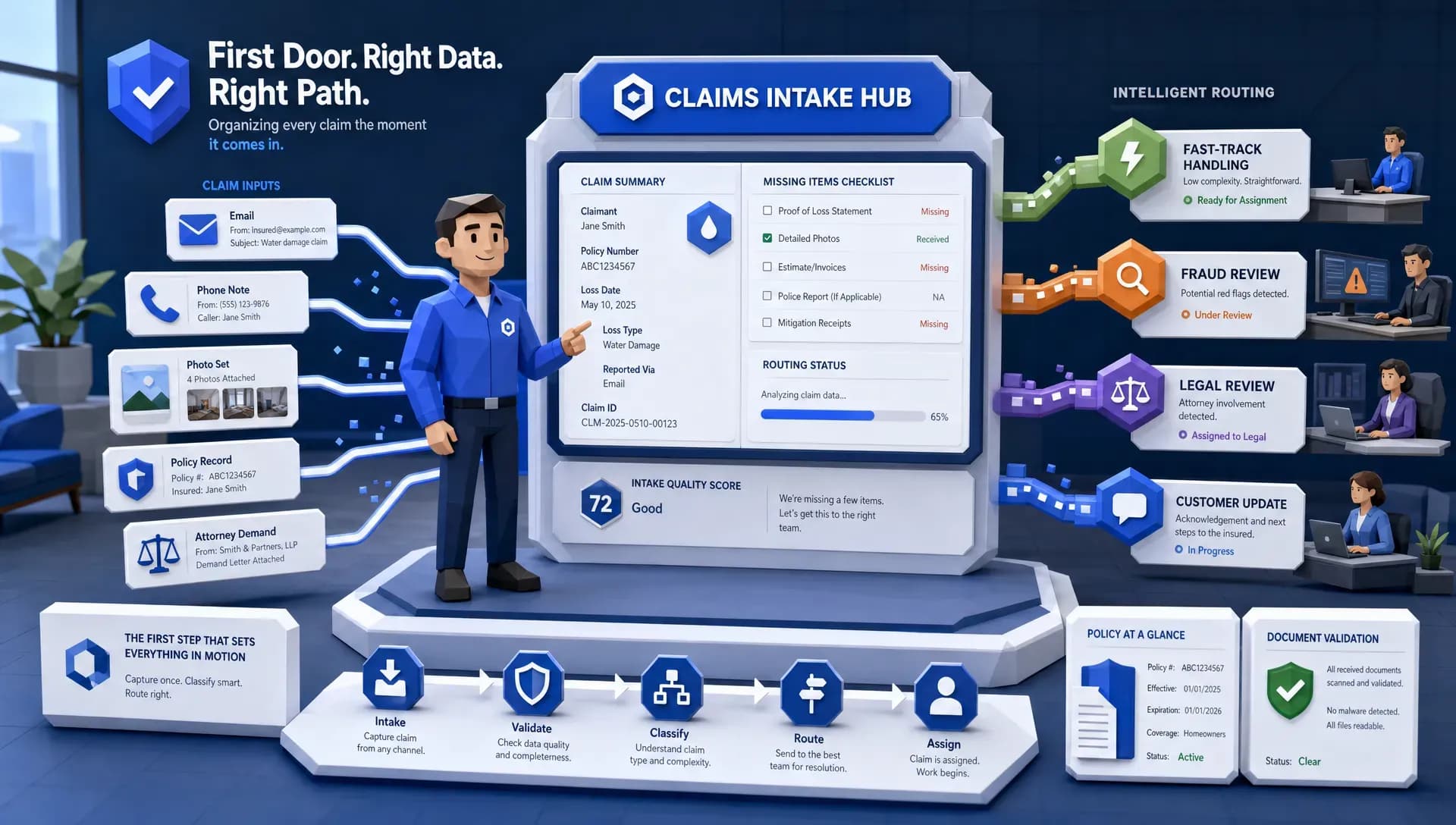
First notice of loss is not just intake. It is the first chance to shape the whole file.
A good FNOL process captures the basics, of course: who, what, when, where, policy details, loss description, photos, documents, police reports, injury indicators, and contact preferences. But the better question is whether the intake process captures the claim’s likely path.
Is this a low-severity routine claim? Does it need a specialist? Are there fraud indicators? Is there potential subrogation? Is the policyholder likely to need proactive communication? Are we missing documents that will block coverage confirmation?
I have seen carriers spend fortunes improving downstream claims handling while leaving FNOL as a glorified web form plus a shared mailbox. That is like installing heated leather seats in a car with a flat tire. Nice, but not the priority.
A smarter FNOL process structures data early, validates it against existing policy information, enriches it where appropriate, and flags gaps before they become delays. If a claims team waits until day 10 to discover the loss location was wrong or the policy number was mistyped, the lifecycle has already started with a limp.
Coverage and triage: the fork in the road
Triage is where claims operations should be brave. Not reckless, just brave.
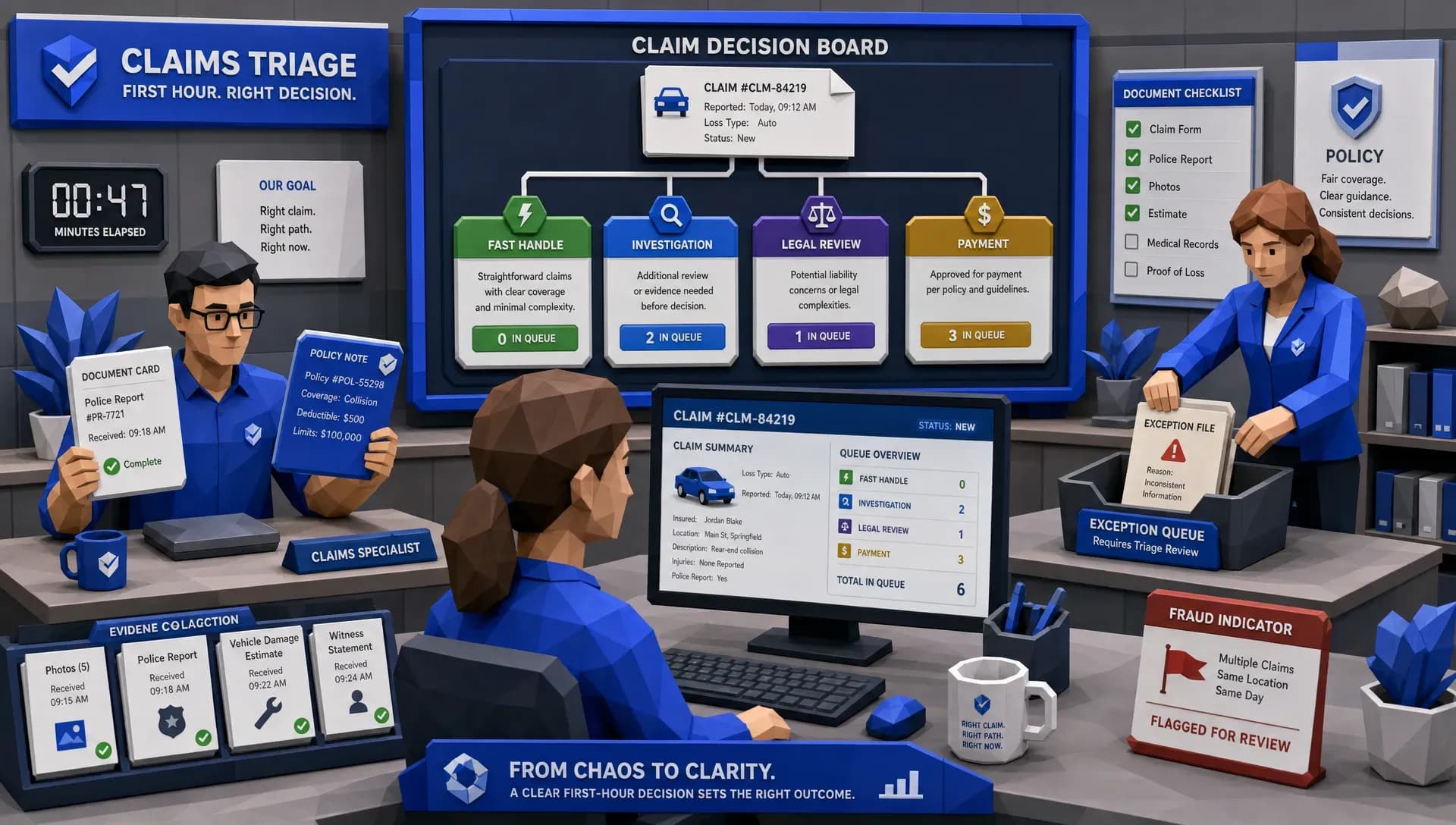
The worst triage model is “everything goes to a human queue and someone will figure it out.” That usually means your best adjusters spend too much time reading routine files, while complex files wait for the attention they deserved on day one.
A better model routes claims based on facts, risk signals, policy rules, severity indicators, customer history, document quality, and claim type. The phrase “claim type” is doing a lot of work here. A cracked windshield, a litigated casualty claim, a commercial property loss, and a suspicious theft claim should not share the same operating path. We have written separately about why each type of claim in insurance needs a different workflow, because this is one of those obvious truths that still gets ignored in system design.
The goal is not to remove judgment. It is to reserve judgment for the claims that actually need it.
J.D. Power’s 2024 U.S. Auto Claims Satisfaction Study has pointed to cycle time as a major driver of customer frustration in auto claims. Anyone who has handled claims knows why. Customers can tolerate a fair process. They struggle with silence, repeated requests, and the feeling that nobody can tell them what happens next.
Investigation: stop making adjusters become file archaeologists
Investigation should feel like building a case, not excavating a ruin.
Yet in many organizations, adjusters still spend too much time hunting for information. Photos in one place. Emails in another. Recorded statements somewhere else. Vendor notes in a portal. Policy documents in the core system. Prior claim history behind another login. If the adjuster needs six screens to understand one claim, the process is asking for leakage.
Here is where connected data becomes a quiet superpower. When claim notes, policy data, documents, images, fraud indicators, payment history, vendor updates, and communication logs sit in one usable view, the adjuster can spend more time deciding and less time searching. That is why claims services tend to perform better with connected data across the claim journey, especially when files move between teams.
Fraud also belongs in this conversation. The FBI describes insurance fraud as a major cost to the industry and consumers, and digital evidence has made the job both easier and harder. Easier because more signals are available. Harder because questionable documents, edited images, and synthetic evidence can move quickly through ordinary workflows if nobody checks them early.
My view is simple: fraud screening should not be a late-stage panic button. It should be a set of proportionate checks that start early, escalate when needed, and avoid slowing down clean claims.
Evaluation and negotiation: where early data pays off
By the time a claim reaches evaluation, the quality of earlier work becomes painfully visible.
If FNOL was vague, investigation was scattered, and coverage notes were inconsistent, negotiation becomes a guessing game. If the file is structured, documented, and current, evaluation becomes much cleaner. This matters most in claims where reserves, liability, medical documentation, repair estimates, attorney demands, or business interruption calculations are in play.
I once watched a senior adjuster resolve a messy liability claim faster than anyone expected because the file had one beautiful thing: a clear timeline. Not a fancy predictive model. Not a 40-slide deck. Just a clean sequence of events, documents, decisions, and open questions. Everyone could see what happened and what still mattered. The claimant’s attorney could not create fog because the file had daylight.
That is the underappreciated value of smarter lifecycle management. It gives people a better story of the claim. Not a biased story, not a convenient story, but a complete one.
For brokers, MGAs, and carriers, that story also matters beyond the individual file. Claim narratives influence renewals, portfolio reviews, reinsurance discussions, and operational planning. If the claims data is trapped in unstructured notes, you lose institutional learning. If it is captured consistently, you can see patterns that improve pricing, underwriting, vendor management, and reserving.
Settlement and payment: the finish line is not the last click
Settlement is where customers judge the whole experience. They may not remember every step, but they remember whether the result felt fair, timely, and clear.
A smart claim lifecycle keeps settlement from becoming a fresh round of confusion. Payment instructions should be validated. Releases should be tracked. Customer communications should be consistent. Exceptions should be visible. Supervisors should be able to see which claims are stalled and why.
The practical mistake I see is treating payment as an accounting event rather than a customer and compliance event. That creates unnecessary friction. A claim can be technically settled and still feel unresolved if the customer does not understand the amount, timing, deductible, depreciation, rental issue, lienholder process, or next step.
This is where automation helps most when it is boring. I mean that as a compliment. Boring automation sends the right update, requests the missing form, checks the payment status, logs the communication, and alerts the right person when something goes off track. Nobody claps for it at a conference. Customers quietly appreciate it.
Closure: the stage everyone skips too quickly
Closing a claim should not mean throwing the file into a digital attic.
A closed claim contains lessons. Which vendors were slow? Which documents caused rework? Which FNOL questions were missing? Which fraud indicators were useful? Which claims reopened? Which adjusters were overloaded? Which policy language caused confusion?
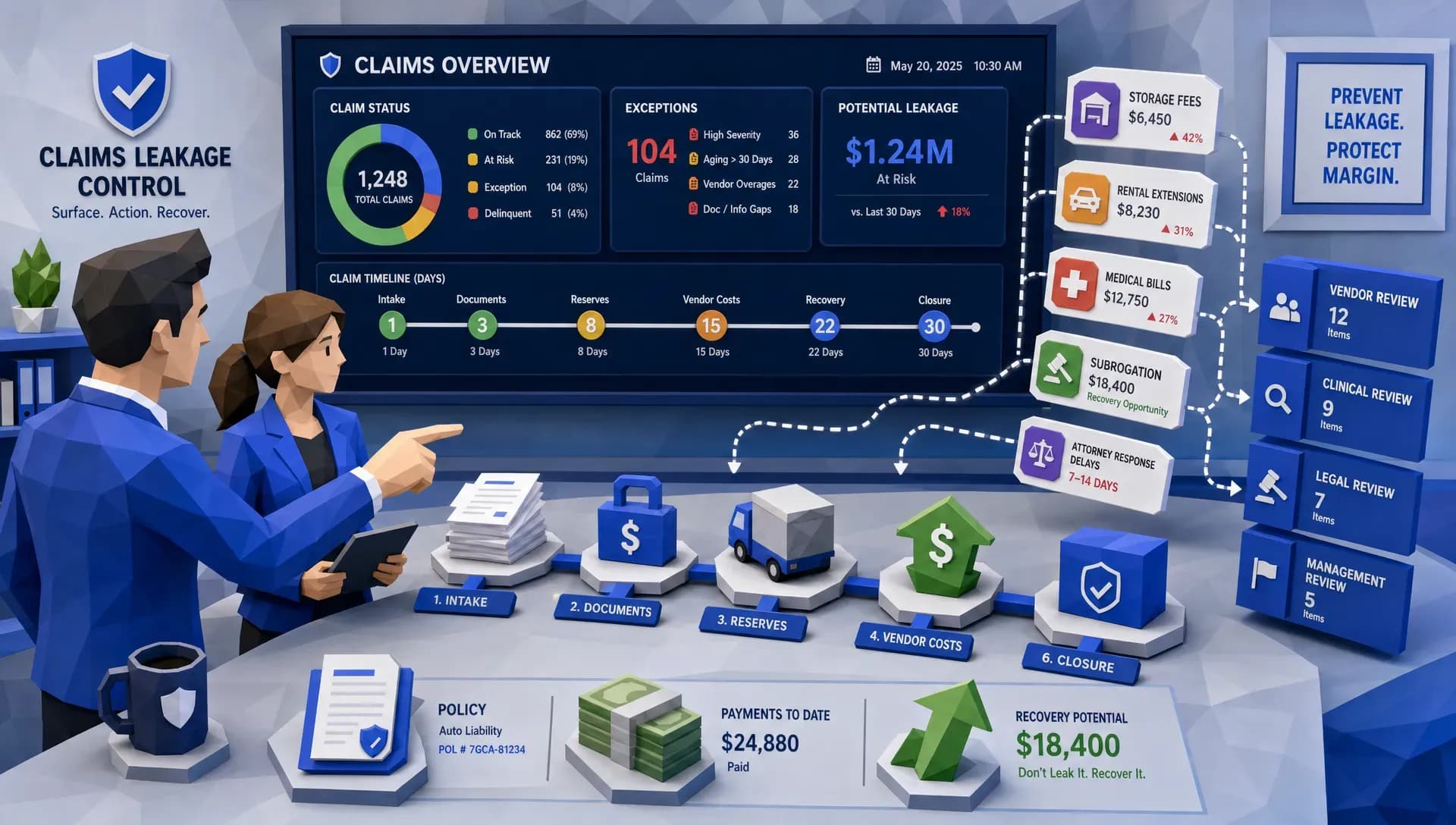
The afterlife of a claim is business intelligence. And this is where many claims platforms disappoint me. They manage tasks, but they do not always preserve the operational data in a way leaders can use. If you cannot see why claims are delayed, which workflows perform best, or how your results compare to relevant benchmarks, you are managing by anecdote.
And I say that as someone who enjoys a good anecdote. But anecdotes should start conversations, not run departments.
Claims leaders need reporting that connects the lifecycle from start to finish. That includes cycle time, touch count, rework, leakage indicators, litigation rates, fraud referrals, customer communication gaps, and outcomes by claim segment. The point is not to drown teams in dashboards. The point is to make the next claim easier than the last one.
People still matter, but we should stop wasting their judgment
Claims work is still human work. Empathy matters. Negotiation matters. Judgment matters. The best adjusters can hear what is not being said, spot what does not feel right, and explain a hard decision without sounding like a script.
But we do not honor that expertise by burying it under admin. McKinsey has noted in the underwriting world that a large share of professional time can be consumed by administrative work rather than core risk assessment, and claims has a very similar disease. Too many skilled people spend too much of the day copying, chasing, rekeying, and reconciling.
There is also a career angle here that the industry does not talk about enough. Claims transformation needs people who can translate field experience into operating change. If you are a senior claims, underwriting, or operations professional trying to tell that story in the job market, a recruiter-led service like Optima Career Studio can be useful because complex insurance experience often needs sharper positioning than a generic resume gives it.
Inside the operation, though, the principle is the same. Let people do the work only people should do. Let systems handle the repeatable tasks, the data capture, the document sorting, the reminders, the status updates, and the routing.
What “smarter” really looks like in 2026
In 2026, a smarter claims lifecycle is not defined by having the newest tool in the stack. It is defined by whether the operation can answer four questions quickly.
What is happening on this claim? What is blocking progress? What should happen next? What can we learn from it?
If your claims team cannot answer those questions without opening multiple systems and asking three people, the lifecycle is not under control. It may be functioning, but it is not managed.
A smarter model has structured FNOL, claim-specific routing, early data enrichment, connected documentation, fraud checks that scale with risk, consistent communications, clear payment tracking, and reporting that actually helps leaders make decisions. It integrates with existing systems rather than forcing teams to rip and replace everything at once. It also gives business users the flexibility to adjust workflows as products, regulations, vendor networks, and customer expectations change.
That last point matters. Claims workflows are living things. If changing a workflow requires a six-month IT project, the business will create workarounds. And once workarounds become normal, the official process becomes theater.
A practical starting point
If I were reviewing a claims operation tomorrow morning, I would not start by asking for a technology roadmap. I would pick five recently closed claims and trace them from FNOL to payment. I would ask where the file waited, where information was rekeyed, where the customer repeated themselves, where documents went missing, where fraud checks happened, and where supervisors lost visibility.
You do not need a consulting army to find the first layer of waste. Claims files are very honest if you read them closely.
Then I would separate issues into two groups: problems of judgment and problems of plumbing. Judgment problems need training, authority, guidelines, and experience. Plumbing problems need better data flow, automation, integration, and workflow design. Do not confuse the two. Buying software to fix unclear authority is expensive theater. Asking adjusters to work harder because systems do not connect is operational negligence with nicer wording.
Frequently Asked Questions
What are the main stages in the life cycle of an insurance claim? The common stages are first notice of loss, coverage validation, triage, investigation, evaluation, settlement, payment, and closure. In practice, the stages often overlap, especially in complex claims involving liability disputes, fraud concerns, litigation, or missing documentation.
Why does the claim lifecycle break down after FNOL? It usually breaks because early information is incomplete, unstructured, or disconnected from the systems and people who need it. When context gets lost after first contact, adjusters spend more time chasing details and customers experience delays.
Can automation improve claims without reducing human oversight? Yes, if it is used selectively. Automation is best for repeatable work such as intake, document capture, routing, status updates, data enrichment, and exception alerts. Human adjusters should still own judgment-heavy decisions, negotiation, empathy, and complex coverage questions.
How should insurers measure whether their claim lifecycle is improving? Cycle time matters, but it is not enough. Insurers should also monitor rework, touch count, stalled claims, reopened claims, fraud referral quality, litigation rates, customer communication gaps, and outcomes by claim type or severity segment.
Make the claim lifecycle easier to manage
The claim lifecycle will never be perfectly neat. Losses are emotional, facts change, documents arrive late, and people are people. But the process can be much smarter than the old model of queues, inboxes, spreadsheets, and heroic adjusters holding everything together.
Inaza helps insurers, MGAs, and brokers automate claims workflows, connect data across existing systems, capture information from all file types, and turn operational activity into useful reporting and analytics. If you want to reduce cycle time without losing control, explore how Inaza supports claims management automation across the insurance claim lifecycle.