If there is one thing I have learned from a decade around claims teams, it is this: the best claims automation feels pleasantly boring. Boring like a reserve that reconciles on the first try. Boring like an adjuster opening a file and seeing the photos, estimate, policy details, prior losses, and next action already lined up in the right place.
My hot take: when automating insurance claims processing, speed is not the main event. Speed is the prize you earn after you get data, controls, handoffs, and trust right. If you automate a messy process without fixing the mess, congratulations, you now have a faster mess.
I once sat beside an auto adjuster who received 17 damage photos, three duplicate emails, a police report with the wrong date, and a voicemail from the claimant asking whether the claim had been received. The actual coverage review took less time than figuring out which attachment belonged where. That is the part of claims automation nobody wants to put on the conference slide, but it is where the money leaks.
So what matters most? Not the flashiest demo. Not the highest promised automation rate. The real test is whether automation helps your claims team make better, faster, more defensible decisions without creating new cleanup work downstream.
Start with the claim decision, not the workflow diagram
A common mistake is to begin with a process map and ask, 'Which steps can we automate?' That sounds practical, but it often leads teams to automate clerical motion rather than decision quality.
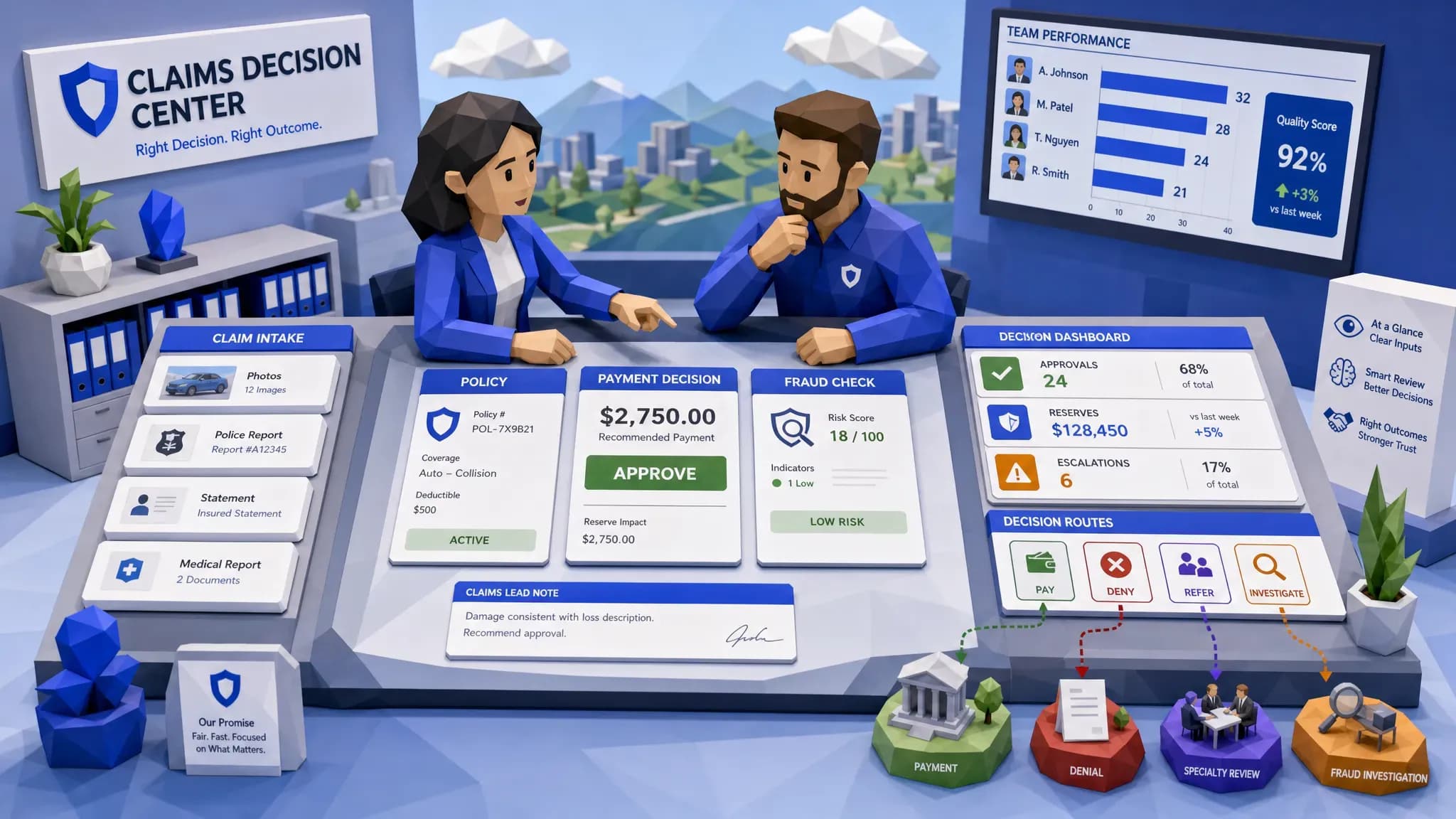
A better starting point is the claim decision. What needs to be true before we can pay, deny, reserve, refer, subrogate, or escalate? What evidence is required? What data must be verified? What exceptions make the claim unsafe for straight-through handling?
For a simple glass claim, the decision might rely on policy status, deductible, date of loss, coverage limits, prior related claims, and vendor validation. For a bodily injury claim with attorney representation, the decision path is obviously different. The automation should know the difference before anyone celebrates cycle-time reduction.
This is where claims automation becomes useful rather than ornamental. It should gather the right documents, check the right facts, and route the file based on the actual decision needed. Otherwise, you are just moving a claim from one queue to another with nicer labels.
Data quality is the first adjuster on the file
Every claims leader I know says they want faster settlements. Fair. Customers want that too. But bad data has a wonderful way of turning a fast payment into a reopened claim, a leakage problem, or an awkward audit conversation.
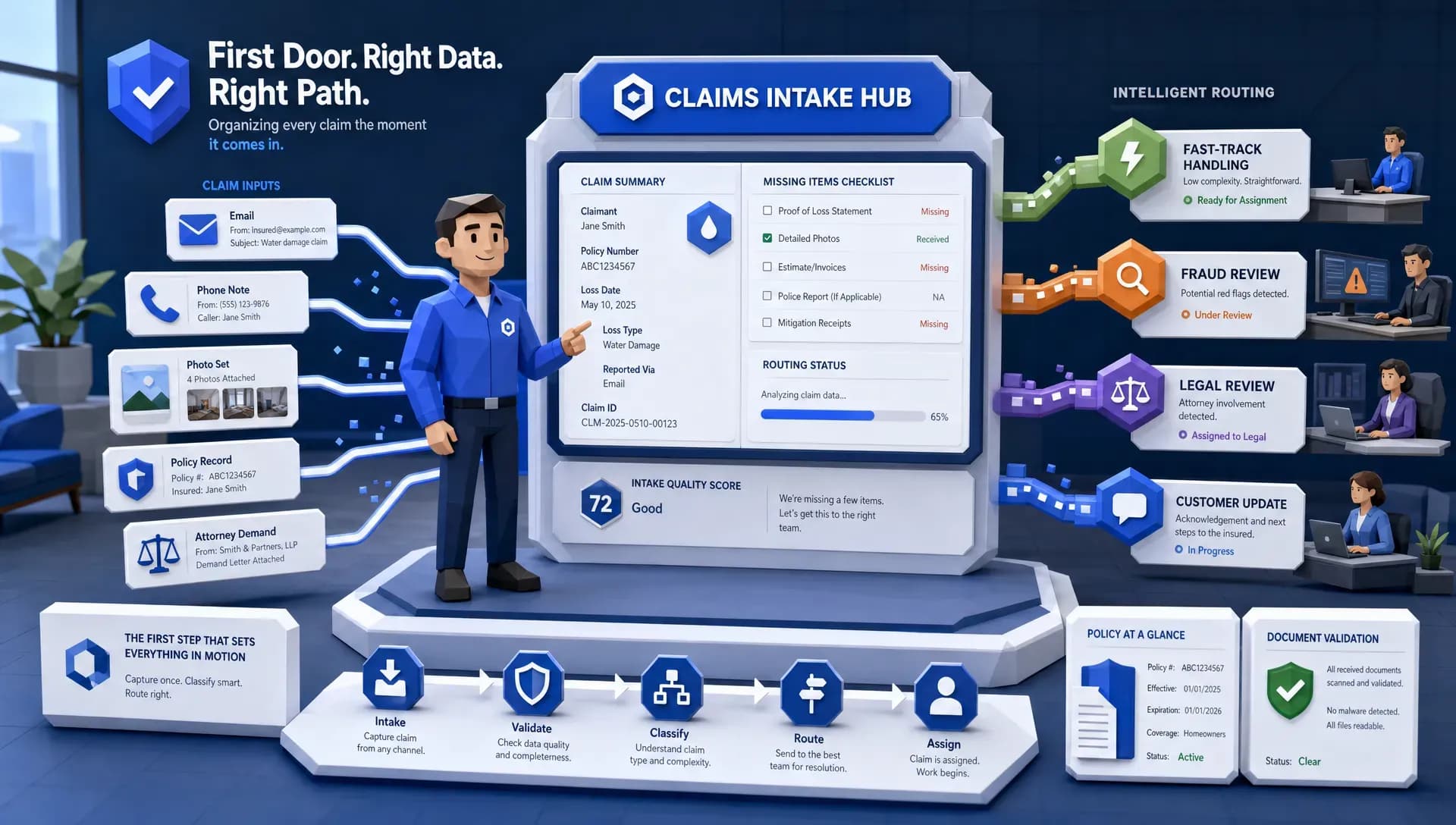
The early claim file is usually a junk drawer. Photos, PDFs, repair estimates, police reports, emails, medical bills, attorney demands, notes from customer service, and third-party data all arrive in different formats. Some come through a portal. Some land in an inbox. Some are photographed at a kitchen table under lighting that would offend a real estate agent.
Automation has to capture, classify, extract, validate, and standardize that information before it becomes operationally useful. This sounds basic, but it is the difference between a workflow that helps and a workflow that quietly poisons your reporting.
The broader file-control market is also raising expectations. Even outside insurance, Telegram-first file-control tools like Cloudon show how people now expect files to be uploaded, summarized, stored, and shared securely from wherever work begins. Claims teams need that same ease of handling, but with policy logic, compliance controls, audit history, and core-system integration wrapped around it.
If you want the more technical version of this argument, we have written about how automation supports data integrity in claims processing. The short version is simple: if the data is wrong at intake, every downstream metric is suspect.
Straight-through processing is not the trophy
I know straight-through processing gets a lot of attention. It should. When a low-severity, low-complexity claim can be verified and paid without manual intervention, everybody wins.
But here is the unpopular bit: a high straight-through rate is not always a sign of a mature claims operation. Sometimes it means the system is too permissive.
Celent has estimated that only a relatively small share of claims are processed straight through without human intervention. I do not read that as failure. Claims are full of exceptions because real life is full of exceptions. Coverage questions, injury indicators, attorney involvement, suspicious metadata, weather events, mismatched VINs, prior losses, inconsistent statements, and vendor anomalies all deserve careful handling.
The goal is not to remove humans from claims. The goal is to reserve human attention for the claims where judgment matters most. Low-severity claims are often the best first target because they have repeatable evidence requirements and less severe downside when guardrails are well designed. If you are choosing a first use case, our guide to automation for low-severity insurance claims is a sensible place to start.
Fraud controls need to be built in before go-live
Fraud is not a side quest. It is one of the central design questions for claims automation.
The FBI has long warned that non-health insurance fraud costs more than $40 billion annually in the United States. More recently, Verisk's 2025 fraud report found that 98% of carriers say AI is fueling digital fraud. That tracks with what claims teams are already seeing: manipulated images, inflated invoices, synthetic documents, staged evidence, and claim stories that look tidy until the data says otherwise.
Automation should not simply accelerate payment. It should check for fraud indicators while the file is still fresh. That can include metadata review, duplicate document detection, vendor pattern checks, prior loss matching, geospatial validation, and referral rules that are clear enough for SIU and claims leadership to defend.
Here is the production rule I like: if the system cannot explain why it paid, denied, escalated, or referred a claim, it is not ready for production. Auditability is not paperwork. It is self-defense.

The adjuster handoff is the product
One of the smartest adjusters I ever worked with kept a sticky note on her monitor that said, 'Do not make me hunt.' That should be carved into the door of every claims automation project.
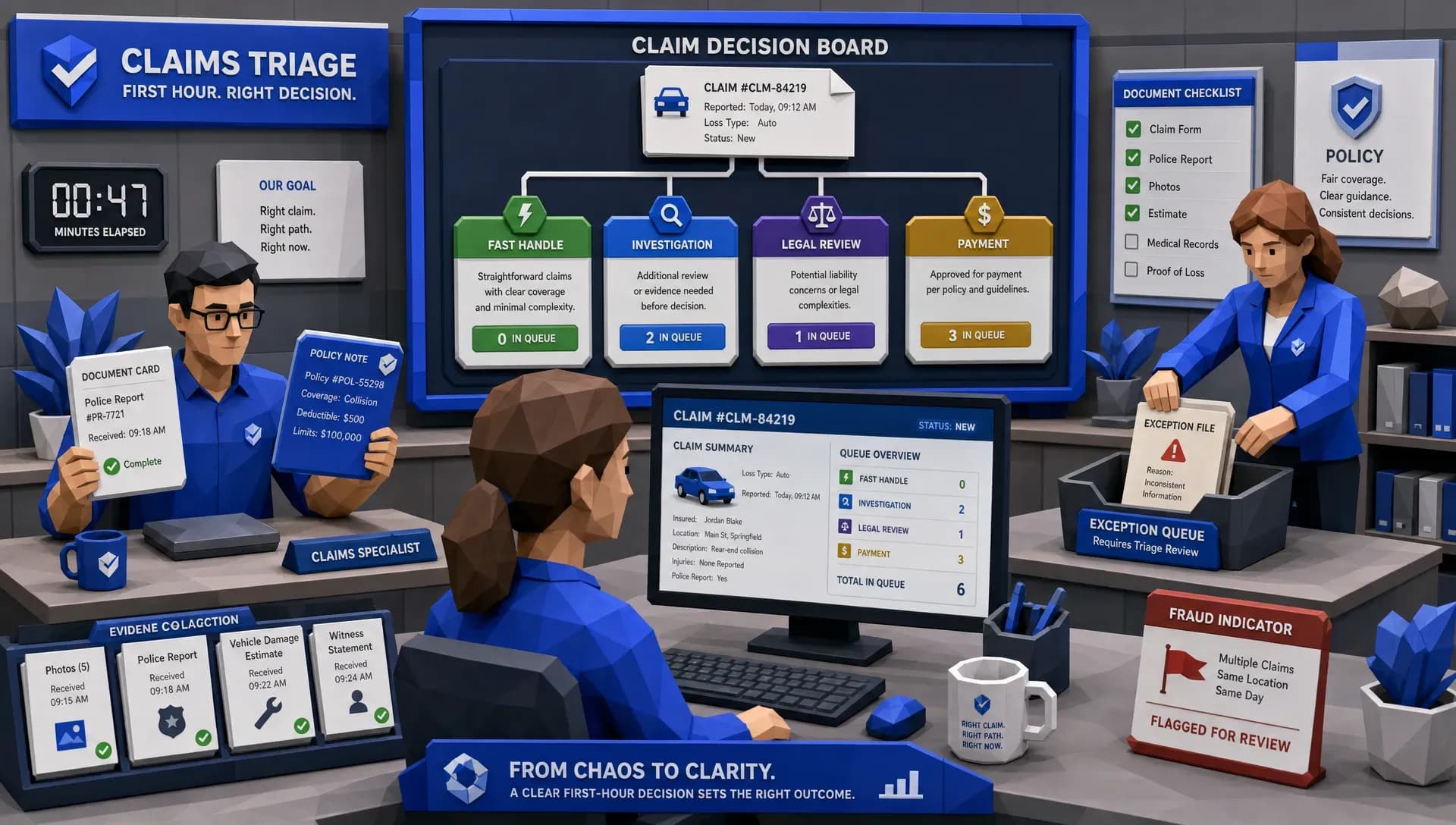
When automation escalates a claim to a human, the handoff should be clean. The adjuster should see what was received, what was extracted, what was verified, what failed validation, what rules fired, what is missing, and what recommended action comes next. If the adjuster has to reverse-engineer the automation's work, you have created resentment with a login screen.
This matters culturally as much as operationally. Claims people are not anti-automation. They are anti-mystery. They have been burned by tools that promised to save time, then added another tab, another queue, and another report to reconcile on Friday afternoon.
Good automation earns trust by being useful in small, repeated ways. It reduces status chasing. It prevents duplicate data entry. It highlights exceptions. It keeps notes consistent. It reminds the team when a document is missing. It gives supervisors a view of bottlenecks before customers start calling.
Integrations are where ROI either appears or dies quietly
The prettiest claims workflow in the world will not help much if it sits outside the systems your team actually uses. Claims automation has to work with policy administration, claims management, billing, document storage, communications, analytics, and external data sources.
This is especially important for MGAs and carriers operating with legacy cores or multiple systems after years of growth, acquisitions, or program expansion. Nobody wants to retrain an experienced claims desk because a vendor brought a shiny new interface. The better approach is to pull data from existing systems, push validated outputs back, and let the team work as normally as possible.
This is also where enrichment matters. A claim decision often improves when automation can bring in external data at the right moment, not after the adjuster has already made three phone calls. Pre-built API templates for data sources such as Verisk, LexisNexis, HazardHub, and similar providers can help claims teams verify facts faster and with less manual searching.
Inaza was built with that reality in mind. Workflows are only part of the story. The platform integrates with existing systems, supports varied file types, and helps insurers configure workflows without turning every operational change into a six-month science project.
Measure rework, not vanity automation rates
If I could ban one metric from claims automation steering committees, it would be automation rate without context. It sounds impressive, but it can hide the real story.
A better question is: how much rework disappeared?
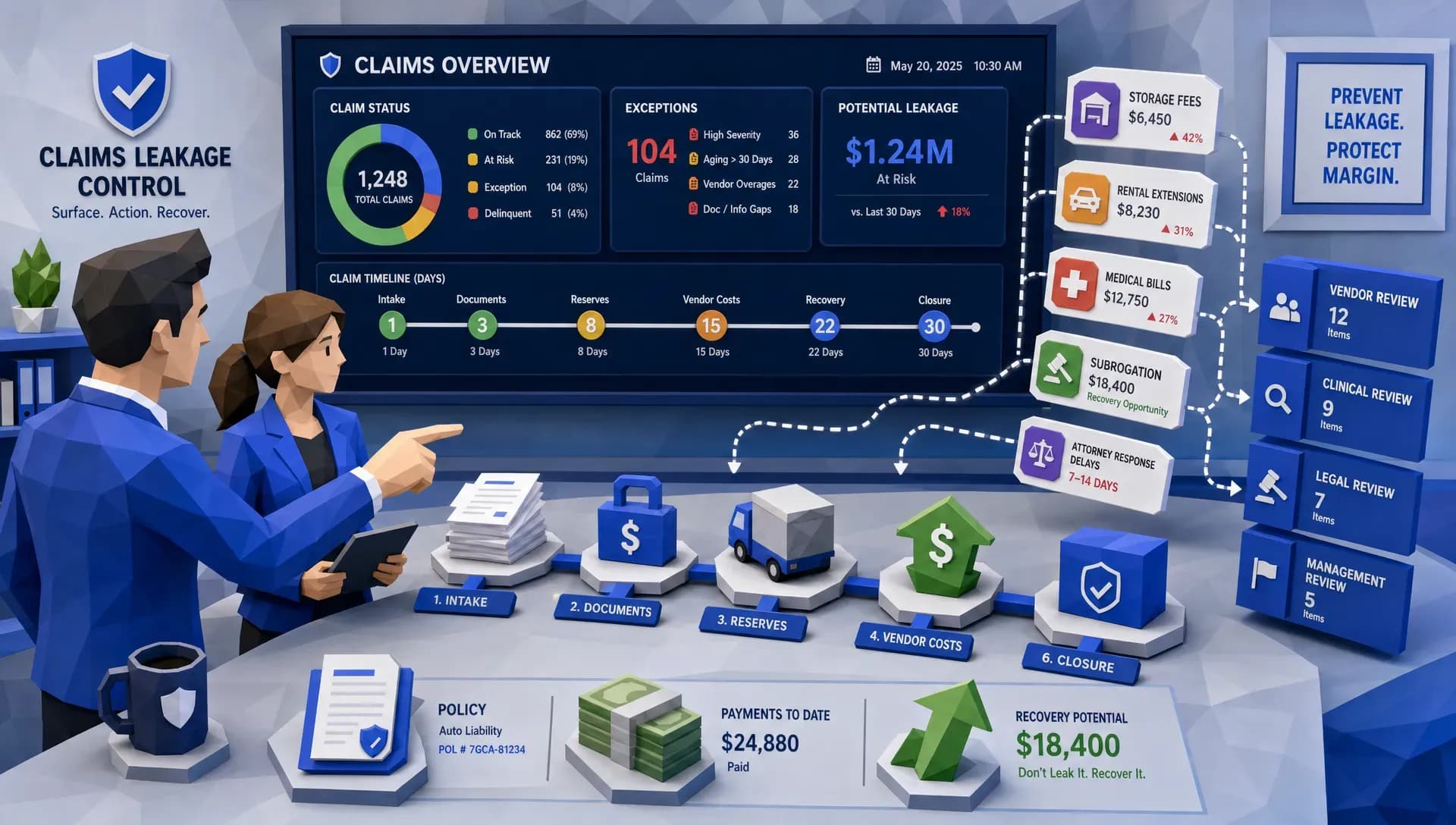
Did duplicate entry fall? Did reopen rates improve? Did adjusters stop chasing missing documents? Did cycle time improve without leakage? Did fraud referrals become more precise? Did customer contacts become more proactive? Did supervisors get a clearer view of backlog and severity shifts?
J.D. Power's 2024 U.S. Auto Claims Satisfaction Study continued to show how strongly claims experience is shaped by communication, repair timelines, and resolution. Customers do not care whether your internal workflow is automated. They care whether you know what is happening and whether you tell them before they have to ask.
This is why I like looking for hidden rework first. It is less glamorous than a fully automated payment demo, but it is usually where the return lives. We have covered this in more detail in our piece on why insurance automation works best where rework is hiding.
Build the data warehouse before you wish you had one
Claims automation should produce operational intelligence, not just task completion. Every automated intake, validation, referral, payment, and exception creates data that can help leadership understand the business.
This is where many programs underbuild. They automate the workflow, then months later someone asks for a dashboard showing claim severity by program, attorney demand trends by venue, supplement frequency by repair network, weather-related loss patterns, or cycle time by adjuster workload. Suddenly, everyone discovers the data was captured in inconsistent fields, or worse, not captured at all.
A unified data warehouse changes the conversation. It lets claims, underwriting, operations, and leadership work from the same facts. It also makes benchmarking more useful. If you can compare your own performance against relevant market indicators, including benchmarks from organizations such as Aon, Munich Re, Howden, and others, you are in a better position to explain portfolio performance, prepare renewals, and support reinsurance conversations.
That is a big reason I think claims automation should be judged as a data strategy as much as an operations strategy. The workflow saves time today. The data tells you where the business is going tomorrow.
A practical way to choose your first claims automation target
If you are planning your first or next claims automation project, resist the urge to chase the loudest pain point. Choose the cleanest learning loop.
Start where the claim type is high-volume, evidence requirements are repeatable, rules are understood, integrations are available, and exception criteria are obvious. You want a workflow where success and failure can be measured quickly. You also want frontline adjusters involved from the start, because they know where the bodies are buried, and sometimes they even remember who buried them.
A good first target usually has a few traits:
- It has enough volume to matter financially.
- It has clear decision rules and predictable documents.
- It creates obvious rework today.
- It can be integrated with existing claims and policy systems.
- It has a safe escalation path when the facts do not fit.
Once that workflow is working, expand carefully. Add more complexity only when the controls, reporting, and adjuster handoffs are holding up. Claims automation should grow like a strong claims team: one good decision habit at a time.
Frequently Asked Questions
What is automating insurance claims processing? Automating insurance claims processing means using software to handle repeatable claims tasks such as document intake, data extraction, validation, routing, communication, reporting, and in some cases payment. The best systems also escalate complex or suspicious claims to the right human reviewer.
Which claims should insurers automate first? Start with high-volume, low-complexity claims where the evidence is predictable and the decision rules are well understood. Low-severity auto, glass, roadside, and routine property claims are common starting points, provided fraud and coverage controls are in place.
Does claims automation replace adjusters? In a well-run program, no. It removes repetitive work so adjusters can focus on coverage judgment, negotiation, complex liability, customer communication, litigation risk, and fraud concerns. If automation makes adjusters hunt for context, it has missed the point.
How does automation help reduce claims fraud? Automation can flag inconsistencies, duplicate documents, suspicious patterns, metadata issues, prior loss conflicts, and vendor anomalies earlier in the process. It also creates an audit trail so fraud referrals and payment decisions are easier to review.
What is the most important metric for claims automation success? Cycle time matters, but rework is often the better metric. Look at duplicate entry, reopen rates, missing-document follow-ups, referral quality, leakage indicators, customer contact frequency, and how much time adjusters spend searching for information.
Final thought: automate for judgment, not theater
Automating insurance claims processing should make the claims operation calmer, cleaner, and more defensible. That means better intake, stronger data, safer fraud controls, clearer adjuster handoffs, useful integrations, and reporting that leadership can actually trust.
If you are evaluating claims automation for a carrier, MGA, broker, or claims operation, focus less on the demo magic and more on what happens on day 90. Are adjusters using it? Are exceptions clear? Are dashboards reliable? Are customers better informed? Are you reducing rework, or simply decorating it?
Inaza helps insurers, MGAs, and brokers automate claims, underwriting, customer service, and operations with configurable workflows, system integrations, a unified data warehouse, and analytics that turn day-to-day automation into usable business intelligence.