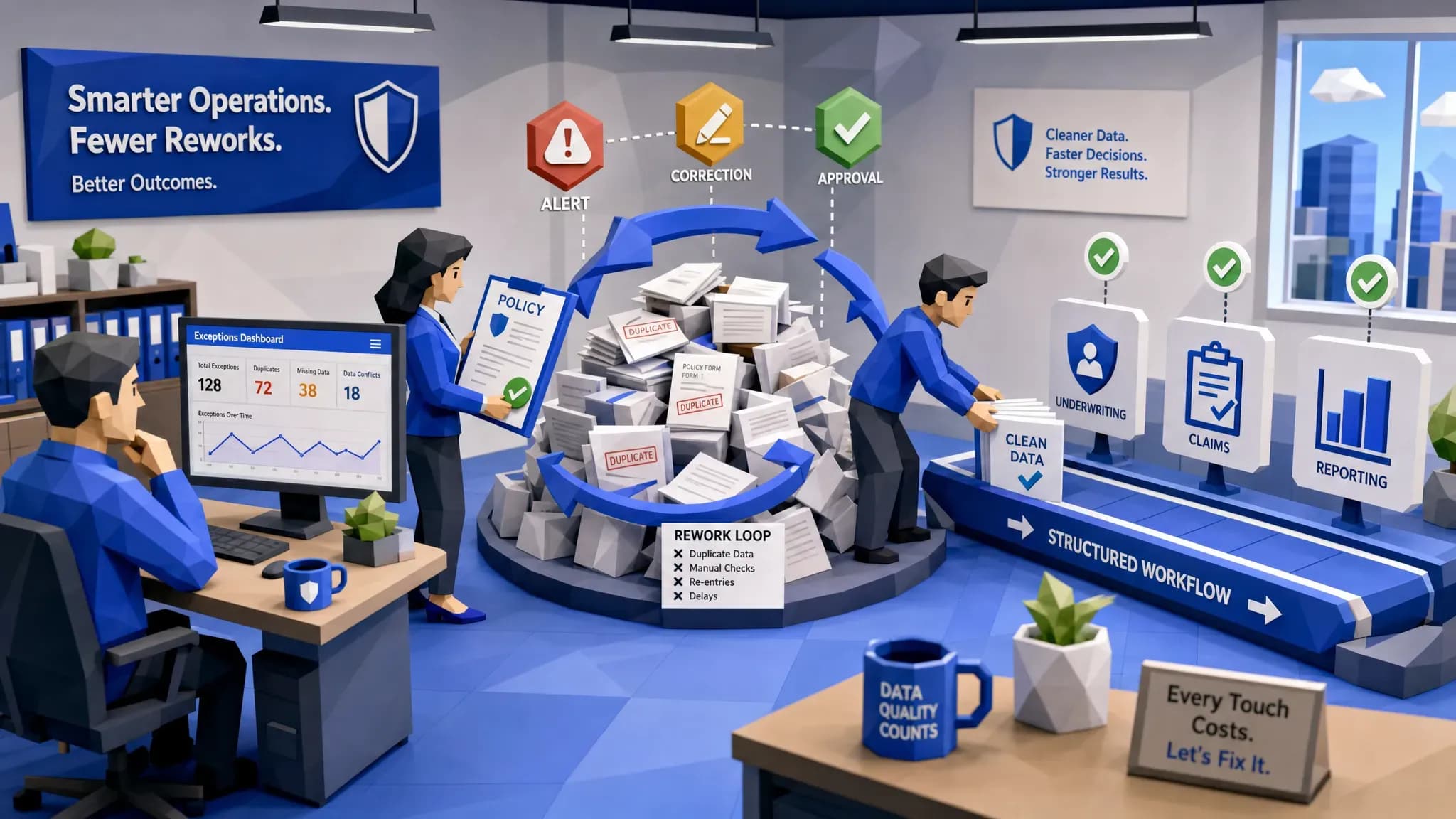
My hot take after a decade around insurance operations: insurance automation delivers the biggest return where nobody wants to look, the rework pile.
Everyone loves the glamorous version of automation. Instant quotes. Lightning-fast FNOL. Dashboards that make executives nod thoughtfully on a Tuesday morning. Fine, I like those too. But the real money is usually hiding in the boring places: the second email asking for a missing loss run, the re-keyed VIN, the claim that gets reopened because the first triage missed a coverage issue, the underwriting referral that bounces between three people because no one trusts the data.
I once watched a team proudly hit a 24-hour quote turnaround target, only to spend the next six days fixing garaging address errors, chasing driver history, and correcting a form mismatch before bind. The scoreboard said “fast.” The staff said something less printable.
That is why I believe insurance automation works best when it starts with rework. Not the loudest process. Not the shiniest demo. The workflow where people keep touching the same file because the first touch did not stick.
Rework is the silent tax in insurance operations
Rework is any extra handling caused by incomplete data, inconsistent rules, missing context, unclear ownership, or manual copy-paste. It is not always labeled as rework. In many insurance teams, it wears a nicer outfit: “quality control,” “follow-up,” “clarification,” “manual review,” “exception handling,” or my personal favorite, “quick check.”
A quick check is rarely quick when 600 of them arrive before lunch.
The issue is not that insurance professionals are careless. Underwriters, adjusters, claims handlers, fraud analysts, and brokers are usually doing heroic work with fragmented inputs. The problem is that our processes often ask talented people to act like human middleware.
McKinsey has noted that underwriters can spend a large share of their time on administrative work rather than risk assessment. Anyone who has sat near an underwriting bench during renewal season knows this is not an abstract consulting statistic. It is the sound of inbox pings, spreadsheet tabs, and someone muttering, “Why is this exposure schedule in a PDF again?”
Insurance automation should not begin with the question, “What can we replace?” It should begin with, “Where are we doing the same work twice?”
That shift matters because rework hits every part of the business. It slows quote turnaround, increases expense ratios, frustrates brokers, creates premium leakage, weakens audit trails, and makes experienced staff feel like they are trapped in a clerical escape room.
Underwriting rework usually starts before the underwriter sees the risk
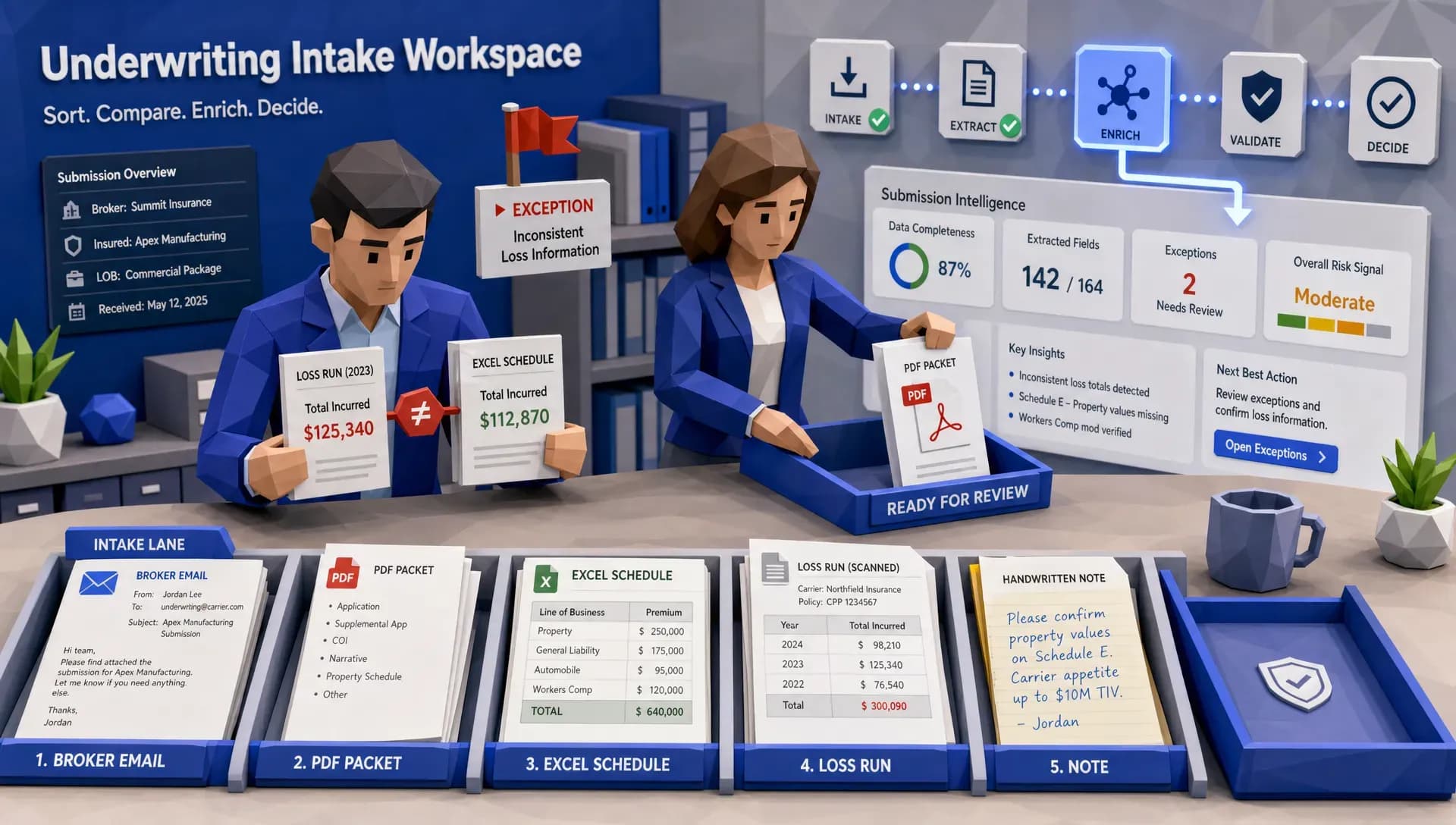
In underwriting, rework often begins at intake. Submissions arrive by email, portal, PDF, spreadsheet, scanned forms, broker notes, and occasionally what appears to be a photograph of a document taken in a moving vehicle. The underwriter is then expected to make a clean decision from messy ingredients.
The hidden rework shows up in questions like these:
- Is this submission in appetite?
- Are all required fields present?
- Does the named insured match across documents?
- Are the loss runs complete and current?
- Do external data sources confirm what the application says?
- Has someone already worked this risk last month under a slightly different name?
If those questions are answered manually, every submission becomes a small investigation. Some deserve that level of attention. Many do not.
Here is a simple example outside the usual commercial auto comfort zone. Manufactured housing can carry very different underwriting considerations depending on location, construction, occupancy, age, tie-downs, replacement cost, and local exposure. If a submission references affordable manufactured homes in Texas, and your intake process treats it like a standard homeowners file, you may be setting up the underwriter for a second pass before they even start. Even basic context from a source such as manufactured homes in San Antonio can remind us that property categories are not interchangeable boxes on a form.
That is the point. Rework is often born when the system does not understand the business context of the file.
A good insurance automation workflow should capture data once, normalize it, validate it, enrich it, and route it with a clear reason. If the risk is clean and within authority, move it forward. If it needs judgment, give the underwriter the facts and the exception, not a treasure hunt.
Claims rework is even more expensive because the clock is public
In claims, rework is operationally painful and emotionally visible. A broker may tolerate a slow quote if the market is tight. A claimant waiting on repairs or injury resolution is less forgiving, and rightly so.
J.D. Power’s 2024 U.S. Auto Claims Satisfaction Study highlights the pressure around claim cycle times and customer satisfaction. The longer a claim drags, the more opportunities there are for frustration, leakage, litigation, and complaints.
Claims rework hides in predictable places: incomplete FNOL, missing policy verification, duplicated document requests, poor image quality, inconsistent injury triage, delayed attorney demand review, and fraud flags that arrive too late to be useful.
Straight-through processing is the dream, but the industry is not there yet. Celent has estimated that only a minority of claims are processed straight through without human intervention. That should not depress us. It should focus us.
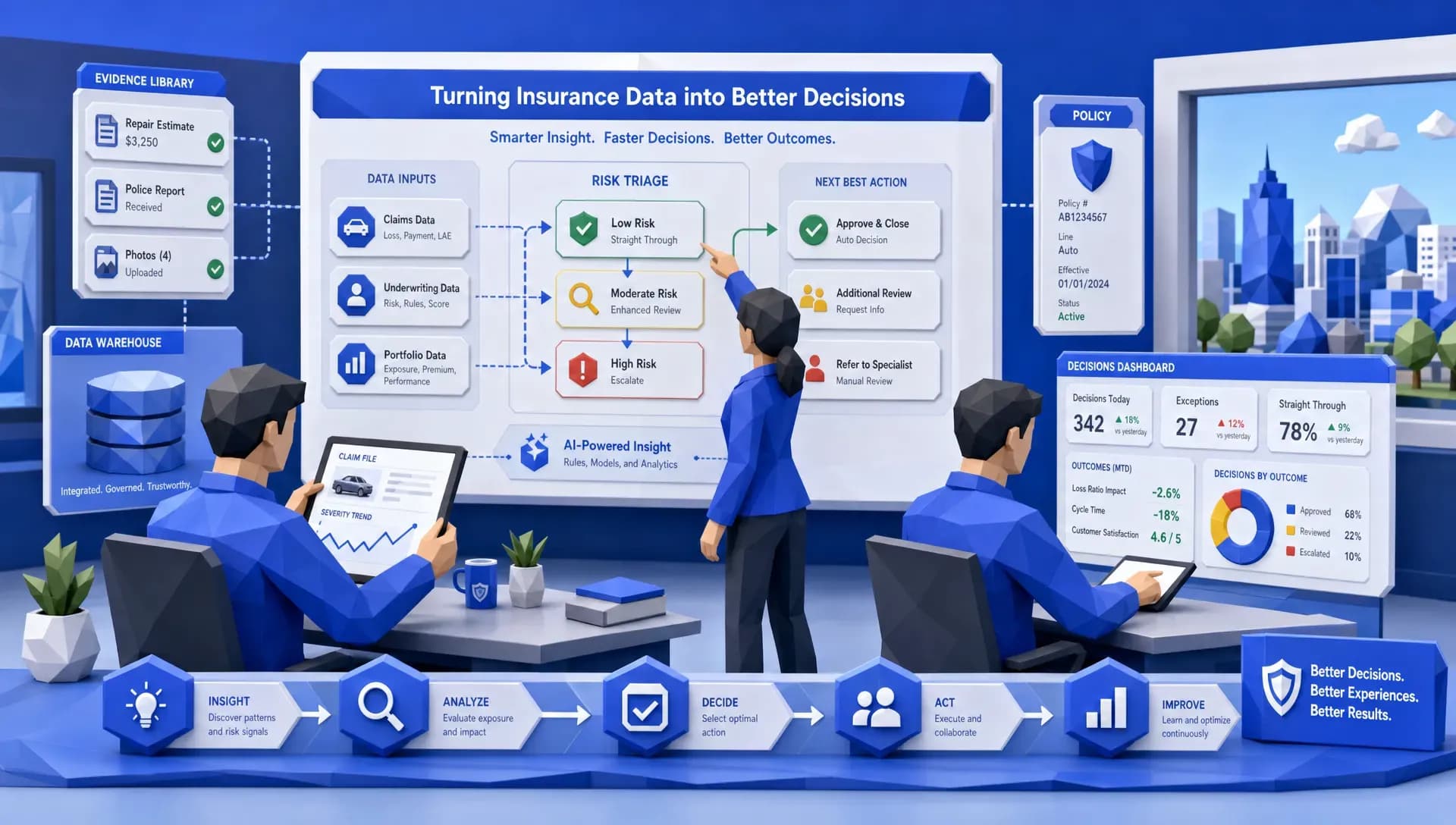
If only a small share of claims can run fully straight-through today, then the smarter goal is to reduce unnecessary human touches while improving the quality of the touches that remain. I would rather have an adjuster spend ten thoughtful minutes on liability or severity than twenty minutes finding the right attachment.
The best claims automation does not pretend every claim is simple. It separates the genuinely complex from the merely messy.
The most dangerous automation mistake: speeding up bad data
Here is another hot take: automating a broken process can make things worse, faster.
If the data is wrong, incomplete, or trapped in silos, automation becomes a high-speed copier of bad decisions. I have seen teams celebrate fewer manual steps while quietly increasing downstream corrections. The front office looks faster. The back office gets indigestion.
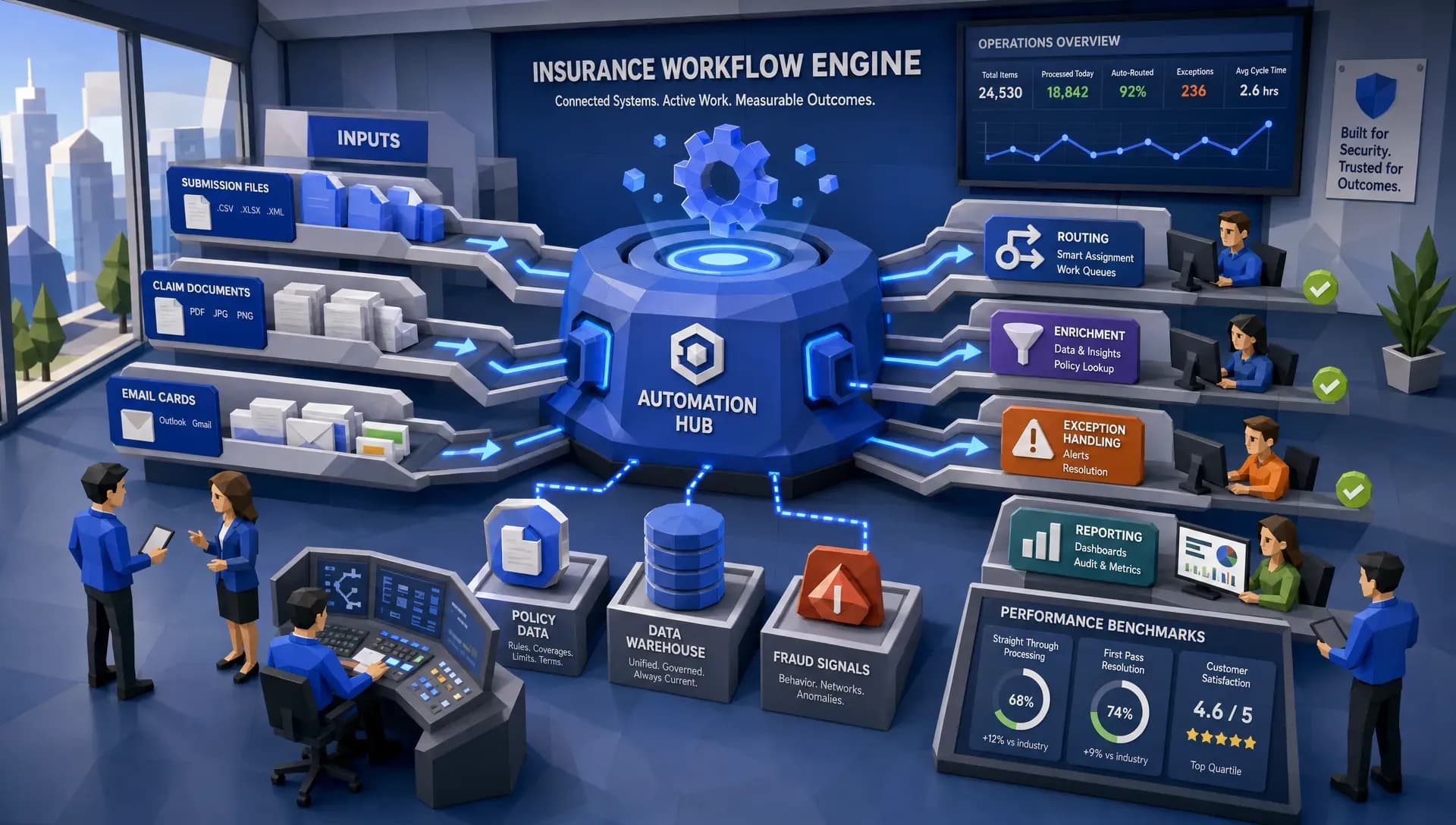
This is why the data layer matters. Workflow automation alone can move files. A proper insurance automation platform should also capture the data created by those workflows, store it in a usable way, and make performance visible.
That is one of the reasons Inaza’s approach is built around a unified data warehouse underneath the workflows. Automating intake, underwriting, claims, customer service, and operations is valuable. Capturing the key data points from those automations is where the long-term intelligence comes from.
When every exception becomes a data point, leaders can finally answer practical questions:
- Which brokers send the cleanest submissions?
- Which fields cause the most quote delays?
- Which claim types are most often reopened?
- Which third-party checks prevent the most downstream corrections?
- Which teams are absorbing hidden work that never appears in productivity reports?
That is not vanity reporting. That is operational control.
How to find rework before you automate
You do not need a six-month transformation program to find rework. You need curiosity, a sample of recent files, and the courage to ask annoying questions.
Pull 30 to 50 recent submissions, claims, renewals, or service requests. Then trace each one from first receipt to final outcome. Mark every second touch. Mark every manual correction. Mark every time someone left one system to check another. Mark every follow-up email asking for data that should have been captured at the start.
Do this honestly and you will find the map.
I like to look for four rework signals. First, files that sit idle while waiting for missing information. Second, files that move backward in the process after review. Third, fields that are re-keyed across systems. Fourth, reports that require manual spreadsheet stitching at month-end.
The month-end reporting one is sneaky. Many insurers tolerate manual reporting because it feels separate from operations. It is not. If your team needs three days to reconcile bordereaux, claims status, premium movements, or referral outcomes, the issue is not reporting. The issue is that the workflow did not capture clean data when the work happened.
Where Inaza fits when rework is the target
Inaza’s platform is designed for insurers, MGAs, brokers, claims teams, and operational leaders who want to automate without forcing teams to relearn their jobs from scratch. That matters. In insurance, change management can eat a project alive if the workflow looks great in a demo but terrible at 4:45 p.m. on a Friday.
The practical value comes from combining automation with flexible deployment and connected data. Inaza can support underwriting automation, claims process automation, customer service automation, data capture, reporting, and analytics while integrating with existing systems. It supports all file types, offers customizable workflows, and includes 250+ workflow templates, which helps teams avoid starting from a blank page.
The other useful piece is enrichment. Insurance decisions often depend on data outside the submission or claim file. Inaza’s pre-built API templates, including connections for providers such as Verisk, LexisNexis, HazardHub, and others, help automate the checks that otherwise become manual tabs, screenshots, and “can someone verify this?” messages.
There is also a benchmarking angle that I think more insurance leaders should care about. Inaza includes industry benchmarks from sources such as Aon, Munich Re, Howden, and more. That can help teams understand how portfolios and policyholders compare with the market, which is especially useful for renewals, reinsurance discussions, and portfolio narratives.
The platform point is simple: if you only automate the task, you may save minutes. If you automate the task and capture the data exhaust, you improve the business.
The best automation keeps humans in the right seat
I do not believe underwriters and adjusters should be pushed out of meaningful decisions. Quite the opposite. The strongest insurance automation gives professionals cleaner files, better prompts, clearer exception reasons, and more time for judgment.
One of the best underwriters I ever worked with could spot a bad risk faster than most systems could load the file. But when I asked how she did it, the answer was not magic. She had patterns in her head from years of seeing what went wrong downstream. The tragedy was that her insights lived in memory, email threads, and desk-side conversations. When she was out, the process got slower.
Automation should help institutionalize that judgment without flattening it. It should capture the rules, the exceptions, the referrals, and the outcomes so the organization learns from its best people.
The same applies in claims. A good adjuster knows when a claimant needs empathy, when a file needs escalation, and when something smells off. Automation should clear the administrative fog so that judgment gets used where it matters.
A practical rollout plan: start with the loop, not the launch party
If you are planning an insurance automation initiative in 2026, resist the urge to start with a giant transformation slogan. Start with one rework loop.
Pick a workflow where the pain is frequent, measurable, and visible. Submission intake is often a strong candidate. FNOL is another. Attorney demand triage, bordereaux processing, renewal validation, eligibility checks, and document extraction are also good places to look.
Then define success in operational language. Do not stop at “automation rate.” Track first-pass completeness, number of follow-up requests, average touches per file, time from receipt to decision, percentage of files reopened, referral quality, and downstream correction rates.
Next, connect the workflow to the systems your team already uses. This is where many projects stumble. If staff must jump into a new tool for one slice of work and then return to the core system for everything else, you may have created another swivel chair. Congratulations, it has a login screen.
Finally, keep humans in the review points that deserve humans. The goal is not blind automation. The goal is fewer avoidable touches and better necessary touches.
What leaders should ask before approving automation spend
Before signing off on any automation initiative, I would ask one blunt question: “Which rework are we eliminating?”
If the answer is vague, keep digging. Faster processing is nice, but faster than what? Fewer errors is nice, but which errors? Better customer experience is nice, but where is the customer currently waiting?
Good answers sound specific. “We are reducing broker follow-ups caused by missing driver data.” “We are cutting claim reopenings caused by incomplete FNOL.” “We are eliminating re-keying between email intake and the policy system.” “We are reducing manual enrichment checks before quote release.”
That level of specificity makes ROI easier to prove and adoption easier to win. Teams do not resist automation when it removes work they already hate. They resist when it feels like a mysterious new process designed by someone who has never processed a mid-market fleet submission with three missing schedules.
Frequently Asked Questions
What is rework in insurance automation? Rework is any repeated handling of a file caused by missing data, errors, unclear routing, duplicate entry, poor documentation, or late validation. In underwriting and claims, it often appears as follow-up emails, manual corrections, reopened files, and repeated reviews.
Why is rework a better automation target than simple task volume? High-volume tasks are not always the most expensive. A lower-volume workflow with repeated corrections, compliance risk, or senior staff involvement may cost more. Targeting rework helps automation improve speed, accuracy, and staff productivity at the same time.
Can insurance automation work with legacy systems? Yes, if it is designed to integrate with existing workflows and systems rather than forcing teams into a completely separate process. Inaza, for example, focuses on seamless system integration and workflow deployment without requiring broad team retraining.
How should insurers measure automation success? Useful metrics include first-pass completeness, touch count per file, cycle time, re-open rates, data accuracy, quote-to-bind speed, claim settlement time, referral quality, and reporting effort. Automation should reduce avoidable work and improve decision quality.
Does automation replace underwriters or adjusters? No. The best use of automation is to remove repetitive administration and surface cleaner information so underwriters, adjusters, and fraud analysts can focus on judgment, negotiation, risk selection, and customer outcomes.
Ready to find the rework hiding in your workflows?
If your team is buried in follow-ups, re-keying, manual checks, and reports that only one spreadsheet wizard understands, the issue may not be staffing. It may be hidden rework.
Inaza helps insurers, MGAs, brokers, and claims teams automate underwriting, claims, customer service, and operations while capturing the data needed for better decisions. If you want to see where automation can remove the most friction in your current workflows, explore Inaza or book a demo with the team.