I’ll say the quiet part out loud: most underwriting analytics arrive too late to change the underwriting decision.
By the time a dashboard tells you loss ratio drifted, quote volume dipped, or a class code underperformed, the quote has already gone out, the risk is already bound, or the account has already walked across the street to a faster market. That is useful information, sure. But it is not the moment where money is made or lost.
The real value of underwriting analytics is before quote. Not after bind. Not at renewal. Not in the quarterly “what happened?” meeting where everyone nods politely and silently blames the spreadsheet.
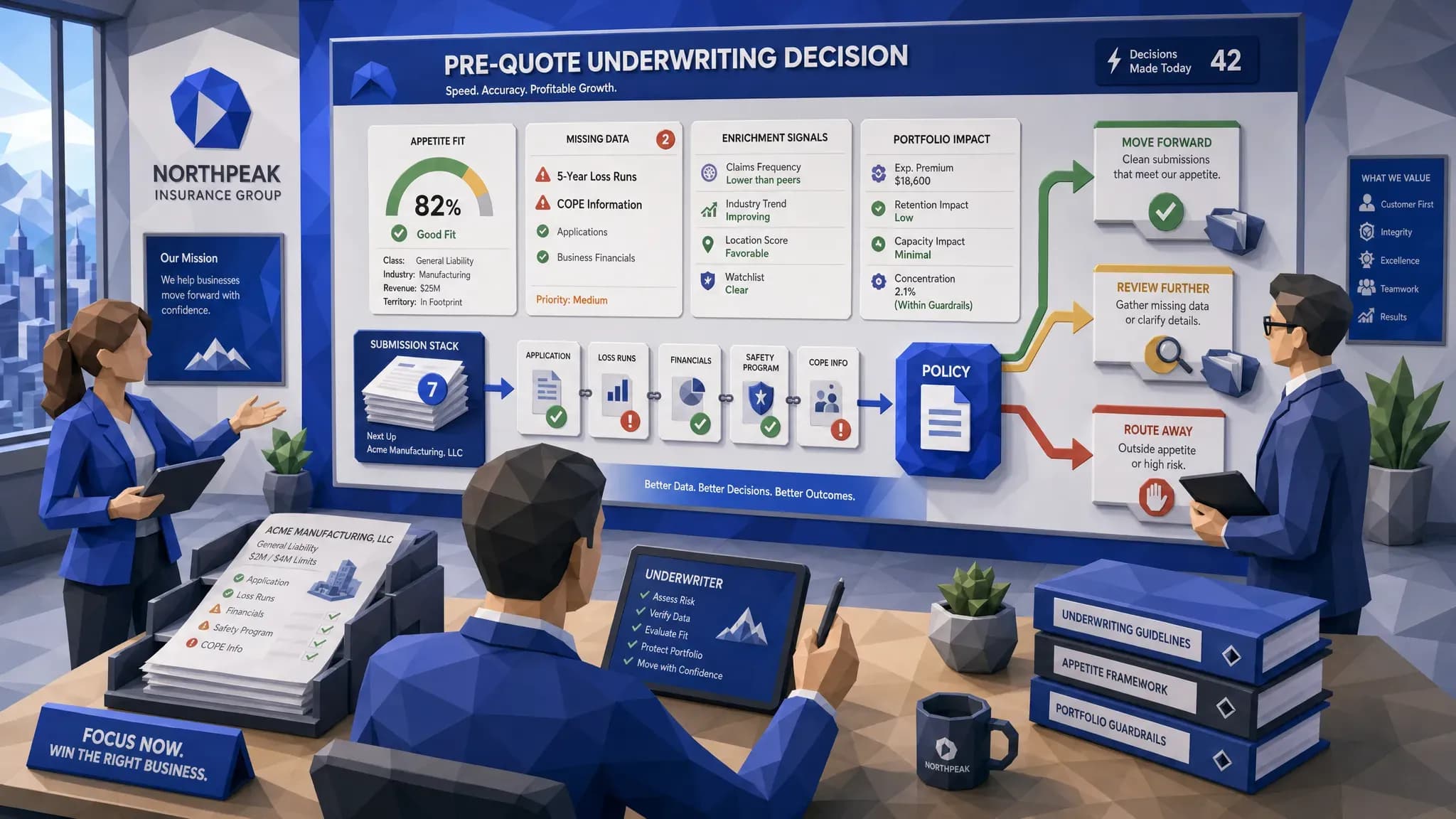
Before quote is where analytics should help underwriters answer the practical questions that matter: Should we spend time on this submission? What data is missing? Is the risk inside appetite? What external signals change our view? Will this quote improve the portfolio or quietly make next year’s loss ratio meeting uncomfortable?
I have sat with underwriters who could spot a bad risk faster than any model, but they were buried under PDFs, loss runs, emails, supplemental forms, and portal rekeying. One senior underwriter once told me, “I don’t need another report. I need someone to tell me which of these 47 submissions is worth opening before lunch.” That sentence has stuck with me for years.
That is the job of pre-quote underwriting analytics.
The problem with after-the-fact underwriting analytics
Traditional analytics in insurance often acts like a rearview mirror. It tells you what bound, what declined, what performed, what leaked premium, and what blew up in claims. Rearview mirrors are important, but they are a poor way to drive through traffic.
The quoting window is where the decision is still alive. If the underwriter has to leave the submission workflow, pull data from three systems, check an appetite guide, compare prior claims, search external databases, and then manually assemble a view of the risk, analytics has already failed the person doing the job.
McKinsey has written about the large administrative burden in underwriting, including the fact that underwriters can spend as much as 60% of their time on non-core activities. That matches what I have seen in the market. The best underwriters are not short on judgment. They are short on clean, timely, decision-ready context.
Here is my hot take: if underwriting analytics does not change what happens before quote, it is mostly management reporting with nicer colors.
That may sound harsh, but the bar should be higher now. Data should not merely explain decisions. It should improve them while there is still time to act.
What underwriting analytics should answer before quote
Pre-quote analytics should not overwhelm underwriters with every data point known to the insurance universe. Nobody needs a 72-field risk profile when the first question is, “Do we even want this?”
Good underwriting analytics should help the team answer a few sharp questions quickly.
Is this submission worth underwriting?
This is the first filter, and it is where many teams lose time. A submission may be outside appetite because of geography, occupancy, vehicle type, prior losses, revenue band, limit request, industry class, or some lovely surprise buried on page 14 of an attachment.
The best analytics catches those issues early. It should flag obvious mismatches, identify borderline cases, and route work accordingly. A clean in-appetite submission should move forward fast. A questionable one should go to the right person. A poor fit should be declined politely before the broker waits three days for an answer everyone could have predicted in three minutes.
That broker experience matters. A fast “no” is often more valuable than a slow “maybe.” I learned this the hard way years ago when a broker told me, with admirable restraint, “Your decline was fine. The four-day silence was not.” Fair point.
Is the data good enough to price?
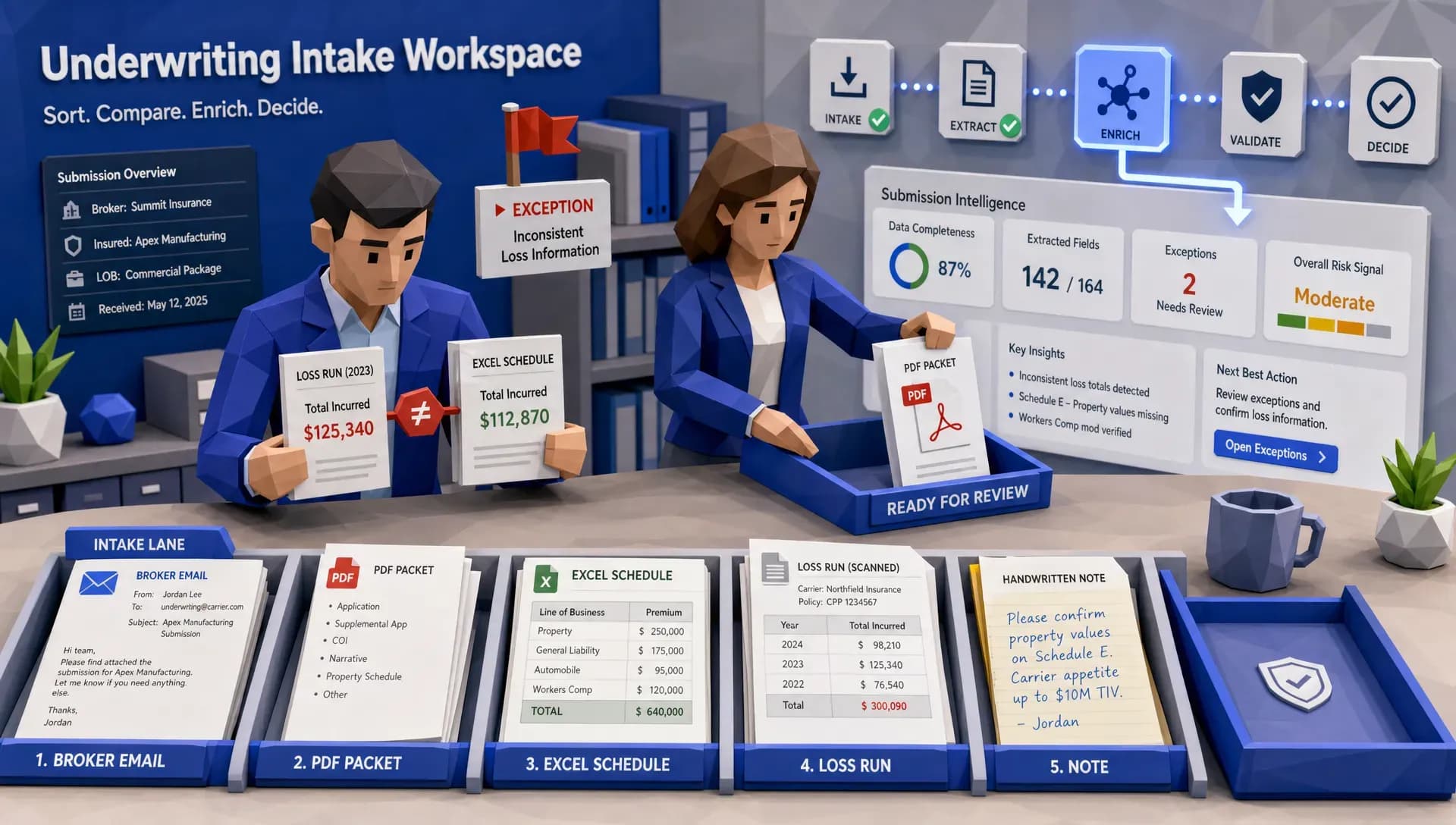
Underwriting analytics depends on intake quality. If the submission arrives with missing garaging addresses, inconsistent business descriptions, outdated loss runs, or a named insured that does not match external records, you are not making an analytics problem easier. You are giving it a blindfold.
This is why better underwriting starts at the front door. We have covered this in more depth in our piece on why insurance underwriting automation starts with better intake, and the same principle applies here. If intake is messy, every downstream score, rule, dashboard, and report becomes less trustworthy.
Before quote, analytics should surface missing fields, contradictions, unusual changes, and data quality issues. Underwriters should not have to discover those manually after they have already spent 20 minutes reviewing the account.
What external signals change the risk view?
Internal data tells part of the story. External data often fills in the gaps.
Depending on the line of business, underwriters may need property characteristics, hazard data, prior claims indicators, vehicle history, MVR data, credit-based attributes where permitted, business records, litigation signals, or location-based risk factors. The point is not to add data for the sake of adding data. The point is to answer: what would change the decision?
For example, a small commercial auto account may look ordinary until garaging details and vehicle usage tell a different story. A property risk may seem acceptable until hazard information shows wildfire, flood, or roof-related concerns. A general liability account may look clean until business classification and web presence suggest the operations are not quite what the application says.
That is where data enrichment earns its keep. If you want a deeper look at that topic, our article on using data enrichment to power smarter underwriting decisions explains how external sources can improve risk selection without asking underwriters to do detective work on every file.
Does this quote fit the portfolio we actually want?
This one is underappreciated. A risk can look acceptable on its own and still be a poor fit for the book.
Maybe you are already concentrated in a geography. Maybe a class is producing worse-than-expected severity. Maybe rate adequacy is thin in one segment and healthy in another. Maybe your reinsurance strategy makes some exposures more attractive than they were last year.
Pre-quote underwriting analytics should bring portfolio context into the individual decision. That does not mean every underwriter needs to think like a chief actuary on every submission. It means the workflow should show whether a new quote supports or strains current portfolio goals.
I once saw a team celebrate premium growth in a niche segment right up until the claims team started calling it “the little volcano.” Everyone had technically followed the rules. The problem was that no one had a live view of how fast the exposure was accumulating.
That is exactly the kind of surprise underwriting analytics should prevent.
The pre-quote signals that actually improve decisions
If I were building an underwriting analytics program from scratch, I would not start with a big executive dashboard. I would start with the five or six signals an underwriter needs at the point of decision.
First, I would show appetite fit. Is the submission clearly in, clearly out, or worth referral? This should be visible immediately, not reconstructed from a PDF appetite guide.
Second, I would show data completeness and confidence. If core fields are missing or inconsistent, the underwriter should know before pricing work begins.
Third, I would show enrichment results that matter. Do not dump every external field into the workflow. Highlight the data that changes routing, pricing, appetite, fraud review, or referral.
Fourth, I would show historical performance for similar risks. Underwriters are practical people. “Accounts like this have underperformed by X” is often more useful than a model score with no explanation.
Fifth, I would show portfolio impact. The quote should be evaluated not only as a single account, but as one more brick in the book you are building.
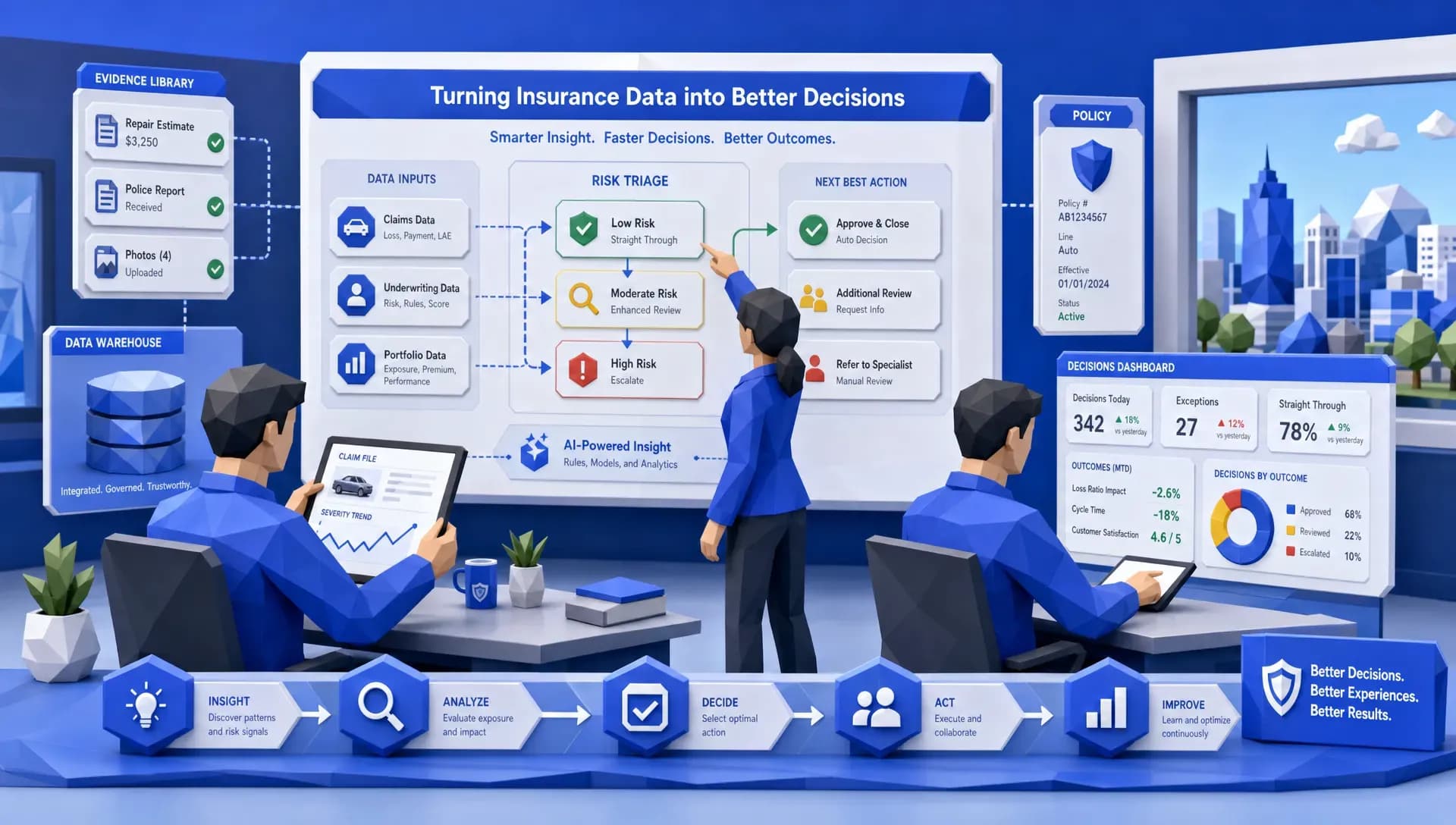
Finally, I would capture the outcome. Was the quote issued, referred, declined, lost, bound, or later problematic in claims? Without that feedback loop, underwriting analytics becomes a one-way street. You can report activity, but you cannot continuously improve decisions.
This is where many analytics projects fall short. They focus on visualizing data, not capturing the decision trail. The better approach is to connect intake, enrichment, workflow, underwriting action, quote outcome, and downstream performance.
For a broader view of why analytics needs to change decisions rather than decorate dashboards, we have written about data analytics in insurance that actually changes decisions.
Why fraud signals belong before quote too
Fraud is often discussed as a claims problem. That is understandable, since claims is where the money leaves the building. But underwriting has a role to play much earlier.
The FBI estimates insurance fraud costs the United States more than $300 billion each year. That figure covers a wide range of behaviors, but the direction is clear: fraud is not a rounding error.
And the risk is evolving. Verisk’s 2025 fraud report found that insurers are increasingly concerned about digitally enabled fraud, including the use of generative tools to fabricate or manipulate information. Whether the issue is a suspicious document, inconsistent loss history, identity mismatch, staged exposure, or unusual broker behavior, some of those signals can appear before quote.
No one is saying underwriting should become a claims SIU unit. Please, nobody needs another turf war. But underwriting analytics should flag unusual patterns early enough to influence the decision. That could mean referral, additional documentation, premium adjustment, exclusion review, or decline.
Pre-quote fraud awareness is especially important in high-velocity environments. If your team is trying to quote faster, weak controls can become expensive. The goal is not to slow every file down. The goal is to let clean business move quickly while suspicious business gets a closer look.
Speed and discipline can coexist
A common objection is that more analytics will slow underwriting down. In badly designed processes, that is true.
If analytics means another portal, another login, another spreadsheet export, and another dashboard that underwriters have to interpret manually, then yes, congratulations, you have built a traffic jam.
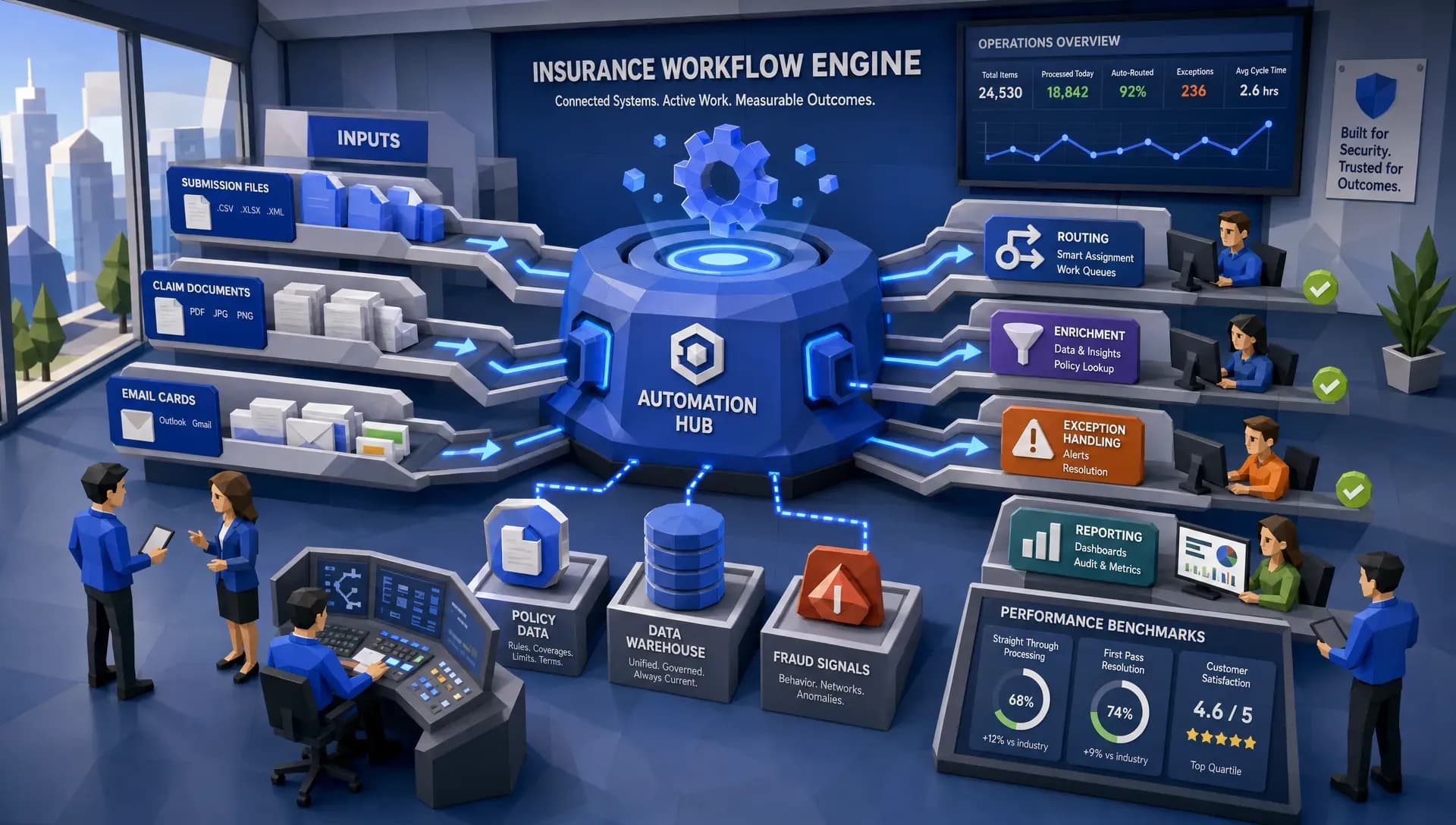
But when analytics is embedded in the workflow, it should do the opposite. It should reduce rekeying, shorten review time, improve referral quality, and help underwriters focus on judgment rather than scavenger hunts.
This matters because speed is now part of underwriting quality. A perfect quote that arrives after the broker has placed the account is not perfect. It is a souvenir.
The best teams use underwriting analytics to separate work into sensible lanes. Straightforward risks move quickly. Complex accounts receive expert review. Poor-fit submissions exit early. Suspicious cases get flagged. That is how you improve speed without turning underwriting into a coin toss.
What insurers should measure before quote
If you want underwriting analytics to improve decisions before quote, measure the parts of the process where decisions are actually made.
I would pay close attention to submission-to-triage time, data completion rates, referral rates by reason, quote turnaround by segment, decline reasons, quote-to-bind conversion, pricing overrides, broker response time, and downstream loss performance by underwriting decision path.
The magic is not in any one metric. The magic is in connecting them. If a certain referral reason consistently produces poor conversion, fix the rule or the intake. If a segment quotes quickly but performs badly, review risk selection and pricing. If underwriters override a score frequently and perform better than the score, learn from them. If they override it and perform worse, learn from that too, preferably before the next reinsurance meeting gets spicy.
This is also where benchmarks matter. Internal performance tells you how you are doing against yourself. Market and industry benchmarks help you understand whether your book is actually competitive, underpriced, overexposed, or simply different from the market in ways you should be able to explain.
How Inaza supports pre-quote underwriting analytics
At Inaza, we see underwriting analytics as part of the operating workflow, not a side project for reporting season.
Inaza’s AI-powered insurance automation platform helps insurers, MGAs, and brokers streamline underwriting, claims, customer service, and operations. For underwriting teams, that means automating data capture, supporting all file types, integrating with existing systems, and helping teams build customizable workflows without forcing underwriters through heavy retraining.
The important part is the data foundation underneath. Workflow automation is useful on its own, but when key data points are captured consistently, insurers can build real analytics around intake quality, risk signals, quote behavior, operational bottlenecks, and portfolio performance. Inaza also supports pre-built API templates for data enrichment sources such as Verisk, LexisNexis, HazardHub, and others, which helps teams bring external context into the underwriting process more easily.
In plain English: the goal is to help underwriters make better decisions before quote, then preserve the data needed to understand whether those decisions worked.
Frequently Asked Questions
What are underwriting analytics? Underwriting analytics use internal and external data to support risk selection, pricing, triage, referral, and portfolio decisions. The most valuable analytics appear inside the underwriting process before a quote is issued.
Why should underwriting analytics happen before quote? Because the quote stage is where the decision can still change. Analytics delivered after bind may help with reporting, but pre-quote analytics can influence whether to quote, decline, refer, request more information, or adjust pricing.
What data improves underwriting decisions before quote? Useful data often includes submission details, prior loss information, exposure data, appetite rules, external enrichment sources, fraud indicators, portfolio concentration, and historical performance for similar risks.
Can underwriting analytics speed up quoting? Yes, if it is embedded in the workflow. Analytics should help triage submissions, identify missing data, route complex risks, and let clean business move faster. If analytics adds extra manual steps, the process needs redesign.
How do underwriting analytics help MGAs and carriers? They help MGAs and carriers improve risk selection, reduce manual review, increase consistency, monitor portfolio quality, and support better broker experiences through faster and clearer decisions.
Make underwriting analytics useful before the decision is gone
Underwriting analytics should not be a museum of past decisions. It should be part of the moment when the underwriter decides what to do next.
If your team is still relying on manual intake, disconnected enrichment, delayed reporting, and post-bind analysis, you are asking underwriters to make fast decisions with slow information.
Inaza helps insurance teams automate underwriting workflows, capture cleaner data, enrich submissions, and turn operational activity into decision-ready analytics. If you want underwriting analytics that improves decisions before quote, not weeks after, it may be time to rethink where analytics lives in your process.