Here is my mildly spicy underwriting opinion: most insurance underwriting automation projects start one step too late.
We love talking about decision engines, pricing models, straight-through processing, and shiny dashboards. I get it. They look great in a board deck. But if the submission arrives as a half-complete email, three PDFs, a spreadsheet named “final_v7_REALLYFINAL.xlsx,” and a broker note that contradicts the application, your automation is already limping before it gets out of the gate.
After about a decade around insurance operations, I’ve learned that underwriting automation is won or lost at intake. Not at bind. Not at referral. Not even at rating. Intake is where the facts either become reliable enough to use, or become a scavenger hunt that your best underwriters have to solve before lunch.
And frankly, underwriters did not train for years to become professional copy-paste athletes.
The intake problem nobody wants to own
A few years ago, I watched an underwriter review a commercial auto submission that looked simple on the surface. Five vehicles, eight drivers, clean story from the broker. Then the fun began.
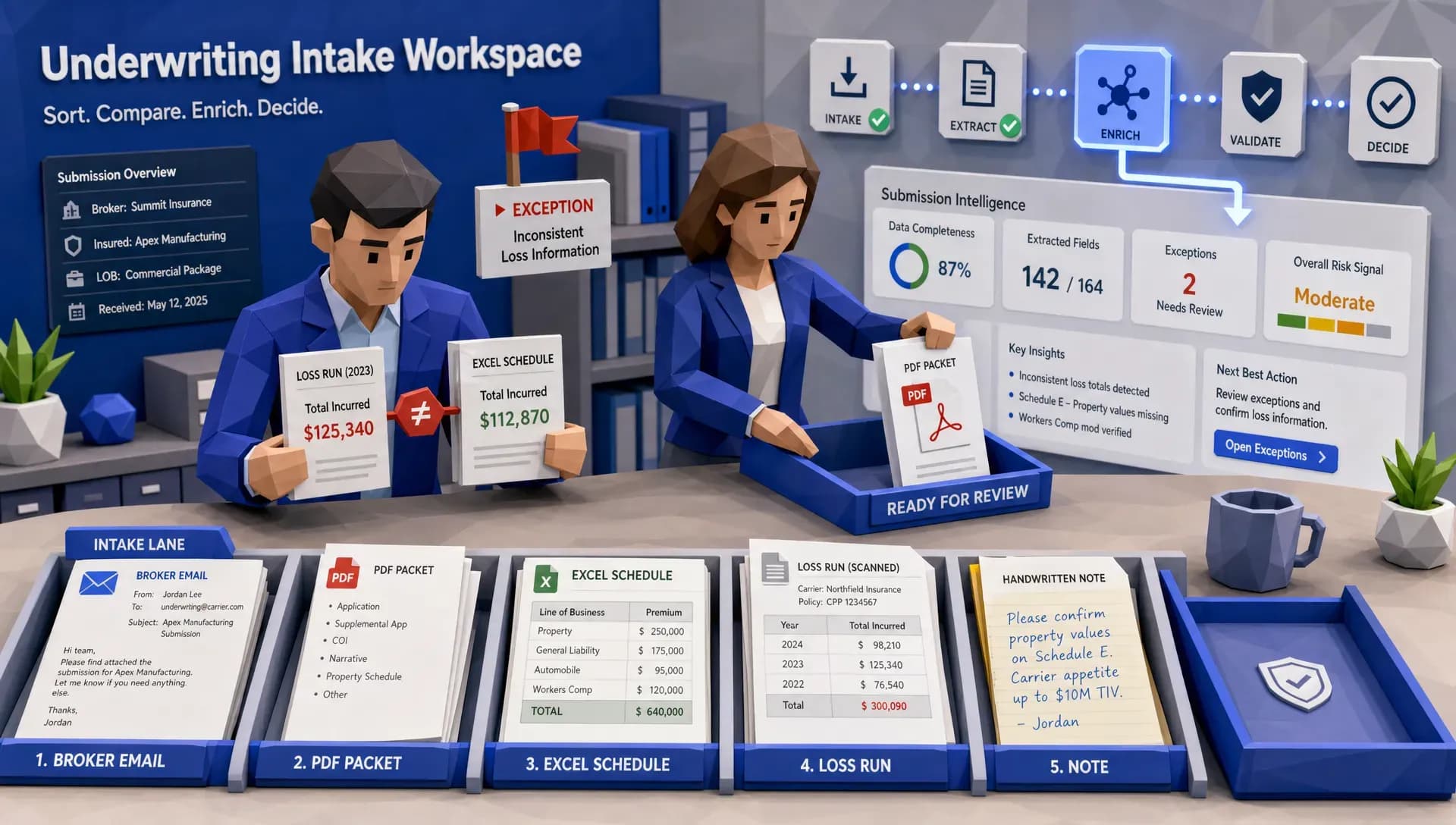
The VINs were in one attachment. Driver dates of birth were in another. Prior insurance was mentioned in the email body but not the application. One vehicle had a garaging address in a different county from the rest. The loss runs were scanned sideways, because apparently someone somewhere still believes PDFs should build character.
The underwriter spent more time finding the risk than evaluating the risk.
That is the intake problem in one sentence. It is not that insurers lack underwriting talent. It is that talented people are forced to burn hours proving that the basic submission data is complete, consistent, and usable.
McKinsey has estimated that underwriters can spend a large share of their time, up to 60 percent, on administrative work rather than true risk assessment in its research on automating the insurance industry. Anyone who has sat near a busy underwriting desk will hear that statistic and think, “Only 60 percent?”
That is why insurance underwriting automation has to begin with better intake. If intake is messy, the rest of the workflow becomes a very expensive way to move bad data faster.
This is where some automation projects go wrong. The carrier or MGA sees bad intake data and decides the answer is to make brokers fill out a longer form. That usually creates two outcomes: broker frustration and more creative ways to bypass the form.
Better intake is not about asking for more information. It is about capturing the right information from the places it already lives.
In the real world, submissions arrive through email, portals, PDFs, spreadsheets, ACORD forms, loss runs, bordereaux, scanned documents, photos, and occasionally a note that says “same as last year,” which is both charming and terrifying. A strong intake process accepts that reality instead of pretending every broker will suddenly become a data entry specialist.
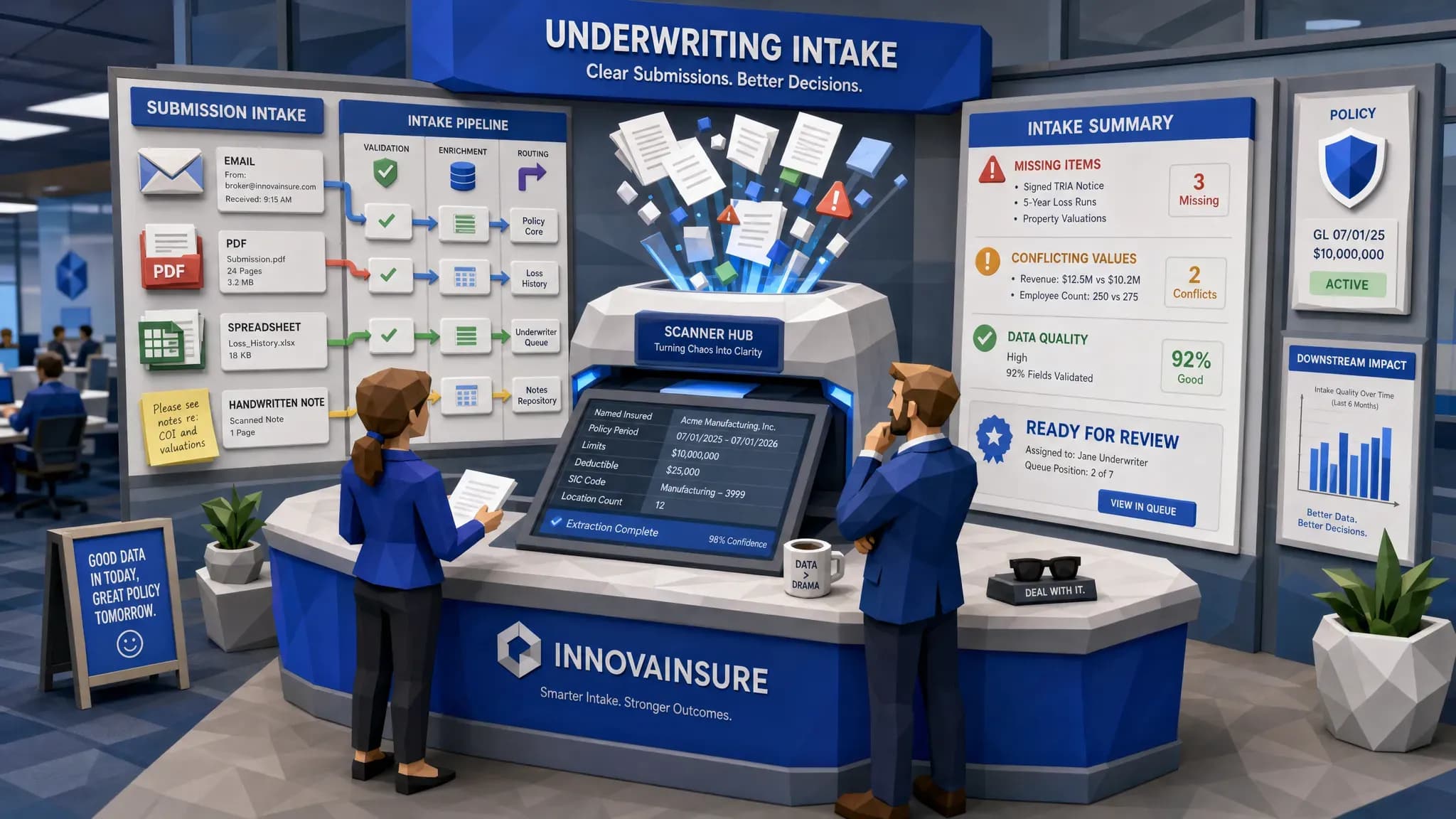
Better intake means the system can read the submission, identify what type of documents it received, extract the key fields, compare them against what is expected, flag missing or conflicting details, and route the file appropriately. The underwriter should see a clean risk summary, not a pile of digital laundry.
If your automation strategy depends on perfect upstream behavior from agents, brokers, customers, and third parties, I have bad news. That is not a strategy. That is a wish.
The three intake jobs that actually matter
In my view, underwriting intake has three practical jobs. First, it must make the submission understandable. Second, it must make the data usable. Third, it must make the next action obvious.
Understandable means the system knows what it has received. Is this a new business submission, a renewal, an endorsement, a proof-of-prior document, a fleet schedule, or a loss run? That classification matters because every document type should trigger a different workflow.
Usable means the system extracts and normalizes the data. A VIN is not useful if it sits trapped in a PDF. A driver violation is not helpful if it is buried in a broker note. A garaging address is not reliable if it is entered three different ways across three documents.
Obvious means the intake process should tell the underwriting team what needs attention. Is the risk eligible for straight-through processing? Does it need enrichment from a third-party source? Is there a missing form? Does the prior loss history conflict with the application? Should the broker be asked one specific follow-up question instead of receiving a vague “please clarify” email?
That last point is bigger than it sounds. A good intake process reduces back-and-forth. A great one reduces the need for back-and-forth in the first place.
Intake is the underwriting version of mise en place
I know, comparing insurance operations to cooking is dangerous. Someone will accuse me of seasoning the loss ratio. But stay with me.
In a kitchen, mise en place means everything is prepared before service starts. Ingredients are chopped, sauces are ready, pans are where they should be. The chef is still the expert, but the expert is not wasting time looking for onions.
Underwriting intake should work the same way. Before the underwriter evaluates the risk, the facts should be assembled, checked, enriched, and presented in context.
There is an extraction lesson here too. Outside insurance, brands like Air Tea Company describe warm-air extraction from herbs as a way to release what is useful without overwhelming the source material. Underwriting intake has a less fragrant version of that same principle: pull out the useful data from messy submissions without stripping away the context an underwriter needs.
That context matters. Automation should not flatten every submission into a few fields and pretend judgment is obsolete. It should prepare the risk so judgment can be applied faster and more consistently.
The data warehouse is the part people underestimate
Here is another hot take: intake automation without a data strategy is just workflow automation wearing a nicer jacket.
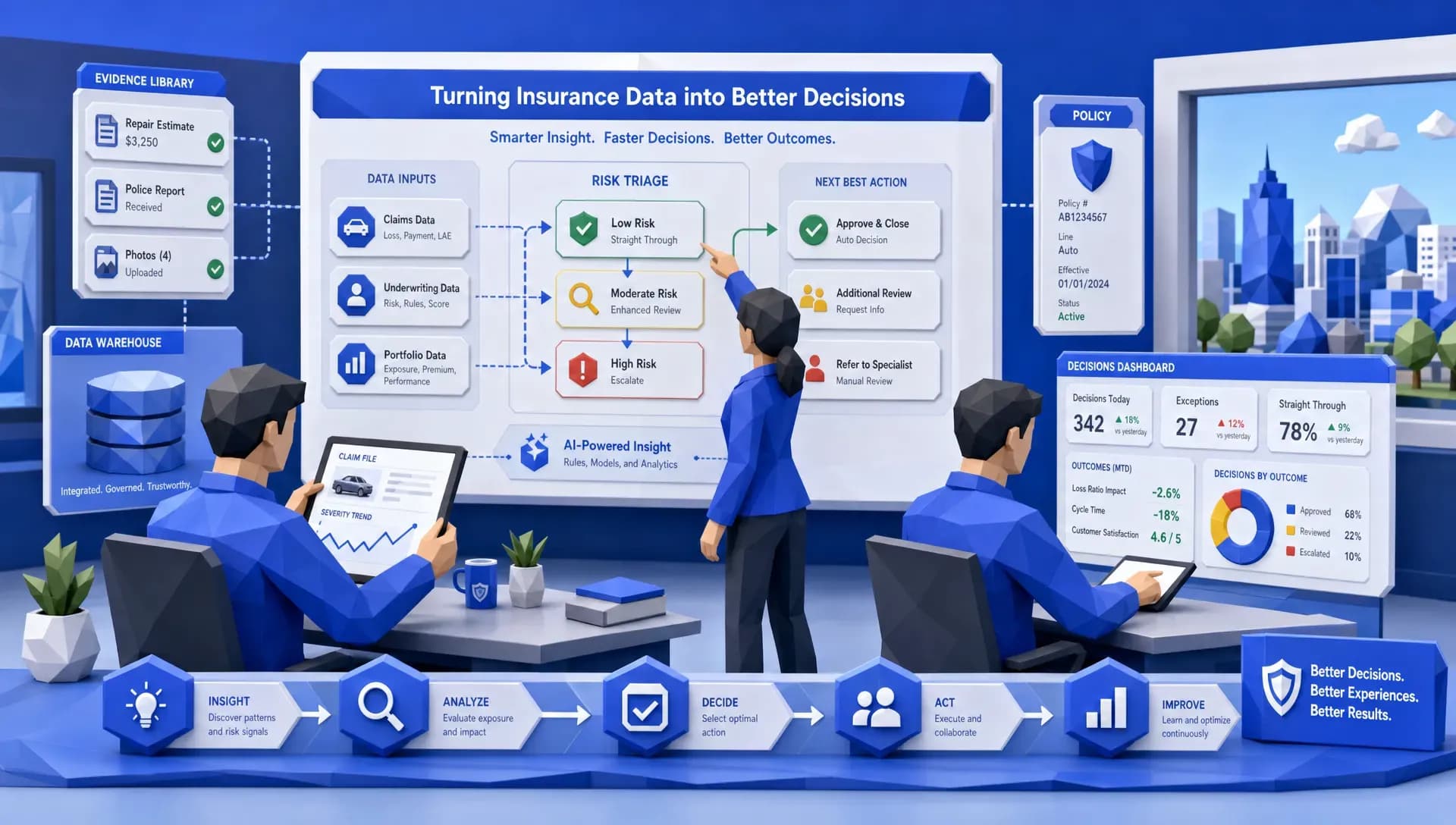
When intake captures clean, structured data, you do not only improve today’s quote. You create a record of how your underwriting operation actually works. What submissions are coming in? Which brokers send complete files? Which risk factors trigger referrals? Where do exceptions cluster? Which appetite rules cause the most decline decisions? Which data points are most often missing?
That is gold for carriers, MGAs, brokers, and reinsurers.
This is why a unified data warehouse matters. If your intake workflow captures useful data but leaves it scattered across inboxes, core systems, spreadsheets, and individual underwriter notes, you have not created intelligence. You have created a slightly tidier maze.
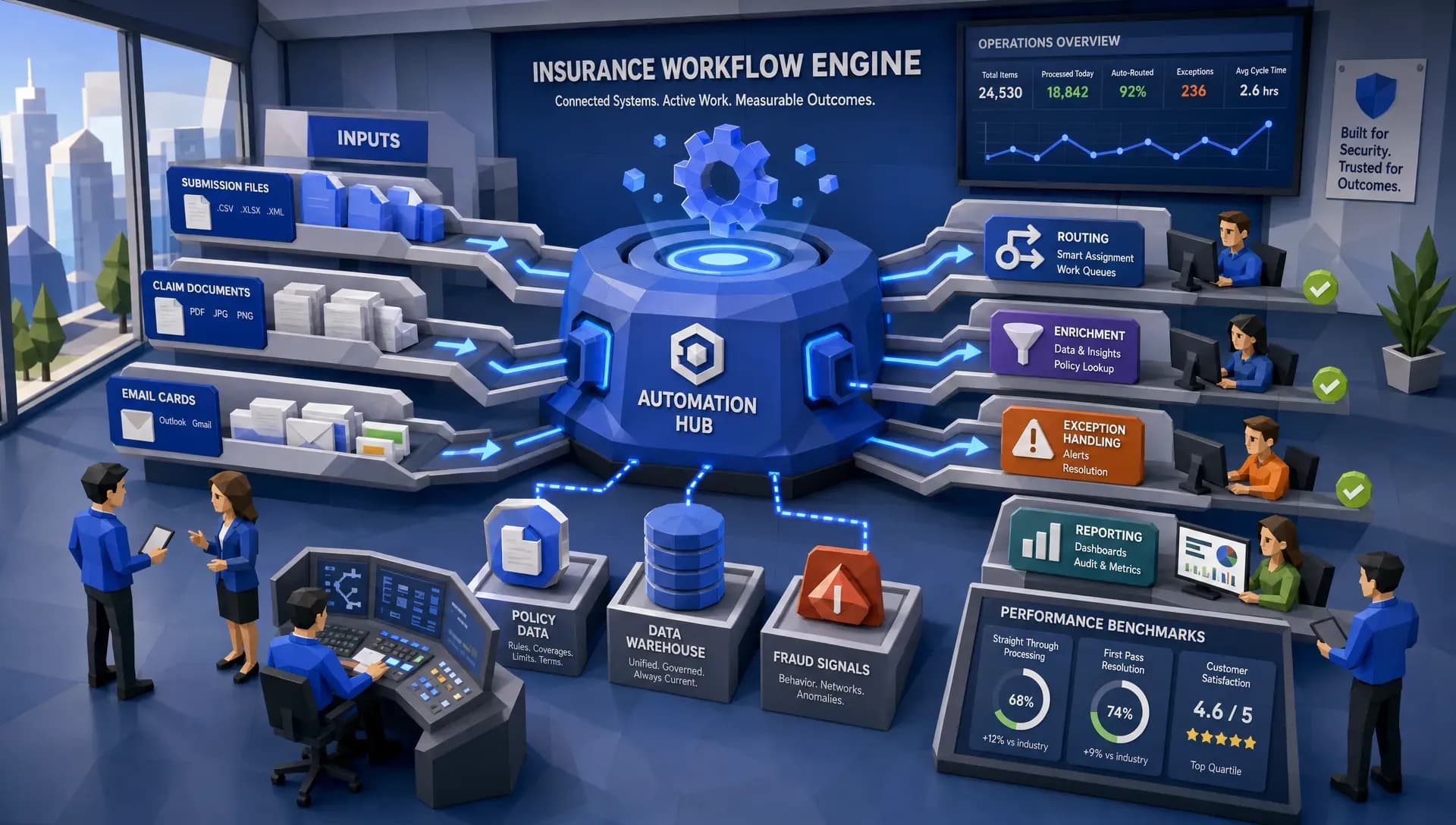
Inaza’s platform is built with a data warehouse underneath the automation layer, so data captured from underwriting workflows can feed reporting, analytics, and dashboards. That distinction matters. Intake is not simply a front-office speed improvement. It becomes the foundation for portfolio intelligence, operational benchmarking, and more credible conversations with capacity providers or reinsurers.
When I speak with insurance teams, they often ask, “Can automation help us quote faster?” Yes, absolutely. But the better question is, “Can automation help us learn from every submission?” That is where the long-term advantage sits.
What should be automated at intake?
I would not begin by automating the final underwriting decision. That is the glamorous part, but it is rarely the best first move. Start with the repeatable friction that underwriters complain about every week.
The most valuable intake automation usually covers a few familiar areas:
- Document classification, so emails, PDFs, forms, loss runs, schedules, and supporting files are identified correctly.
- Data extraction, so key fields are pulled from unstructured documents and converted into structured data.
- Data validation, so missing, conflicting, or suspicious information is flagged early.
- Data enrichment, so submissions can be checked against trusted third-party sources when needed.
- Workflow routing, so clean risks move forward and exceptions reach the right person with the right context.
Notice what is not on that list: “replace the underwriter.” That line gets tossed around too casually. In practice, the best automation removes the grunt work around the underwriter so they can spend more time on appetite, pricing, portfolio fit, broker relationships, and edge cases.
A senior underwriter should not be manually re-keying vehicle data from a spreadsheet into a policy system. That is like asking a surgeon to alphabetize the waiting room magazines before an operation.
APIs make intake smarter, but only if the core data is clean
Third-party data is incredibly useful in underwriting. Verisk, LexisNexis, HazardHub, motor vehicle records, property data, weather data, public records, credit-related data where permitted, prior insurance checks, and fraud signals can all improve risk selection.
But external data enrichment only works when the intake layer knows what to ask and when to ask it.
If the submission has three versions of a driver name, two addresses, and a missing VIN digit, enrichment becomes noisy. You may spend money calling external sources only to enrich the wrong entity or receive results that require more manual review.
This is where pre-built API templates are useful. Inaza supports API templates for sources such as Verisk, LexisNexis, and HazardHub, helping insurers enrich automations without building every connection from scratch. But the principle remains: enrichment should sit on top of structured, validated intake data. Otherwise, you are adding horsepower to a car with square wheels.
Better intake improves broker experience too
Underwriting teams often talk about intake as an internal efficiency issue. It is also a distribution issue.
Brokers remember which markets are easy to work with. They remember who responds quickly, who asks precise follow-up questions, and who sends them into a two-day loop over information they already provided.
A better intake process allows insurers to respond with clarity. Instead of “we need more information,” the broker gets, “we’re missing the driver license number for John Smith and the prior carrier name for vehicle three.” That is a very different experience.
It also helps reduce quote abandonment. If a customer or broker has to repeat data across multiple channels, wait days for review, or chase vague requirements, they will go elsewhere. In competitive personal and commercial lines, intake quality can quietly become a growth lever.
How to start without creating a science project
I have seen insurers overcomplicate this. They try to automate every line of business, every document type, and every exception from day one. Six months later, everyone is in a steering committee discussing “phase two readiness,” which is corporate code for “we are tired.”
Start narrower.
Pick a workflow with clear volume, measurable pain, and repeatable documents. For example, new business submissions for non-standard auto, renewal intake for commercial auto, or proof-of-prior verification. Map what arrives today, what fields matter, what checks underwriters perform, and what systems need to receive the result.
Then measure the basics: time to triage, re-keying volume, missing data rate, broker follow-up rate, referral rate, quote turnaround time, and bind conversion. You do not need thirty KPIs. You need enough to prove whether the intake layer is making underwriters faster and decisions cleaner.
If you want a deeper look at submission workflows specifically, Inaza has also covered what carriers need to know about automating submission intake. The short version is this: the best first projects are operationally boring and financially obvious. That is a compliment, not an insult.
Where Inaza fits
Inaza focuses on insurance automation across underwriting, claims, customer service, and operations. For underwriting intake, the platform can help automate data capture from different file types, integrate with existing systems, support customizable workflows, and turn captured data into reporting and analytics through its unified data layer.
The practical benefit is that teams do not have to rip out their current systems or retrain everyone around an entirely new way of working. Intake automation can sit around existing workflows, clean up the data, enrich it where needed, and route the work with better context.
The part I like most is the connection between workflow automation and business intelligence. Intake decisions become visible. Exceptions become measurable. Submission quality becomes comparable. Over time, that gives underwriting leaders a clearer view of portfolio performance and operational bottlenecks.
That matters for reinsurers and capacity conversations too. When you can explain not only what you wrote, but how the risk was assessed, what data was verified, and how your portfolio compares to market benchmarks, you are telling a stronger story. Inaza supports industry benchmark context from sources such as Aon, Munich Re, and Howden, which can help turn underwriting operations data into a more useful portfolio narrative.
The real goal: cleaner decisions, not just faster quotes
Speed matters. I will never argue otherwise. Faster quotes help brokers, customers, and growth teams. But if speed is the only goal, you can automate your way into poor risk selection faster than ever. Congratulations, your bad decisions now have a turbocharger.
The real goal is cleaner decisions.
Cleaner decisions come from cleaner intake. That means fewer missing fields, fewer manual errors, fewer inconsistent rule applications, better enrichment, and clearer referrals. It also means underwriters can spend more time asking the questions that actually require judgment.
Insurance underwriting automation should feel less like replacing expertise and more like removing the fog around it. The machine gathers, checks, organizes, and routes. The underwriter decides where judgment is needed. That balance is where the best results usually appear.
Frequently Asked Questions
What is insurance underwriting automation? Insurance underwriting automation uses software to reduce manual work in the underwriting process, including data capture, document review, validation, enrichment, routing, and in some cases straight-through processing for eligible risks.
Why does underwriting automation start with intake? Intake is where submission data first enters the insurer’s workflow. If that data is incomplete, inconsistent, or trapped in documents, every later step becomes slower and less reliable. Better intake gives automation clean inputs to work with.
Does intake automation replace underwriters? No. The better use case is removing repetitive administrative tasks so underwriters can focus on risk assessment, pricing judgment, broker relationships, and complex exceptions.
What documents can be handled during automated underwriting intake? Common examples include applications, ACORD forms, loss runs, fleet schedules, driver lists, prior insurance documents, inspection reports, emails, spreadsheets, and supporting PDFs.
How should insurers measure intake automation success? Useful metrics include triage time, quote turnaround time, re-keying volume, missing data rates, broker follow-up rates, referral accuracy, straight-through processing rate, and underwriting productivity.
Ready to fix underwriting intake first?
If your underwriters are still hunting through emails, PDFs, spreadsheets, and portals before they can even assess the risk, the biggest automation opportunity may be right at the front door.
Explore Inaza to see how AI-powered insurance automation can streamline underwriting intake, enrich submissions, integrate with existing systems, and turn everyday workflow data into better business intelligence.