Here is my slightly unpopular opinion after a decade around P&C claims teams: most claim cycle delays are self-inflicted, but not because adjusters are slow.
Adjusters are usually moving as fast as the system allows. The real drag comes from waiting states that nobody owns. Waiting for a document. Waiting for coverage confirmation. Waiting for a supervisor note. Waiting for the vendor estimate to be matched to the file. Waiting for someone to ask the claimant the one question that should have been asked on day one.
That is how a simple claim becomes a 28-day scavenger hunt with a deductible attached.
If you want to shorten the claim cycle without cutting corners, do not start by telling your people to work harder. Start by removing the idle time, duplicate work, and late-stage surprises that make good claims handling feel harder than it should.
The claim cycle is mostly a waiting problem
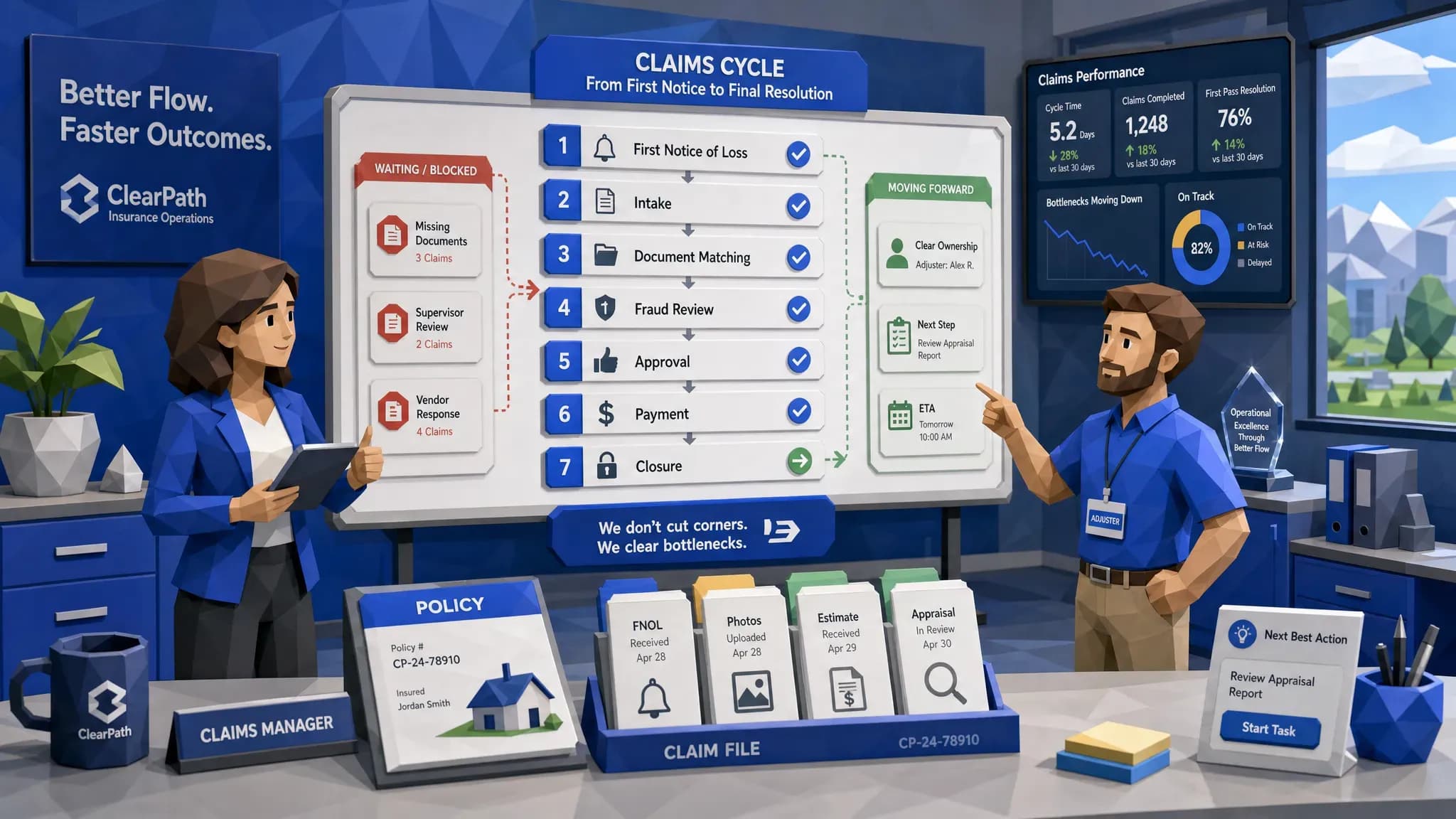
The claim cycle runs from first notice of loss through investigation, evaluation, settlement, payment, and closure. In theory, it is linear. In real life, it looks more like a dog chasing a squirrel through three departments and a shared inbox.
I once sat with a claims team handling a straightforward auto physical damage claim. The adjuster had the loss description, photos, policy, and repair estimate by day two. Payment still went out on day nineteen. Why? The estimate was attached to the wrong file, the rental approval sat in a queue, and nobody noticed the lienholder field was blank until payment review.
No one made a bad decision. No one ignored the insured. The claim just kept stepping on rakes.
That is why I am careful when people say they want to reduce cycle time. If they mean faster decisions with the same discipline, great. If they mean fewer checks, thinner documentation, or a blind rush to settlement, that is not operational excellence. That is future leakage wearing a nice suit.
The industry has good reason to care. J.D. Power’s 2024 U.S. Auto Claims Satisfaction Study notes that average auto claim settlement can stretch beyond 30 days, while faster, clearer handling improves customer satisfaction. Customers do not expect magic. They expect not to repeat themselves five times.
First, decide what must never be shortened
Before you speed anything up, draw a red line around the controls that protect the business. I like to call this the “do not get clever here” list.
Coverage confirmation still matters. Liability investigation still matters. Fraud screening still matters. Reserving discipline still matters. Regulatory notices still matter. Empathy still matters, especially when the claimant is dealing with a real loss, not a tidy workflow diagram.
The goal is not to skip those steps. The goal is to make sure they happen earlier, with better data, and with fewer manual handoffs.
A fast claim with weak controls can cost more than a slow claim. A fast claim with strong controls is where the money is.
Make FNOL boring, in the best possible way
First notice of loss is where the claim cycle is either set up cleanly or cursed for the next three weeks.
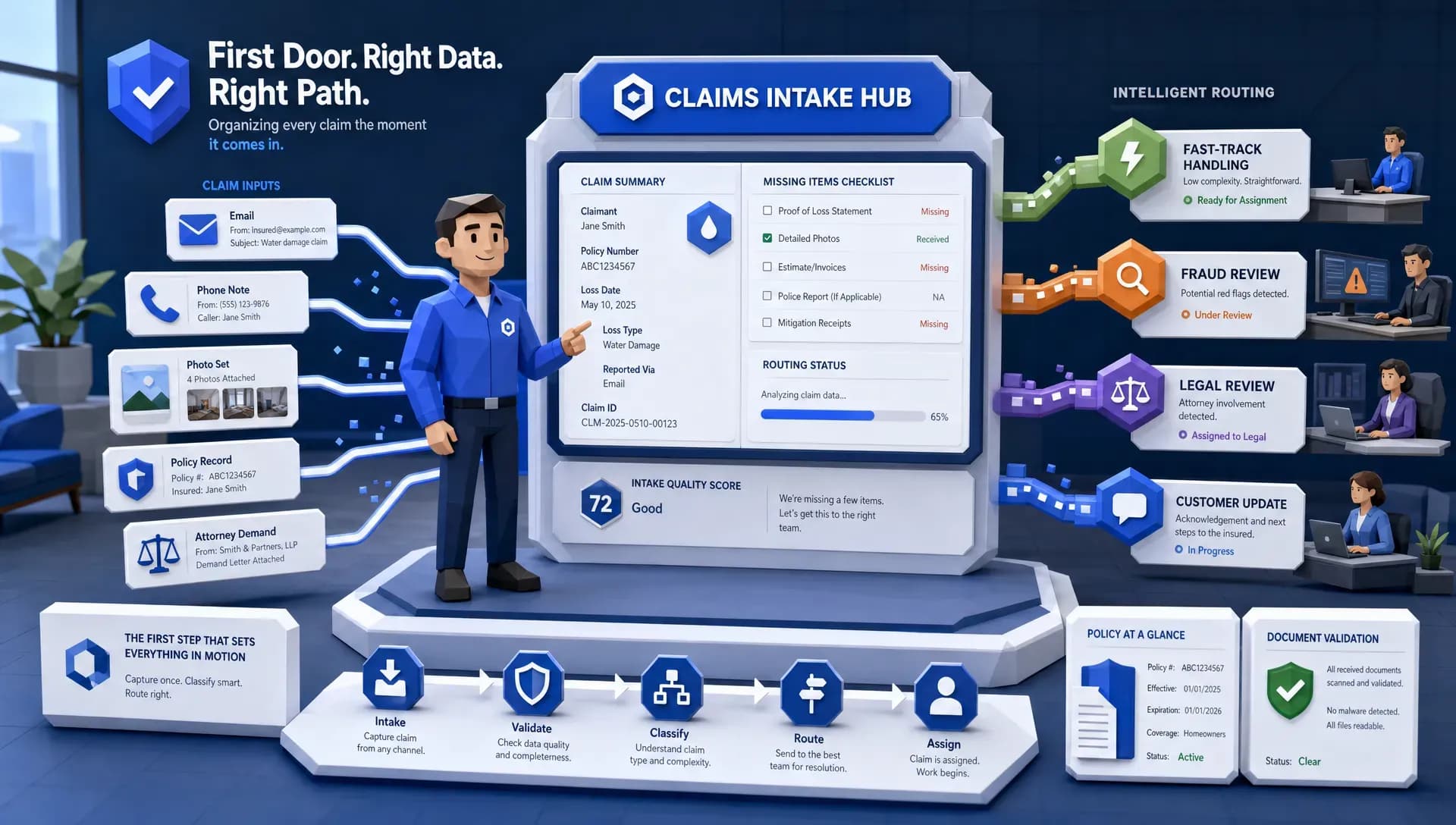
A messy FNOL creates follow-up calls, missing documents, unclear facts of loss, bad routing, and rework. A clean FNOL gives the adjuster a running start. The trick is to stop treating intake as a form and start treating it as the first underwriting decision of the claim.
That means structured questions by line of business, jurisdiction, loss type, and severity. It means required fields that are actually required. It means collecting photos, police reports, invoices, medical documentation, attorney letters, and claimant statements in a way that connects to the claim file instead of floating around in email.
The practical test is simple: could a qualified adjuster open the file and know what to do next within sixty seconds?
If the answer is no, your claim cycle problem probably starts before the adjuster ever touches the file. For a deeper look at the early intake and rework problem, Inaza has covered how insurance claims software cuts rework and cycle time by tightening FNOL, triage, handoffs, and data capture.
Triage claims in minutes, not tomorrow morning
A lot of claims operations still triage like it is 2008. New claim comes in, sits in a queue, gets eyeballed, gets assigned, gets reassigned when someone realizes it involves an attorney, injury, coverage issue, or suspicious pattern.
That delay sounds small until you multiply it across thousands of claims. Then it becomes staffing pressure, customer frustration, missed recovery opportunities, and late reserves.
Modern triage should sort claims immediately based on the signals that matter: line of business, severity, coverage ambiguity, litigation likelihood, jurisdiction, prior claims, injury indicators, fraud concerns, vendor needs, and customer vulnerability.
My hot take: straight-through processing is useful, but it is not the whole game. According to Celent research cited in industry discussions, only a minority of claims are processed fully straight-through without human involvement. That should not disappoint anyone. The bigger prize is getting the right claim to the right human with the right context, faster.
If a low-complexity windshield claim can move automatically, wonderful. If a bodily injury claim with attorney representation lands with an experienced adjuster on day one instead of day four, that may be even more valuable.
Stop letting documents become a second job
Claims are document-heavy because real life is document-heavy. Estimates, invoices, medical bills, police reports, demand letters, repair photos, proof of ownership, wage statements, engineering reports, subrogation packets, the list keeps going.
The problem is not the documents. The problem is making trained claims professionals spend their day opening attachments, renaming files, searching for dates, copying amounts, and checking whether the VIN on one PDF matches the VIN in the claim system.
I have watched adjusters do this with the patience of saints and the posture of people who need a better chair.
Document intake should identify the file type, extract the important fields, flag missing or inconsistent information, and route the item to the right step in the workflow. That does not remove the adjuster’s judgment. It protects it. The adjuster reviews the issue instead of hunting for it.
For claims teams buried in PDFs, images, emails, and demand packages, intelligent document processing can reduce claims cycle times by turning unstructured files into usable claim data much earlier in the process.
Enrich the claim early, not at the eleventh hour
One of the easiest ways to shorten the claim cycle is to bring external data into the file before the adjuster has to ask for it.
Think of vehicle data, property characteristics, hazard information, prior loss history, identity checks, repair network data, litigation indicators, and coverage-related data. If your team waits until evaluation to discover something that could have been known at intake, you have added days for no good reason.
Early enrichment also helps with segmentation. A claim with clean coverage, consistent facts, no injury indicators, and a known repair path should not travel the same road as a claim with conflicting statements, prior losses, and attorney involvement.
This is where pre-built integrations matter. Inaza, for example, supports enrichment through API templates with providers such as Verisk, LexisNexis, HazardHub, and others. That kind of connectivity helps claims teams reduce the manual search work that quietly bloats the claim cycle.
Put fraud controls in the fast lane
Fraud screening is often treated like a brake pedal. I think that is backwards. Good fraud controls make the right claims move faster because they separate ordinary claims from claims that deserve more scrutiny.
The stakes are not small. The FBI estimates insurance fraud costs the United States more than $300 billion per year. At the same time, carriers are seeing more digital manipulation, synthetic documents, and suspicious images. Verisk’s 2025 fraud reporting also points to rising concern among carriers about technology-enabled fraud.
So, no, shortening the claim cycle should not mean relaxing fraud review. It should mean running fraud checks earlier and making the signals more visible.
For example, if a claim has metadata inconsistencies, prior loss overlap, suspicious provider patterns, mismatched addresses, or unusual timing, the file should not wait until payment review for someone to notice. By then, you have already spent days moving the claim down the wrong path.
The best claims organizations do not choose between speed and fraud discipline. They build a lane for clean claims and a separate lane for claims that need investigation.
Manage the claim like a relay race, not an inbox
A claim cycle is a series of handoffs. Intake to triage. Triage to adjuster. Adjuster to vendor. Vendor back to adjuster. Adjuster to supervisor. Supervisor to payment. Payment to closure.
Every handoff is a chance to lose context.
This is where insurance can learn from outside the industry. In education, for instance, personalized models work best when teachers know the student, the next step is clear, and feedback is continuous. I see a similar operating principle in institutions like Pioneros Costa’s personalized and adaptive learning model, where care, challenge, and purpose are built into the process rather than left to chance. Claims handling is obviously a different world, but the lesson travels well: people perform better when the system gives them context, ownership, and timely feedback.
In claims, that means every file should have a clear next action, owner, due date, and reason for delay. If the claim is waiting on a police report, say that. If it is waiting on medical records, say that. If it is waiting on coverage counsel, say that. “Pending” is not a status. It is a hiding place.
The more visible the waiting state, the easier it is to shorten it.
Automate updates before the phone rings
There is a special kind of operational pain that comes from a claimant calling for an update that already exists somewhere in the system.
The payment was approved, but nobody told them. The estimate was received, but nobody confirmed it. The claim needs one more document, but the request is buried in an email from three days ago.
Those calls are expensive. They also make the customer feel ignored, even when the claim is moving.
Automated status updates, document reminders, vendor notifications, and payment communications can reduce inbound volume while improving trust. Again, this is not about removing people from sensitive conversations. It is about not using people for repetitive updates that a system can handle cleanly.
A good rule: if the claimant would reasonably ask, “What happens next?”, the answer should be communicated before they have to ask.
Measure the right version of faster
If leadership only measures average cycle time, people will find ways to make the average look better. Some of those ways are healthy. Some are accounting gymnastics in a claims costume.
To shorten the claim cycle without cutting corners, measure speed alongside quality. The scorecard should show whether you are paying accurately, communicating clearly, and avoiding rework.
Useful measures include:
- Average and median claim cycle time by loss type, severity, jurisdiction, and handler group
- Time from FNOL to first contact, first coverage decision, first reserve, first payment, and closure
- Reopen rate, supplement rate, complaint rate, litigation rate, and escalation rate
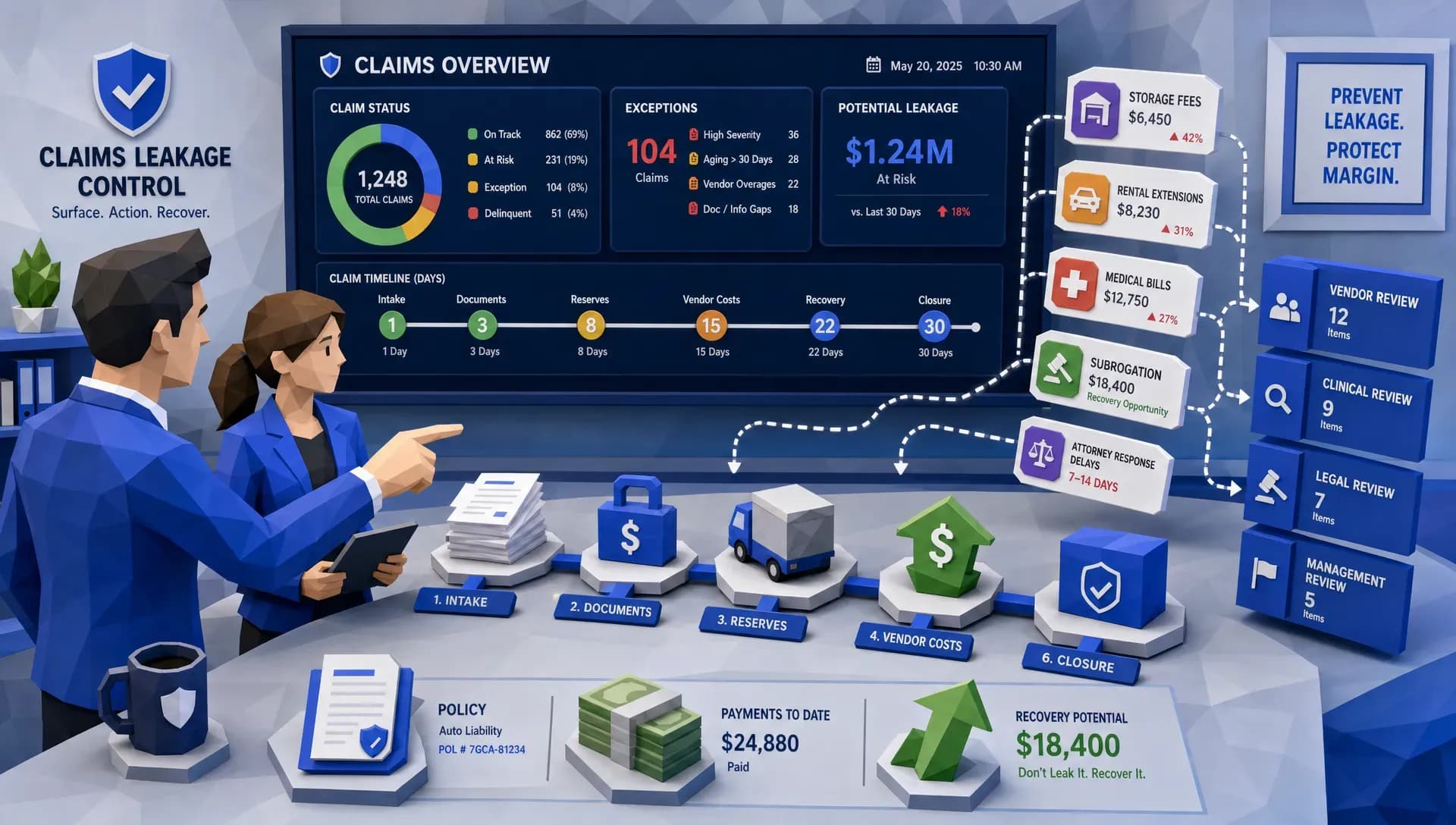
- Percentage of claims delayed by missing documents, vendor response, coverage review, or supervisor approval
- Fraud referral rate, confirmed fraud outcomes, and false positive trends
The reason to segment these metrics is simple. A two-day glass claim and a complex liability claim do not belong in the same average. If you mix them together, you will get a number that is technically correct and operationally useless, which is my least favorite kind of correct.
This is where dashboards earn their keep. Not pretty dashboards for board meetings, practical dashboards that show managers where claims are stuck today.
Use automation where it removes friction, not where it removes judgment
Claims automation works best when it handles the repeatable work around the adjuster: intake, classification, data capture, document review, enrichment, routing, reminders, reporting, and analytics.
It should not pretend every claim is simple. It should make simple claims easier and complex claims clearer.
That distinction matters. When carriers or MGAs try to automate the entire world on day one, they usually end up in a long proof-of-concept loop with impressive slides and not much production value. A better approach is to pick a high-friction workflow, deploy it, measure it, and expand from there.
Inaza is built around that practical approach. Claims teams can use customizable workflows, 250+ workflow templates, support for all file types, system integrations, and a unified data warehouse to capture the operational data that usually disappears inside emails and notes. The workflow is the front door, but the data warehouse is where the long-term value compounds.
That matters because shortening the claim cycle once is nice. Knowing exactly why it shortened, where it still stalls, and how your performance compares against internal and market benchmarks is much more useful.
If you are deciding where to begin, focus on the workflows that create the most rework and delay. Inaza has also written about where claims automation delivers ROI in the first 90 days, which is usually a better starting point than trying to redesign the entire claims department at once.
The corner-cutting test
Here is a simple test I use when reviewing a claim cycle improvement idea: if a regulator, reinsurer, plaintiff attorney, or internal auditor reviewed the file six months later, would we be proud of the process?
If the answer is yes, speed up.
If the answer is no, fix the control before you brag about the cycle time reduction.
The best claims operations are not reckless. They are disciplined enough to know which steps require human judgment and which steps are just clerical drag. They do not pressure adjusters to do ten things at once. They give adjusters cleaner files, earlier warnings, better data, and fewer needless interruptions.
That is how you shorten the claim cycle without cutting corners.
Frequently Asked Questions
What is the fastest way to shorten the claim cycle? Start with FNOL quality and triage. If the claim is captured cleanly and routed correctly on day one, you prevent downstream rework, reassignment, missing information, and late-stage surprises.
Can automation reduce claim cycle time without increasing leakage? Yes, if automation is used to improve intake, document handling, data enrichment, fraud detection, and workflow routing. It should strengthen controls, not bypass them.
Which claims should be automated first? Begin with high-volume, repeatable workflows that create obvious delays, such as document intake, status updates, low-complexity claims, vendor follow-ups, and missing information reminders.
How should insurers measure claim cycle improvement? Measure cycle time together with quality indicators such as reopen rate, supplement rate, complaint rate, litigation rate, fraud outcomes, and leakage. Faster is only better when accuracy holds.
Why do claims still stall after first contact? Most stalls happen because context gets lost after FNOL. Missing documents, unclear ownership, manual handoffs, delayed enrichment, and vague pending statuses all add idle time to the claim cycle.
Ready to find the waiting states in your claim cycle?
If your claims team is doing good work inside a slow process, the answer is not another reminder to “move files faster.” The answer is a cleaner operating model with better intake, smarter routing, earlier enrichment, stronger controls, and real visibility into what is stuck.
Inaza helps insurers, MGAs, brokers, and claims teams automate claims workflows, capture better data, and see where cycle time is being lost. If you want to shorten the claim cycle without gambling on quality, start by finding the friction hiding in plain sight.