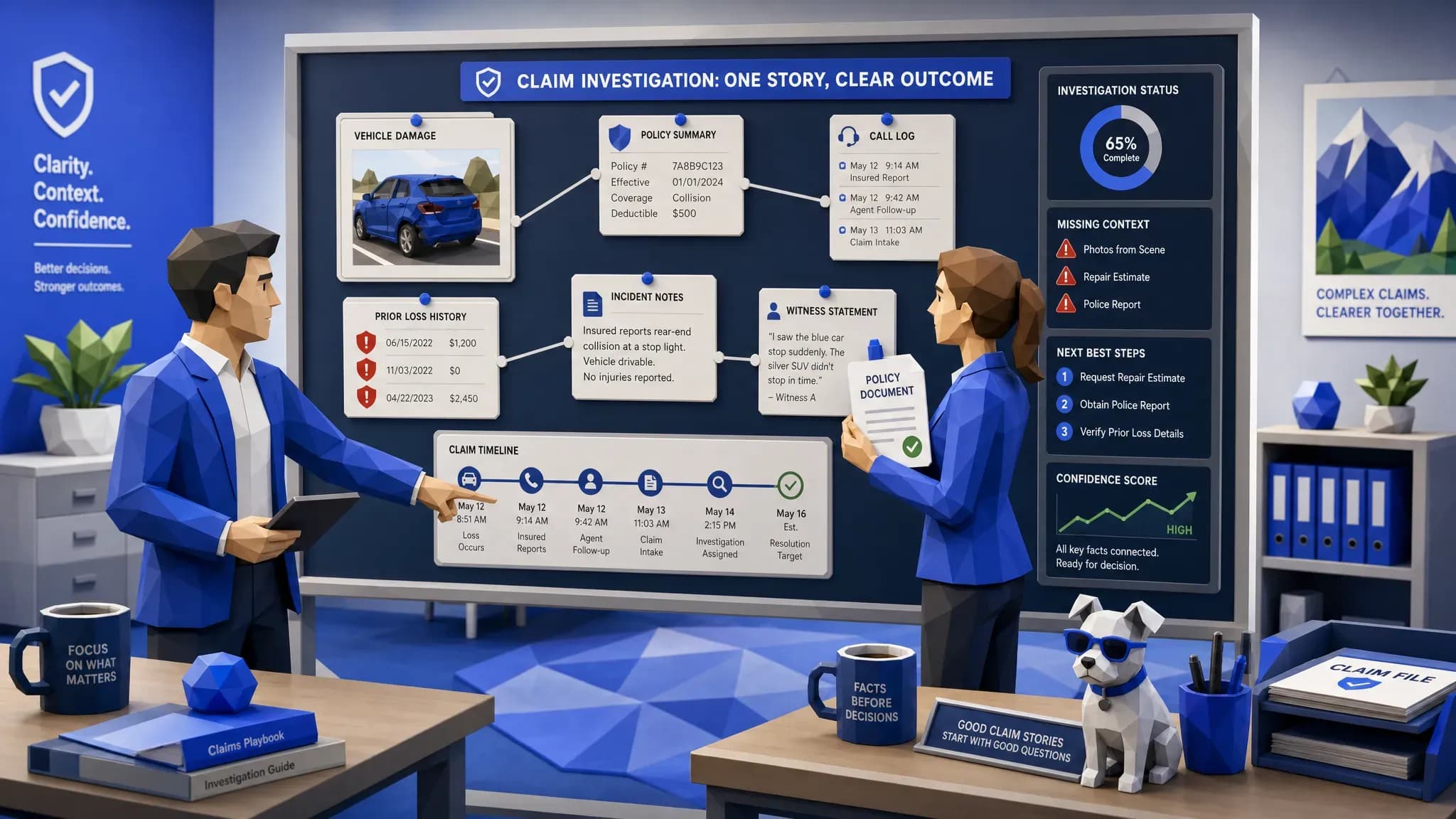
Here’s my hot take after a decade around claims teams: most claims handling does not become expensive because the loss is mysterious. It becomes expensive because the story is scattered.
The vehicle photo is in one inbox. The FNOL is in a portal. The policy endorsement is buried in a PDF. The prior loss note is sitting in a core system nobody wants to touch before coffee. By the time an adjuster has enough information to make a confident call, the claim has already cost money in phone calls, rework, diary extensions, legal reviews, and customer frustration.
I learned this the boring way. Years ago, I watched a small auto claim, the kind everyone assumed would be closed before lunch, turn into a week-long scavenger hunt. The damage photo showed a rear bumper scrape. Simple enough. But the policy had a recent endorsement, the garaging address had changed, and there was a prior claim involving the same panel. None of that context was visible in one place. The claim was not complicated. Our view of it was.
That is the quiet budget killer in claims handling. When context goes missing, the claim does not pause politely. It grows teeth.

The expensive part is the hunt
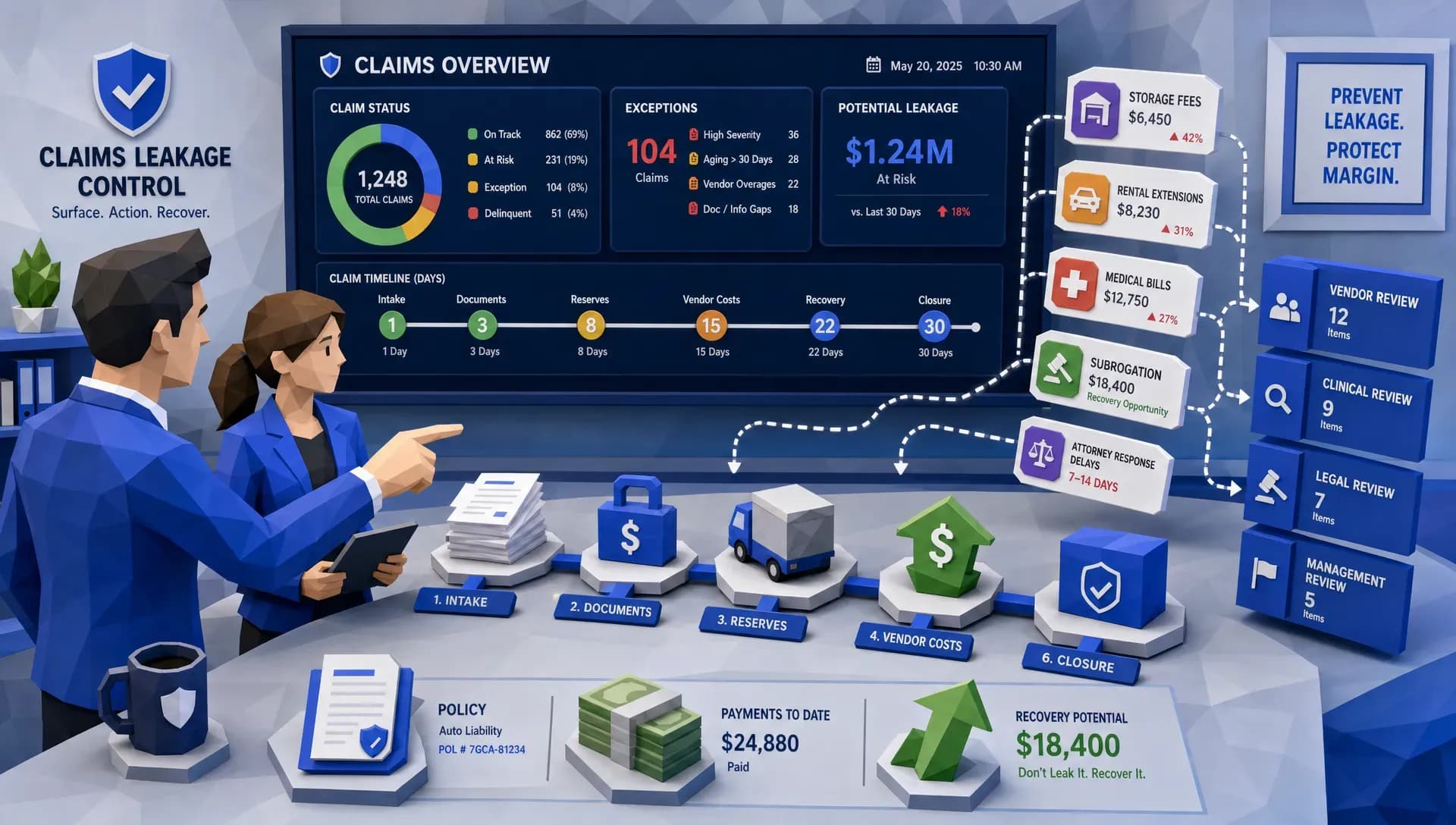
Claims leaders tend to measure the visible costs: indemnity, allocated loss adjustment expense, legal spend, appraisal costs, rental days, medical review, and so on. Fair enough. Those numbers matter.
But I have always been more suspicious of the invisible cost: the hunt for context. It shows up as an adjuster asking a broker for a document that already exists somewhere else. It shows up as a supervisor reviewing a file because the coverage picture is unclear. It shows up as a claimant calling three times because nobody can explain what happens next.
J.D. Power’s 2024 U.S. Auto Claims Satisfaction Study has highlighted that auto claims can take more than 30 days to settle on average, and satisfaction suffers when repair and settlement timelines stretch. Some of that delay is external. Shops are busy. Parts are delayed. Medical treatment takes time. But inside the carrier or MGA, a surprising amount of delay comes from missing or fragmented information.
And the industry knows it. Celent has estimated that only a small share of claims, often cited around 10-15 percent, are processed straight through without human intervention. That does not mean every claim should be automated end to end. I would not want that, and neither would most good adjusters. It means too many claims still require humans to do clerical archaeology before they can do actual judgment work.
What context really means in claims handling
When I say context, I do not mean dumping every possible data field into a claim file and calling it progress. That is how you build a digital junk drawer. Context is the relevant information that helps someone answer: what happened, what is covered, what is unusual, what happens next, and who needs to know?
Coverage context is the starting point. Was the policy active? Were there endorsements? Were limits, exclusions, deductibles, garaging details, drivers, vehicle use, or prior changes relevant to the loss? If the adjuster has to leave the claim file to answer those questions, the workflow is already leaking time.
Loss context is the next layer. The loss date, location, reported facts, photos, police report, weather, vehicle history, repair estimate, injury indicators, and prior damage should connect cleanly. A photo without metadata is weaker than a photo with timestamp, location, upload history, and a link to the reported event. A police report without the claim narrative beside it is just another PDF asking to be misunderstood.
Relationship context matters too. Has the claimant called before? Is a broker involved? Has counsel appeared? Is the policyholder upset because they have already been asked for the same document twice? I once heard a claimant say, very calmly, that the company knew less about her claim on day eight than she did on day one. That sentence should be framed and hung in every claims operations meeting.
Portfolio context is often forgotten. Is this claim behaving like similar claims in this territory, coverage, vehicle class, attorney segment, or repair network? Is the reserve movement unusual? Are certain FNOL patterns predicting longer cycle times? Without that broader view, teams are handling claims one by one while the real pattern walks out the back door.
Where context disappears
In my experience, context usually disappears in handoffs. FNOL creates one version of the facts. The adjuster adds another. The appraiser sees something slightly different. Customer service answers a call and writes a note. Legal receives a demand. SIU pulls data from somewhere else. Everyone is doing their job, but the claim story starts to resemble a group text where half the messages did not send.
Email is the classic culprit. A document arrives as an attachment, someone downloads it, someone re-keys a field, someone renames the file, and someone else later wonders whether it was the final version. Portals help, but only if the data moves into the systems people actually use. Otherwise, you have built a nicer front door that still opens into a maze.
Legacy systems are not villains. I have seen plenty of core systems do exactly what they were bought to do. The issue is that claims handling now depends on more context than those systems were originally designed to capture. Photos, texts, emails, call transcripts, third-party data, telematics, repair networks, attorney correspondence, public records, and policy lifecycle events all need to speak to each other.
When they do not, adjusters compensate. They open more tabs. They maintain side spreadsheets. They build personal workarounds. They become the integration layer, which is a very expensive use of skilled people.
Missing context makes fraud easier
Fraud thrives in gaps. That is not a dramatic statement, just a practical one.
The FBI describes insurance fraud as a serious cost to consumers and the industry. In claims handling, fraud is harder to spot when the claim file cannot easily compare the reported facts against policy history, prior losses, image metadata, repair patterns, medical billing, and external data.
The problem is getting sharper. Verisk’s 2025 fraud report points to rising concern around digital fraud, including AI-generated or manipulated claim materials. Whether you are dealing with recycled photos, exaggerated injuries, staged accidents, or padded invoices, the detection problem is rarely one suspicious item in isolation. It is the mismatch between items.
A photo might look fine until you compare its metadata to the reported date of loss. A medical bill might look normal until you compare it to treatment patterns and injury severity. A claimant statement might sound reasonable until you compare it to prior claims, vehicle history, or repair estimates. Fraud detection is often a context exercise before it is an investigation exercise.
Claims is also a brand moment
This may sound soft, but stay with me. Claims handling is where the policy promise either becomes real or becomes a customer complaint with screenshots.
When context is missing, the customer feels it immediately. They get repeated questions. They receive vague updates. They hear different answers from different people. Even if the eventual settlement is fair, the experience feels disorganized. That damages trust, and trust is expensive to rebuild.
Claims teams can learn something from brand and go-to-market teams here. Clear narratives reduce friction. Consistent experiences build confidence. Agencies focused on brand growth for challengers talk about standing out through sharper positioning, and the same principle applies inside insurance operations: if the claim experience feels confused, the market will not describe you as reliable for very long.
The best claims organizations I have worked with do not treat communication as an afterthought. They make sure the adjuster, customer service rep, broker, supervisor, and claimant are working from the same facts. That is not glamourous. It is just good insurance.
The fix is making context travel with the claim
The answer is not to automate everything and hope the humans stop noticing the gaps. Please do not do that. The answer is to make sure the right context travels with the claim from intake through resolution.
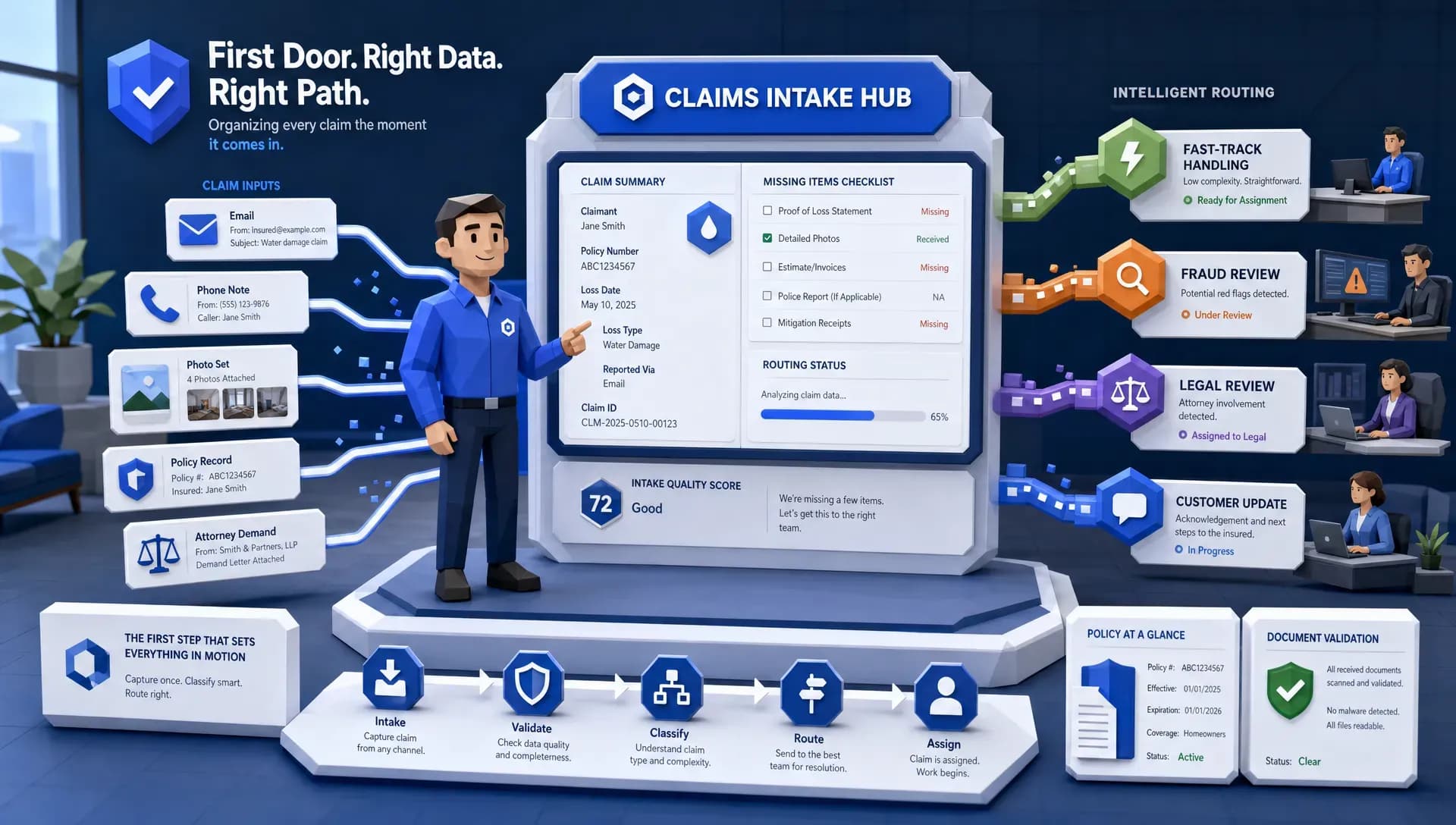
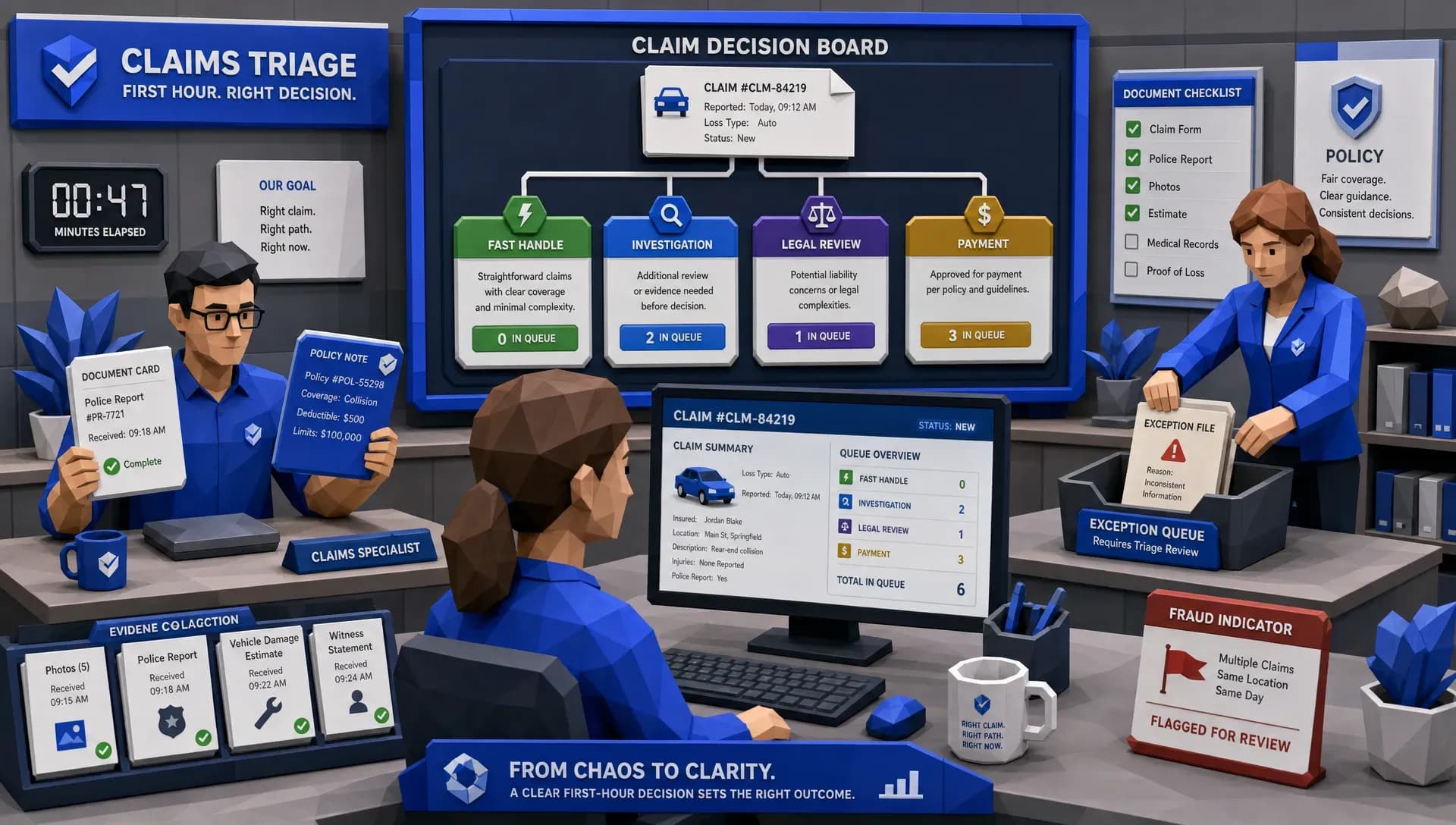
Start at intake. FNOL should capture more than basic loss details. It should collect information in a structured way, validate what can be validated immediately, identify missing documents, and route the claim based on the facts available. If a claim has injury indicators, attorney involvement, suspicious image metadata, coverage uncertainty, or high severity potential, that should be visible early.
Then bring underwriting data downstream. Claims should know the policy story. Was this risk recently bound? Were there unusual submission details? Did underwriting rely on specific garaging, mileage, fleet, driver, or property information? If those facts are relevant to coverage, liability, fraud, or subrogation, they should not require a separate treasure hunt.
Enrichment should happen in the background. Data from providers, public records, vehicle sources, property data, claims history, hazard information, and fraud signals can add useful context. The trick is to present it in plain operational language. Adjusters do not need a science project. They need to know what changed, what conflicts, what is missing, and what action is recommended.
Finally, every claim touch should become data. A reopened claim, late attorney demand, repeated customer call, reserve change, coverage escalation, SIU referral, or missing document request should not vanish into a note field. These events are operational signals. Over time, they tell leaders where cycle time is being lost, where leakage is occurring, and where teams need better workflows.
What good claims automation should feel like
Good automation in claims handling should feel less like a robot taking over and more like a very organized colleague who never forgets where the file is.
The adjuster opens the claim and sees the relevant policy details, documents, images, communications, alerts, and recommended next steps. The supervisor sees which claims are drifting and why. The SIU team sees which files deserve attention because the facts conflict, not because a crude rule fired. Operations leaders see dashboards that explain bottlenecks by workflow, claim type, jurisdiction, severity, and team.
This is where a data platform matters. Workflow automation is useful, but workflow automation without a connected data foundation can become another set of disconnected tasks. At Inaza, we focus on insurance automation that captures the key data points from underwriting, claims, customer service, and operations so insurers can act on them later.
That means automating data capture from different file types, integrating with existing systems, enriching workflows through pre-built API templates, and turning operational activity into reporting and analytics. It also means teams can configure workflows without getting trapped in a long proof-of-concept loop. For carriers, MGAs, brokers, and claims teams, the practical goal is simple: less hunting, more deciding.
My five-minute test for claims context
When I review a claims operation, I use a simple test. Can a competent adjuster open a file and understand the claim story in five minutes?
Not every detail. Not every legal nuance. Just the story. What happened? What coverage applies? What documents exist? What is missing? What is unusual? Who has been contacted? What is the next best action?
If the answer is no, the organization has a context problem. And context problems become cost problems.
The good news is that this is fixable without ripping out every system or asking experienced adjusters to become software engineers. Start with one workflow where missing context is obviously costing money. Attorney demands. BI triage. Auto physical damage. FNOL routing. Coverage verification. Pick the pain point where everyone already groans when it hits the queue.
Then measure the practical things: time to first action, number of touches, missing document rate, reopen rate, escalation rate, leakage indicators, customer callbacks, and cycle time. If context improves, those numbers should move. If they do not, the workflow probably got prettier but not smarter.
Frequently Asked Questions
What does missing context mean in claims handling? Missing context means the adjuster cannot easily see the relevant facts needed to make a confident decision. That can include policy details, prior claims, loss facts, photos, communications, coverage changes, fraud signals, repair history, or attorney involvement.
How does missing context increase claims costs? It increases costs through rework, slower cycle times, repeated customer contact, delayed coverage decisions, unnecessary escalations, higher legal involvement, missed fraud indicators, and inconsistent reserving. None of those costs always look dramatic at first, but they compound across a claims book.
Should claims handling be fully automated? No. Some claims can move straight through, especially low-complexity claims with clean data and clear coverage. But complex, sensitive, high-severity, litigated, or suspicious claims still need human judgment. The better goal is to automate the hunt for information so adjusters can focus on decisions.
What data should insurers connect first? Start with the data that most often delays decisions: FNOL details, policy and endorsement data, claim documents, images and metadata, prior loss history, customer communications, payment and reserve activity, and third-party enrichment sources relevant to your line of business.
Can carriers improve claims context without replacing core systems? Yes. Many insurers can improve claims context by adding automation and data orchestration around existing systems. The key is to extract, validate, enrich, and route information cleanly while preserving the workflows teams already understand.
Bring the claim story back together
If your claims team spends too much time looking for facts, chasing documents, and reconstructing timelines, the issue is not adjuster effort. It is missing context.
Inaza helps insurers, MGAs, and brokers connect claims data, automate workflows, enrich files, and turn operational activity into useful analytics. If you want claims handling that is faster, clearer, and less expensive without forcing teams to relearn their entire day, explore Inaza and see how connected insurance automation can bring the claim story back together.