I have a slightly unpopular opinion: most insurance underwriting software does not fail because the rating logic is weak. It fails because the intake is a circus.
I have seen this more times than I care to admit. A carrier spends serious money on a shiny underwriting system, launches a steering committee, names the project something heroic, and then feeds the platform the same half-complete PDFs, email threads, spreadsheets, ACORD forms, handwritten notes, and broker follow-ups it was already struggling with before. Six months later, everyone says the software “didn’t work.”
My hot take? The software often worked exactly as instructed. The intake was the problem.
In insurance, bad intake is like giving a chef mystery ingredients in unmarked cans and asking for a Michelin-star meal. You might get dinner. You will not get consistency.
The uncomfortable truth about insurance underwriting software
Insurance underwriting software is usually bought to solve a real business pain: slow quotes, expensive manual review, inconsistent decisions, premium leakage, or underwriters drowning in submissions. Those are all valid problems. But the workflow usually breaks before the underwriter even gets to evaluate the risk.
Submission intake is where the raw material enters the business. It is where emails, broker portals, PDFs, loss runs, schedules, bordereaux, public records, third-party data, and prior policy documents become the file an underwriter actually sees.
If that first step is messy, everything downstream gets shaky. Eligibility checks misfire. Rating data is incomplete. Referral rules trigger too often. Dashboards lie by omission. Underwriters lose trust and go back to spreadsheets, which is the insurance equivalent of hiding snacks in your desk drawer. Understandable, but not exactly scalable.
McKinsey has estimated that underwriters can spend up to 60% of their time on administrative work rather than risk assessment. In my experience, a large slice of that admin burden starts with intake: chasing missing files, re-keying data, checking whether the VIN matches the schedule, asking a broker to resend the loss run, or wondering whether “final_submission_v3_revised.xlsx” is in fact final. Spoiler: it is never final.
Good intake is not email sorting
A common mistake is treating intake like a digital mailroom. “Just route the submission to the right queue,” someone says. That helps, but it is not enough.
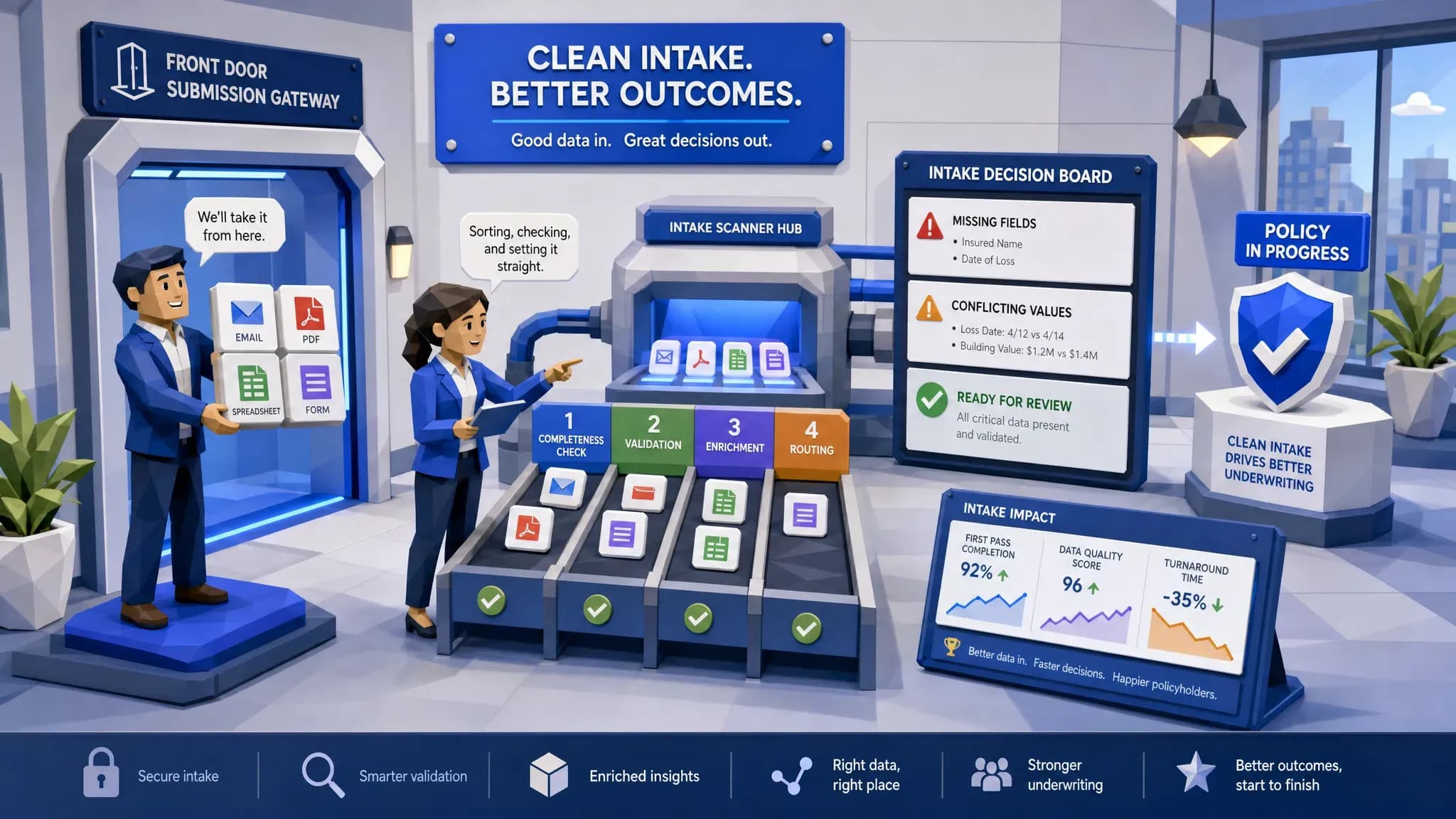
Good intake does more than move files around. It turns unstructured submission chaos into usable underwriting data. It captures the document, identifies what it is, extracts the right fields, validates them, enriches them where needed, flags gaps, and gives the underwriter a clean starting point.
A good intake workflow should be able to answer practical questions before an underwriter spends time on the file:
- Is this submission complete enough to review?
- Which documents were received, and which are missing?
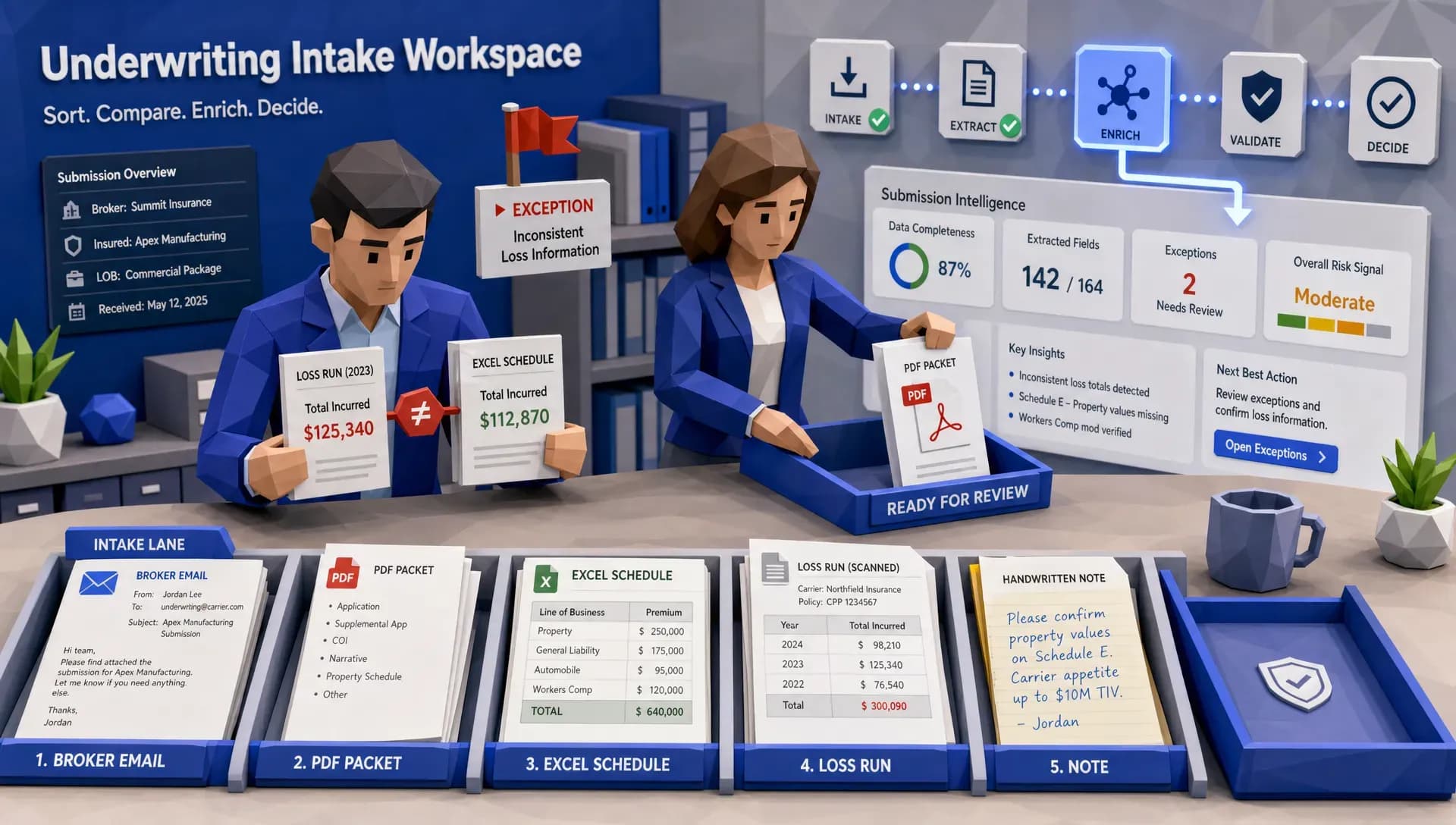
- Are the extracted values consistent across forms, schedules, loss runs, and prior policies?
- Does the risk fit appetite before anyone spends thirty minutes reading it?
- Which fields came from which source document?
- What needs human judgment, and what can move forward automatically?
- Has the file been enriched with trusted external data where appropriate?
That last point matters more than people think. If intake only extracts what the broker sent, you are still depending entirely on the quality of the submission. If intake also validates and enriches the data, the underwriting software gets a much better foundation.
For a deeper look at the mechanics, Inaza has already covered what carriers should know about automating submission intake. Here, I want to focus on why the failure happens when that intake layer is weak.
Why poor intake makes automation look worse than it is
Here is the pattern I have seen across carriers, MGAs, and brokers: a team automates the middle of the underwriting workflow while leaving the front door wide open.
The rating engine is configured. Referral rules are mapped. Appetite criteria are documented. The integration team gets the core system talking to the new platform. Everyone feels good.
Then the submissions arrive.
One broker sends a PDF schedule. Another sends an Excel file with columns that do not match last month’s template. Someone attaches an old loss run. The business name appears three different ways across documents. A driver date of birth is missing. The garaging address is in one file, but the vehicle schedule says something else. Now the automated workflow has to choose between bad options.
It can stop the file and ask for review, which creates bottlenecks. It can push the file through, which creates risk. Or it can guess, which is where underwriters start sharpening pitchforks.
I once watched an underwriting team spend twenty minutes debating whether a vehicle count was 42 or 47 because the submission had two schedules, one PDF and one spreadsheet, with different totals. That was not a modeling problem. That was intake malpractice.
Bad intake destroys underwriter trust
Underwriters are not anti-technology. They are anti-nonsense.
If software produces a recommendation based on data the underwriter knows is incomplete, the underwriter will stop trusting it. That loss of trust is expensive. Once a team believes the system is unreliable, adoption becomes a daily wrestling match.
You will hear phrases like “I’ll just check it myself,” “the system missed it last time,” or my personal favorite, “this is faster manually.” Sometimes they are right. Not because manual work is better, but because the automation has been forced to operate on bad intake.
Underwriting is still a judgment business. The goal of automation is not to remove judgment. The goal is to stop wasting judgment on clerical cleanup.
That distinction is important. If intake gives underwriters clean, traceable, validated data, they can focus on exposure, pricing, terms, and portfolio fit. If intake gives them a suspicious pile of semi-structured fields, they become data janitors. Nobody became an underwriter because they dreamed of correcting spreadsheet headers.
Submissions are stories before they are fields
One reason intake is hard is that insurance submissions are not sterile datasets. They are messy little stories about people, businesses, vehicles, buildings, locations, drivers, claims, and behavior.
A broker note may explain why last year’s loss ratio looks ugly. A claims description may reveal that a “minor” incident involved attorney representation. A schedule change may signal a fleet growing faster than its safety program. A property address may look fine until you check hazard data.
This is why I like thinking of intake as translation. The submission arrives in human form. The underwriting system needs it in decision-ready form. Somewhere in between, context can get lost.
If you have ever read candid, first-person writing such as raw personal insight, you know that the details around an event often matter as much as the event itself. Insurance is similar. The structured field may say “prior claim.” The surrounding context tells you whether that claim is noise, signal, or a blinking red light.
Good intake preserves that context while still organizing the data. Weak intake strips the story down to fields and hopes nothing important fell out of its pockets.
The reporting problem nobody talks about
Most leaders discover intake problems through reporting, but only after the damage is already baked in.
If submissions are not captured consistently, your dashboards become a polite fiction. Quote turnaround time may look better than it is because the clock starts only after manual cleanup. Declination reasons may be inconsistent because underwriters free-type them. Referral rates may spike because missing data is being treated like high risk. Broker performance may look worse because some brokers submit harder business, not necessarily poorer files.
This is where I get a little grumpy, in a friendly way. You cannot benchmark what you cannot normalize.
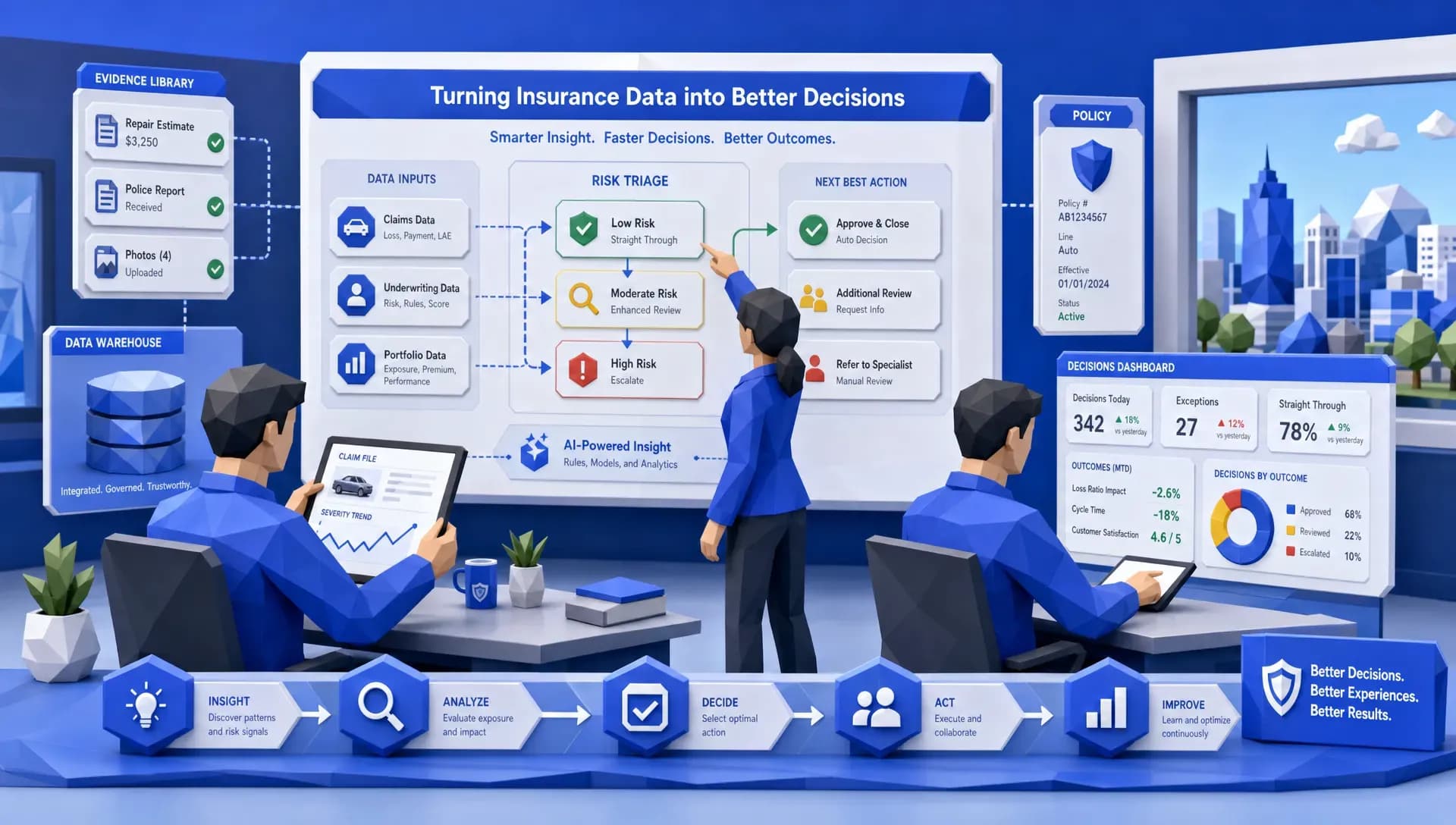
A clean intake layer gives leaders better operational intelligence. You can see which fields are most often missing, which brokers submit complete files, which classes require the most enrichment, which underwriters spend the most time on cleanup, and which appetite rules create avoidable referrals.
This is one reason Inaza’s approach is built around a data warehouse underneath the workflows. Capturing data from automation is valuable, but making that data usable for reporting, analytics, and business intelligence is where the operational value compounds.
Intake quality directly affects quote speed
Every carrier says it wants to be faster to quote. Fair enough. Speed wins business, especially in competitive P&C markets where brokers do not have infinite patience.
But quote speed is not only about the underwriting decision. It is about the time between submission arrival and decision-ready review. If your underwriters spend the first day figuring out what they received, your fancy quote workflow is already behind.
Good intake shortens that lag. It can identify the submission type, extract the required fields, check completeness, enrich key risk attributes, and route the file based on appetite or priority. The underwriter opens the file and sees something closer to a risk profile than a document dump.
That is the difference between “we received your submission” and “we are already reviewing terms.” Brokers notice.
If quote speed is a current board-level topic, the fastest improvement is often not rewriting underwriting rules. It is cleaning up the first five minutes of the submission journey. Inaza has written more on how underwriting leaders are using automation to become faster to quote, but intake is the ignition switch.
What good intake looks like in practice
Let us make this concrete. Imagine a commercial auto submission lands in an underwriting inbox.
In a weak intake process, someone opens the email, downloads attachments, renames files, checks the schedule, manually copies vehicle and driver data, reviews the loss run, asks the broker for missing information, and eventually enters data into the underwriting system. If the file is declined, some of that work was wasted. If it is quoted, the underwriter still has to hope the entered data is accurate.
In a strong intake process, the system captures the email and attachments, classifies the documents, extracts fields from all relevant file types, checks for missing or conflicting values, enriches the risk with approved external sources, applies appetite checks, and routes the submission with a clear audit trail. The underwriter still decides where judgment is needed, but the clerical fog has lifted.
That is the version of insurance underwriting software buyers should be asking for. Not just a place to house rules. A front door that makes the rest of the house usable.
The hidden cost of “we’ll fix intake later”
I have heard this sentence in more project meetings than I can count: “Let’s get the underwriting platform live first, then we’ll improve intake in phase two.”
That sounds reasonable. It is also how phase two becomes a haunted mansion.
When intake is postponed, teams build workarounds. Underwriters create spreadsheets. Operations adds manual quality checks. Brokers get custom instructions. IT creates one-off integrations. Managers build reports that depend on inconsistent data definitions. By the time someone revisits intake, the organization has built a small city around the problem.
Fixing intake early is less glamorous than launching a new underwriting platform, but it is the move that protects the investment.
Accenture has reported that insurance leaders are investing heavily in new technology for underwriting and claims. That investment makes sense. But I would argue that intake readiness should be treated as a boardroom issue, not a back-office clean-up task.
How to evaluate intake before choosing underwriting software
If you are assessing insurance underwriting software, do not start with a demo built around a perfect submission. Perfect submissions are mythical creatures, like unicorns or expense reports filed on time.
Bring real files. Bring ugly files. Bring the submission that made your best underwriter mutter something unprintable.
Then watch what the system does. Can it identify the document types? Can it extract the right fields from PDFs, spreadsheets, scanned forms, and email text? Can it show where each value came from? Can it detect conflicts between documents? Can it enrich data through sources you already trust? Can it route exceptions without dumping everything into a manual queue?
Most importantly, can your underwriters understand and verify the output quickly?
A practical test is to take ten recent submissions and ask the vendor to process them as they arrived, not after your team cleans them up. Include a mix of easy, average, and painful files. The painful ones are where the truth lives.
Where Inaza fits
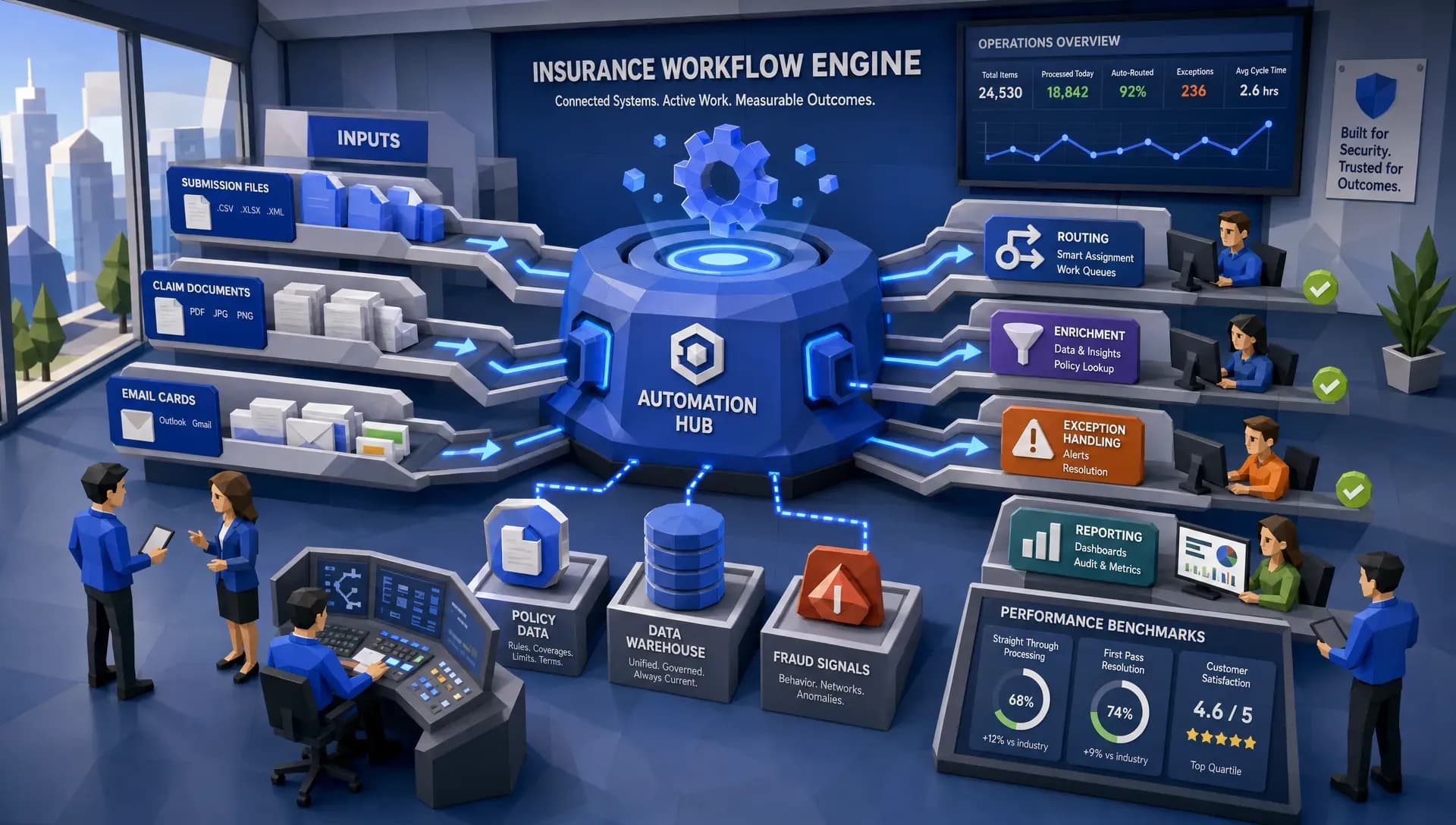
At Inaza, we see underwriting automation as a workflow and data problem first. The platform is designed to help insurers, MGAs, and brokers capture data from existing submission channels, automate underwriting workflows, enrich data through pre-built API templates, and connect the results to reporting and analytics.
That matters because intake is not a standalone chore. It is the start of the underwriting record.
Inaza supports customizable automation workflows, works with existing systems, and can handle all file types. The platform also includes a unified data warehouse and real-time dashboards, so the information captured at intake can support operational reporting, portfolio analysis, and better decision-making. With pre-built workflow templates and API templates for sources such as Verisk, LexisNexis, and HazardHub, teams can move faster without asking underwriters to relearn their entire job.
One of the more practical differentiators is speed of deployment. Inaza gives insurers the ability to deploy their own workflows without the usual proof-of-concept shuffle. When the use case is clear, a production-ready workflow can be configured on a single call. In insurance technology, that is refreshingly un-theatrical.
The real win: cleaner decisions downstream
When intake improves, underwriting software starts doing what leadership expected it to do in the first place.
Underwriters spend less time chasing information. Brokers get faster responses. Appetite checks become more consistent. Referral rules become more meaningful. Dashboards become more trustworthy. Claims and underwriting teams can eventually connect data more cleanly, which helps with renewal strategy, portfolio management, and fraud signals.
That is the part I wish more teams appreciated. Intake is not an admin function. It is the first underwriting decision, because it determines what information the business accepts as usable.
If your intake is weak, your underwriting software will always be compensating. If your intake is strong, the same software suddenly looks smarter, faster, and more reliable.
Funny how that works.
Frequently Asked Questions
Why does insurance underwriting software fail without good intake? It fails because downstream automation depends on clean, complete, and validated submission data. If intake is inconsistent, the software produces unreliable outputs, underwriters lose trust, and manual work returns through the side door.
What is submission intake in insurance underwriting? Submission intake is the process of receiving, classifying, extracting, validating, enriching, and routing underwriting submissions. It includes emails, PDFs, spreadsheets, loss runs, schedules, ACORD forms, broker portal data, and third-party data.
Can underwriting automation work with messy submissions? It can handle some variation, but it should not be expected to fix every missing or contradictory data point without rules, validation, and exception handling. Strong intake separates routine cleanup from cases that need human review.
What should insurers look for in an intake solution? Look for support across file types and channels, reliable data extraction, field-level source traceability, completeness checks, data enrichment, integration with existing systems, workflow routing, and reporting that exposes intake performance.
Should intake be fixed before or after implementing underwriting software? Before, or at least as part of the first implementation phase. Waiting until later usually creates workarounds that become harder and more expensive to unwind.
Build underwriting software on intake that actually works
If your underwriting team is fighting messy submissions, missing fields, and manual re-keying, the problem may not be your underwriters or your rating logic. It may be the intake layer feeding the whole process.
Inaza helps insurers, MGAs, and brokers turn submission chaos into structured, validated, decision-ready workflows without forcing teams through a painful retraining exercise. If you want underwriting automation that starts at the front door, talk to Inaza and see what better intake can do for quote speed, accuracy, and operational control.