I’ll say the quiet part out loud: many insurance software systems are glorified filing cabinets with better fonts.
That may sound harsh, but after a decade around P&C operations, underwriting rooms, claims teams, broker submissions, and the occasional spreadsheet named FINAL_final_v9.xlsx, I’ve earned the right to be a little grumpy about passive technology.
For years, the industry’s big promise was simple: digitize the paper. Store the policy. Archive the claim. Keep the audit trail. All useful, of course. Nobody wants to go back to banker’s boxes and coffee-stained loss runs. But in 2026, storing data is no longer the achievement. It is the starting line.
The real question is this: when data enters your business, does your system do anything useful with it?
Hot take: a system of record that never becomes a system of action is a compliance tool pretending to be an operating model.
The Filing Cabinet Problem in Insurance Technology
Traditional insurance software systems were built for a different world. They were designed to record policies, track claims, store documents, and give teams a central place to retrieve information. That made sense when the main operational challenge was moving from paper to digital.
But today’s challenge is different. Underwriters are not short on documents. Adjusters are not short on photos, emails, PDFs, repair estimates, medical records, or attorney letters. Fraud teams are not short on suspicious signals. Brokers are not short on submissions.
They are short on time, clean data, and fast decisions.
That is where many systems fall down. They hold the data, but they do not structure it. They display the document, but they do not extract the facts. They store the email, but they do not trigger the next step. They preserve the mess beautifully.
I once sat with an underwriter who had three systems open, two spreadsheets, an inbox, and a PDF viewer. She was technically using modern software. In practice, she was acting as the integration layer. Copy here, paste there, verify somewhere else, then send an email asking for the missing field that should have been caught at intake. If that is the workflow, the problem is not the person. The problem is the system.
McKinsey has estimated that up to 60% of underwriter time can be spent on administrative work rather than risk assessment. That should make every carrier, MGA, and broker pause. If experienced underwriting talent is spending most of the day chasing data, formatting data, and re-keying data, then the software is not doing enough.
Passive Data Creates Active Losses
Bad data does not sit politely in one corner of the business. It travels.
A mistyped VIN becomes a pricing issue. A missing driver exclusion becomes a coverage dispute. A stale address affects territory rating. An unstructured loss run slows quote turnaround. A claims note buried in one system never reaches renewal underwriting. A suspicious image gets reviewed too late, after payment momentum has already built.
This is why I think passive data is one of the most expensive problems in insurance. It rarely appears as a neat line item on the P&L. Instead, it shows up as leakage, rework, late quotes, claim delays, inconsistent decisions, frustrated producers, and overworked teams.
Fraud makes the point even sharper. The FBI estimates that insurance fraud costs the United States more than $300 billion per year. Meanwhile, Verisk’s 2025 fraud report found that carriers are increasingly worried about digital fraud, including manipulated documents and images. A system that merely stores suspicious material for someone to review later is already behind the pace of the problem.
Claims cycle time tells a similar story. J.D. Power’s 2024 U.S. Auto Claims Satisfaction Study continues to highlight the customer impact of long repair and settlement timelines. Policyholders do not care that the data is safely stored. They care whether the claim moves.
That may sound obvious, but insurance has a bad habit of celebrating storage as progress. The customer is not buying a database. The broker is not impressed that a submission disappeared into a portal. The adjuster does not need another place to upload a file. They need the next action to happen faster and with fewer mistakes.
A Simple Analogy From Outside Insurance
Sometimes it helps to step outside our industry for a minute. Imagine a homeowner in Phoenix schedules a repair with a same-day garage door repair provider. If the booking system merely stores the homeowner’s name and address, that is barely useful. The valuable system confirms availability, routes the technician, checks the job type, sends updates, and records what happened for future service.
Insurance should hold itself to at least that standard.
A first notice of loss is not a diary entry. A commercial auto submission is not a museum artifact. An attorney demand is not something to admire in a document viewer. These are events that should kick off decisions, workflows, alerts, checks, and measurements.
What Modern Insurance Software Systems Should Actually Do
The better version of insurance technology starts with a different assumption: every piece of incoming information should either improve a decision, trigger a workflow, or create intelligence for the business.
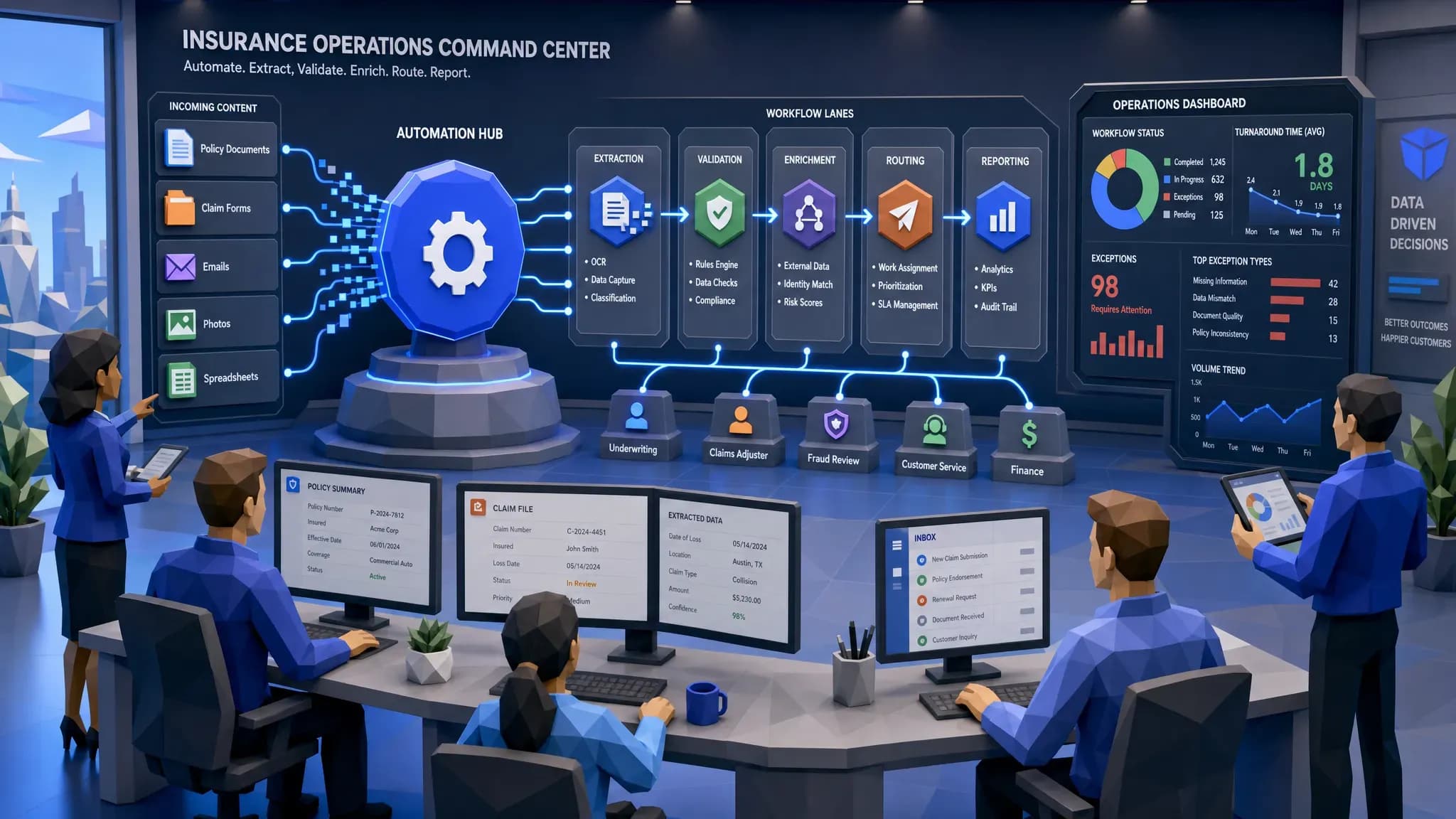
That begins with capture. Insurance data arrives in ugly, inconsistent formats. ACORD forms, broker emails, scanned PDFs, bordereaux, loss runs, photos, repair estimates, medical bills, police reports, call notes, spreadsheets, and portals all tell part of the story. A modern system should read across these formats and convert the important facts into usable data.
Then comes validation. Before data moves downstream, the system should catch obvious issues. Is the VIN valid? Does the policy number match? Is the loss date within the policy period? Is the driver listed? Are required fields missing? Does the garage address line up with the risk being priced? These are not glamorous checks, but neither is finding out three weeks later that the quote was built on shaky information.
Next comes enrichment. Good insurance decisions often depend on data beyond the submission or claim file. External data sources can help verify risk characteristics, property attributes, driving information, hazard exposure, prior losses, or business details. The key is making that enrichment part of the workflow, rather than forcing an underwriter or adjuster to go hunting across separate tools.
Finally, the system should act. If a submission is complete and eligible, route it forward. If it is missing data, ask for what is missing. If a claim has fraud indicators, flag it early. If a demand package crosses a severity threshold, escalate it. If a renewal has deteriorating loss experience, put it in front of the right underwriter with the relevant context already assembled.
That is the difference between storing work and moving work.
The Data Warehouse Under the Hood Matters More Than People Think
Here is another opinion that tends to get me invited to fewer vendor cocktail hours: workflow automation without a strong data foundation becomes another silo.
If you automate intake but the extracted data is not stored consistently, you have made one process faster while starving the business of insight. If you automate claims triage but cannot analyze which claim types are driving leakage, you have improved speed without improving strategy. If underwriting and claims data never meet, renewal pricing is still half blind.
This is why a unified data warehouse matters. Every workflow creates valuable signals. Which submissions are being declined? Which documents are most often incomplete? Which brokers send the cleanest data? Which claim types escalate into attorney involvement? Which territories are showing unusual loss development? Which underwriting rules are causing referrals, and are those referrals actually improving results?
These are not abstract analytics questions. They are portfolio questions, profitability questions, and reinsurance questions.
For example, if you are preparing for reinsurance negotiations, you do not want a scramble across six systems and three teams to build a narrative. You want clean, connected data that shows how the portfolio is performing, how risk selection has changed, where losses are emerging, and how your book compares with relevant benchmarks.
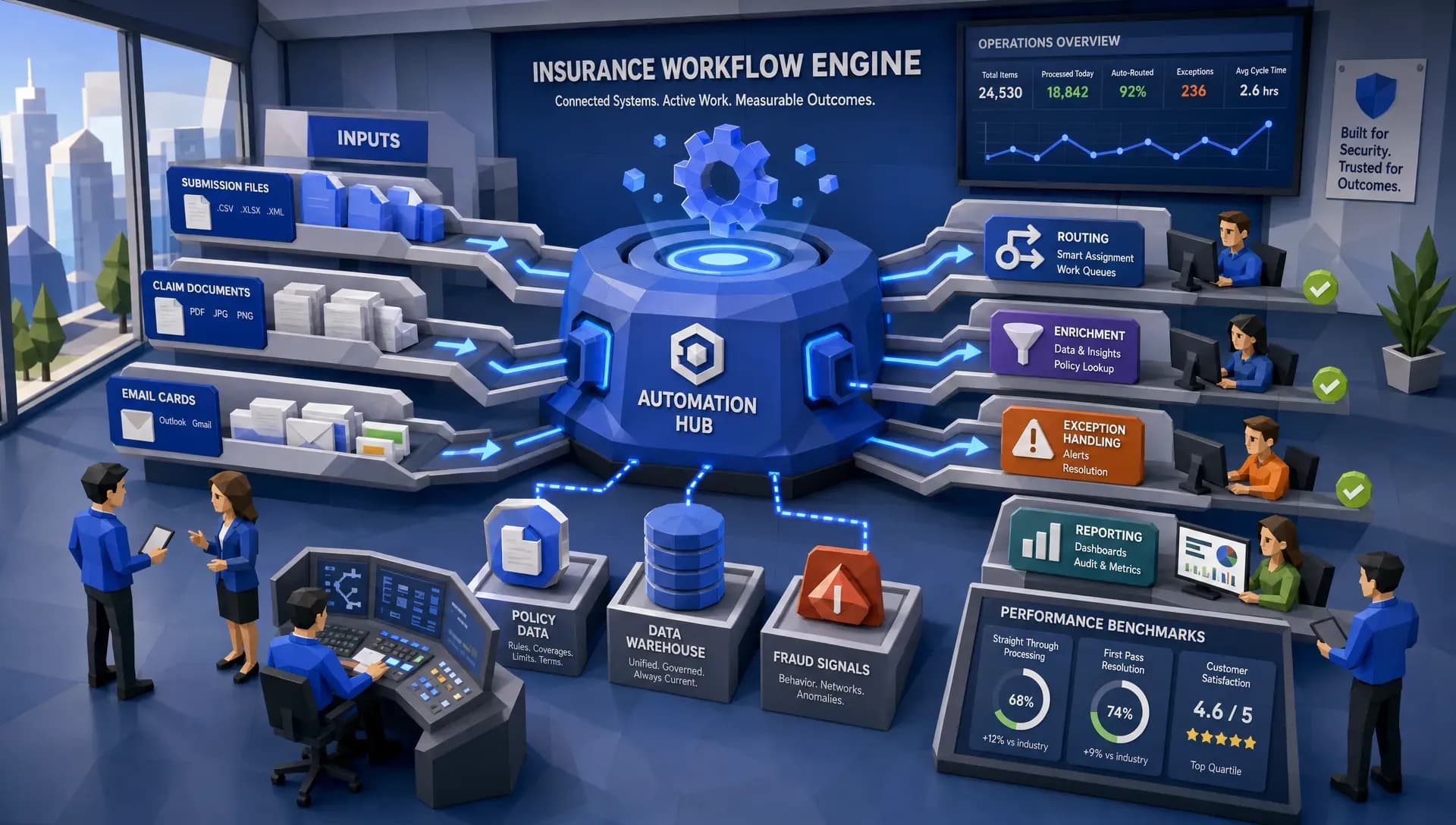
This is one reason Inaza was built with a data warehouse underpinning the automation layer. The workflow is the visible part. The bigger value comes from capturing key data points as work happens, then turning them into dashboards, reporting, analytics, and benchmarking. For insurers, MGAs, and brokers, that means operations can become a source of business intelligence instead of a pile of completed tasks.
Underwriting Needs Fewer Copy-Paste Athletes
Underwriting is where the limits of passive systems are painfully obvious.
A good underwriter is part analyst, part negotiator, part skeptic, part relationship manager. I have yet to meet one who joined the profession because they loved manually reconciling vehicle schedules.
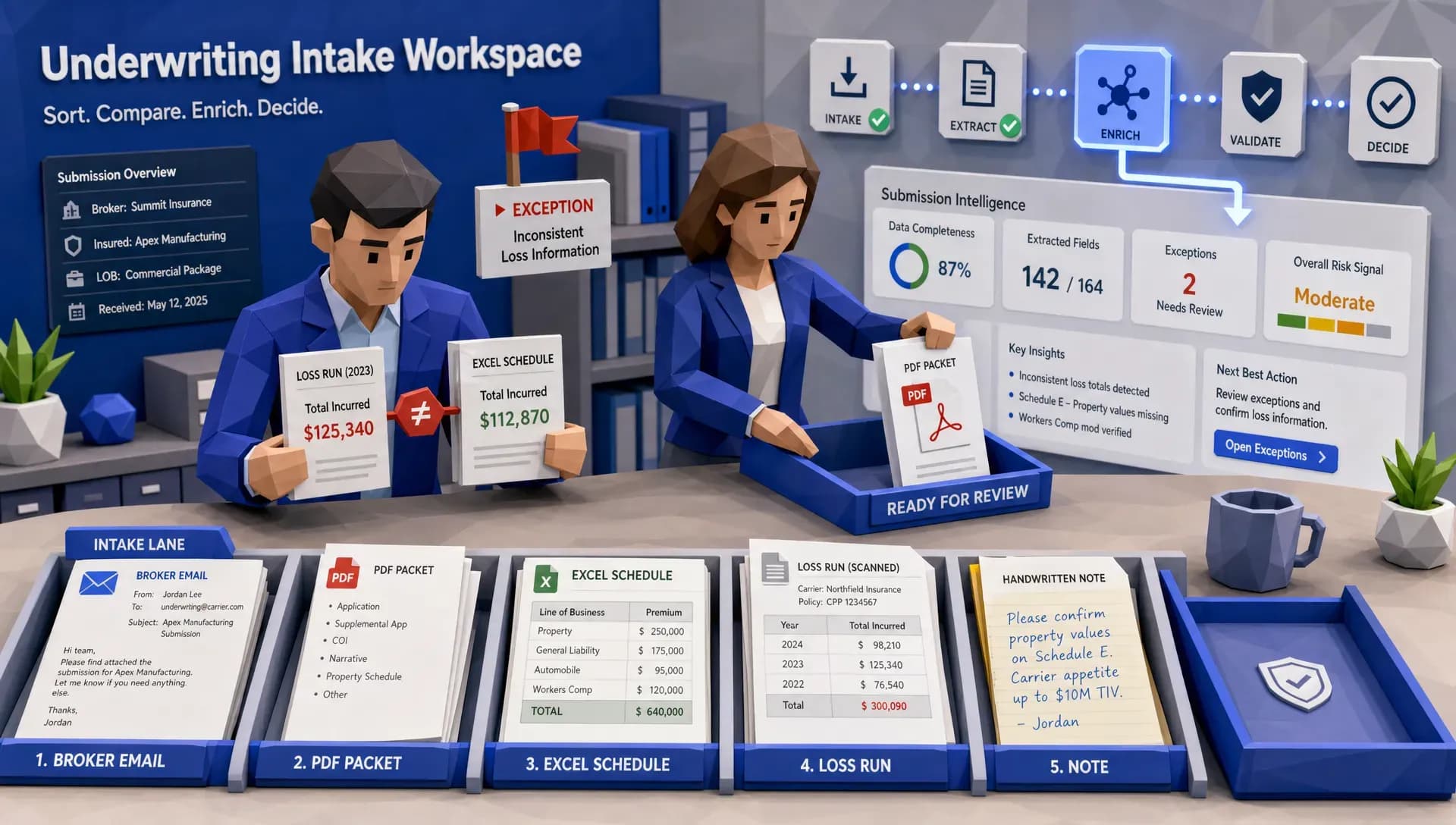
Yet that is how many teams spend their day. They receive submissions by email. They open attachments. They extract key fields. They compare against guidelines. They check third-party sources. They ask brokers for missing data. They re-enter information into the rating system. Then they do it again for the next account.
There is a better way.
Modern insurance software systems should automate the intake and preparation work so underwriters can spend more time on judgment. That means extracting data from submissions, validating it, enriching it through sources such as Verisk, LexisNexis, HazardHub, or other relevant providers, applying underwriting rules, and presenting the underwriter with a clear view of the risk.
The goal is not to remove underwriting judgment. Frankly, I would not trust a system that pretends every risk can be reduced to a green light or red light. The goal is to remove avoidable friction before the underwriter gets involved.
A simple example: if a fleet submission has 80 vehicles and 12 have questionable VINs, the underwriter should not discover that after manually reviewing the file. The system should catch it at intake, request clarification, enrich what it can, and route only the right exceptions for review. That is how you improve speed without turning underwriting into a vending machine.
Claims Systems Should Move the Claim, Not Memorialize the Delay
Claims teams face a similar issue, but with higher emotional stakes. A policyholder reporting a loss is usually not having a great day. If the claim file becomes a holding pen for unstructured notes, missing photos, delayed estimates, and manual follow-ups, customer frustration builds quickly.
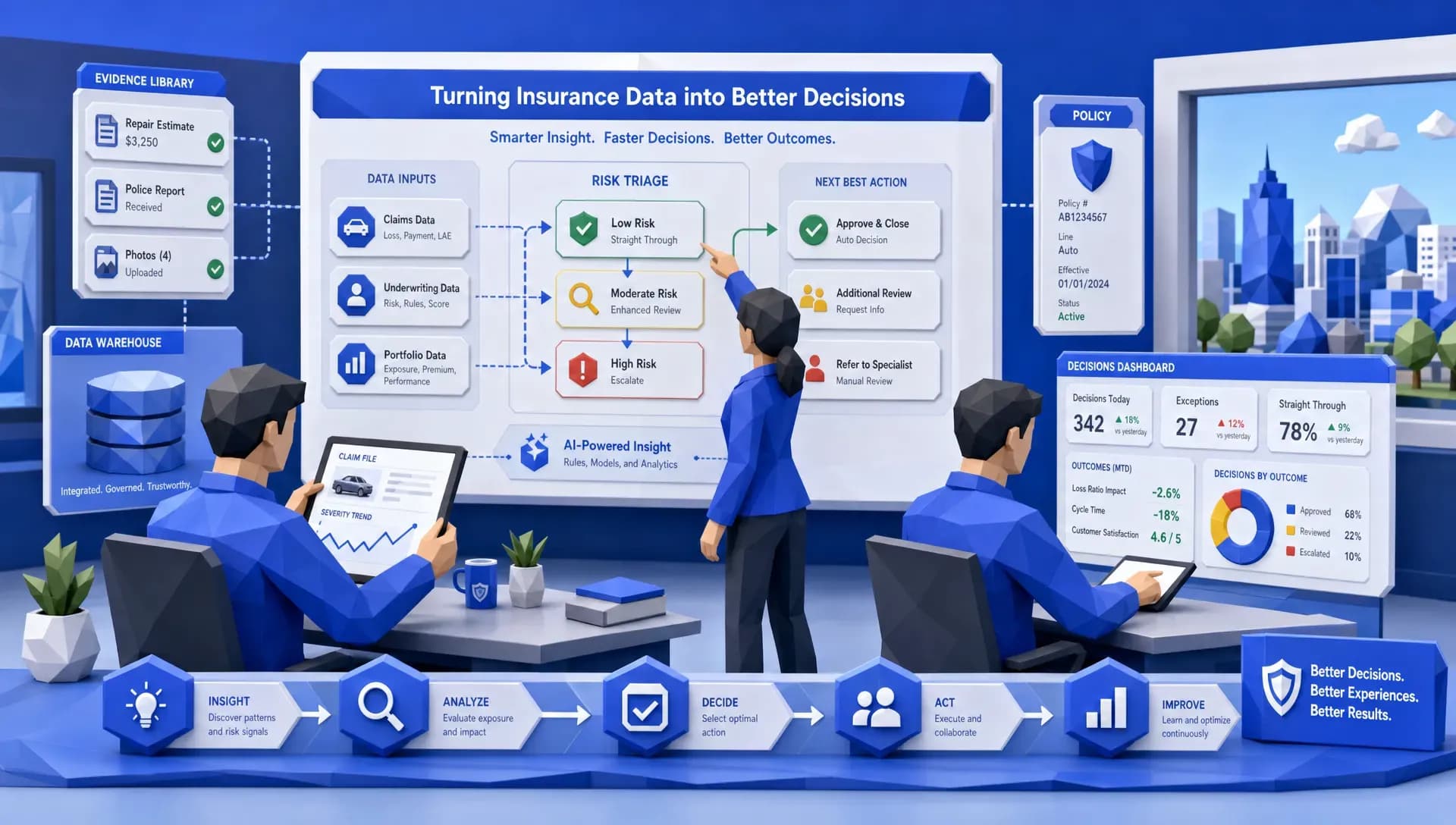
Better claims software should turn FNOL into structured action. It should capture the facts of loss, check coverage basics, classify severity, identify missing information, route the claim, flag potential fraud, and keep the policyholder informed. For bodily injury claims or attorney demands, it should help organize medical records, demand letters, timelines, and exposure indicators so the adjuster is not starting from a blank page.
Again, this does not mean every claim should be processed without a human. Some claims need empathy, negotiation, legal judgment, or careful investigation. But the system should know the difference between routine work and work that needs human attention.
This is where straight-through processing can be powerful, as long as it is used responsibly. Low-complexity claims can move quickly. Complex claims can be escalated earlier. Fraud teams can review higher-quality referrals. Adjusters can spend less time searching and more time resolving.
That is a much better use of talent than asking skilled claims professionals to behave like document clerks with nicer headsets.
The Core System Should Not Be Treated as the Whole Operating Model
One of the biggest mistakes I see is assuming the core system must do everything.
Core systems matter. Policy administration, claims administration, billing, rating, and document systems are critical infrastructure. But many were not designed to handle today’s volume of unstructured data, real-time enrichment, automated decisioning, and cross-functional analytics.
Trying to force every modern workflow into the core can turn a simple improvement into a 12-month project with three steering committees and one person named Gary who knows where the legacy field mappings live.
The smarter approach is to connect around existing systems. Keep the systems your teams already rely on, then add an automation and data layer that can ingest files, structure information, trigger workflows, integrate through APIs, and push clean data back where it belongs.
That is also why speed of deployment matters. Insurers are tired of proof-of-concept purgatory. A workflow that takes months to test, debate, rebuild, and re-test often loses momentum before it reaches production. Inaza’s approach is designed to let insurers deploy configurable workflows quickly, including production-ready workflows, while integrating with existing systems and avoiding unnecessary team retraining.
In plain English: fix the process without making everyone learn a new job.
What to Look for When Modernizing Insurance Software Systems
When I evaluate insurance software systems, I do not start with the prettiest dashboard. I start with the operating questions.
Can the system handle the files your teams actually receive, not the tidy samples used in a demo? Can it extract, validate, and normalize data from emails, PDFs, spreadsheets, images, and forms? Can it connect to the third-party sources your underwriting and claims teams already trust? Can business users adjust workflows without a six-week IT queue? Can it show why a file was routed, flagged, approved, referred, or escalated? Can it measure outcomes across underwriting, claims, customer service, and operations?
The best systems make work easier without hiding the reasoning. That matters for compliance, auditability, and trust. If a system changes how submissions or claims are handled, teams need to understand the logic. Regulators may need to understand it too.
I also look closely at analytics. A dashboard should do more than display volume. Volume is useful, but it is not strategy. Leaders need to see bottlenecks, exception rates, cycle times, accuracy, referral reasons, quote abandonment signals, claim severity trends, fraud indicators, and benchmark comparisons.
Inaza supports this through real-time analytics dashboards, customizable automation workflows, a unified data warehouse, and pre-built workflow templates. The practical value is that insurers can automate work and measure what the automation is teaching them. That is where operational efficiency starts turning into competitive advantage.
The Future Belongs to Systems That Learn From the Work
The next generation of insurance software will be judged less by what it stores and more by what it improves.
Does it help underwriters quote faster without weakening risk selection? Does it help claims teams resolve faster without missing fraud? Does it help brokers get cleaner responses? Does it help reinsurance teams tell a stronger portfolio story? Does it help executives see where the business is drifting before the combined ratio sends a strongly worded memo?
I am only half joking about that last one.
The insurers that win will not be the ones with the most databases. They will be the ones that turn operational data into decisions, workflows, and intelligence. They will connect underwriting and claims. They will treat every inbound document as a chance to improve the process. They will stop paying skilled people to re-key information that software should have handled in the first place.
And perhaps most importantly, they will stop confusing stored data with usable data.
Frequently Asked Questions
What are insurance software systems? Insurance software systems are platforms used by insurers, MGAs, brokers, and claims teams to manage policies, submissions, claims, billing, documents, workflows, reporting, and customer interactions. Modern systems should also structure data, automate tasks, and support better decisions.
Why is storing data no longer enough for insurers? Storing data does not reduce manual work by itself. Insurers need systems that can extract information from messy documents, validate it, enrich it with trusted sources, trigger workflows, and surface insights for underwriting, claims, fraud, and operations.
How can better insurance software improve underwriting? Better systems reduce re-keying, validate submission data, enrich risk information, apply underwriting rules, and route exceptions to the right people. This helps underwriters spend more time assessing risk and less time chasing missing or inconsistent information.
How can better insurance software improve claims? Claims teams benefit when systems structure FNOL data, route claims by severity, flag fraud indicators, organize documents, automate follow-ups, and provide real-time visibility into cycle times and bottlenecks.
Do modern insurance systems replace underwriters or adjusters? No. The strongest systems remove repetitive administrative work and give professionals better information. Human judgment remains essential for complex risks, sensitive claims, negotiations, litigation, and customer conversations.
Make Your Insurance Software System Work for the Business
If your platform stores data but still leaves teams buried in manual work, it is time to expect more.
Inaza helps insurers, MGAs, and brokers automate underwriting, claims, customer service, and operational workflows while capturing the data needed for reporting, analytics, and better decision-making. With configurable workflows, a unified data warehouse, pre-built API templates, and real-time dashboards, Inaza is built for insurers that want systems to act, not merely archive.
Ready to see what that looks like in practice? Visit Inaza to explore how your insurance workflows can become faster, cleaner, and more measurable.