Here is my hot take after a decade around underwriting desks, claims teams, broker submissions, and more spreadsheet rodeos than I care to admit: most property insurance software is built for clean demo day, not for a normal Tuesday.
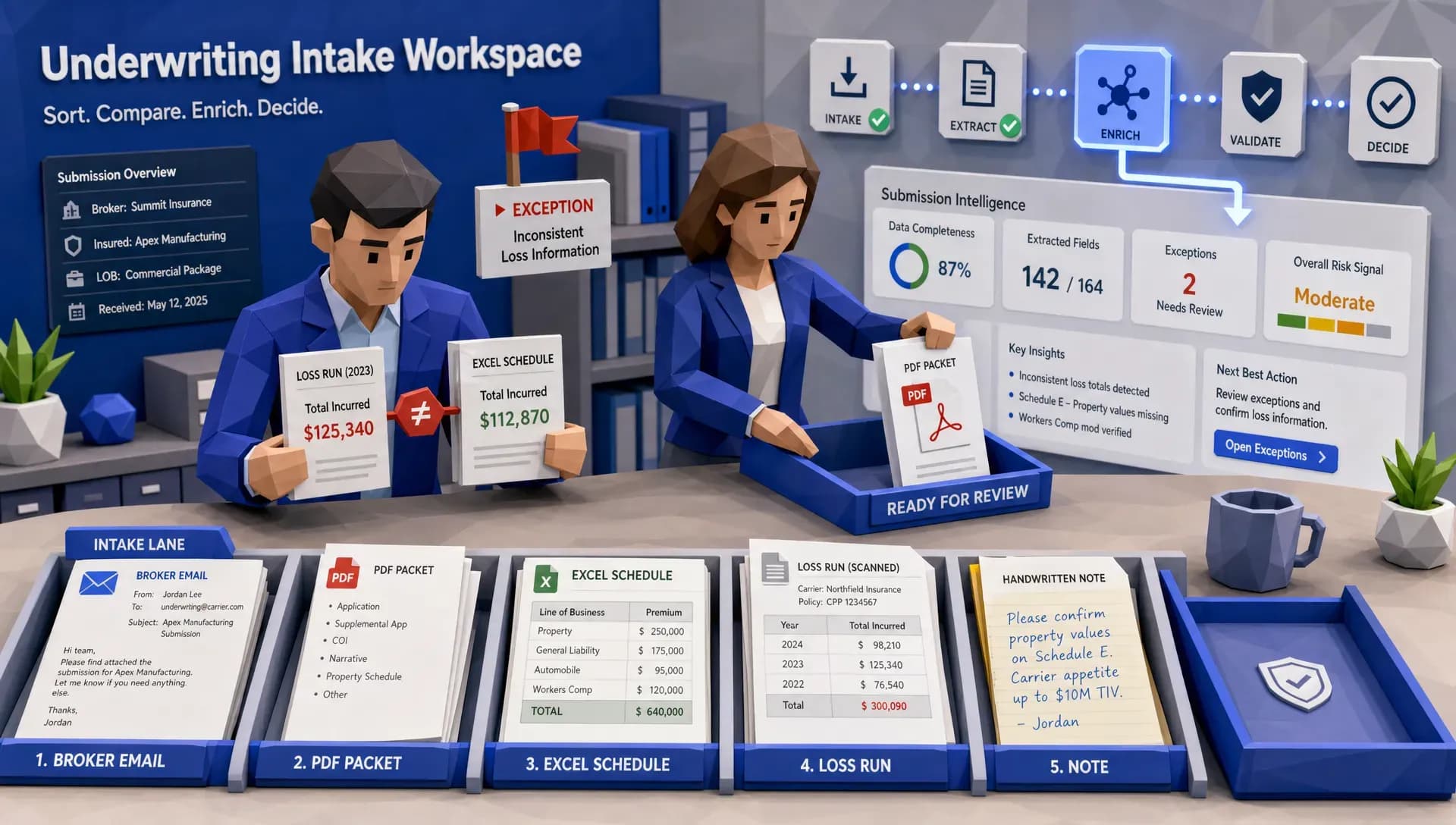
And a normal Tuesday in property insurance is not clean. It is an SOV with three tabs named Final, Final v2, and Use This One. It is a broker email with missing roof age, a PDF inspection report scanned sideways, five locations with different occupancies, a prior loss run that does not match the application, and an underwriter who still has to make a call before lunch.
That is the work property insurance software should handle. Not the glossy version. The real version.
Real work starts with messy intake
If property insurance software cannot handle messy intake, everything downstream becomes expensive theater.
Submissions arrive by email, portal, spreadsheet, PDF, broker management system, API, and occasionally by what I call the ancient art of forwarded chaos. A good platform should capture the submission, identify the documents, extract the relevant data, and structure it without forcing staff to re-key the same fields into three different systems.
I once watched a commercial property underwriter process a strip mall submission where the building schedule said one construction type, the application said another, and the inspection report implied a third. The underwriter was not being slow. The work was slow because the data had to be hunted, compared, and challenged before risk assessment could even begin.
That is not underwriting. That is clerical archaeology.
McKinsey has noted that underwriters can spend as much as 60 percent of their time on administrative tasks, rather than actual risk assessment. In property, that figure feels painfully believable. If software only digitizes the mess but leaves humans to reconcile it manually, we have simply moved the clutter from the desk to the screen.
Good software should ingest the mess and make it usable. That means recognizing locations, total insured values, occupancy, construction, protection class, roof age, limits, deductibles, prior losses, mortgagee details, endorsements, inspection notes, and broker commentary. It should also flag what is missing, contradictory, or stale.
The goal is not to remove judgment. The goal is to stop wasting judgment on copy-paste work.
Property risk is local, physical, and annoyingly specific
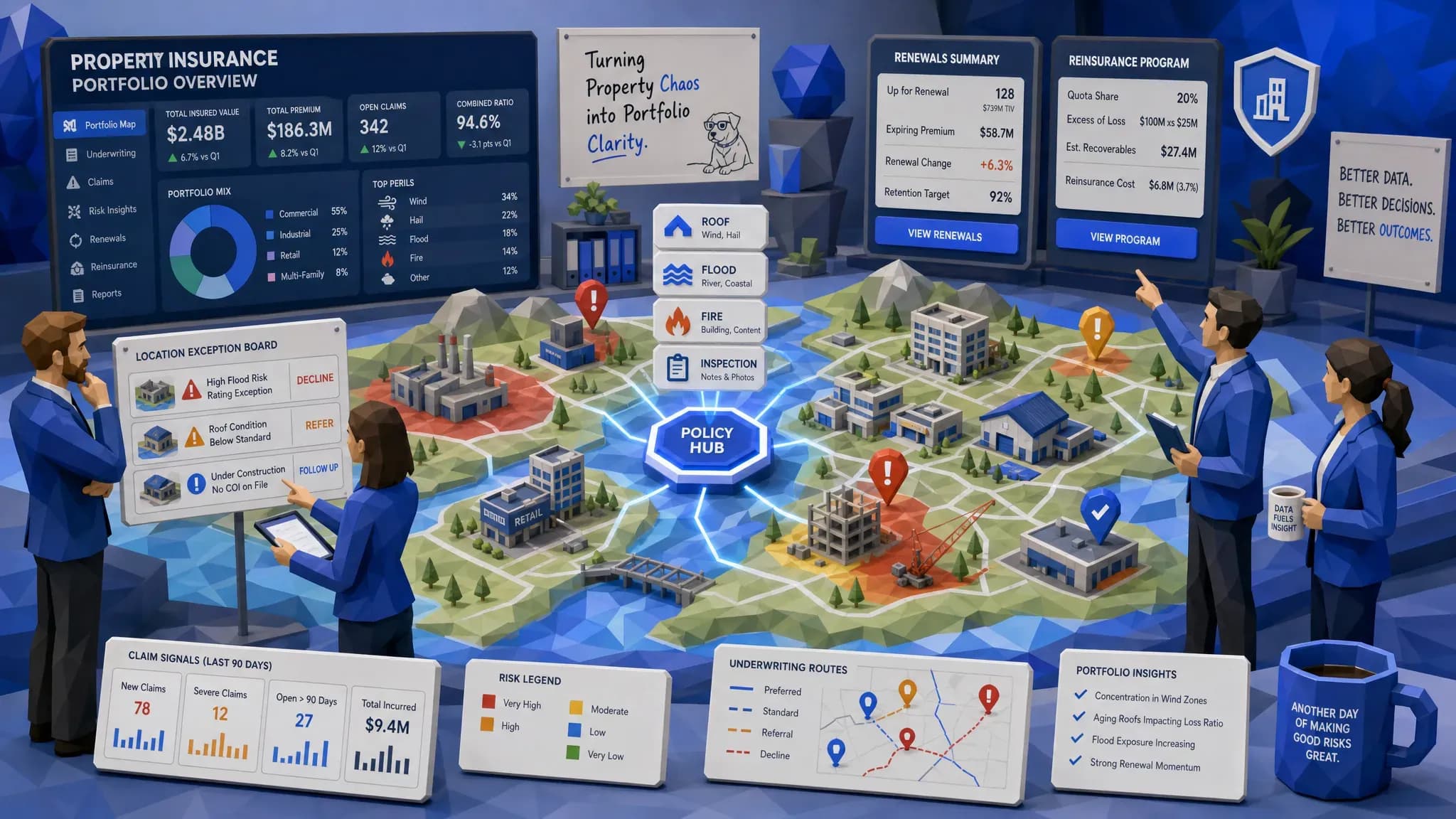
Property underwriting has always had a local flavor. A building is not just an address. It is a roof, a flood zone, a wildfire exposure, a wind corridor, a sprinkler system, a tenant mix, a claims history, and a maintenance story.
The best property insurance software should understand that context. It should enrich raw submissions with third-party data, local hazard information, geocoding, catastrophe indicators, and claims history where available. It should help an underwriter see the real risk picture without opening six browser tabs and muttering under their breath.
This is why I get twitchy when someone says a property platform is only about documents. Documents are the starting line. The real value is what happens after the data is captured. Can the software validate the data? Can it compare it to underwriting rules? Can it add hazard information? Can it route exceptions? Can it show the portfolio impact?
Property risk is also a reminder that local knowledge matters. Outside insurance, you see the same principle in travel planning. A serious local guide does not treat every trip as a generic itinerary; for example, Uganda safari planning around gorilla trekking and wildlife tours depends on terrain, timing, permits, and local conditions. Property insurance is similar in spirit. Two buildings with the same replacement cost can behave very differently once location, weather, construction, and use enter the picture.
That is where software earns its keep.
The workflow should follow the work, not the other way around
Here is another opinion that occasionally gets me invited to fewer vendor dinners: if your software requires the operations team to rebuild its day around the tool, the tool has already lost.
Property insurance software should fit into the systems insurers, MGAs, and brokers already use. That includes policy administration systems, claims systems, rating engines, data providers, email inboxes, document stores, and reporting tools. Nobody wants another swivel-chair platform where the user has to jump from screen to screen like they are playing a low-budget video game.
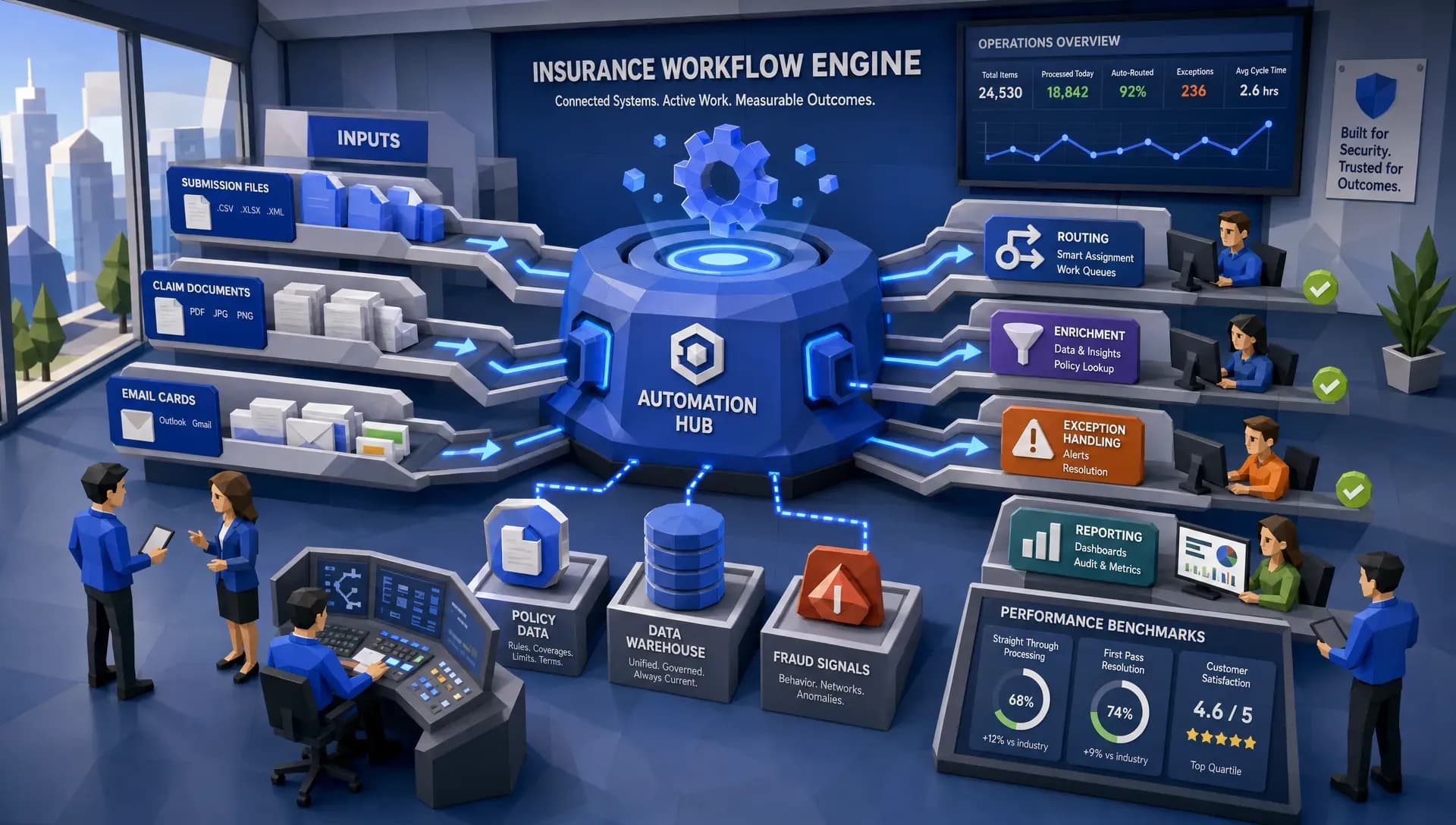
A strong workflow should feel almost boring. Submission comes in. Data is extracted. Missing fields are requested. External data is appended. Eligibility rules run. Straightforward risks move ahead. Exceptions go to the right person with the right context. Decisions are recorded. Reports update automatically.
That may not sound glamorous, but neither is a water leak in a 1970s apartment block. Property insurance is a business of operational discipline. Glamour is optional. Auditability is not.
The software must know when to stop
Real automation does not mean every file should be pushed straight through. In fact, the fastest way to lose trust in a system is to automate decisions that clearly deserve a human look.
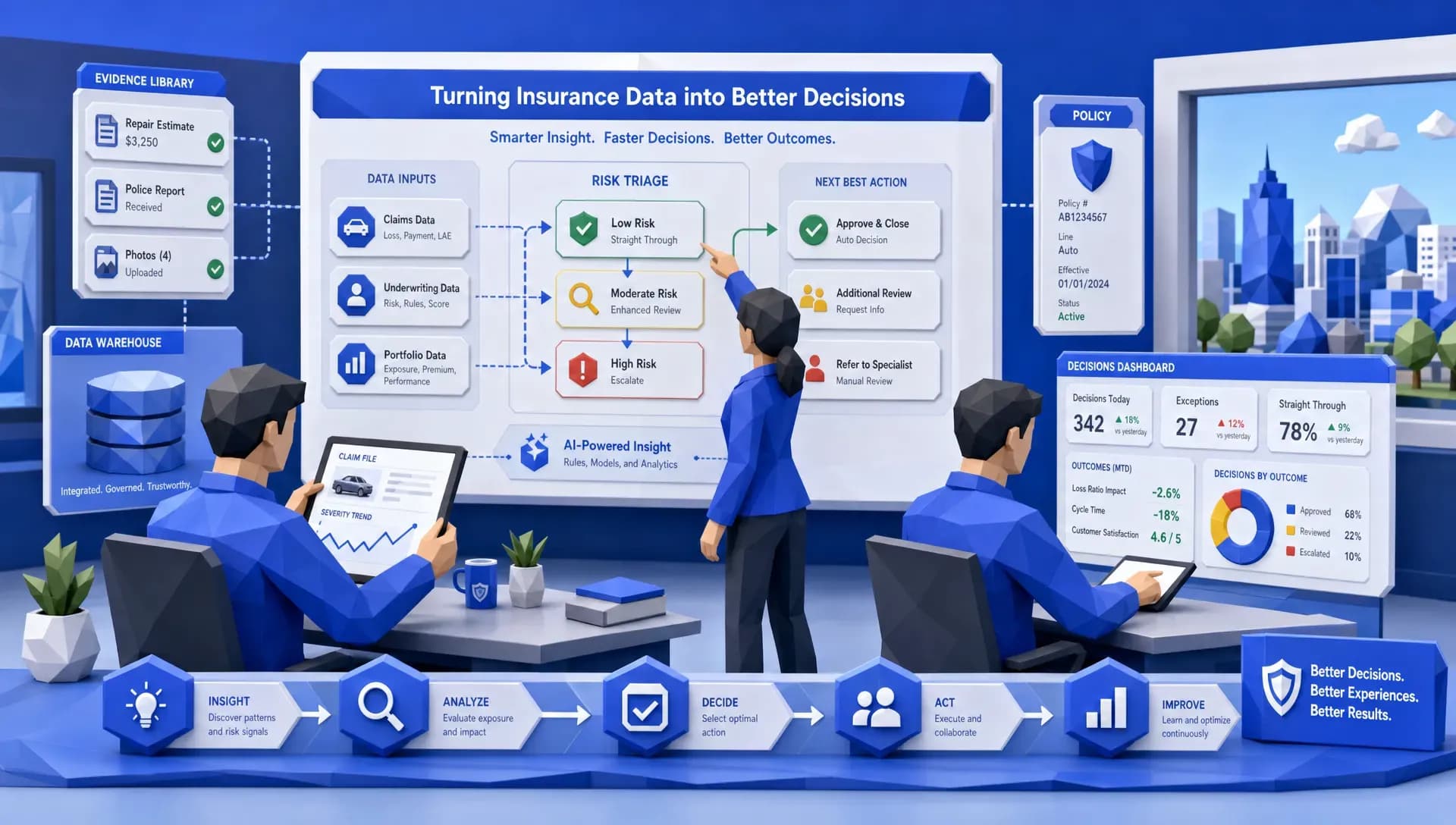
A good property platform should know when to pause. If the roof age conflicts across documents, pause. If the TIV jumps materially at renewal, pause. If a claimed cause of loss does not match weather data, pause. If an insured location sits inside a newly updated flood exposure area, pause. If an image or invoice looks suspicious, pause.
This is especially important in claims. The FBI has long warned that insurance fraud costs consumers and insurers billions, and property claims are not immune. After a major storm, claims teams face volume, urgency, and emotion all at once. That is exactly when fraud, exaggeration, and plain old mistakes can slip through.
I remember speaking with an adjuster after a hail event who said the hardest part was not the obvious total losses. It was the gray zone. Was the roof damage from this storm or the last one? Was the invoice reasonable? Did the photos match the address? Software should not pretend those are easy questions. It should gather the evidence, compare it, flag anomalies, and help the adjuster focus on the files where experience matters most.
The best systems do not replace professional skepticism. They give it better evidence.
Underwriting and claims need the same data spine
One of the biggest missed opportunities in property insurance is the gap between underwriting and claims. Underwriting gathers risk information. Claims reveals what actually happened. Then, too often, those insights live in separate systems like neighbors who wave but never speak.
That is a problem.
If a certain occupancy type is producing more water damage than expected, underwriting should know. If roof age data is consistently wrong at submission, underwriting should know. If a broker segment has unusually high claim frequency or missing documentation, underwriting should know. If a geographic cluster is producing losses after a weather pattern, portfolio managers should know.
The phrase property insurance software can sound narrow, but the best version is not just a quoting tool or a claims tool. It is a connected operating layer. It should create feedback loops between submissions, policies, endorsements, inspections, renewals, claims, fraud reviews, and portfolio analytics.
NOAA's Billion-Dollar Weather and Climate Disasters data is a useful reminder that severe weather is not a theoretical concern for property insurers. Catastrophe exposure, secondary perils, and accumulation management all depend on data that is timely, connected, and trusted.
If claims data takes months to become underwriting insight, you are pricing yesterday's weather with yesterday's assumptions. That is a brave strategy, and not in a good way.
Reporting should not be a month-end scavenger hunt
I have seen teams spend days building reports that leadership treats as old news by the time they arrive. That is not a reporting problem. That is a data architecture problem.
Property insurance software should capture the key data points generated by everyday work, then make them available for analytics. That includes operational metrics like processing time, exception rates, missing data frequency, straight-through rates, claim cycle time, and referral reasons. It also includes portfolio metrics like exposure concentration, loss trends, rate adequacy, premium leakage, and renewal performance.
This is where a unified data warehouse becomes more than a nice-to-have. Workflow automation improves today's process. A strong data layer improves tomorrow's decisions.
For reinsurers and reinsurance brokers, this matters even more. When renewal season comes around, nobody wants to scramble for a credible portfolio narrative. You need to explain the book, show how performance compares with the market, defend underwriting actions, and tell a coherent risk story. Benchmarks and clean historical data can make those conversations far less painful.
And yes, I am saying this as someone who has seen reinsurance packs assembled with enough manual effort to qualify as a team-building exercise.
What I would look for in property insurance software
If I were evaluating a platform today, I would care less about the slickest demo and more about how it behaves under pressure. Can it handle a surge after a storm? Can it process inconsistent broker submissions? Can it integrate without a year-long technology project? Can business users adjust workflows without waiting for an endless proof-of-concept cycle?
A practical property insurance software platform should pass a few real-world tests:
- It should support unstructured files, structured data, emails, PDFs, spreadsheets, images, and API feeds.
- It should integrate with existing systems instead of forcing a rip-and-replace project.
- It should automate routine decisions while escalating unclear or high-risk cases.
- It should leave a clear audit trail for compliance, governance, and internal review.
- It should enrich data through reliable external sources and configurable rules.
- It should turn workflow activity into analytics, dashboards, and portfolio insight.
- It should be usable by underwriting, claims, operations, and leadership without weeks of retraining.
That last point is underrated. In insurance, adoption dies quietly. Nobody announces that a platform failed because it annoyed the team. People just work around it, usually in Excel. Then the vendor wonders why the transformation did not transform much.
Where Inaza fits into this picture
Inaza was built around the idea that insurance automation should handle operational reality, not just tidy workflows. The platform supports underwriting, claims, customer service, and insurance operations, with automation that integrates into existing systems and captures data as work moves through the business.
For property insurers, MGAs, brokers, and reinsurers, that matters because the work rarely lives in one neat lane. A submission can become a policy. A policy can become an endorsement. A claim can become a fraud review. A claims pattern can become a renewal action. A portfolio trend can become a reinsurance conversation.
Inaza's AI-powered insurance automation platform includes customizable workflows, 250+ workflow templates, support for all file types, seamless system integration, and a unified data warehouse for reporting and analytics. Its pre-built API templates can help enrich workflows with data providers such as Verisk, LexisNexis, HazardHub, and others. The platform also includes industry benchmarks, including sources such as Aon, Munich Re, and Howden, to help teams compare performance and build stronger portfolio narratives.
The piece I like most is speed to value. In my experience, many insurance technology projects get trapped in the proof-of-concept swamp. Everyone is busy proving something can work while the operations team is still drowning. Inaza is designed to help insurers deploy production-ready workflows quickly, often without the usual back-and-forth that slows transformation before it starts.
Frequently Asked Questions
What is property insurance software? Property insurance software helps insurers, MGAs, and brokers manage underwriting, policy servicing, claims, data capture, risk analysis, reporting, and workflow automation for property risks.
What should property insurance software automate first? Start with intake, document extraction, data validation, missing information requests, eligibility checks, claims triage, and reporting. These areas usually create immediate time savings without removing human oversight from complex decisions.
Should property underwriting be fully automated? Some property risks can move through automated workflows, especially simple or well-defined submissions. Complex risks, conflicting data, high-value properties, catastrophe exposure, and unusual claims should still be escalated to experienced professionals.
Why does a data warehouse matter in property insurance software? A data warehouse turns everyday workflow activity into usable business intelligence. It helps teams track performance, analyze exposure, spot leakage, benchmark portfolios, and support reinsurance or renewal discussions.
How can insurers adopt automation without retraining every team? The best approach is to integrate automation into existing systems and workflows. Staff should see cleaner queues, better data, and clearer exceptions, rather than being forced into an entirely new operating model.
Make property insurance software do the real work
If your team is still stitching together submissions, claims, inspections, emails, spreadsheets, and reports by hand, the problem is not your people. It is the operating model.
Property insurance software should reduce manual handling, improve data quality, connect underwriting and claims, support better portfolio decisions, and give teams the confidence to move faster without losing control.
Inaza helps insurers, MGAs, brokers, and reinsurance teams automate the workflows that actually slow the business down. If you want a platform built for real insurance work, not demo-day perfection, visit Inaza to see how automation, data enrichment, and real-time analytics can work inside your existing operations.