Hot take: the claims team has been underwriting your renewals for years. They just did not always get invited to the renewal meeting.
I have sat in plenty of renewal reviews where the underwriter had the loss run, the rating sheet, the expiring premium, and a heroic amount of coffee. What they did not have was the story behind the claims. The loss run showed three auto claims. The claims file showed one distracted driver pattern, one coverage misunderstanding, and one suspicious late-reported bodily injury claim that had the word “attorney” written all over it.
That is the difference between looking at loss history and using connected claims. One gives you a spreadsheet. The other gives you renewal signals.
The renewal meeting should start with claims
Renewal underwriting is where the carrier or MGA decides whether the account still fits, whether the premium still makes sense, and whether the terms need tightening. Yet in many P&C operations, claims information reaches underwriting late, thin, or in a format only a very patient person could love.
A renewal underwriter may see paid loss, incurred loss, open or closed status, date of loss, and claim description. Useful, yes. Complete, no.
Claims teams see much more. They see whether the FNOL came in promptly or three weeks late. They see the repair estimate, damage photos, adjuster notes, attorney involvement, reserve movement, subrogation potential, customer responsiveness, fraud indicators, and whether a claim reopened after everyone thought it was done.
Those details matter because two accounts with the same loss ratio can have very different futures. One had bad luck and handled it cleanly. The other has a pattern forming, and the renewal price is about to pretend everything is fine.
What “connected claims” actually means
Connected claims means claims data is captured, structured, enriched, and fed back into underwriting, renewals, claims operations, fraud review, and portfolio reporting. In plain English, it means the claim file stops living in a basement filing cabinet with a password and starts helping the rest of the business make better decisions.
This is not about dumping every claim note on an underwriter’s desk. Underwriters already have enough to read. McKinsey has estimated that underwriters can spend as much as 60 percent of their time on administrative work rather than risk assessment. Handing them more raw data is like giving someone with a flat tire a second flat tire.
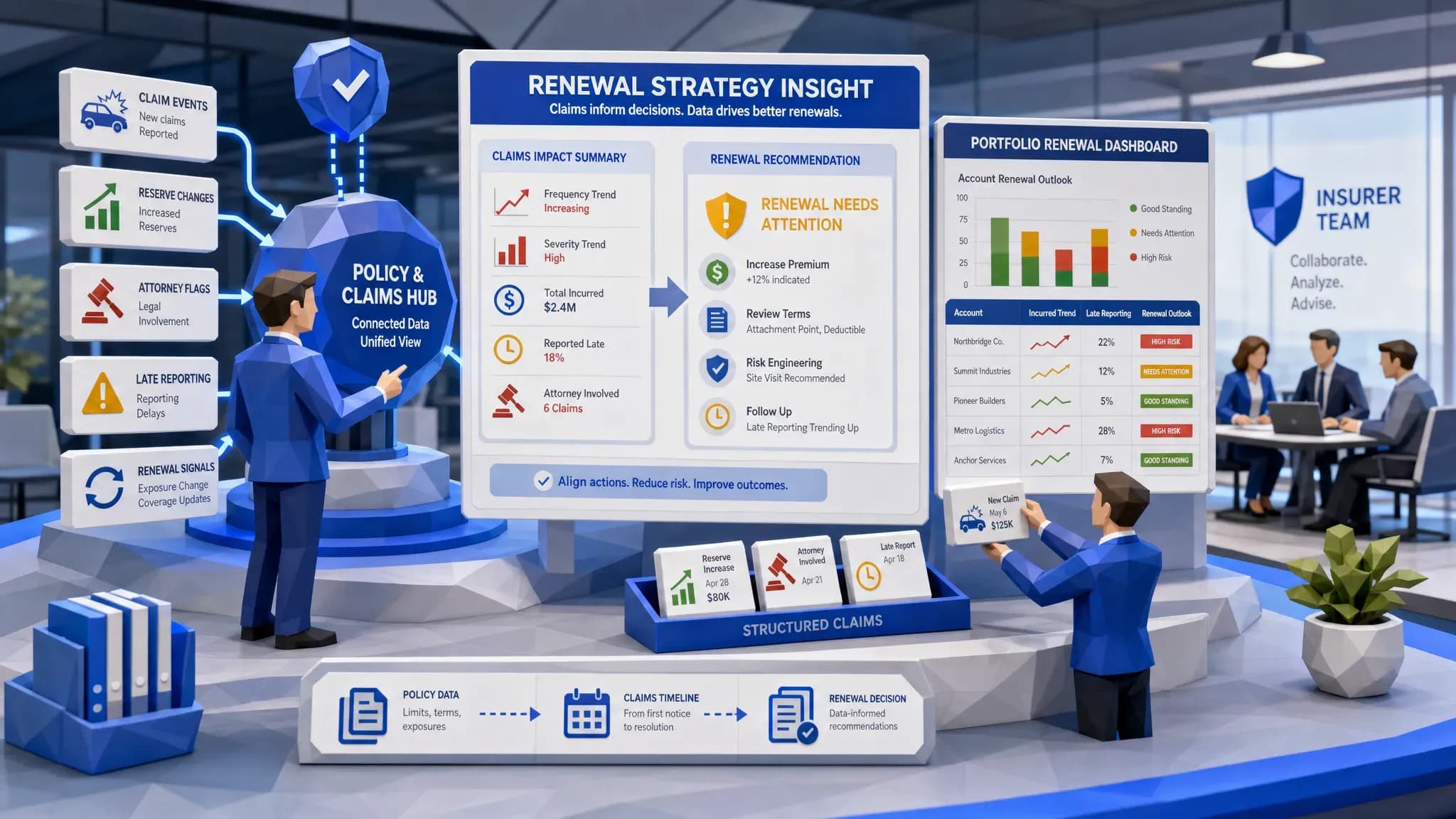
The goal is to turn claims activity into usable renewal signals, such as severity trends, coverage friction, litigation likelihood, repair cost patterns, recurring loss causes, and fraud concerns. The underwriter should not need to become a claims adjuster for the afternoon. They should see what changed, why it matters, and what action is recommended.
The signals underwriters miss when claims sit in a silo
Here is where I think many insurers underuse their own data. They treat claims as a historical accounting function. Claims happened, money moved, reserves changed, file closed. Fine. But for renewal underwriting, the claim is evidence of how the insured behaves under stress.
A few signals are especially valuable.
- FNOL timing: Late reporting can point to poor internal controls, possible coverage disputes, or a policyholder who does not understand their obligations.
- Reserve volatility: A claim that keeps jumping in value may reveal severity creep, poor initial information, or a loss type that the rating plan is not catching well.
- Attorney involvement: Early representation, demand letters, or repeated attorney patterns can change the expected cost of future claims.
- Damage and repair detail: Photos, estimates, and repair notes can expose mismatch between declared use and actual use, especially in commercial auto.
- Fraud and anomaly indicators: Metadata issues, repeated claimants, inconsistent statements, and recycled documents can all affect renewal confidence.
The best renewal signals usually come from combinations. A single late FNOL may be nothing. A late FNOL, a mismatched garaging location, a prior coverage dispute, and similar damage patterns across vehicles? Now we have something worth discussing.
Insurance fraud is one reason this matters. The FBI notes that non-health insurance fraud costs more than $40 billion per year in the United States. Fraud is not only a claims problem. If the underwriting team never sees the patterns coming out of claims, the same risk can quietly renew, reprice incorrectly, and create another ugly surprise later.
The claim file knows what the application forgot to mention
One of my favorite renewal examples is a small commercial auto fleet. On paper, the account looked average. Nothing dramatic. A few claims, manageable loss ratio, long-term customer, decent premium.
Then the claims detail came through. Two vehicles had similar rear-end losses within six months, both during early morning delivery runs. One driver had a prior violation that was not clearly reflected in the last submission. The insured had also added routes, but the policy record had not fully caught up.
No villain here. No dramatic fraud movie music. Just a growing exposure that the renewal process almost missed.
That is the practical value of connected claims. It helps underwriters separate bad luck from deteriorating risk quality. It also helps them avoid punishing good accounts. A single large weather-related loss should not always trigger the same renewal action as repeated preventable losses. Without context, the spreadsheet can make them look more similar than they are.
Think of it like the check engine light in your car. The light itself is useful, but the diagnostic code is what tells you whether you need a new gas cap or a new transmission. Loss history is the light. Connected claims provide the diagnostic code.
Better renewal decisions are rarely about more data
Most insurers do not have a data shortage. They have a “please stop making me copy this from one system into another” shortage.
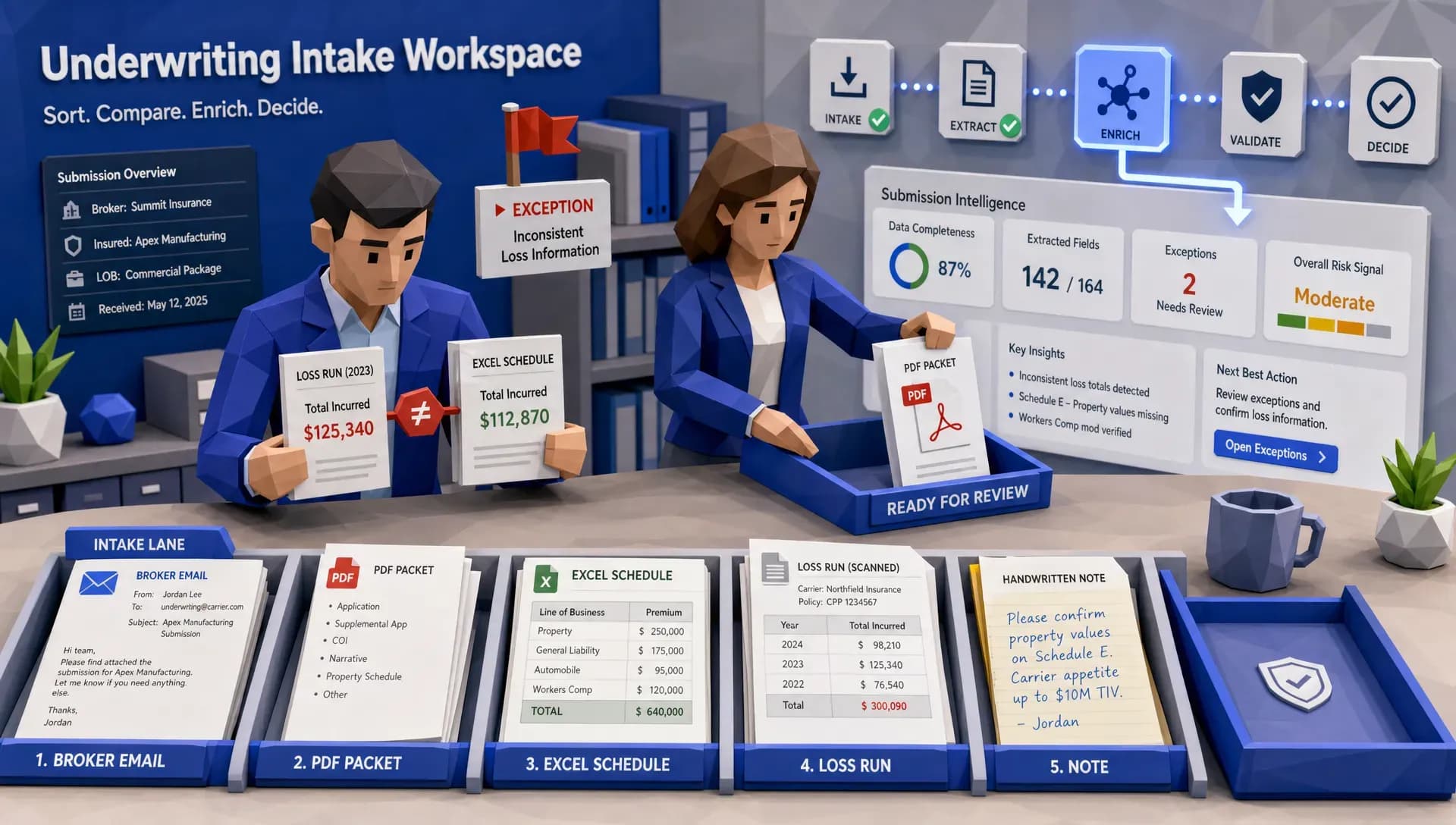
Claims details may be buried in emails, PDFs, adjuster notes, claim platforms, image files, call transcripts, attorney demands, police reports, medical bills, and vendor estimates. Underwriters usually get the polished version, often too late to shape the renewal conversation.
This is why I am skeptical when people say the answer is simply “more data.” More data without structure is clutter. More data without workflow is a scavenger hunt. More data without timing is a post-mortem.
The better question is: what should an underwriter know 30, 60, or 90 days before renewal?
For example, a connected claims workflow can surface whether open claims are likely to deteriorate, whether recent FNOL activity suggests a frequency issue, whether a specific coverage is producing unexpected disputes, or whether attorney demand patterns are affecting severity. Those insights should appear before renewal terms are finalized, not after the broker asks why premium moved.
J.D. Power’s 2024 U.S. Auto Claims Satisfaction Study highlights how claim handling and cycle time affect customer experience. I would add that they also affect renewal strategy. A slow or messy claim can become a retention issue. A well-handled claim can strengthen the relationship, even when money was paid.
A quick lesson from outside insurance
This closed-loop thinking is common in other industries. Marketers, for example, do not want ad spend, conversion tracking, audience research, and follow-up sitting in separate corners of the room. They want the whole system connected so every campaign teaches the next one what to do better, the kind of operating model you see from full-stack digital marketing teams.
Insurance should borrow that mindset. Every claim should teach the next underwriting decision something useful. Every renewal should reflect what claims have learned. Every portfolio review should connect exposure, loss behavior, operations, and market benchmarks in one coherent story.
Yes, I know, insurance is more regulated than marketing and nobody is pricing umbrella liability based on click-through rate. But the operating principle is the same: disconnected feedback loops create expensive blind spots.
What this looks like in a real renewal workflow
In a connected claims environment, renewal preparation starts well before the expiration date. The system links claims to the policy, exposure, vehicle, driver, property, location, coverage, and originating submission. It also captures the key events in the claim lifecycle: FNOL, triage, reserve changes, payments, documents received, attorney activity, fraud review, repair estimate, closure, reopen, and recovery.
The underwriter does not need to read every detail. They need a renewal view that says, in effect:
This account has two new frequency signals, one severity warning, one possible coverage mismatch, and no material fraud concern. Reserve movement is stable. Losses are concentrated in one vehicle class. Similar portfolios are trending worse in the market. Renewal action: review deductibles, verify vehicle use, and consider adjusted pricing rather than non-renewal.
That is a much better conversation than “loss ratio is up, so premium is up.” Brokers can work with a narrative. Reinsurance partners can work with a narrative. Policyholders, if handled carefully, can work with a narrative. Nobody enjoys a mystery surcharge.
For reinsurance brokers and portfolio managers, this is especially useful. Connected claims can support renewal and treaty discussions with evidence about where losses are coming from, which segments are improving, and which controls are working. Market benchmarks, where available, make the narrative stronger because the question becomes not only “how did we perform?” but “how did we perform compared with the market?”
Why connected claims matter for MGAs and carriers
For MGAs, connected claims help protect delegated authority. If you can show that claim trends are being fed back into underwriting rules, pricing, eligibility, and portfolio monitoring, you have a stronger story for capacity providers. You are not simply writing business and waiting for bordereaux to tell you how it went.
For carriers, connected claims improve discipline across the book. Claims leakage, premium leakage, misclassification, and fraud are often connected by data quality problems. The same missing driver, incorrect garaging location, or vague business-use description can hurt underwriting accuracy and claim handling later.
For brokers, the value is communication. A broker armed with a clear claim-based renewal narrative can explain terms more credibly to insureds. “The carrier is concerned about repeated preventable backing losses and late reporting” is more actionable than “the model changed.” I have never met a client who enjoyed hearing that the model changed. It has all the warmth of a parking ticket.
How to start without boiling the ocean
The best place to start is usually not a giant transformation program with 19 steering committees and a name like Project Phoenix. Start with one renewal workflow where claims signals are obviously valuable.
Commercial auto is a strong candidate because vehicle, driver, route, location, damage, injury, and fraud patterns all matter at renewal. Bodily injury-heavy books are another good candidate because attorney involvement, treatment patterns, reserves, and demand timing can materially change expected severity.
A practical first step is to connect FNOL and claim status data to the policy record. Then add document extraction for claim documents, adjuster notes, photos, attorney demands, and loss runs. After that, create a renewal dashboard that highlights exceptions rather than forcing underwriters to search manually.
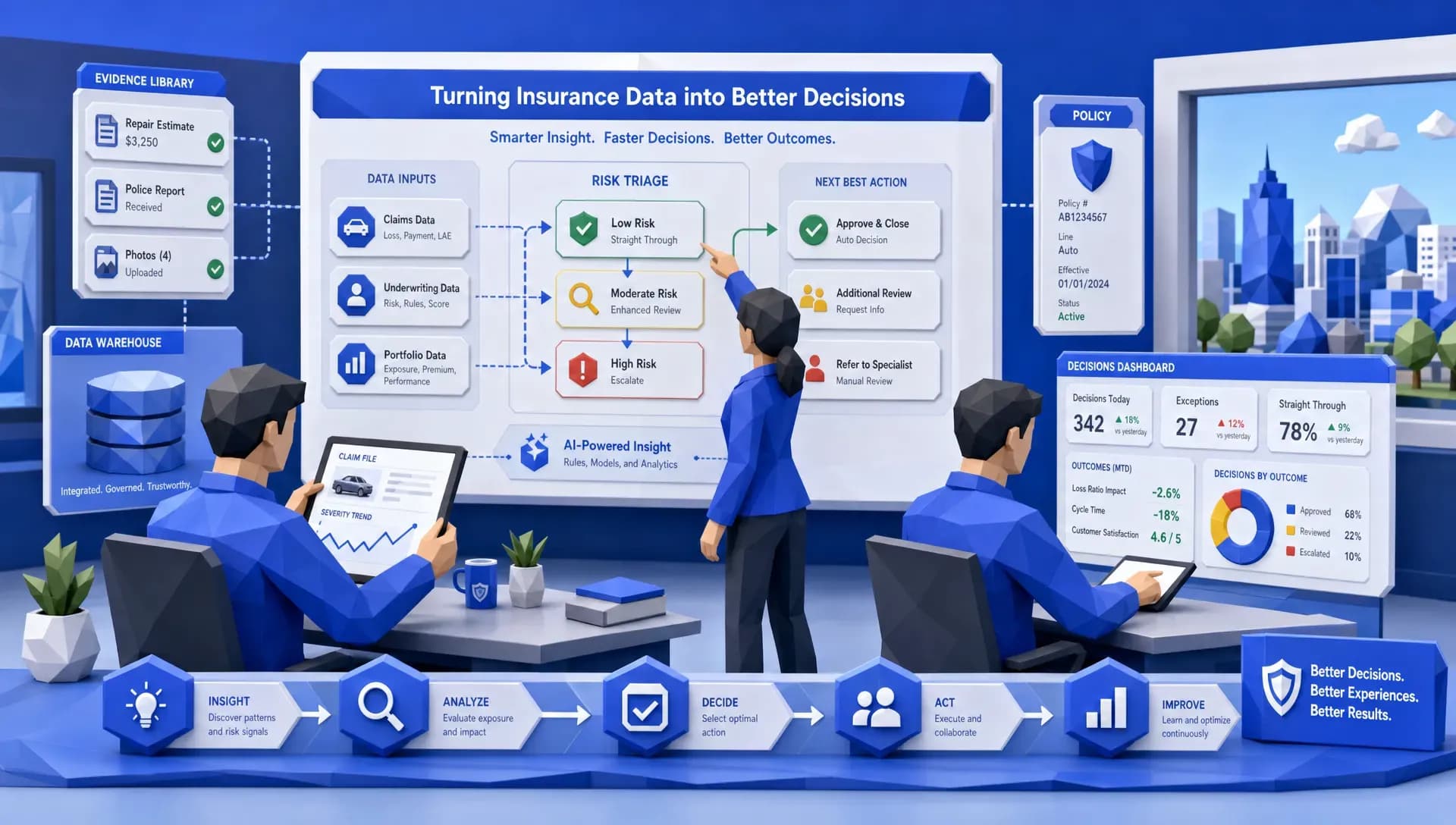
The key is to design around decisions, not data fields. Ask what renewal action the signal supports. If a signal does not help price, retain, re-underwrite, refer, decline, investigate, or explain, it may be noise.
Where Inaza fits
Inaza is built around this exact problem: insurance teams have valuable data trapped across workflows, files, inboxes, systems, and third-party sources. Our platform helps insurers, MGAs, and brokers automate data capture, connect workflows, and turn operational data into analytics that can actually be used.
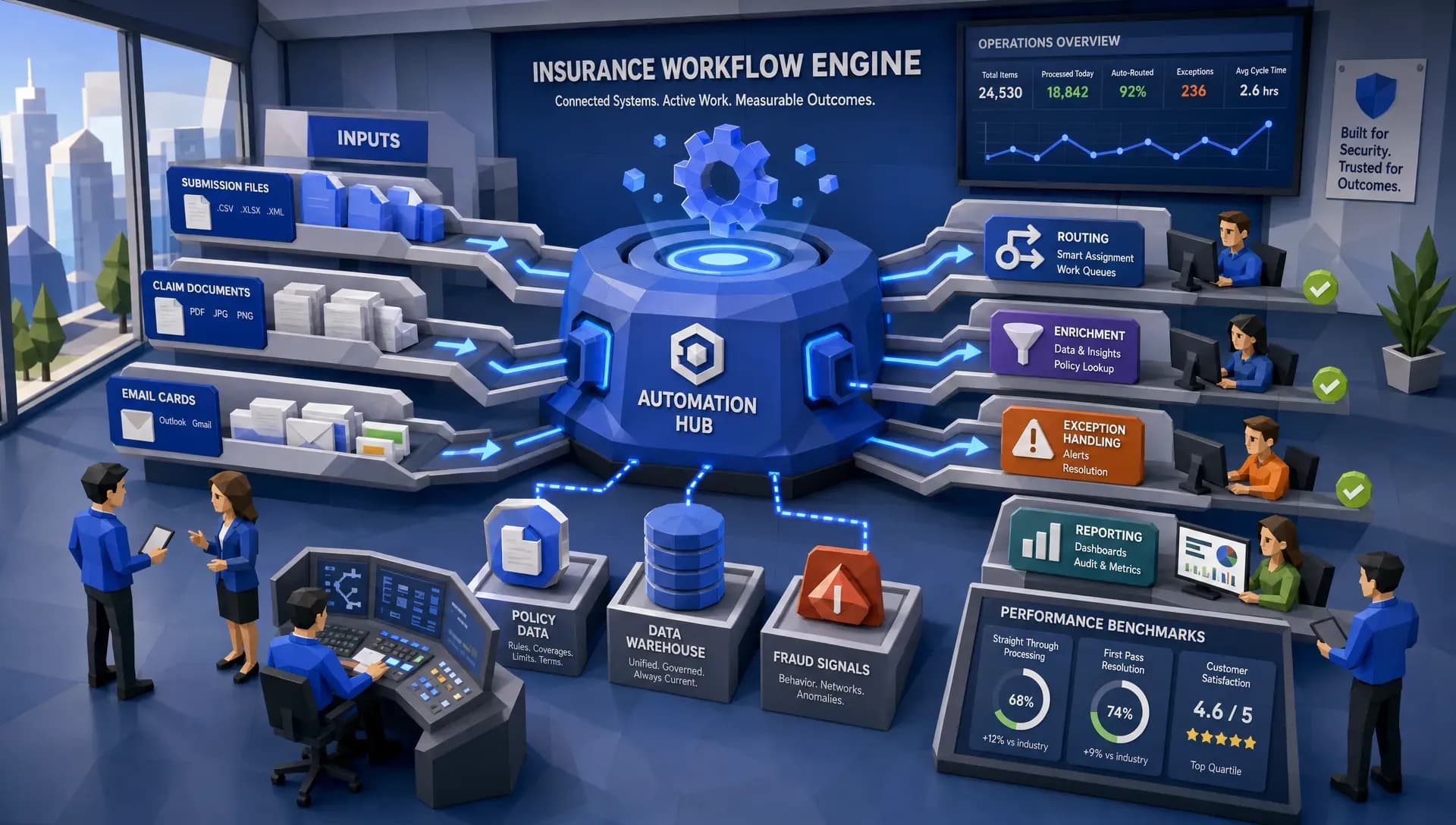
For connected claims and renewal underwriting, that means claims automation can feed a unified data warehouse, not disappear into another workflow queue. Underwriters can get structured renewal signals from claim events, documents, notes, images, and external data sources. Teams can use dashboards to monitor trends, benchmarks, and portfolio performance without rebuilding every process from scratch.
Inaza also supports customizable workflows, pre-built workflow templates, integrations with existing systems, and enrichment through API templates. That matters because claims and underwriting teams should not have to retrain from zero just to get better data flowing through the business.
The win is simple: fewer blind spots at renewal, less manual hunting, better pricing conversations, and stronger portfolio control.
Frequently Asked Questions
What are connected claims? Connected claims are claims workflows where data from FNOL, documents, adjuster notes, reserves, payments, fraud indicators, and claim outcomes is structured and shared with underwriting, renewals, analytics, and portfolio management.
How do connected claims help underwriters at renewal? They give underwriters earlier and richer signals about risk quality, including frequency trends, severity movement, attorney involvement, coverage issues, late reporting, and possible fraud patterns.
Do connected claims replace underwriters? No. They help underwriters focus on judgment rather than manual research. The underwriter still decides how to price, retain, refer, or adjust terms based on the account context.
Which claims signals are most useful for renewal underwriting? The most useful signals often include FNOL timing, open claim status, reserve volatility, claim reopenings, attorney demands, recurring loss causes, damage patterns, fraud flags, and claim cycle time.
Can MGAs use connected claims to support capacity discussions? Yes. MGAs can use connected claims data to show capacity providers how loss trends are being monitored, how underwriting rules are improving, and how portfolio performance compares against relevant benchmarks.
Turn claims into renewal intelligence
Claims should not only tell you what went wrong last year. They should help you decide what to do next year.
If your renewal process still depends on late loss runs, manual claim reviews, and scattered notes, connected claims may be one of the fastest ways to improve underwriting quality without asking your team to work nights and weekends.
Inaza helps insurance teams connect claims, underwriting, customer service, and operations through automation, data capture, and real-time analytics. If you want renewal signals that arrive before the renewal decision, not after the surprise, we should talk.