In 2026, here is my slightly spicy insurance take: the winners in automation will not be the carriers with the flashiest demo. They will be the ones whose underwriters, adjusters, brokers, and customers believe the system after the second or third interaction.
I have watched good automation die in committee because a team did not trust it. I have also watched a very plain workflow save a claims team from a Monday morning pile-up of PDFs, photos, and frantic broker emails. The difference was not magic. It was proof.
Automated insurance solutions earn trust fast when they do three things well. They show their work, they make the human's day easier, and they improve the data left behind. Miss any one of those and you are back to what I call spreadsheet theater, lots of tabs, very little confidence.
The ugly little secret: insurance teams do not hate automation
Insurance people get accused of being resistant to change. Sometimes that is fair. Sometimes we deserve the coffee mug that says, I survived another transformation project.
But in my experience, underwriters and adjusters are not anti-automation. They are anti-surprise. They do not want a black-box decision landing on their desk with no source, no audit trail, and no obvious way to correct it. They do not want to explain to a broker why a submission was declined if the only answer is, the system said so.
That matters because the administrative burden is real. McKinsey has reported that underwriters can spend as much as 60 percent of their time on administrative work rather than risk assessment. No underwriter went into the business dreaming of re-keying VINs, chasing missing loss runs, or comparing two versions of the same PDF until their eyes start negotiating a settlement.
So the opportunity is obvious. The trap is assuming speed alone creates trust. It does not. Speed without transparency just creates faster arguments.
What trust fast actually means in insurance
Trust fast does not mean everyone instantly believes automation is perfect. That would be strange. I have worked in insurance long enough to know perfection is usually a sign nobody has looked closely enough.
Trust fast means a user can understand what happened, verify the source, and override or escalate when needed. It means a broker sees a faster response without feeling like the relationship has been replaced by a vending machine. It means a claims leader can open a dashboard and explain performance to the CFO without doing interpretive dance over a CSV export.
Trust also means different things to different people. An underwriter wants clean intake and explainable data enrichment. A claims adjuster wants faster triage and fewer duplicate touches. A fraud analyst wants suspicious patterns surfaced early without drowning in false positives. A compliance lead wants auditability. A policyholder wants a fair answer before they have to call three times and become, understandably, spicy.
That is the standard automated insurance solutions need to meet.

Start where trust is easiest to prove
If I were advising an MGA, carrier, or broker that needed quick wins, I would not start by automating the most judgment-heavy decision in the building. I would start with the work everyone already agrees is painful.
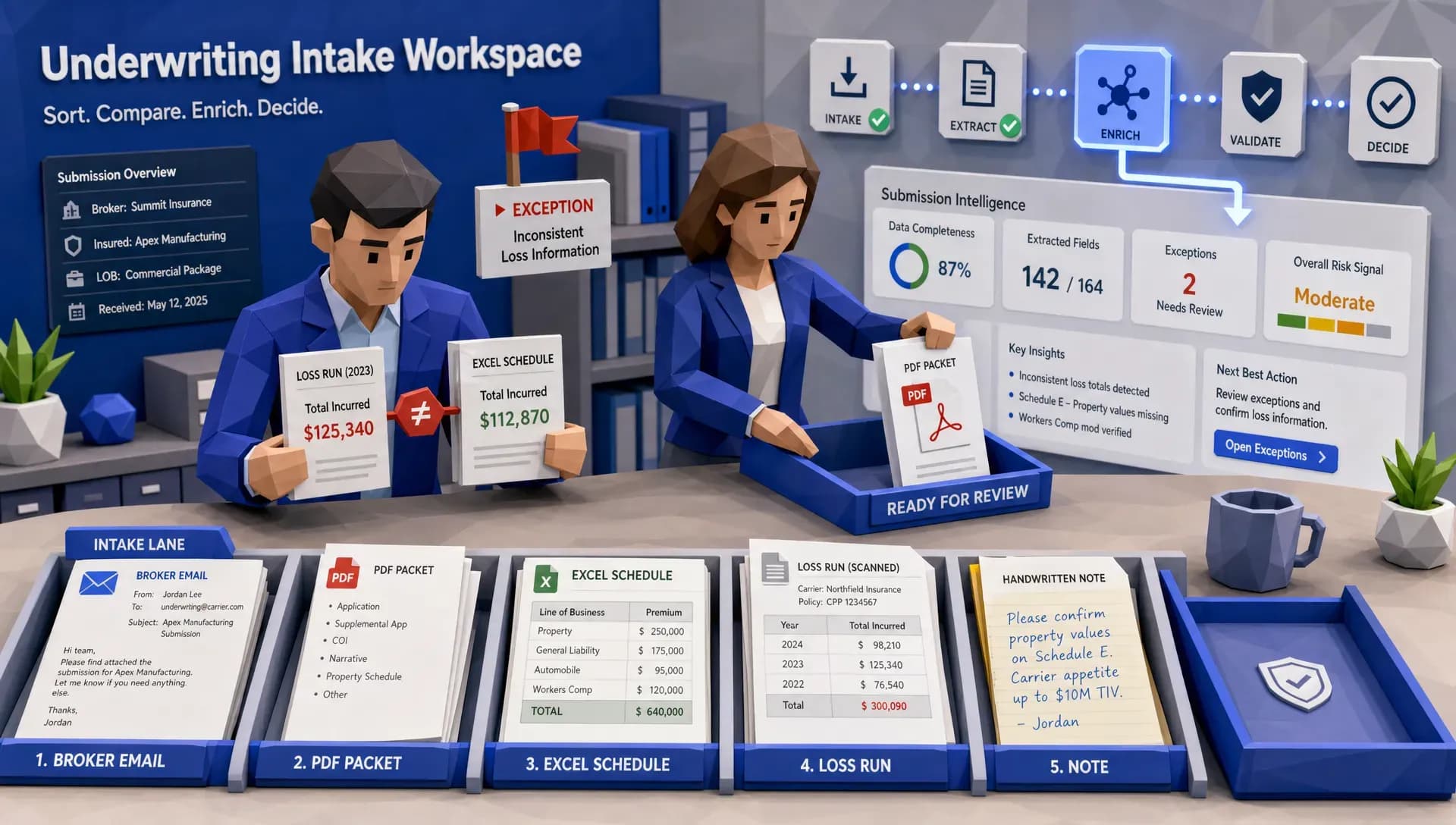
Submission intake is a prime candidate. Emails arrive with attachments in every flavor: PDFs, spreadsheets, scanned forms, image files, ACORD documents, bordereaux, loss runs, schedules, and the occasional mystery file named final_final_revised_USE_THIS. The first trust-building move is simple: capture the data, normalize it, route it, and flag what is missing.
Claims triage is another strong starting point. If a claim comes in with photos, police reports, medical records, repair estimates, and attorney correspondence, automation can organize the packet before an adjuster opens it. The human still makes the judgment call, but they are not spending the first 30 minutes hunting for the date of loss.
Customer service routing also earns trust quickly. A policyholder asking for an ID card should not sit in the same queue as a bodily injury escalation. A broker chasing endorsement status should not need to send three follow-ups and a prayer. Smart routing is not glamorous, but neither is plumbing, and we all become very interested when it stops working.
Accuracy gets attention. Auditability keeps the room calm
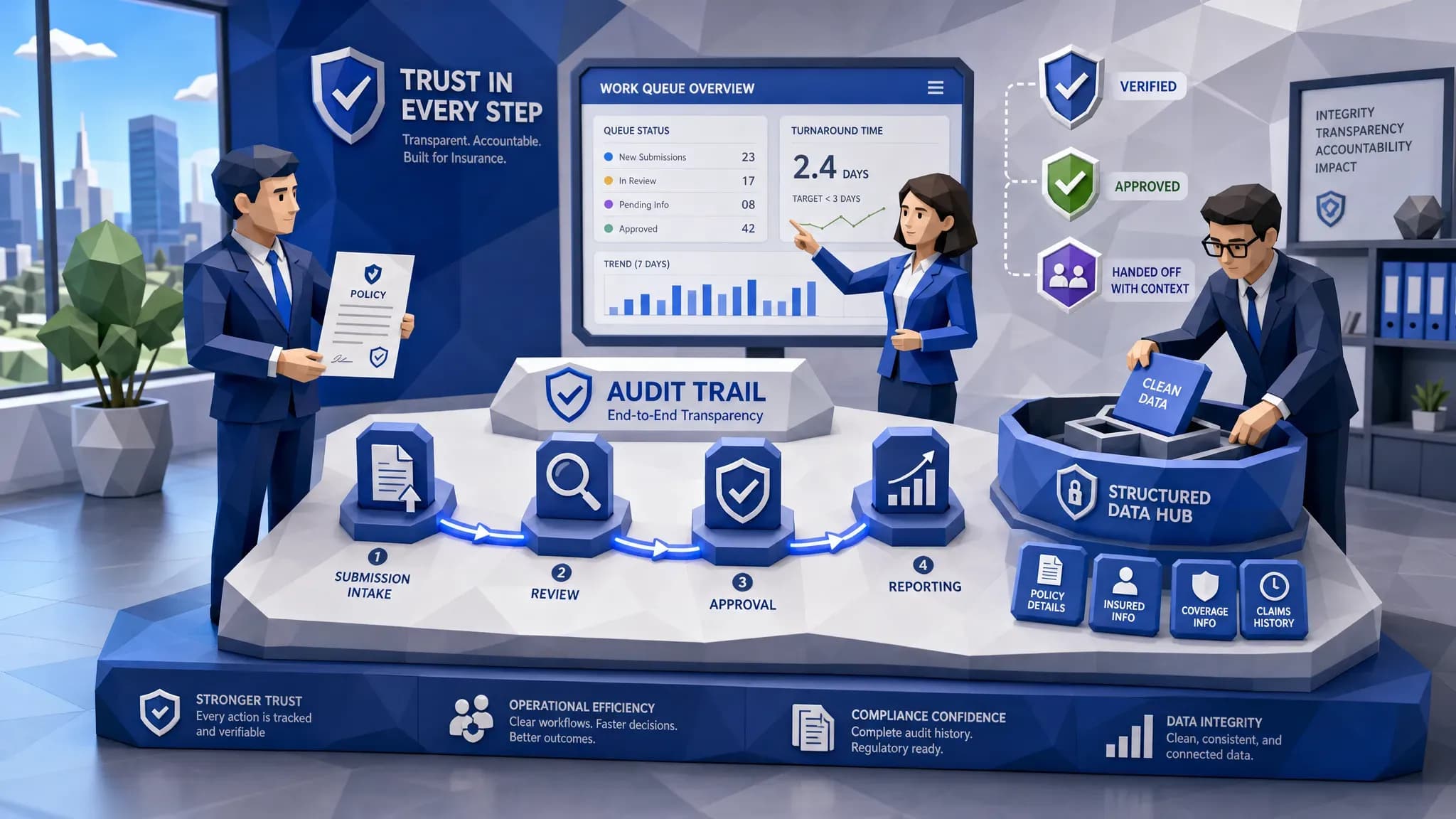
The best insurance automation does not simply produce an answer. It produces a trail.
That trail should show which document was read, which data point was extracted, which rule was applied, which external source was checked, and when a human stepped in. In underwriting, that might mean showing how a risk classification was derived. In claims, it might mean showing why a file was escalated for severity review or fraud investigation.
Auditability is not a nice-to-have in insurance. It is how teams defend decisions, train staff, satisfy regulators, and improve the next version of the workflow. When automation is auditable, people stop treating it like a mysterious intern with too much responsibility.
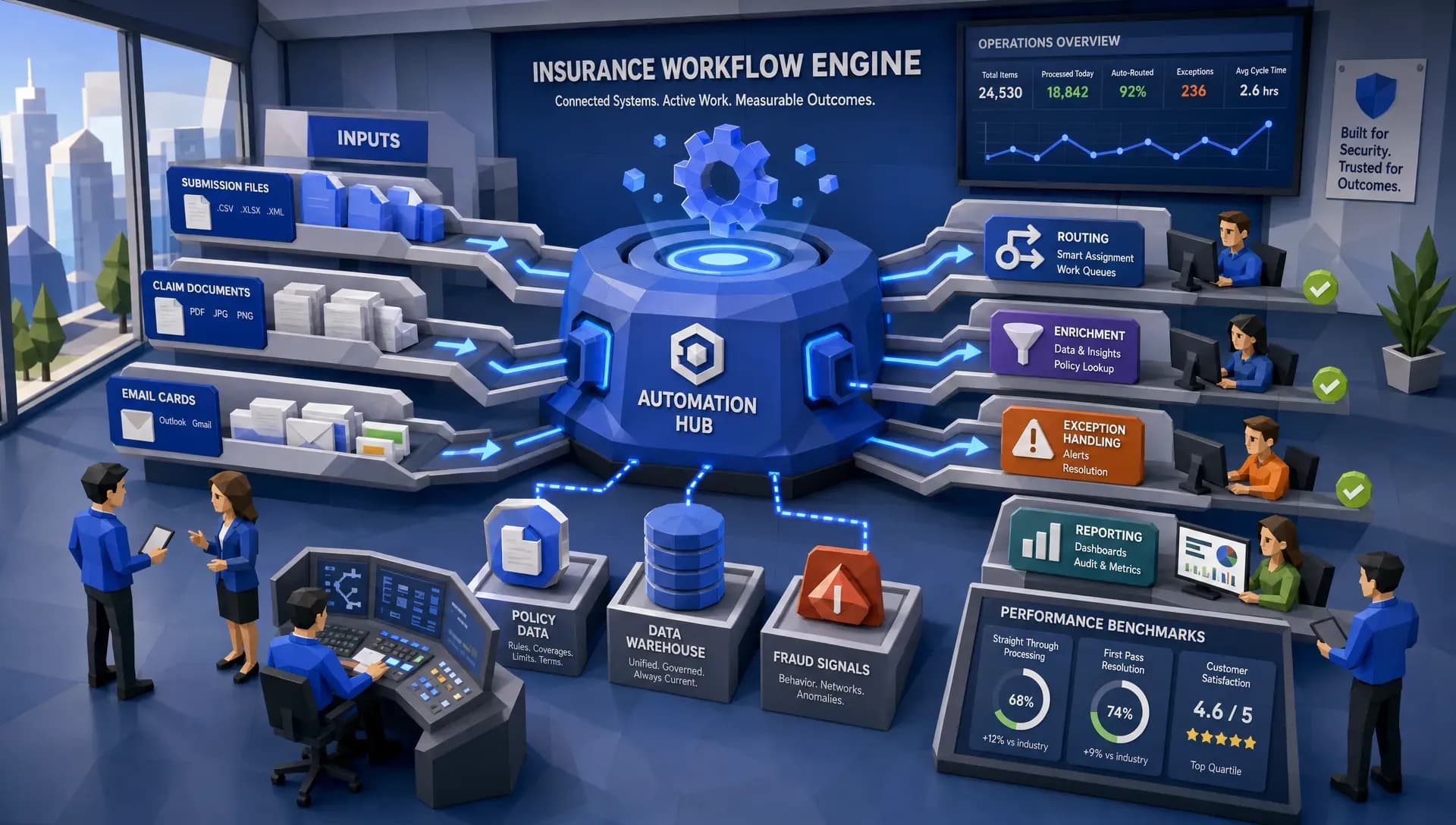
This is where a connected data foundation matters. If automation captures useful data but leaves it scattered across inboxes, portals, and one-off reports, you get short-term speed and long-term confusion. If the same automation feeds a unified data warehouse, you start building business intelligence. You can see turnaround times, missing data patterns, referral rates, quote abandonment, claims cycle bottlenecks, and the exact places where work keeps bouncing between teams.
That is the difference between automating tasks and learning from operations.
Data enrichment should feel like a second set of eyes
Underwriting and claims decisions are only as strong as the data supporting them. Internal data is rarely enough on its own, especially in auto, property, casualty, and specialty lines where outside context can change the risk picture fast.
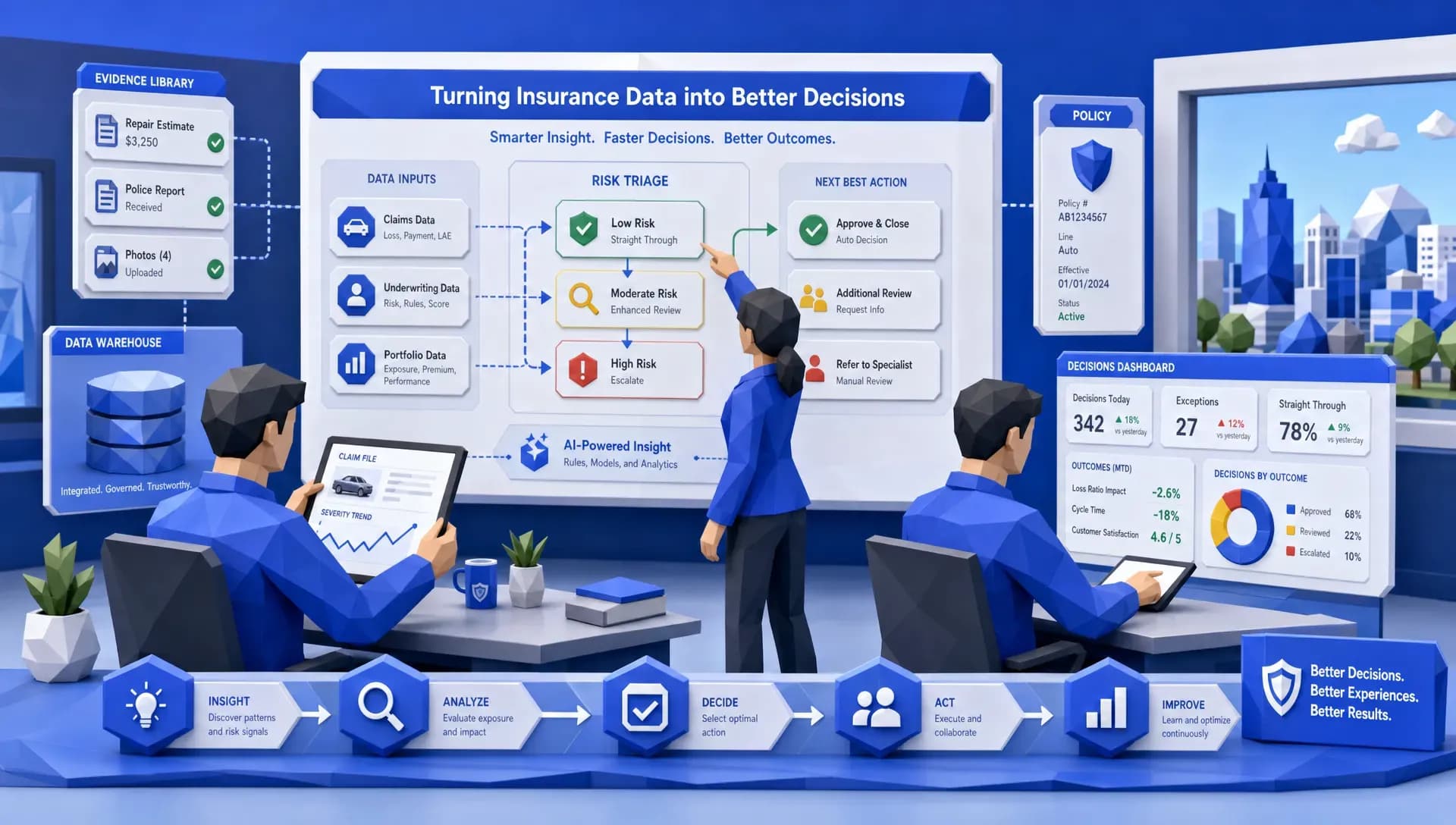
This is why enrichment matters. A submitted address, driver, vehicle, property, business, or claimant can be checked against third-party sources, public records, hazard data, fraud signals, and policy history. Done well, enrichment does not replace expertise. It gives the expert fewer blind spots.
Inaza's platform includes pre-built API templates for data sources such as Verisk, LexisNexis, HazardHub, and others, which helps teams enrich workflows without rebuilding every integration from scratch. That is important because slow integration is one of the quiet killers of automation momentum. When a project spends months connecting pipes before users see value, trust starts leaking before the workflow goes live.
Fraud is a good example. The FBI estimates insurance fraud costs the United States more than $300 billion per year. Meanwhile, Verisk's 2025 fraud report points to growing concern around digitally enabled fraud, including manipulated documents and images. If your claims automation cannot enrich, validate, and flag anomalies, it is missing half the job.
Claims automation has one public scoreboard: the customer's patience
Underwriting teams measure speed to quote. Claims teams measure cycle time, leakage, severity, litigation risk, and about 47 other things. Customers measure one thing first: how long this awful day is going to remain awful.
I once helped review an auto claim workflow where the customer had already submitted photos, an estimate, and a police report. The adjuster still had to ask for two of those items again because they were buried in separate email threads. Nobody was lazy. The process was just playing hide-and-seek with its own data.
That is exactly where automated claims workflows earn trust. They can capture FNOL data, ingest documents and images, sort attachments, flag missing information, detect potential fraud indicators, and route higher-risk files to the right person. The goal is not to remove adjusters from sensitive decisions. The goal is to stop wasting adjuster time on document archaeology.
The pressure is visible in the market. J.D. Power's 2024 U.S. Auto Claims Satisfaction Study highlighted how cycle times and customer experience continue to shape satisfaction. When claimants wait weeks for clarity, even a fair settlement can feel rough. Faster organization, cleaner handoffs, and clearer communication go a long way.
Fraud controls need to protect honest customers too
Here is another hot take: fraud detection that punishes honest customers is bad fraud detection.
A system that flags everything suspicious might look productive on a dashboard, but it creates friction, delays, and extra work. Fraud teams need prioritization, not panic. Adjusters need context, not a blinking red light with no explanation. Policyholders need to feel the process is fair, especially when they have done everything right.
The trustworthy approach is layered. Automation should validate data, compare patterns, check documents and images, identify anomalies, and escalate cases that truly need attention. It should also let straightforward claims move faster. That is how automation protects both loss ratio and customer goodwill.
In my opinion, this is one of the most underappreciated benefits of automated insurance solutions. The best systems do not only find bad actors. They create a smoother path for good customers.
The customer service layer is where trust often leaks
A carrier can have excellent underwriting and claims automation, then lose trust through poor communication. We have all seen it. The file is moving, but nobody told the broker. The claim was assigned, but the claimant did not receive an update. The renewal is in progress, but the insured thinks they have been forgotten.
Automation should support customer service, not make it colder. That may mean automated acknowledgements, smart routing, status updates, or human escalation when the tone or complexity of a message calls for it. For insurers that need extra operational support around service design, queue management, or staffing, partners such as managed CX teams and consulting specialists can be useful alongside the insurance workflow technology itself.
The point is simple. Trust is not only built in the decision. It is built in the update, the acknowledgement, the handoff, and the moment someone says, yes, we have what we need.
What I would automate first if I had to earn trust in 30 days
If a leadership team told me they had 30 days to show credible progress, I would start with intake and visibility.
First, I would pick one high-volume workflow with a clear pain point, such as submission intake, claims document organization, attorney demand triage, proof-of-prior verification, or quote abandonment follow-up. Then I would map the actual workflow, not the version in the procedure manual that everyone politely pretends still exists.
Next, I would automate the capture, classification, extraction, enrichment, and routing of that work. I would keep humans in the review points where judgment matters. I would make the audit trail obvious. I would build a dashboard before anyone asks for one, because someone will ask for one, usually right before a board meeting.
Finally, I would measure boring but important things: turnaround time, manual touches, missing data rates, referral rates, error rates, cycle time, and customer response speed. Boring metrics are underrated. They pay the bills.
Why Inaza is built for the trust problem
The reason I like Inaza's approach is that it focuses on practical deployment, connected data, and workflow ownership. That combination matters.
Inaza helps insurers, MGAs, and brokers automate underwriting, claims, customer service, and operations while integrating with existing systems. The platform supports all file types, offers 250+ workflow templates, and is designed so teams do not need broad retraining just to get value. For organizations tired of endless proof-of-concept loops, Inaza can deploy production-ready workflows quickly, including during a single working session with a user.
The data warehouse underneath the platform is also a big deal. Workflow automation gives you speed. Captured workflow data gives you insight. With real-time analytics dashboards, teams can see what is happening across operations rather than relying on anecdote, gut feel, or the loudest person in the Monday meeting.
There is also value in benchmarking. Inaza includes industry benchmarks in the system, including references such as Aon, Munich Re, Howden, and others, so users can compare business performance against the market. That can support portfolio narratives, policy renewal discussions, and reinsurance negotiations. In practical terms, it helps turn operational data into a story executives and trading partners can actually use.
Avoid the haunted proof of concept
Every insurance professional knows the haunted proof of concept. It starts with excitement, spends months in meetings, produces a nice slide deck, then wanders the halls forever without becoming a production workflow.
To avoid that, automation projects need a narrow first use case, real data, a measurable outcome, and a path to scale. The first workflow should be important enough to matter but contained enough to launch. It should connect to existing systems, preserve human oversight, and create useful data from day one.
Most importantly, the team using it should be involved early. If adjusters, underwriters, fraud analysts, and service teams do not recognize their real-world process in the workflow, trust will not show up later like a surprise endorsement.
Frequently Asked Questions
What are automated insurance solutions? Automated insurance solutions are technologies and workflows that handle repetitive insurance tasks such as data capture, document processing, underwriting checks, claims triage, customer service routing, reporting, and analytics. The best solutions integrate with existing systems and keep humans involved where judgment is required.
How do automated insurance solutions build trust quickly? They build trust by showing source data, keeping audit trails, improving response times, reducing manual errors, and escalating uncertain cases to humans. Trust comes from transparency as much as speed.
Will automation replace underwriters or adjusters? In well-designed workflows, automation removes low-value administrative work so underwriters and adjusters can focus on judgment, negotiation, risk assessment, broker relationships, and complex claims. That is the right balance.
Where should insurers start with automation? Start with high-volume, repetitive workflows where pain is obvious and results are measurable. Submission intake, claims document triage, FNOL routing, attorney demand processing, and customer service classification are strong candidates.
How should insurers measure whether automation is working? Track turnaround time, manual touches, data accuracy, referral rates, straight-through processing rates, customer response times, quote conversion, claims cycle time, and compliance outcomes. If automation does not improve the operating metrics, it is not earning its keep.
Build automation people can believe in
Automated insurance solutions earn trust when they make work clearer, faster, and easier to defend. They should not ask teams to take a leap of faith. They should provide evidence, every step of the way.
If you are looking to automate underwriting, claims, customer service, or insurance operations without ripping out your existing systems, Inaza can help you move from manual friction to connected, auditable workflows that your teams can trust quickly.