Emerging risks in UK and Ireland motor insurance, October 2026: more electric cars, a staged automated-vehicle law, and cost in the parts and glass
Updated:
Data period: UK licensed vehicles to 30 June 2026, published 23 September 2026; Automated Vehicles Act commencement status as of 1 July 2026; UK CPI through September 2026; ABI motor figures for Q3 2026
The emerging-risk story in this market is not a sudden jump in driverless claims. It is a growing electric fleet, a UK automated-vehicle law coming into force in stages, and ordinary repair inflation that is now concentrated in parts and glass rather than in a headline labour rate.
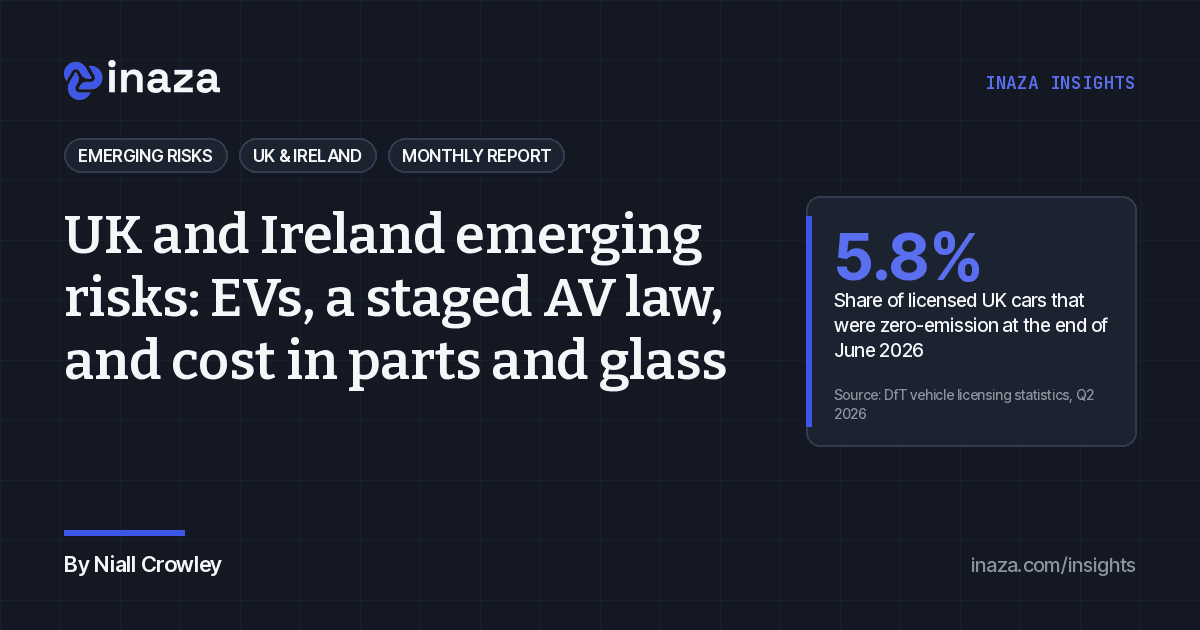
At the end of June 2026, the United Kingdom had 2,017,093 licensed zero-emission cars, 5.8% of all licensed cars, up 34.0% on a year earlier [1]. The Automated Vehicles Act 2024 is being commenced in stages, with marketing restrictions due on 7 January 2027 [2]. In the latest claims-cost data, UK spare parts rose 5.1% (adverse for insurers) over the year to September, and the average ABI windscreen claim rose 9% (adverse for insurers) to £298 (adverse for insurers) [3][4]. Those two cost lines are where ADAS calibration and glazing already show up.
What you can do about this
- 1
Identify zero-emission and late-model vehicles at FNOL
The UK had 2,017,093 licensed zero-emission cars at the end of June, 5.8% of the car park, up 34.0% in a year. These vehicles, and other late-model cars, carry more sensors and more expensive parts.
- 2
Automate parts, glass and calibration review
UK spare parts rose 5.1% (adverse for insurers) in the year to September, and the ABI's average windscreen claim rose 9% (adverse for insurers) to £298 (adverse for insurers) in Q3, while headline repair inflation cooled to 3.7%.
- 3
Keep electric total losses off the falling used-car index
UK second-hand car prices fell 3.2% (favorable for insurers) in the year to September. That relief should not be applied automatically to a written-off electric vehicle whose residual value is driven by the battery.
- 4
Prepare product and marketing files for 7 January 2027
Part 4 of the Automated Vehicles Act 2024 comes into force, so far as not already in force, on 7 January 2027. That is a wording and marketing date, not a volume claims event.
A larger electric fleet, still a small share of the park
The Department for Transport's vehicle licensing statistics, based on DVLA records and covering the whole United Kingdom, including Northern Ireland, were published on 23 September and run to the end of June [1]. There were 34,888,140 licensed cars in the UK, of which 2,017,093 were zero-emission, or 5.8% [1]. Across all licensed road-using vehicles the zero-emission share was 5.2%, or 2,169,589 of 42,063,529 [1].
Licensed vehicles in the United Kingdom at the end of June 2026
Source: Department for Transport, Vehicle licensing statistics: April to June 2026, published 23 September 2026, as of June 30, 2026
A 34% rise in licensed zero-emission cars in a year is fast. A 5.8% share of the car park is still small. The claims implication sits in the mix, not in a headline that the fleet has already turned over. Newer cars, whether battery-electric or not, carry more sensors and more expensive parts. The official cost data already show parts running hotter than the cooled UK repair CPI of 3.7% [3]. Used car prices, which help total-loss settlements on conventional cars, fell 3.2% (favorable for insurers) in the year to September [3]. That relief should not be applied automatically to a written-off electric vehicle whose residual value is driven by the battery. This edition does not attach a single official battery-depreciation rate, because we did not have one official UK or Irish series that could be cited with the same confidence as the DVLA stock figures.
The Department also noted a revision to ultra-low-emission-vehicle classifications, which lowered recent ULEV stock figures by around 1.8% [1]. The 2,017,093 figure above is the zero-emission car count in that latest release, not the older ULEV definition.
Ireland is not included in the DVLA counts. This piece does not invent a comparable official Irish electric-car stock figure for mid-2026.
Want the next report when it comes out? We can email it to you.
SubscribeThe Automated Vehicles Act is arriving in stages, not as one go-live date
The Automated Vehicles Act 2024 is UK legislation. It is being brought into force by commencement regulations rather than on a single day [2]. Further commencement regulations were made in 2026, and marketing restrictions under the Act are due to commence on 7 January 2027 [2]. Permits for automated passenger services and other provisions were commenced earlier in the year [2].
That timetable matters for product, wording and advertising reviews before January. It does not, on its own, tell you how many automated vehicles will generate claims in 2027. Licensed zero-emission cars are already in the park in known numbers. Authorised self-driving features are not yet a large, official claims volume. The useful work is to know which policies, comparison journeys and marketing claims will be in scope of the new restrictions, and to keep Northern Ireland in the UK reading of the Act.
Monthly reports and live alerts, by email, when you want them.
SubscribeParts and glass are where the technology already hits the bill
The UK repair CPI cooled to 3.7% in the year to September [3]. Spare parts and accessories did not. They rose 5.1% (adverse for insurers), and tyres rose 4.9% (adverse for insurers) [3]. The ABI's average windscreen repair or replacement claim was £298 (adverse for insurers) in Q3, up 9% (adverse for insurers) on the year and 5% on the quarter [4]. Windscreen claims are a standard place for ADAS camera calibration to appear as a line item. A book that still reviews glass at a 2025 average will miss that.
Latest official or industry year-on-year change, %
Source: Office for National Statistics, Consumer price inflation, UK, September 2026 (ons.gov.uk), published 21 October 2026; Association of British Insurers, motor insurance payouts, Q3 2026, as of September 30, 2026
The combination is specific: a growing share of newer and electric vehicles, parts inflation above the repair average, and windscreen severity up 9%. The action is not a generic "watch EVs" note. It is to reserve and review the parts, glazing and calibration lines on late-model vehicles, and to keep total-loss values for battery-electric vehicles on a different path from the falling used-car CPI.
What this means for underwriting and claims
Underwriting. A 5.8% zero-emission share is not yet a book-level mix shift, but a 34% annual rise means the 2027 and 2028 renewal cohorts will be more electric than the 2026 earned book. Rating and terms that still treat battery-electric and internal-combustion total losses as one used-value trend will drift.
Claims. The near-term money is in parts and glass, including calibration, on the vehicles that already have the sensors. The January 2027 marketing rules are a wording and product date. They are not a reason to delay those estimate checks.
Get a note when something in this market changes.
SubscribeHow Inaza can help
Every action above can be run with your own teams and tools. Where volume makes manual checks hard, Inaza can take on the routine work. Mapped to the actions:
- Identify zero-emission and late-model vehicles at FNOL. Read the VIN and vehicle records at notification, tag battery-electric and high-ADAS vehicles, and apply the parts and glass severity path, not the headline repair CPI.
- Automate parts, glass and calibration review. Check estimates for parts rates, windscreen lines and calibration against your thresholds and the vehicle's equipment, and route only the exceptions.
- Keep electric total losses off the falling used-car index. Apply a separate total-loss valuation path for battery-electric vehicles, rather than the 3.2% (favorable for insurers) used-car CPI.
- Prepare product and marketing files for 7 January 2027. Flag automated-vehicle wording, comparison journeys and promotional claims that need a review before the marketing restrictions commence.
To see how this would work on your own book, talk to the Inaza team.
Sources
- 1. Department for Transport, Vehicle licensing statistics: April to June 2026, published 23 September 2026, based on DVLA records for the United Kingdom. https://www.gov.uk/government/statistics/vehicle-licensing-statistics-april-to-june-2026/vehicle-licensing-statistics-april-to-june-2026
- 2. The Automated Vehicles Act 2024 (Commencement No. 3) Regulations 2026, SI 2026/731, made 1 July 2026, commencing Part 4 marketing restrictions on 7 January 2027; earlier commencements in SI 2025/1339 and SI 2026/437. https://www.legislation.gov.uk/uksi/2026/731/made
- 3. Office for National Statistics, Consumer price inflation, UK: September 2026, published 21 October 2026, series D7IP, D7IN, L7R2 and D7IL. https://www.ons.gov.uk/economy/inflationandpriceindices/datasets/consumerpriceinflation
- 4. Association of British Insurers, Motor insurance payouts remain at £3.2 billion for second consecutive quarter. https://www.abi.org.uk/media-hub/news-post/motor-insurance-payouts-remain-at-32-billion-for-second-consecutive-quarter
Subscribe to Inaza Insights
Get the monthly reports, the quarterly outlook and live alerts by email.